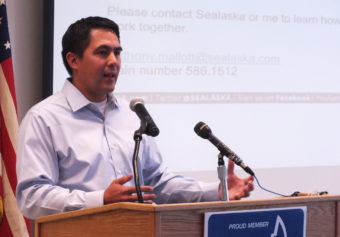
Anthony Mallott took over as CEO of Sealaska Corp. in June. (Photo by Casey Kelly/KTOO)
New Sealaska CEO Anthony Mallott says part of the Juneau-based regional Native corporation’s strategy for reversing recent losses will be to do business closer to home.
“Very likely within six months you’ll see significant investments by Sealaska in Southeast, or within industries that are heavily represented in Southeast Alaska,” Mallott told the Juneau Chamber of Commerce on Thursday.
He said Sealaska wants to provide economic opportunities and jobs for its nearly 22,000 shareholders. Most live in Southeast and the Pacific Northwest.
The corporation has sold some of its business interests in areas like Florida, Mexico and Alabama. Mallott says it now has a $100 million investment fund and a $65 million fund for acquisitions.
“So what we’ve done to transition is to load up effectively dry powder,” he said. “And bring on some people that know how to do mergers and acquisitions, and know what we want to look like as a corporation five, 10 years from now, and start making those acquisitions.”
While jobs for shareholders will be important, Mallott says the number one priority will be to invest in profitable enterprises. In 2013, Sealaska businesses lost about $57 million. That shrunk to $35 million due to revenue from investments and natural resource earnings shared by all Native corporations.
Mallott believes Congress is poised to pass legislation completing Sealaska’s land entitlement under the Alaska Native Claims Settlement Act. The long-awaited measure would transfer up to 80,000 acres of the Tongass National Forest to the corporation, providing a boon to Sealaska’s timber businesses.
“It’s been a long wait,” Mallott said. “We’re patient, we know that it’s owed to us and we’ll get there. But it is having some significant effects on our timber harvest and potentially the timber industry in Southeast.”
“I’ve been a member of the Masters, Mates and Pilots since 1992, worked out on the ferries myself and up until now we’ve never rejected a tentative agreement. So this is a first for me,” Bressette says.
He declined to say whether the vote was close or if an overwhelming majority of members were opposed to the deal. MMP represents about 100 ferry workers, including captains, chief, second and third mates, and pilots.
Union leaders had recommended approval of the deal, reached June 29, a day before the workers’ old contract expired. Bressette says many members were frustrated that the agreement included no pay increase in the first year, a 1 percent raise in 2015 and a 2 percent increase in 2016. Second mates would also get a 3 percent raise in year two.
“They feel that the wage increases that we negotiated were not adequate,” he says.
Bressette hopes to meet with state officials Friday to discuss what to do next. Options range from negotiating a new agreement to binding arbitration. He won’t rule out members going on strike.
“We’re making the preliminary steps to be ready to go on strike, you know, start the planning process and that. That option is available to us,” he says.
Department of Administration spokesman Andy Mills says the state’s negotiating team is looking forward to hearing union members’ concerns and figuring out the best way forward.
“Obviously when both sides are having a negotiation at a table, I don’t think either side takes anything completely off the table,” Mills says. “But I don’t actually think we’re that far apart. It’s about polling the members and finding out what are those differences.”
None of the candidates to represent Juneau in the state House of Representatives next year have challengers in this month’s primary election.

But come the November general election, Democrat Sam Kito III and Republican Peter Dukowitz will square off in House District 33, while Republican Cathy Muñoz faces Democrat George McGuan in House District 34.
Sam Kito III
Sam Kito III. (Photo courtesy Alaska Division of Elections)
“I’ve spent a fair amount of time volunteering on campaigns,” Kito says. “But it is a little bit different being the focus of the campaign, and so that’s been a bit of a learning experience. I’ve actually been enjoying that experience as much as I was enjoying the new experience of being a sitting legislator.”
A single parent, Kito says he wants his teenage daughter to have the same opportunities he had growing up. He supported a larger increase to the base student allocation than the one ultimately approved by lawmakers this year. The BSA is the dollar amount districts across Alaska receive from the state for each student enrolled at the beginning of every school year.
“It should be the first priority,” he says. “We take care of education for the students in Alaska, and then we look at other opportunities that we have with the money that we have available.”
According to state campaign finance reports, Kito has raised about $27,000 this election cycle, while spending about $17,000. He’s campaigned in Gustavus, Haines and Skagway, which are part of House District 33 along with downtown Juneau and Douglas.
Peter Dukowitz
Peter Dukowitz. (Photo courtesy Alaska Division of Elections)
Kito’s opponent in the general election will be Republican Peter Dukowitz, who’s also making his first bid for elected office. So far Dukowitz has not raised or spent any money.
“I’m getting off to a slow start actually,” says Dukowitz, who works for Alaska Electric Light & Power. “I’ve been doing some door-to-door. But I’ve essentially been clearing my schedule, finishing up personal projects, and that has taken time away from my campaign.”
If elected, he says he would work for insurance reform, responsible resource development and education. Dukowitz says he supports the state fully funding education, and doing away with the local contribution to school districts from municipalities. Rep. Tammie Wilson, R-North Pole, sponsored a similar proposal this past legislative session, and the Ketchikan Gateway Borough is suing the state to drop the requirement.
“Nobody’s getting fully funded, everybody is short on money,” Dukowitz says. “So our education system is suffering because of it. And when you have a local contribution requirement, not all communities can raise that money.”
Dukowitz and his wife have three sons.
Cathy Muñoz
Cathy Muñoz. (Photo courtesy Alaska Division of Elections)
Republican Cathy Muñoz has represented the Mendenhall Valley in the House for six years, and is now the senior member of the capital city’s legislative delegation. For the past two years she’s served on the House Finance Committee, which helps craft state budgets.
“Whether it’s the transportation system, the marine highway, whether it’s mine training, whether it’s university funding, a lot of different aspects of what we do here in Southeast are affected by bills and budgets that move through the finance committee,” Muñoz says.
The general election will be the first in which she’s had a challenger since she took office. So far she’s raised about $37,000 and spent about $11,000.
“I think it’s good for the public to have a choice. It’s also important to be able to have a fuller discussion of the issues,” she says.
George McGuan
Muñoz’s general election opponent, Democrat George McGuan, says he’s happy to give voters a choice.
George McGuan. (Photo courtesy Alaska Division of Elections)
“I didn’t feel like I was being represented, and most of the big votes were going along party lines instead of really being thought out,” says McGuan.
On education, McGuan says he wants to tie the base student allocation to inflation.
“Right now school districts are kind of caught in limbo while they battle it out over the education funding,” he says. “So I think it would be really wise to just stop playing games with education funding and make sure that education is fully funded and get it out of the way, and then start dealing with the other important work of the state.”
McGuan is a union electrician. He and his wife are expecting their first child in October. He’s raised about $24,000 for his campaign, and spent about $10,000.
The primary election is August 19.
*Editor’s Note: This story was updated to clarify that Cathy Muñoz did not sponsor legislation putting $3 billion in the Alaska’s Public Employees’ Retirement System. Muñoz carried the bill, which was sponsored by the governor’s office.
The Tlingit language was incorporated into drills at a recent basketball camp in Juneau sponsored by Sealaska Heritage Institute. (Photo by Casey Kelly/KTOO)
The legislature passed a bill granting the designation to 20 Alaska Native languages. Gov. Sean Parnell is expected to sign the measure soon. Supporters hope it will help boost efforts to revitalize those languages, many of which have just a handful of native speakers left. One such effort took place in Juneau last week: A camp that’s using sport to keep the Tlingit language alive.
On the basketball court at the University of Alaska Southeast in Juneau, a dozen middle and high school students warm up for their first day of camp. As they stretch near half court, Jessica Chester counts to 10 in Tlingit: “Tléix’, déix, nás’k, daax’oon, keijín, tleidooshú, daxadooshú, nas’gadooshú, gooshúk, jinkaat.”
Chester teaches Alaska Native languages for the Juneau School District. She’s been helping out with Sealaska Heritage Institute’s summer basketball camps since 2006. She says all of the drills incorporate at least some Tlingit.
“You know, if they’re saying, ‘Go get a ball,’ I’m going to be behind the coach saying ‘kooch’eit’aa…” You know, go get a ball in Tlingit,” she says.
Chester’s originally from Yakutat, where she grew up hearing elders speak the language. She began studying it herself in college.
Languages carry the ideas, and the feelings, and the emotions and thoughts of a culture, of a people, and so bringing that back is real important to me,” she says.
Linguists say fewer than 150 native Tlingit speakers are alive today. Some Alaska indigenous languages have no remaining native speakers. They exist only in written form or as recordings.
Sealaska Heritage Institute is dedicated to advancing the Tlingit, Haida and Tsimshian cultures of Southeast Alaska. President Rosita Worl says many Alaska Natives grew up ashamed of their languages and traditions.
“We’ve had a policy and history in this country to suppress Native languages and suppress Native culture,” Worl says.
About 15 years ago, the heritage institute decided to make language preservation its top priority. Worl says the inspiration came after meeting with a group of Hawaiian language preservationists. That state officially recognized indigenous languages in 1978.
“We looked at their programs,” Worl says. “And I will tell you, our board of trustees started to cry, because they saw little children speaking the Hawaiian language. And they said, ‘If the Hawaiians can do that, we can do that.'”
Now that Native languages are getting official recognition in Alaska, efforts like this camp are expected to grow.
Worl says she no longer worries about the Tlingit language becoming extinct.
“It may be that it will never be spoken as a first language. But we have always said that you’ll be hearing the voices of our ancestors through our children,” she says.
Michelle Martin’s daughter and son are attending the camp for the third time. Martin’s from Hoonah, where she picked up some of the language from her grandparents. She says her kids already speak it better than she does.
“I can understand phrases and I know what they’re saying,” Martin says. “And I try to learn, and I’m like, oh my gosh, I need to go back and learn some more.”
Most of the kids say they were initially hooked because of the basketball, but keep coming to learn their language. Jaime Kelley-Paul, 16, says he’s not even that interested in sports. Instead, he wants to build up the Alaska Native pride that was almost lost.
It’s my culture. I love it,” Kelley-Paul says. “It’s fun to learn about it. It’s important to keep our culture alive instead of just everyone being one type of person.”
Kelley-Paul says he can’t wait to teach his little brother everything he learned about Tlingit language and culture.
*Editor’s note: A version of this story appeared on NPR’s “All Things Considered” on Friday August 8, 2014.
A 23-year-old Juneau man was arrested over the weekend for allegedly pointing a bow and arrow at a couple in the Willoughby District.
Wesley Bowman is charged with two counts of felony assault. Police say he approached a man and woman Saturday afternoon near Willoughby Avenue and Whittier Street, made a racist comment then walked about 10 feet away and pointed a bow and arrow at the couple. No one was injured.
Officers found Bowman in a parking lot near Willoughby and Village Street with a compound bow and several arrows. He was arrested and lodged at Lemon Creek Correctional Center.
Former Alaska Gov. Sarah Palin speaking at the 2013 Conservative Political Action Conference in National Harbor, Maryland. (Creative Commons photo by Gage Skidmore)
Former Gov. Sarah Palin is using her new online news channel to promote the repeal of Alaska’s current oil tax system.
In a rambling 18 minute video posted on the site, Palin says Alaskans should vote yes on Ballot Measure 1 at this month’s primary election. The measure would roll back the SB 21 tax regime passed by the legislature in 2013, and return to the system Palin championed while in office − Alaska’s Clear and Equitable Share, or ACES.
SB 21 did away with the progressive tax feature of ACES, where the tax rate increased with rising oil prices. In the video, Palin makes several references to “crony capitalism” and ethics as reasons to vote for SB 21’s repeal.
“SB 21 landed us a one-way giveaway to big oil without any guarantees or concessions to protect the people’s longterm interests,” Palin says.
Supporters of the current tax system say it has increased oil exploration and development, as well as jobs.
Palin launched her online channel this week. The primary election is August 19.
Close
Update notification options
Subscribe to notifications
Subscribe
Get notifications about news related to the topics you care about. You can unsubscribe anytime.