Casey Kelly

Dr. Walter Soboleff Day bill signed into law

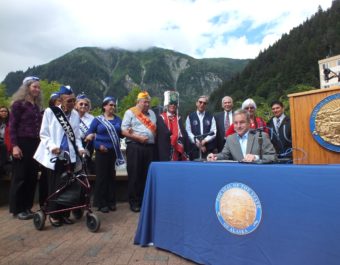
Gov. Sean Parnell has signed legislation making Nov. 14 Dr. Walter Soboleff Day in Alaska.

About 100 of the late Tlingit elder’s family and friends gathered at Juneau’s Marine Park for the bill signing ceremony on Wednesday, where Soboleff was remembered as a man who spread love and good will to all Alaskans.

The idea for a day honoring Soboleff first took off at the 2012 Alaska Native Brotherhood and Sisterhood Grand Camp convention.

“We were in Sitka at our 100th anniversary,” said Peter Naoroz, ANB’s 2nd Grand Vice President.

At the time, Naoroz was ANB grand secretary. He recalled that there were two competing resolutions calling on the legislature to make Soboleff’s birthday a day of remembrance in Alaska. His job was to combine them.

“It was quite an undertaking to try to get all of his accomplishments in a couple of pages,” he said.

Soboleff was born in 1908 in the now abandoned village of Killisnoo, near Angoon.

He was the first Alaska Native pastor in Juneau at a time when the town was segregated. He fought for civil rights alongside Alaska Native Brotherhood and Sisterhood leaders Roy and Elizabeth Peratrovich.

Later in life, Soboleff became the cultural and spiritual standard bearer of the Tlingit people, helping launch efforts to revitalize the language, as well as traditional art and dance.

He passed away in 2011 at the age of 102.

Naoroz said the thing he found most remarkable about Soboleff was his ability to make his fellow Alaska Natives take pride in themselves and their culture.

“He made people who were from this world, from this countryside right here, feel so special about their ability to tell stories, remember stories,” Naoroz said. “The power of the oral tradition and how he made people stand up and feel good about who they were.”

Wednesday’s bill signing ceremony included many similar sentiments. Gov. Parnell said Soboleff was known for his love of all Alaskans.

“And this day will help us remember the love that he had for each of us, as well as for this place,” Parnell said.

One of Soboleff’s four children, Walter junior, said his father would have been humbled by the recognition. He said the family hopes Alaskans will mark the day of remembrance by thinking about Soboleff’s teachings.

“Respect for others, caring, loving, compassion,” Soboleff said.

Walter Soboleff joins Elizabeth Peratrovich, Ted Stevens and Jay Hammond as prominent Alaskans to have a day named for them. Sealaska Heritage Institute’s new cultural center under construction in downtown Juneau will be named for him as well.

Are Southeast Alaska’s recent earthquakes connected?

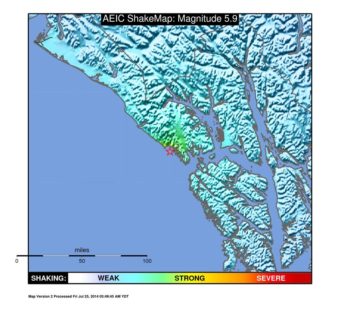
Friday's 5.9 magnitude earthquake centered about 97 miles west of Juneau is one of a handful of quakes to hit recently in Southeast Alaska. (Image courtesy Alaska Earthquake Information Center)
Friday’s 5.9 magnitude earthquake centered about 97 miles west of Juneau is one of a handful of quakes to hit recently in Southeast Alaska. (Image courtesy Alaska Earthquake Information Center)

There’s a whole lotta shakin’ going on in Southeast Alaska. But State Seismologist Michael West with the Alaska Earthquake Information Center says it’s unclear whether the activity is related.

“We have no sort of direct lines of evidence that show that those earthquakes are related in anyway,” West says. “But as anybody feeling earthquakes day-to-day and keeping track of these things would note, there has truly been a clustering, there’s been a little rash of earthquakes in Southeast in recent months.”

Friday’s 5.9 magnitude earthquake about 97 miles west of Juneau was the latest to hit the region. Earlier this month, a 6.0 magnitude quake hit northwest of Yakutat. And in early June, a 5.7 magnitude quake struck near Glacier Bay National Park and Preserve.

The largest earthquake in Southeast in the last two years was  a 7.5 magnitude temblor along the Queen Charlotte-Fairweather fault in January 2013. West says it’s plausible to think the recent activity is related, but proving it is not easy.

We can’t actually put any of those pieces together,” West says. “That said, when you move a big piece of the earth, like we did a year and a half ago, it’s not unreasonable at all to think that things need to readjust. And we do know that there are ways that earthquakes are connected in this world that we don’t fully appreciate.”

West says seismologists are facing a challenge similar to doctors trying to determine why a certain type of cancer is more prevalent in a particular community.

“People suspect that maybe it’s the water supply or something like this. Well, it turns out to be a very, very hard thing to tell natural coincidence and clustering from something with a clear cause and effect.”

He says Friday’s temblor was a normal strike-slip quake, where the earth moves horizontally along a vertical fault line. West says the only thing that made it somewhat unique was a 5.3 magnitude foreshock about 45 seconds before the larger quake. But he says even that is fairly common.

Juneau Assembly debates parking or housing for downtown lot

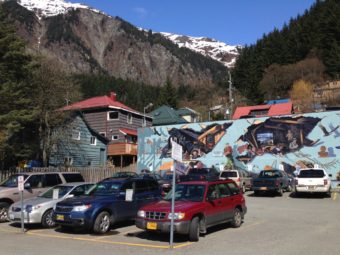
North Franklin Street parking lot
The Juneau Assembly is considering a proposal to sell the North Franklin Street parking lot to a group of local investors who want to build a 29-unit apartment complex with ground floor retail space on the property. (Photo by Casey Kelly/KTOO)

The Juneau Assembly has authorized the CBJ Lands Department to negotiate terms of sale for a city-owned parking lot to a group of local investors.

Juneau Legacy Properties wants to turn the North Franklin lot across the street from the Baranof Hotel into an apartment complex for seasonal workers.

The group’s proposal is forcing the assembly to consider if the city needs more parking or housing downtown.
Juneau Legacy Properties submitted the only proposal for the North Franklin lot during a month-long solicitation that ended in early May. In a report to the assembly last Monday, City Lands Director Greg Chaney described the group’s plan as mixed-use.

“Twenty-nine units of workforce housing, 990-square foot commercial space and 22 parking spaces on the ground floor,” Chaney said.

The building would include six two-bedroom apartments, 15 one-bedroom apartments and eight efficiency units. Chaney said parking would be for apartment residents only. The 25 public spaces on the lot now would be displaced.

Baranof Hotel Manager Steve Hamilton urged members of the assembly’s Lands Committee to keep the parking lot, according to minutes from the panel’s June 2nd meeting. Hamilton said the lot is used by hotel guests and employees.

Parking is also a big concern for some assembly members.

I know a lot of small businesses and people downtown who use those spaces,” said Assemblywoman Karen Crane. “So I’m having a real problem with the parking.”

Mayor Merrill Sanford said Juneau Legacy Properties’ plan doesn’t do enough to address the city’s housing shortage. Chaney said the lot can support up to 60 units − more than twice what the group proposed. Sanford wondered if there was a way for the city to facilitate a larger development.

“Doing 29 apartments and one floor or two floors of parking, we’ve kind of lost out on the ability of what that lot can provide for us,” Sanford said.

The assembly directed Chaney to get a more detailed proposal from the group, and at a minimum draw up terms of sale for what they’ve already submitted. The proposal would have to go through the Planning Commission then back to the assembly for final approval.

Juneau Legacy Properties partner Steve Soenksen says financial considerations played into the group’s decision to propose a smaller building.

“We wanted to keep the proposal small and doable,” Soenksen said. “So once you get above a three-story building, it goes into a different building type. We’d have a steel-framed structure most likely, instead of wood frame.”

The city bought the property in 2003 when it held an office building and 11-unit apartment complex.

Soenksen believes housing makes more sense for the lot than parking.

Our first goal is to try and help replace some of the housing that’s gone out of service in the last 20 years,” Soenksen said. “And this is designed to address the needs of people that want to live and work downtown.”

The Juneau Legacy Properties partnership also includes Jill Ramiel and Ken Alper, owners of the Silverbow Inn, as well as Evelyn Rousso. Both Soenksen and Rousso are architects.

Assemblyman Jesse Kiehl has considered joining the partnership. He’s recused himself from assembly discussions about selling the property.

An appraisal of the lot paid for by the city says it’s worth $530,000. City code requires municipal land be sold at fair market value. Soenksen says the appraisal gives both sides a good starting price.

Janice Sheufelt: “There isn’t a harder or longer race”

Janice Sheufelt 2014 RAAM
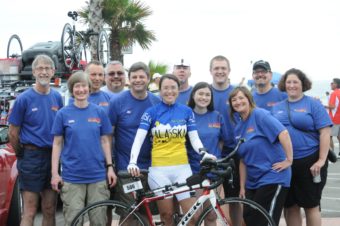
Janice Sheufelt (center) with her crew at the start of the 2014 Race Across America ultra-marathon cycling race. (Photo courtesy Janice Sheufelt)

After more than 3,000 miles on a bicycle in less than two weeks, Juneau’s Janice Sheufelt is back in the capital city with her second consecutive Race Across America title in hand.

Sheufelt won the premier ultra-marathon cycling event last year as part of a two-person mixed-gender team. This year she won the solo female division, finishing June 22 with a time of 11 days, 18 hours and 2 minutes. That’s despite a mid-race setback due to breathing problems.

There isn’t a harder or longer race, so I’m really glad to have won this one,” Sheufelt says.

After jumping out to an early lead in the non-stop bike race from Oceanside, Calif. to Annapolis, Md., Sheufelt started having difficulty breathing in the Rocky Mountains.

Janice Sheufelt 2014 RAAM
Janice Sheufelt with Dr. James Cusick at Rio Grande Hospital in Del Norte, Colo. Sheufelt developed breathing issues during the 2014 Race Across America that required nebulizer treatments. (Photo courtesy Janice Sheufelt)

“I was coughing and wheezing and the smallest little uphill I could barely get up it, because I couldn’t get any breath,” she says. “The crew said I sounded like a 90-year-old smoker. I just sounded terrible.”

Sheufelt says she’s never had asthma or other breathing issues. She tried using an inhaler, but that didn’t work. So after reaching the time station in South Fork, Colo., Sheufelt and her crew made their way to a local hospital.

Sheufelt is a family physician and was worried she might have fluid building up in her lungs due to the high altitude. Fortunately, a chest X-ray revealed otherwise.

“Because if I had had that, my race would have been over,” she says. “You can’t keep going with that.”

The emergency room doctor told her the breathing problems probably resulted from a combination of the dry desert air in the early stages of the race and too much exercise without giving her body time to recover. The doctor prescribed breathing treatments with a nebulizer and lots of rest.

“I told the doctor I wanted to get back on my bike within a few hours,” Sheufelt says. “And he’s like, ‘Well, you shouldn’t be back on your bike, period. But, you know, if you’re going to do the race, you need to at least give your body like 12 hours.'”

While she was off the bike, Sheufelt fell into third place. She says it was demoralizing and to make matters worse, she still felt terrible when she returned to the race.

At one point in eastern Colorado, you know, I just thought there’s no way I was even going to finish,” she says.

Sheufelt slowly began to regain form, moving into second place in Kansas. She and Canadian cyclist Joan Deitchman were neck-and-neck through most of Missouri, before Sheufelt re-took the lead for good.

She says a lot of back and forth is unusual in the Race Across America, where stronger cyclists tend to build leads and keep them.

“I was like, I really don’t want to be racing in Missouri,” she says with a laugh. “I just want to ride my bike my own pace.”

Janice Sheufelt 2014 RAAM
Janice Sheufelt cools off in a pool at the time station in Congress, Ariz. during the 2014 Race Across America. (Photo courtesy Janice Sheufelt)

Sheufelt says doing RAAM with a teammate last year contributed to the success of her solo race. About half of her 11-member crew this year did the race with her last year as well. Her husband, Jim, served as crew chief. He says even when Janice was feeling down, the crew tried to remain upbeat.

“She thought she was doing horrible. We didn’t feel that way at all,” Jim Sheufelt says. “We were amazed she was riding so well.”

Their daughter Megan was responsible for keeping track of the 8,000 calories a day that Janice ate during the race. Jim says the crew also featured Janice’s brother, Ted, a massage therapist, as well as some of her co-workers from the Ethel Lund Medical Center in Juneau.

“It’s definitely a team effort, because if the riders aren’t getting enough to eat and really being taken care of by the crew, they’re just not going to win,” Jim says. “So it was really nice to get the win from the crew perspective.”

Now that she’s won RAAM two years in row is Sheufelt planning to go for a three-peat?

I really don’t want to do Race Across America again,” she says. “Just because it’s so hard. The training itself is incredibly hard. So I’m just looking forward to riding my bike for fun.”

Her husband says she’ll find another way to challenge herself.

Gov. Parnell signs $3 billion PERS/TRS infusion bill

PERS TRS bill signing
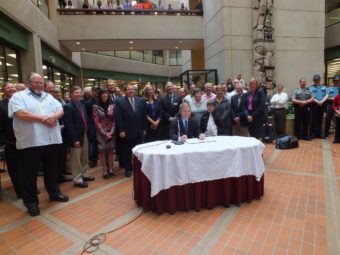
Gov. Sean Parnell signs House Bill 385, transferring $3 billion from the state’s Constitutional Budget Reserve to the Alaska Public Employees Retirement System and Teachers Retirement System. (Photo by Casey Kelly/KTOO)

Surrounded by dozens of public employees in the atrium of Juneau’s State Office Building, Gov. Sean Parnell on Monday signed legislation transferring $3 billion from state savings into Alaska’s public employee pension systems.

Like many state and local governments across the country, Alaska’s pension shortfall is the result of years of neglect and bad financial advice. Even as the estimated amount of future payments to retired public employees has grown, state and municipal officials opted to put minimal amounts into retirement systems.

The cash infusion cuts the long-term projected deficit for the Alaska Public Employee Retirement System and Teachers’ Retirement System to an estimated $9 billion. It also reduces the amount of future annual payments into the systems, which Parnell said is the single biggest cost driver of the state’s operating budget.

But beyond both of those worthy goals of this legislation,” he said. “It takes the burden off of our kids and grandkids to pay this debt that is owed. It’s a debt that we will make good on, but it takes that obligation off of future generations of Alaskans.”

Parnell says credit rating agencies recommended the state address the shortfall, or risk losing its AAA bond rating.

“They identified our unfunded pension liability as the single biggest risk to our state,” said Parnell, who met last year with officials from ratings agencies Moody’s, Fitch and Standard & Poor’s.

“And they said, ‘Yeah, there are 49 other states who would love to have your financial challenges. But there is one real financial challenge for you, and risk, and that is this unfunded pension liability,'” Parnell said.

The $3 billion will come out of the state’s Constitutional Budget Reserve, part of more than $17.5 billion in state savings outside Alaska Permanent Fund. Two-thirds will go toward the teachers’ retirement system. The rest will go into PERS.

Parnell’s plan overcame early skepticism from members of his own Republican Party to pass the Alaska Legislature by a near unanimous vote.

The idea of putting a large lump sum of cash into state pension systems is not new. In 2012, Sen. Johnny Ellis, D-Anchorage, proposed creating a $2 billion special fund to address the state’s retirement shortfall.

Juneau Sen. Dennis Egan, a Democrat who caucuses with the Alaska Senate’s Republican-led Majority, says it took a while for some of his colleagues to come around to the idea.

People finally realized that there is a serious problem, and this is the only way to fix it,” Egan said.

Alaska communities backed the pension infusion plan. Juneau Assemblywoman Karen Crane is president of the Alaska Municipal League, a group that lobbies the state and federal governments on behalf of cities and boroughs.

“Thirty-some percent of the debt belongs to municipalities,” Crane said. “So the quicker we get it paid off, it lowers the cost to all of us.”

Right now local governments contribute 22 percent of their payroll to PERS every year. Some also put 12.5 percent into the Teachers’ Retirement System. Crane is hopeful the local contribution will stay at that level until the state pays down its pension shortfall.

Janice Sheufelt wins Race Across America solo title

Janice Sheufelt and her husband Jim check on her bike during the 2013 Race Across America. After setting a record with racing partner Joel Sothern in a mixed gender team division last year, Sheufelt won RAAM's solo female under 50 division this year. (Photo courtesy Peter Apathy)
Janice Sheufelt and her husband Jim check on her bike during the 2013 Race Across America. After setting a record with racing partner Joel Sothern in a mixed gender team division last year, Sheufelt won RAAM’s solo female under 50 division this year. (Photo courtesy Peter Apathy)

Eleven days, 18 hours and two minutes. That’s all it took for Juneau’s Janice Sheufelt to claim another title in the Race Across America ultra-marathon cycling event.

Sheufelt won first place in the solo female under 50 division in the race from Oceanside, Calif. to Annapolis, Md., crossing the finish line at 9:43 a.m. Eastern time on Sunday.

Five other solo women cyclists started the race this year. Three did not finish and two were still on the course on Sunday.

Last year, Sheufelt and a partner set the record for fastest time in the event’s 50-59 year-old mixed gender category. She was 46 at the time, but competed in the older age division because the Race Across America uses each team’s average age.

Sheufelt is a family physician and medical director of the Ethel Lund Medical Center in Juneau, part of the Southeast Alaska Regional Health Consortium. She began participating in ultra-marathon cycling events three years ago.

Site notifications
Update notification options
Subscribe to notifications