Casey Kelly

Centennial Hall roof work to stop during Celebration

Centennial Hall roof replacement
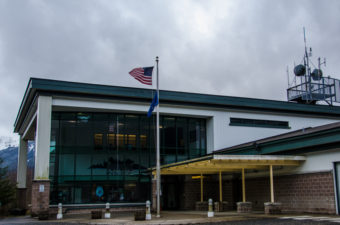
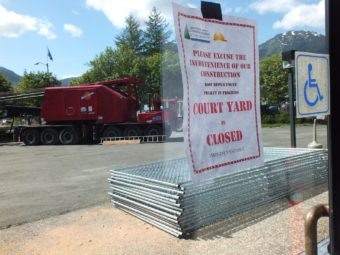
The courtyard on the Egan Drive side of Centennial Hall serves as the mobilization area for North Pacific Erectors, the contractor replacing the roof on Juneau’s 31-year-old convention center. (Photo by Casey Kelly/KTOO)

Juneau’s Centennial Hall Convention Center is getting a new roof this summer.

North Pacific Erectors began mobilizing for the $1.4 million project about three weeks ago.

City and Borough of Juneau Project Manager Theresa Mores says the contractor plans to work around events at the hall, including this week’s Celebration festival, hosted by Sealaska Heritage Institute.

“They are going to stop construction during Celebration and then they’ll start demoing the roof immediately following Celebration,” Mores says. “That was one event that we knew about beforehand that we tried to schedule around.”

Mores expects the project to be complete by the end of August. Not only do crews want to avoid working around snow and Taku winds, but Mores says the outside temperature needs to be warm enough for adhesives to work on the roof membrane.

She says the roof will be replaced in sections.

“They’re going to start in the section that’s farthest away from their mobilization area, and go towards the mobilization area,” she says. “So they’ll demo, and then as they’re doing that their supplies will be coming into Juneau, and then they will start construction. Hopefully the timing will be just right, so they can start constructing the new roof immediately after they demo the old one.”

The mobilization area is the courtyard on the Egan Drive side of Centennial Hall. That’s typically where Sealaska Heritage does its Celebration group photo. It’s also a popular gathering spot for people attending events at the hall. SHI spokeswoman Kathy Dye says this year’s group photo will take place in the parking lot between Centennial Hall and the Juneau Arts and Culture Center on Saturday after the parade.

Mores says this is the first roof replacement in the 31-year history of Centennial Hall.

It’s past its useful life,” Mores says. “There’s stuff growing up there, and things are kind of disintegrating a little bit. It’s just time.”

Centennial Hall serves as a venue for events, concerts and meetings, as well as an emergency shelter for downtown Juneau.

The city’s legislative delegation secured funding for a new roof in the state capital budget three times, but Governors Sarah Palin and Sean Parnell vetoed the funds. Juneau voters in 2012 approved a bond measure to fund $3.2 million in maintenance and upgrades to the facility.

Coast Guard Sector Juneau gets new leadership

U.S. Coast Guard Sector Juneau has a new commanding officer.

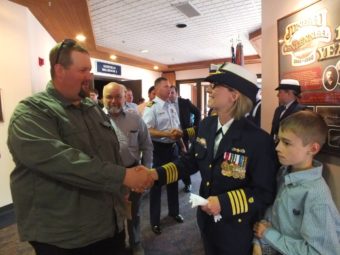
Capt. Shannan Greene took over for Capt. Scott Bornemann in a ceremony Friday at Centennial Hall.

Bornemann led Sector Juneau for the past three years. He said the men and women under his command during that time are the best the Coast Guard has to offer.

“I’d match them with any crew in the country,” he said, before listing some of their accomplishments.

“You sank a derelict Japanese fishing vessel,” Bornemann said, referring to the Ryou-Un Maru, which sailed across the Pacific Ocean without a crew following the 2011 Japanese earthquake and tsunami.

“You planned and conducted multiple unified command-based exercises that broadened stakeholder and tribal engagement and group participation with key agencies in search and rescue, security and natural disaster scenarios,” he said. “You also ensured the safety of the pristine marine environment in Southeast Alaska.”

Bornemann is staying in Juneau as Chief of Prevention for the Coast Guard’s 17th District. He’ll oversee maritime safety, maritime security and environmental stewardship for the entire state.

Greene most recently served as Deputy Chief of Incident Management for the Coast Guard’s 1st District in Boston, where she supervised hazard response and search missions for eight Northeast states. According to a Coast Guard biography, highlights of her tour there include coordinating responses to Hurricane Sandy and the Boston Marathon bombing.

Greene said she was impressed by all aspects of Sector Juneau during her transition week working with Bornemann.

“To our many partners throughout Southeast Alaska, we could not be successful without your expertise and involvement,” she said. “I look forward to continuing the robust relationship that already exists today.”

Greene’s husband is a Coast Guard commander. They have three young sons.

Coast Guard Sector Juneau has about 250 active duty, reserve and civilian employees.

District 17 Commanding Officer Rear Adm. Thomas Ostebo presented Bornemann with a citation for meritorious service to Sector Juneau. Ostebo has been promoted to a position in Washington, D.C. His change of command ceremony is June 12.

A reporter passes the JPD physical fitness test

The Juneau Police Department is looking for a few good men and women.

The department is currently recruiting for 11 open officer positions. But the process of becoming a cop is not easy. There are background checks, written tests and physical requirements.

I’m not in the best shape, but I recently did a practice physical fitness test for those interested in becoming JPD officers.

I’m in my mid-30s. I try to hit the gym five times a week, but usually I’m lucky if I make it once or twice. As for diet, I prefer pizza and beer to salad and mineral water.

On the plus side, I’m pretty religious about taking vitamins and I quit smoking seven years ago.

JPD Lt. Kris Sell says many recruits approach the physical test with some consternation.

“So that’s why we’re having this practice test is to let people get a feel for it,” she says, as five of us gather on the Thunder Mountain High School track.

The test

Things get underway with a 300-meter sprint, which we must run in under 77 seconds.

“You might want to jog a little bit,” Sell says. “We’ve seen people pull a hamstring on this section. It will make for a long day if you do that.”

The other “recruits” and I line up, and Sell lets us know when to start.

On your mark, get set, go!”

About a minute later we all pass the finish line with plenty of time to spare.

The sprint tests our anaerobic capacity. Sell says that comes in handy when chasing bad guys.

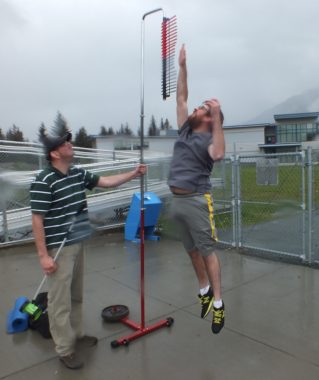
The vertical jump is next. It measures leg strength. To pass, we must jump at least 14 inches.

Measuring upper body strength requires we do at least 21 pushups. Then we try 15 sit ups in under a minute to test our core strength.

We finish with a 1.5 mile run in no more than 17:17.

“Try not to start too fast, but at a pace you can sustain for about 10 to 15 minutes,” Sell advises us. “You may walk, but walking will make it very difficult to meet the standard.”

I do end up walking part of two laps thanks to stomach cramps, but still finish in 15:29.

I cross the finish line with a flourish, and collapse on the track in mock exhaustion.

Minimum standard

The physical fitness test is JPD’s minimum standard. New hires are required to go through the Public Safety Training Academy in Sitka, where the physical demands only increase.

“Well, your day starts at 5:30, and sometimes you’re not done until 8 o’ clock that night,” says Officer Keith Byrne. “So you’re kind of going, going, going, and by the time you get into your bed you’re just sleeping.”

Byrne says he was in pretty good shape when he went to the academy in 2012, and in even better shape by the time he finished.

“I was running five minute miles,” he says.

Besides running and strength training, Byrne says there’s a heavy dose of swimming at the academy, including some uniquely Alaskan scenarios.

They do things where maybe you’re on the water edge and you might get a crab pot caught on your leg,” Byrne says. “And they throw you into the pool and you have a crab pot tied to your leg.”

Police Chief Bryce Johnson says there’s no ongoing physical fitness requirement for JPD officers, but they are encouraged to stay healthy.

“We have a really nice exercise facility at the police department, where we encourage our officers to workout,” Johnson says. “We have a fitness pin that we give officers. We give them points for a master officer program, where they can get paid more. So, we incentivize fitness, and a lot of officers go to the gym.”

“The whole thing is physically tough”

My fellow “recruit” Matt Ferster says the practice test gave him a good idea what he needs to work on to pursue a career in law enforcement.

Just the whole thing is physically tough,” Ferster says. “When you haven’t stayed in shape for 20 years, it’s hard to get back in shape, and so that’s where I’m at.”

Ferster, 44, says he has friends on the police force who are encouraging him to keep at it. He thinks being a police officer would be rewarding.

Chief Johnson says JPD is recruiting heavily to fill its 11 vacancies, about half of them to provide security at Juneau International Airport as part of new federal rules.

The police academy is held twice a year. The next one starts in August.

Alaska journalist Bob Tkacz found dead

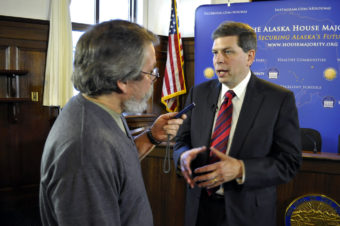
Reporter Bob Tkacz interviews U.S. Sen. Mark Begich following the senator’s annual address to the Alaska Legislature, March 3, 2014. (Photo by Skip Gray/Gavel Alaska)

Veteran Alaska journalist Bob Tkacz has died. He was 61.

With his gravelly voice and dogged interviewing style, Tkacz was a fixture in the state capital press corps for more than 20 years.

Tkacz peppered his share of Alaska politicians with a seemingly endless line of questions. Former Administration Commissioner Becky Hultberg was press secretary under former Gov. Frank Murkowski.

“Bob really liked to get under people’s skin if he could, and he’d kind of know when he did and he’d keep poking, keep going,” Hultberg says.

But she says she always respected the job Tkacz was trying to do. She doesn’t remember the issue, but says there was one exchange in particular where she tried to step in to prevent the governor from saying something he might regret.

“Ultimately, I was physically trying to maneuver my body between the governor and the podium to try to get the governor out of the room,” she recalls. “Because Bob had really accomplished what he wanted to accomplish, which was getting the governor riled up, and when people are upset they tend to be very quotable and not always in a good way.”

Former APRN Juneau Correspondent Dave Donaldson began covering the Alaska Legislature about the same time as Tkacz. They worked near each in the Capitol press room for 21 years. Though they were friends, Donaldson says even fellow reporters sometimes got fed up with Tkacz’s aggressive style.

Bob Tkacz
Bob Tkacz. (Photo by Skip Gray/Gavel Alaska)

Bob would not let go, and he would go forever,” Donaldson says. “And yeah, it did get a little annoying every once in a while. But the fact is that he came closer to really doing the job that we all ought to be doing than a lot of people who say, ‘Okay, thank you,’ and hang up.”

In September 1991, Tkacz was beaten and stabbed in an apparent mugging in Juneau. A New York Times story about the incident is still one of the first search results when you Google his name. Donaldson remembers visiting him in the hospital.

“He couldn’t talk, so he was trying to draw notes,” he says. “And he finally got it across to me that the reason I was there was to call his publisher and say that he’d be late for deadline.”

Tkacz worked or freelanced for several Alaska media outlets, including KTOO. In recent years, he wrote for Alaska Legislative Digest and the Alaska Journal of Commerce. His stories also appeared in national and international publications.

In 1994, he started his own subscription news service, Laws for the SEA, about the commercial fishing and seafood industry. Donaldson says that was the endeavor in which Tkacz took the most pride.

“He was kind enough when I retired that he gave me an honorary subscription, so I could keep reading them, and it really was good stuff,” Donaldson says.

In recent years, Tkacz traveled to Asia several times to report on how countries in the region are involved with Alaska’s seafood industry. Legislative Digest co-publisher Tim Bradner says he was passionate about the issue.

“The fact that so many of our seafood exports go to Asia, he just became interested in the market over there and what was happening to it and how that affected Alaska,” Bradner says.

Besides working as a reporter, Tkacz also did maintenance work at Jordan Creek Center, an office building in Juneau. He lived alone on his boat in Aurora Harbor, and often spent his free time at Augustus Brown Swimming Pool. He also was a volunteer DJ on KTOO’s sister station, KRNN, where he did a jazz show.

Juneau police say they responded to a report of a death at Tkacz’s downtown office Tuesday and found his body. The death is not considered suspicious. His body was initially taken to Alaskan Memorial Park Mortuary & Crematory then sent to the state medical examiner’s office in Anchorage for an autopsy.

Tkacz was originally from Ohio, where friends say he still has family. Services are pending.

Original post:

Longtime Alaska freelance journalist Bob Tkacz has died. He was 61.

Juneau police say they responded to a report of a death at Tkacz’s downtown office Tuesday morning and found his body. The death is not considered suspicious. The body was initially taken to Alaskan Memorial Park Mortuary & Crematory then sent to the state medical examiner’s office in Anchorage for an autopsy.

Tkacz was a fixture in the state capital press corps for years. His gravelly voice and dogged interviewing style needled a number of Alaska politicians. He had his own subscription news service, Laws for the SEA, which covered the commercial fishing and seafood industry. He also wrote for Tim and Mike Bradner’s Legislative Digest in recent years. He’d been published in the Alaska Journal of Commerce and once worked for KTOO.

In 1991, Tkacz was stabbed in an apparent mugging in Juneau that was highly publicized. A New York Times story about the incident is one of the top results when you Google his name.

His LinkedIn profile says Tkacz went to Ohio University, where he earned a bachelor’s degree in Newspaper and Magazine Editing. He lived on a boat in Aurora Harbor, and was a volunteer jazz DJ on KTOO’s sister station, KRNN.

Friends say he has family in Ohio. Services are pending.

(Check back for more details)

Do you have what it takes to be a Juneau police officer?

The Juneau Police Department
Juneau Police Department headquarters. (Photo by Heather Bryant/KTOO)

Do you have the strength and endurance to be a Juneau police officer? You can find out this Saturday when JPD holds a practice fitness test for the general public at Thunder Mountain High School.

The test consists of the five physical activities you must complete to meet the department’s minimum hiring standards. Lt. Kris Sell says JPD often hears from people who want to become a police officer, but either can’t pass the physical test or are worried they won’t be able to pass it.

“So we decided to do this practice test to let people come out, see what the test was going to feel like, get some advice on training for the test, ask about life at the academy, and the hiring process, and anything they had questions about to just kind of demystify that process,” Sell says.

To be hired by JPD, recruits must complete a 300 meter run in less than 74 seconds; do a vertical jump of two feet or higher; do a minimum of 21 pushups; complete 15 sit ups in less than a minute; and run a mile and a half in less than 16:44.

Sell says recruits should be able to do all that before they go to the police academy.

“Passing the test does not mean you’re ready for a police academy,” says Sell. “Passing the test means that we can send you to the police academy and you won’t need an ambulance on the first day.”

Sell says JPD has 10 vacancies right now, and only a few candidates are close to being hired. The process, which also includes mental tests and a background check, can take several weeks if not months.

Officers will be on hand to answer questions at Saturday’s practice test, which takes place from 1 to 3 p.m. at the Thunder Mountain High School track.

Man faces child sex abuse charges after investigations by Juneau, Sitka police

A 20-year-old Juneau man was arrested Friday for attempted sexual abuse of a minor, after a months-long investigation by the Juneau and Sitka police departments.

Regal Robert Hudson faces a total of nine charges, including sexual abuse of a minor, attempted sexual abuse of a minor, online enticement and contributing to the delinquency of a minor.

According to a Juneau Police Department release, the initial charge came after Hudson allegedly set up a sex date with an undercover JPD detective posing as a 13-year-old girl. When Hudson arrived at the location where the sex was to take place he was greeted by several JPD officers.

Juneau police say their investigation into Hudson started in March. Sitka police began investigating Hudson in January 2013.

Hudson’s first court appearance was on Saturday. Additional proceedings are scheduled for Tuesday. He has not entered a plea.

He’s being held at Lemon Creek Correctional Center on $75,000 cash bond.

Site notifications
Update notification options
Subscribe to notifications