A young black bear killed in downtown Juneau on Saturday appeared to be about a 150-pound three-year-old.
Juneau police shot the bear after it broke into a home on Rawn Way near Gastineau Avenue. Fish and Game biologists arrived a short time later.
Acting area biologist Stephanie Sell says the bear was able to push open the door to the home and helped himself to some food on a shelf just inside.
Juneau is surrounded by black bear habitat and the downtown area has always been a popular place for bears to roam, she says.
It seems like there’s an underground bear-making factory. And you know every time we take bears out of downtown, either move them or get rid of them, there’s always a bear that takes its spot.”
Sell doesn’t believe there are more bears in the downtown area this summer. Instead, she says, humans’ unsecured or poorly secured garbage give the bears easy targets.
We could take a bear out of an area but if we don’t solve the initial problem, which maybe the trash or poor garbage enclosures, you know the bears are just going to keep coming back.”
Juneau garbage laws are in effect year around. A violation for unsecured garbage in Juneau ranges from $50 for the first offense to $300 dollars for the third within two years.
Original story:
Juneau police shot and killed a black bear that broke into a home on Rawn Way near Gastineau Avenue on Saturday.
An officer shot at the bear twice with a shotgun after seeing the animal a doorway, according to a JPD news release. After the bear was shot, it ran behind the house, where it was later found dead.
Police say the bear was able to enter the home through the front door, which did not have a working doorknob. No other details about the incident were immediately available.
JPD says officials from the Alaska Department of Fish and Game were notified and responded.
Janice Sheufelt during the 2013 Race Across America. (Photo courtesy Peter Apathy)
Juneau cyclist Janice Sheufelt is trying to win her second consecutive title in the Race Across America, and this time she’s doing it by herself.
Sheufelt is currently atop the leader board in the race’s solo female under 50 division.
The Race Across America is considered the ultimate ultra-marathon cycling event. Sheufelt and six other solo women started the race on June 10 in Oceanside, Calif. By Thursday afternoon, she’d traveled nearly 2,400 miles to western Ohio, and was about 620 miles from the finish line in Annapolis, Md. Her closest competitor is Canadian cyclist Joan Deitchman, who’s about 50 miles behind Sheufelt. Two other racers in their division have been disqualified.
Last year, Sheufelt and California cyclist Joel Sothern finished the Race Across America in record time for the mixed gender 50-59 year-old age division. Though Sheufelt was 46 at the time, she was able to participate in the category because the race averages the age of each team.
After last year’s win, Sheufelt said her next goal was to do the race solo.
The Walter Soboleff Center under construction in downtown Juneau. (Photo by Casey Kelly/KTOO)
Sealaska Heritage Institute raised more than $75,000 last week during Celebration for the Walter Soboleff Center under construction in downtown Juneau.
The nonprofit is about $2 million short of the $20 million it needs to pay for the building, which will house the institute’s offices and collections. It also will feature space for SHI’s language program, art exhibits and an artist-in-residence program.
The 29,000 square foot facility is expected to open by early 2015.
“This will help Juneau become the new Northwest coast art capital of the world,” said Sealaska Corp. board chair Albert Kookesh, who led a fundraising pitch from the Celebration stage on Saturday.
Kookesh accepted a $50,000 check from Wells Fargo Bank for the Soboleff Center project. Sealaska shareholder Rod Worl and his wife, Dawn Dinwoodie, donated $25,000, and a handful of individuals gave gifts of a few hundred dollars each.
Sealaska Heritage Institute President Rosita Worl, Rod’s mother, said hundreds of Sealaska shareholders have supported the project to date.
“The most important donors have been our own people,” Worl said.
She also thanked several other donors, including the state of Alaska and City and Borough of Juneau, which are financing about half the project.
The center is named for the late Dr. Walter Soboleff, a Tlingit spiritual leader and educator who passed away in 2011.
Celebration attracted thousands of Southeast Alaska Natives from around the state, country and Canada. Sealaska says it is committed to Celebration for generations to come.
The largest labor union representing Alaska Marine Highway System workers has a tentative agreement for a new three-year contract with the state.
The Inlandboatmen’s Union of the Pacific and the Alaska Department of Administration reached the agreement last week after more than six months at the bargaining table.
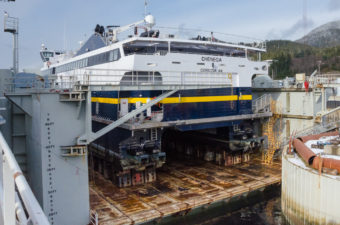
The M/V Chenega undergoes repairs in drydock at the Ketchikan Shipyard earlier this year. (Photo by Heather Bryant/KTOO)
The IBU represents about 650 Alaska Marine Highway System employees.
While the proposed contract does not include a pay increase in the first year, workers would get a 1 percent raise in year two and a 2 percent increase in year three. Some employees would get additional increases to make their wages more competitive with other jobs in the maritime industry.
IBU Regional Director Ricky Deising says the union’s negotiating team believes it’s the best possible deal and is urging members to ratify it.
We fought for almost seven months to get fair treatment for our members and we believe that’s what came out of this negotiation,” Deising says.
The state backed off a controversial proposal to change how the cost of living differential is calculated for ferry workers who live in Alaska. Those employees currently get an in-state salary adjustment based on Seattle wages. The state wanted to change the base city to Anchorage for all new employees hired after the start of the contract.
“We weren’t willing to back off and allow future work to be paid less,” Deising says.
The two sides agreed to freeze the cost of living differential for the duration of the contract, meaning employees won’t get any additional geographic adjustment as part of the negotiated wage increases.
Administration Commissioner Curtis Thayer says the state is trying to keep the cost of running the marine highway system in check. The state operating subsidy averages more than $100 million a year, according to recent financial reports for the agency.
“So when you have one sector of state government costing potentially a billion dollars in less than a decade, then there has to be a look for savings,” Thayer says. “And anytime that you’re negotiating wages and benefits that’s one of them.”
Last month, IBU members voted overwhelmingly to authorize a strike if negotiations failed. Thayer says the vote wasn’t much of a factor in reaching the tentative agreement. Deising says it was a show of solidarity, but the union never threatened to strike and had hoped to avoid one.
“The bottom line I believe is the state understood they needed to come to an agreement to take care of their employees,” Deising says.
The state is still negotiating with the other two unions representing ferry workers: the Marine Engineers Beneficial Association and the International Association of Masters, Mates and Pilots. Thayer says the state won’t budge much from the deal struck with the IBU.
IBU has set the stage, and we’re not going to differ much for those two unions,” Thayer says.
The current contracts for all three unions expire June 30. Now that IBU has a tentative agreement, Deising says its members will continue working under the current contract. He expects a ratification vote to take place in the next two months.
The Alaska Legislature must approve the financial terms of the contract.
Editor’s note: This story has been updated to clarify Ricky Deising’s comments about the strike authorization vote. A previous version stated Deising did not think the strike authorization was much of a factor in reaching the tentative agreement. In fact, he said it was a show of solidarity.
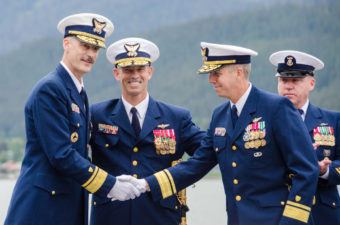
Rear Adm. Tom Ostebo inspects the District 17 crew with Rear Adm. Dan Abel. (Photo by Heather Bryant/KTOO)
Rear Adm. Dan Abel inspects the District 17 crew. (Photo by Heather Bryant/KTOO)
Pacific Area Commander, Vice Adm. Charles Ray praised Rear Adm. Tom Ostebo's leadership during his 3 years of command in Alaska. (Photo by Heather Bryant/KTOO)
Rear Adm. Tom Ostebo thanked the men and women under his command. (Photo by Heather Bryant/KTOO)
A salute and a handshake conclude the transfer of command. (Photo by Heather Bryant/KTOO)
With the buoy tender Sycamore as a backdrop and Coast Guardsmen and women in their dress blues, Rear Adm. Tom Ostebo turned over Coast Guard District 17 command to Rear Adm. Dan Abel on Thursday.
Ostebo is known for his work in the Arctic, and Abel says he’s ready to continue what his predecessor started.
Pacific Area commander, Vice Adm. Charles Ray, praised Ostebo’s leadership over the past three years.
“Tom Ostebo has flown over, sailed across, walked the beaches more than any Coast Guardsman, I believe, in the history of this district,” Ray said.
For these and other successes, Ostebo gave credit to the men and women under his command.
Every day you protect the nation’s commerce, you protect Alaskans, and you protect America’s greatest maritime resources,” Ostebo said. “And you do it better than anyone else, with efficiency and skill.”
Ostebo received a citation for exceptional meritorious service. He’s been nominated for a promotion to vice admiral and a post as the Coast Guard’s Deputy Commandant for Mission Support in Washington, D.C. The position is subject to Senate confirmation. Ostebo says it will allow him to continue focusing on the Coast Guard’s Arctic mission.
He says there’s still a lot of work to be done in that part of the world.
“It’s more than just exploration. It’s the maritime commerce piece,” Ostebo told reporters after the ceremony. “It’s what’s the Bering Strait is going to look like 10, 20 years from now? Will it look like the Straits of Hormuz or the Straits of Malacca? You know, one of these big international straits.”
This will be Abel’s first tour in Alaska, but he says he’s no stranger to the Arctic. In his previous command in Boston, he supervised the International Ice Patrol. That’s the Coast Guard program established to monitor icebergs in the North Atlantic to avoid another Titanic.
“We also supported Operation Nanook, which was practice mass rescue, environmental cleanup in the Arctic,” Abel said. “And the other thing we did, we supported the North Atlantic Coast Guard Forum to 17 nations that band together. Eight of those are the Arctic nations.”
Abel says he plans to travel extensively in Alaska and work with local communities to learn as much as he can about the state’s unique needs.
The far reaches at these high latitudes are going to be the challenge,” he said. “And I’m going to have to learn from the folks that’ve been standing watch a little longer than I.”
Abel is already planning to visit Nome, where Mayor Denise Michels says marine traffic has increased so much that the port, which used to close in October, is now open into November.
“Last year we had over 400 dockings in Nome,” Michels said. “Every year it’s more and more. We have more cruise ships this year.”
Michels hopes Abel can visit in July, when vessel traffic is at its peak.
“Safety is a concern, environmental issues is a concern,” she said. “The marine mammal migration through the Bering Strait, which is the choke point where we’re at, you know, it’s our front yard. So, to have him understand our concerns for subsistence, food security is going to be very important for his leadership for the next couple of years.”
The Coast Guard’s 17th District is based in Juneau. The commander leads 2,500 active duty, reserve, civilian and auxiliary personnel statewide, and manages operations over more than 3.8 million square miles and more than 44,000 miles of coastline.
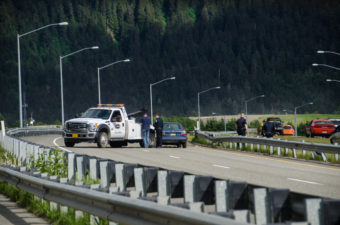
The single car accident yesterday afternoon on Egan drive closed both lanes of traffic on the overpass near Walmart. (Photo by Greg Culley)
A medical issue led to a single vehicle crash that closed Egan Drive in both directions Wednesday afternoon.
The crash happened on the inbound lane, near Walmart.
Juneau police in news release say 25-year-old Cory Kim crashed his vehicle into a guard rail. He was taken to Bartlett Regional Hospital. Police say he did not suffer any injuries in the crash. His medical issue was not specified.
JPD closed Egan Drive inbound for about 30 minutes. Outbound traffic was diverted to Glacier Highway.
Close
Update notification options
Subscribe to notifications
Subscribe
Get notifications about news related to the topics you care about. You can unsubscribe anytime.