Casey Kelly

Alaskan Brewing Co. now selling beer in cans

Alaskan Brewing Co. cans
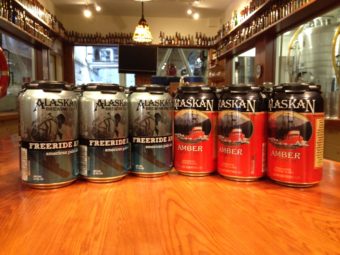
Juneau-based Alaskan Brewing Co. is now selling its flagship Amber Ale and its Freeride American Pale Ale in 12 ounce cans. Initially they’ll be available only in Alaska. (Photo by Casey Kelly/KTOO)

Alaskan Brewing Co. is entering the growing canned microbrew market.

Starting Monday, the Juneau-based beer maker will sell its flagship Amber Ale and its Freeride American Pale Ale in 12-ounce cans.

In recent years, consumers have become more accepting of craft beer in cans. But is it as good as bottles?
I set out to answer that question on a recent sunny afternoon. I grabbed six-pack of Freeride APA bottles and a can of the same beer supplied by the brewery, and got together with a few friends for some grilled halibut and a side-by-side taste test.

Before we started there were a lot of theories about the differences between bottles and cans. My girlfriend, Kate, thought there might be a change in the level of carbonation. Our friend Quinn thought the can itself might affect the taste of the beer.

Ultimately, we decided there wasn’t much difference. None of us are beer snobs, and to our untrained palettes, the stuff from the can tasted a lot like the stuff from the bottle.

In light of that, Quinn brought up the next logical question, at least to our group of friends: “If you were to hike to a cabin, would you grab a six pack of cans or a six pack of bottles?”

Everyone answered cans.

Bottles vs. cans

Geoff Larson Alaskan Brewing Co.
Alaskan Brewing Co. co-founder Geoff Larson stands next to cans of Amber Ale stacked in the Juneau-based brewery’s warehouse. (Photo by Casey Kelly/KTOO)

Alaskan Brewing Co. co-founder Geoff Larson is banking on a lot of beer drinkers being into cans. They’re lighter and more portable than glass, especially when empty, making them great for outdoor activities. Larson says the company had numerous requests for cans, and wants to provide its beer in places where customers want to drink it.

“Backpacking, boating, fishing, being on the beach,” he says.

But Larson says Alaskan isn’t willing to sacrifice quality for convenience. While some small breweries like Colorado-based Oskar Blues have had success with canned beer for more than a decade, Alaskan took its time getting into the market. Larson says the company researched several canning lines before finding the right one at a brewing festival in Germany. The line reduces the amount of oxygen picked up during the canning process.

“That’s the key. Anytime you’re dealing with filling bottles of beer, or cans, or kegs, it’s exposure to air, exposure to oxygen that can lower the life,” Larson says. “And this canning line is right now packaging the cans at the same quality as our bottling line.”

He says the biggest difference between cans and bottles is that you’re drinking from a different vessel.

Just the way the beer comes out of the can. It comes out in these little gurgles,” he says. “In that way you’re actually getting a different kind of experience. But as far as the quality of the beer, it’s spot on.”

Plant expansion

The Alaskan Brewing Co. plant is a maze of staircases and narrow walkways. As the company has grown over nearly 30 years, the footprint of its operation has stayed relatively small, even for a craft brewer. The new canning line is wedged in near the bottling line and a packaging area in the main brew house.

Curtis Holmes Geoff Larson Alaskan Brewing Co
Alaskan Brewing Co. co-founder Geoff Larson (left) and Plant Manager Curtis Holmes stand next to the brewery’s new canning line. (Photo by Casey Kelly/KTOO)

“When we made the commitment to go ahead and put the line in, we knew exactly what size we had and it had to fit only in here,” Larson says from a platform above the new line. “It looks like it fits perfectly, but it took a little bit of effort.”

Initially the cans will be available only in Alaska, because the company doesn’t have enough space to produce canned beer for its markets in the Lower 48.

The brewery recently broke ground on a multi-million dollar expansion that will link its two buildings in Juneau’s Lemon Creek area. The larger facility will allow the cans to be more widely distributed.

While it’s too soon to say what new beers Alaskan might produce, Larson says the expansion will let the company grow comfortably over the next decade.

You can’t really know what’s going to happen 12 months down the road. But now I think we’re looking at five to 10 years with a lot more certainty and clarity,” Larson says.

The expansion project is scheduled to be complete by early next year.

In addition to the new canning line, Alaskan recently started distributing its beers in two new states — Michigan and South Dakota. Alaskan Brewing Co. beer is now available in 17 states nationwide.

Bartlett board defends salary for new CEO Chuck Bill

Kristen Bomengen and Bob Storer
Bartlett Regional Hospital board president Kristen Bomengen and vice president Bob Storer met with the Juneau Assembly on Wednesday to defend the compensation package the board offered new CEO Chuck Bill. (Photo by Casey Kelly/KTOO)

The Bartlett Regional Hospital board of directors is defending the compensation package it offered new CEO Chuck Bill.

Board president Kristen Bomengen and vice president Bob Storer met with the Juneau Assembly on Wednesday to discuss the issue at the request of Assemblyman Randy Wanamaker. They said Bill’s salary of $315,000 and two signing bonuses worth a total of $63,000 were developed with input from board members and Human Resources Director Mila Cosgrove.

Storer said discussions about compensation started with the search committee, which included two doctors and two public members.

“So we used all of that in developing what I would call broad guidelines,” Storer said.

The city-owned hospital also hired a consultant, which made a recommendation based on the average salary of non-profit hospital CEOs nationwide. Bomengen said Bill’s salary is between the 50th and the 75th percentile of that average.

“In fact, the analysis that we were provided with encouraged us around the 65th level,” Bomengen said. “So we feel we fell within that range very comfortably.”

She said a $31,500 signing bonus and a relocation fee for the same amount were added during negotiations with Bill.

Previous Bartlett CEO Chris Harff’s annual salary was $262,000.

Wanamaker provided a list of written questions, but said he had more. He said he only learned about Bill’s compensation through media reports.

“But before even the media released it, members of the public were contacting me to let me know that they had learned about it, and they were not pleased with it,” Wanamaker said.

Bomengen and Storer said the board attempted to contact each assembly member before the news was announced. Assembly members Loren Jones, Jesse Kiehl and Karen Crane said they were notified.

Bartlett board members are appointed by the Juneau Assembly.

Juneau Assembly sets school funding floor

Randy Wanamaker
Assemblyman Randy Wanamaker wants to cut local funding for the Juneau School District next year as the city seeks to deal with an estimated $12 million budget shortfall over the next two years. (Photo by Casey Kelly/KTOO)

The Juneau Assembly on Wednesday voted to provide no less than $24.1 million in local funding to schools next year. That’s the same amount the city gave the Juneau School District this year, but two assembly members argued for a lower amount.

In order to ensure school funding is relatively equal across the state, Alaska limits the amount of local money communities can put toward education. For years, the assembly has given the school district the maximum allowed under state law, known as funding to the cap.

We have a reputation of funding to the cap, of being fully supportive of education. I, for one, want to maintain that level,” said Assemblywoman Kate Troll at special meeting on the topic Wednesday evening.

While the cap is set to go up next year, the city won’t know the exact amount until the Alaska Legislature passes an education funding bill that’s still being debated as part of this year’s extended session.

In the meantime, the assembly is required to let the district know the minimum amount of local funding to be provided. Until the cap is set, City Manager Kim Kiefer and Finance Director Bob Bartholomew recommended setting next year’s minimum at this year’s cap of $24.1 million. Bartholomew said the assembly could adjust the amount later depending on the new cap.

“We’re proposing something that’s slightly below the cap and recommending that that be the floor for funding for this year,” Bartholomew explained “And then you can change it upwards from there if you want, or if the state comes in and there’s a change in how much is required, we have flexibility to adjust to that.”

The city also routinely gives the district money for things like activities and transportation, which are considered to be outside the cap. The administration’s proposed budget would cut that funding by $200,000 next year, a 5 percent reduction.

In light of an estimated $12 million budget shortfall over the next two years, Assemblyman Randy Wanamaker said the district should have to give up more.

This school district has enjoyed the benefit of many, many years of outstanding support from the assembly, because the assembly believed that it could do that at those times,” Wanamaker said. “And I was one of those that helped support it. But I believe it’s time for them to join in the cost reductions that we have to go through.”

Jesse Kiehl
Juneau Assemblyman Jesse Kiehl says cutting local money provided to the Juneau School District would exacerbate already deep cuts the district has made due to stagnant state funding. (Photo by Casey Kelly/KTOO)

Wanamaker proposed setting the minimum funding amount for the district under the cap at $23 million.

Assemblyman Jerry Nankervis said he’d take it down to $12 million, the minimum required under state law. Though he admitted he would never actually vote for that small an amount of school funding.

“But we’re painting ourselves into a corner because we’re obligated to paint ourselves into a corner,” Nankervis said.

Assemblyman Jesse Kiehl pointed out that the school district has been cutting its budget for three or four years as the state’s education funding formula has remained flat.

“And it’s coming out of our kids. It’s coming out of our classrooms,” Kiehl said.

Wanamaker and Nankervis were the only assembly members to vote against the administration’s recommended minimum school contribution.

School Board President Sally Saddler, who attended the meeting, said afterward that the district has cut nearly 100 employees in the last four years. But she said the city also has had to cut.

“So, I don’t want to get into who feels the pain the most, because I think we all feel it together as a community,” Saddler said.

The assembly continues to work on the city’s two-year budget. A public hearing on the proposed city operating budget and the Juneau School District budget will be held next Monday.

Alaska becomes the second state to officially recognize indigenous languages

Supporters of a bill to make 20 Alaska Native languages official state languages organized a 15 hour sit-in protest at the Capitol on Sunday. Their dedication paid off early this morning, when the Alaska Senate passed the measure on an 18-2 vote.

The Alaska House passed the bill last week, 38-0. It now heads to Governor Sean Parnell for his signature.
Dozens of people of all ages and races, many wearing their Easter finest,  gathered in the hall outside Sen. Lesil McGuire’s office. The Anchorage Republican and chair of the Senate Rules Committee had the power to put House Bill 216 on the Senate’s calendar. But with end of the legislative session looming, the bill’s supporters worried it was getting caught up in last-minute, behind-the-scenes politics.

The group started their vigil just after noon, singing, dancing, and playing drums, and talking about why Alaska Native languages are so important.

“Our language is everything. It’s the air we breathe. It’s the blood that flows through our veins,” said Lance Twitchell, a professor of Native Languages at the University of Alaska Southeast.

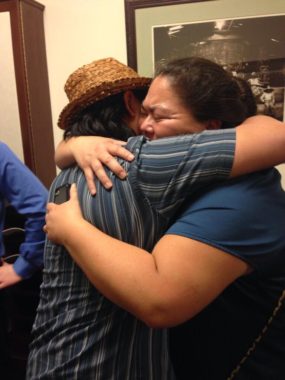
Lance Twitchell and Liz Medicine Crow embrace after HB 216 passed. (Photo by Casey Kelly/KTOO)

HB 216 would add the state’s indigenous languages to a statute created by a 1998 voter initiative, which made English the official language of Alaska. While the bill is largely symbolic, Twitchell said it’s important to recognize all languages as equal.

“That’s all we want is equal value,” he said. “And there’s nothing wrong with standing up and saying that. It takes a lot of courage to do that. And it takes a lot of something else to try and go against that.”

Many elders who attended the sit-in recalled being punished as children for speaking their first languages. Irene Cadiente of Juneau said her teachers would hit her with a ruler when they caught her speaking Tlingit.

“Sometimes I wonder when my hand hurts, is it on account of me speaking Tlingit?” Cadiente asked. “My hands were rulered. Is that why it hurts? I never forget that.”

Cadiente said she’s proud that her great grandchildren are now learning to speak the language.

Heather Burge, a student in the Native Languages program at UAS, said she didn’t understand how HB 216 could become controversial.

“We should be at the point where this should be a non-issue,” Burge said. “But it’s still scary to some people, which is a little disheartening. But hopefully we can get past this.”

Additional Coverage:
[icon name=”icon-angle-right”] Coghill proposes change to Alaska Native languages bill
[icon name=”icon-angle-right”] Alaska House sends Native languages bill to Senate
[icon name=”icon-angle-right”] Alaska Native languages bill clears final House committee
[icon name=”icon-angle-right”] House passes Soboleff Day as Native languages bill draws critics
[icon name=”icon-angle-right”] Supporters cheer Alaska Native languages bill

After the group had been outside McGuire’s office for about 30 minutes, the senator’s Chief of Staff Brett Huber announced the bill would be scheduled for a floor vote. McGuire later made an appearance of her own.

“We just got the bill, so we’re going as fast as we can,” McGuire said. “But it’s nice to see all of you. Thank you for coming, and thank you for your passion. I know you have support.”

It was 3 a.m. by the time the measure finally reached the floor.

Sen. Donny Olson, D-Golovin, who’s Inupiaq, said the bill would not have made it through the legislature without a groundswell of support.

“The elders, the youth, Native and non-Native,” Olson said.

Senate Majority Leader John Coghill, R-North Pole, took responsibility for the delay in getting the bill to the floor. Coghill tried to explain what he hoped to achieve last week when he proposed amending the bill to create a new category in statute for “ceremonial languages.”

“I thought if you had them in that place of honor you would aspire to them and honor them,” Coghill said. “Where if you put them in this place, they’re more likely to be under tension that I think would be harder to get to the honor and easy to get to divisiveness.”

Coghill said he was an apologetic no vote. He added that he would be willing to own up to it if he ends up being proven wrong. Sen. Pete Kelly, R-Fairbanks, was the other Senator to vote against the bill.

After the bill passed, supporters gathered outside Senate chambers to embrace each other and shed tears of joy. Twitchell summed up the feeling with a Tlingit phrase.

“We succeeded. We obtained,” Twitchell said after first saying it in Tlingit.

The bill explicitly says the official language designation does not require the state or local governments to conduct business in languages other than English. But Twitchell said putting them in the same part of the law builds momentum for future generations of Native language speakers.

If Gov. Sean Parnell signs the bill into law, Alaska will become just the second state after Hawaii to officially recognize indigenous languages.

(Editor’s note: Story audio has been added to this post)

Coghill proposes change to Alaska Native languages bill

John Coghill
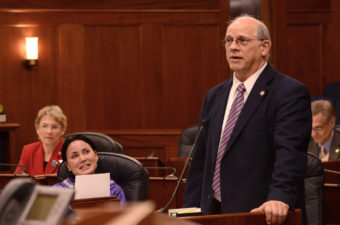
Sen. John Coghill, R-North Pole, speaks on the Alaska Senate floor. (Photo by Skip Gray/Gavel Alaska)

With two days left in this year’s legislative session, a key member of the Alaska Senate is questioning a bill that would make 20 Alaska Native languages official state languages.

Supporters say House Bill 216 is an important recognition of the work scholars and advocates are doing to save Alaska’s endangered indigenous languages.

But Senate Majority Leader John Coghill, R-North Pole, says he’s not sure if those languages should be elevated to the same level as English under state law. In the Senate State Affairs Committee on Friday, Coghill pointed to a 1998 voter initiative making English the official state language.

“It [the bill] puts all these other languages right in the middle of what that initiative was under official language,” Coghill said. “And it would probably be better, if we’re really going to honor them, to say those should be the ceremonial languages used in Alaska.”

In 2007, the Alaska Supreme Court struck down part of the voter initiative that required English to be used for all government business.

After running into similar questions in the House, HB 216 was amended to include a section clarifying that it does not require the state and local governments to conduct business in languages other than English.

But Coghill said he’s uncomfortable changing a law passed by voters. He offered an amendment to the bill that would create a ceremonial languages section in state law.

“I think we should honor them. I just didn’t know if that was the right place to put this language,” Coghill said.

Jonathan Kreiss-Tomkins
Rep. Jonathan Kreiss-Tomkins, D-Sitka, is the prime sponsor of HB 216, which would make 20 Alaska Native languages official state languages along with English. (Photo by Skip Gray/Gavel Alaska)

Rep. Jonathan Kreiss-Tomkins, D-Sitka, is prime sponsor of HB 216. At a Senate State Affairs Committee hearing on Thursday, Kreiss-Tomkins explained why the bill is important to Native language advocates.

“There’s a statewide movement to prevent the extinction of Alaska Native languages and promote the revitalization of Native languages, and this recognition quite simply means the world to a lot of people,” Kreiss-Tomkins said. “I’m not normally one for symbolic bills. But I think if a symbolic bill can create a sense of energy and momentum and excitement, then the bill in a certain sense achieves its purpose.”

House Bill 216 passed out of the State  Affairs Committee on Friday without Coghill’s amendment. The bill could appear on the Senate floor as early as Saturday, where Coghill could bring the amendment back up.

Sens. Fred Dyson, R-Eagle River, and Dennis Egan, D-Juneau, are co-sponsors of the bill in the Senate.

HB 216 passed the House on Wednesday on a 38-0 vote.

Alaska unemployment rate stays below national average

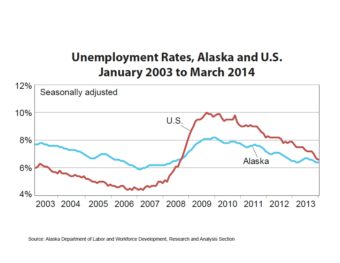
Unemployment rate chart
(Courtesy Alaska Department of Labor and Workforce Development)

Alaska’s seasonally adjusted unemployment rate was 6.6 percent in March.

That’s up one-tenth of a percent from February, according to the Alaska Department of Labor and Workforce Development.

The state’s unemployment rate is still below the national average of 6.7 percent, which held steady in March.

Last month kicked off the seasonal hiring season in much of Alaska. The labor department reports unemployment rates fell in 26 of 29 boroughs and census areas from February to March.

Juneau continues to have one of the lowest rates in the state at 5.4 percent. The North Slope Borough had the lowest rate last month, at 4.3 percent.

The highest rate was in Western Alaska’s Wade Hampton Census Area, at 25.8 percent. The Hoonah-Angoon Census Area in Southeast Alaska was second highest at 25.7 percent.

Site notifications
Update notification options
Subscribe to notifications