The mill at Kensington Gold Mine. (Photo by Rosemarie Alexander/KTOO)
The Kensington Mine near Juneau produced about 25,400 ounces of gold during the first three months of 2014.
That’s about the same amount as the mine produced in the first quarter of 2013, but a step back from the 37,400 ounces produced in the final quarter of last year.
More than 159,000 tons of rock was milled at Kensington in the first part of the year. The company calls it “a significant increase compared to prior quarters.”
Coeur will release full first quarter production and financial results on May 7.
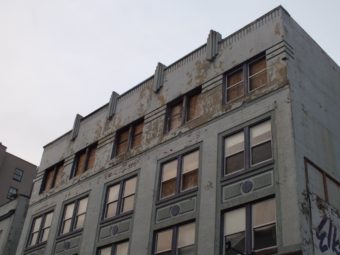
The Gastineau Apartments in downtown Juneau partially burned in November 2012. The city recently gave the owner until May 1 to install a temporary roof and clean up the garbage inside the building or face legal action. (Photo by Casey Kelly/KTOO)
The owner of a downtown Juneau apartment building that partially burned in 2012 has until May 1 to clean out the place and put up a temporary roof, or face legal action from the City and Borough of Juneau.
In a March 6 letter to Gastineau Apartments owner James Barrett, CBJ Building Official Charlie Ford said “the roof remains in such poor condition that water pours all the way down to the ground floor,” saturating drywall and garbage throughout the vacant complex. According to Ford’s letter, the city sent two previous notices to Barrett, requesting that he address multiple violations of the building code.
Deputy City Manager Rob Steedle says the city has had complaints about a bad smell coming from the building.
“A couple of people have mentioned that they find it objectionable,” Steedle said. “It hasn’t rained lately and it’s been relatively cold, so the odor is not as noticeable now as it has been in the past.”
Last November, about a year after the Gastineau Apartments burned, Barrett received a CBJ building permit to put up heat-shrinked plastic wrap in lieu of an actual roof.
Steedle says the building’s exterior shell is structurally sound. It’s the roof and trash inside the building that has the city concerned.
“If the building owner doesn’t accomplish the needed roof repairs to keep water from draining into the building when it rains, then we can expect that mold problems will persist, that the public will be complaining and we will go to court,” he said.
Steedle said City Attorney Amy Mead would have to decide the appropriate course of action.
The city has precedent for taking a property owner to court to force them to clean up their land. In 2012, the city initiated legal action against Ronald Hohman after several neighbors complained that his West Juneau home and property were a public nuisance. Steedle says the city completed the cleanup of Hohman’s property last year, after a contractor hired by the property owner failed to do the task by an agreed upon deadline.
Attempts to reach Barrett for this story were unsuccessful. Steedle says Barrett’s contact with city officials has been sporadic.
“We are waiting for the May 1 deadline to arrive and then we will attempt to contact him again,” Steedle said.
Juneau Douglas High School senior Ruby Steedle speaks at a rally on the Capitol steps organized by Great Alaska Schools on April 4 2014. (Photo by Skip Gray/Gavel Alaska)
Mary Hakala, a member of the Great Alaska Schools steering committee from Juneau speaks at a rally on the Capitol steps on April 4, 2014. (Photo by Skip Gray/Gavel Alaska)
Students from the Juneau Community Charter School participate in a rally on the Capitol steps organized by Great Alaska Schools. (Photo by Skip Gray/Gavel Alaska)
The group Great Alaska Schools took to the steps of the Capitol on Friday to demand an increase in the state’s education funding formula. The students, parents and business owners at the rally even handed out slices of pie to lawmakers to symbolize their request for a larger cut of the budget.
Mary Hakala of Great Alaska Schools in Juneau said education funding in the state has not kept up with rising costs.
“Schools across the state are facing deep and devastating cuts,” Hakala said. “It’s impacting our kids, our own children, our neighbors, our schools, the state’s future.”
The group wants the legislature to increase the state’s base student allocation about $650 over the next three school years. That’s more than double the current proposal before lawmakers.
Juneau Douglas High School senior Ruby Steedle says flat funding is starting to take a toll.
“This year our college and career advisor was cut from full to half time. The counseling office almost lost another position, and next year we’re losing 20 teachers across the district,” Steedle said, as the crowd booed the cuts. “That means that we have fewer teachers to reach the same number of students, meaning more students will start slipping through the cracks.”
The governor’s omnibus education bill is expected to be heard on the House floor on Monday.
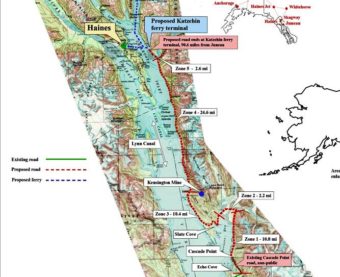
Map of the proposed Juneau Access project (courtesy Alaska Department of Transportation and Public Facilities)
Juneau residents on Thursday weighed in for and against a $35 million appropriation for the Juneau Access project in Gov. Sean Parnell’s proposed capital budget.
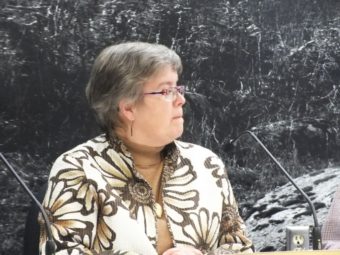
The Senate Finance Committee took general comments on the spending plan. Those who spoke about the proposed road north of Juneau were split about evenly between supporters and opponents.
“We have felt for decades now that this project has been overblown in its usefulness, and that it won’t really serve the people of Juneau as well as many people think,” Sullivan said.
He asked the committee to pull funding for the project until the Alaska Department of Transportation completes a Supplemental Environmental Impact Statement.
Supporters of the road say it would improve Juneau’s economy and quality of life. Juneau Chamber of Commerce CEO Cathie Roemmich urged the committee to fully fund Parnell’s request.
“This $35 million will get the road as far as the Kensington Mine,” Roemmich said. “That means that over 200 workers out there can drive home every day, instead of staying in small rooms and cots that other employees share. To us that’s really important, because we want to keep those Kensington Mine workers and all of our mine workers here in Juneau.”
Opponents said the state should not be building the road for a private company.
Sometimes called the Lynn Canal Highway, the entire project is supposed to go to the Katzehin River, where day boats would transport vehicles and passengers to Haines and Skagway.
Juneau Mayor Merrill Sanford and Deputy Mayor Mary Becker also testified in favor of the project.
During the public hearing, several other Juneau residents testified in support of a proposed arts complex in the city’s Willoughby District.
More testimony is scheduled on the capital budget this weekend and early next week.
City Manager Kim Kiefer listens as members of the Juneau Assembly discuss her budget proposal. (Photo by Casey Kelly/KTOO)
City Manager Kim Kiefer wants to balance Juneau’s budget with a combination of savings, spending reductions and property tax increases.
With the city facing a projected $12 million shortfall, Kiefer last night presented her proposed budget for the next two fiscal years beginning in July. In the first year, the spending plan would be about $321 million, down 0.4 percent from this year. It would be reduced even more the following year, to nearly $317 million.
Kiefer says coming up with the final budget will be a fluid process.
“But this right now as of tonight, with the scenario in front of you, we are providing a balanced budget,” she said. “It’s a place for us to start the discussions that we’ll have over the next 8-10 weeks.”
Kiefer’s plan calls for $3.6 million in cuts to programs and services over the next two years. That includes laying off as many as 11 full-time employees and eliminating 12 already vacant positions. Bus service and library hours would be reduced, and two major Parks and Recreation facilities would close. As reported on Wednesday, one of those would be the Augustus Brown Swimming Pool downtown. The other would be Mt. Jumbo Gym in Douglas.
The proposed property tax increase would raise about $3.8 million in additional revenue over two years. Finance Director Bob Bartholomew said the increase on a $300,000 home would be about $132 a year.
The plan also calls for using about $4.4 million not spent in previous years to balance the budget in upcoming years, as well as $1.6 million from the city’s budget reserve and $1 million currently earmarked for capital projects.
In perhaps a preview of what’s to come during the assembly’s budget meetings, Assemblyman Randy Wanamaker said there are other ways to balance the budget.
“And that is to reduce spending even further, so that you don’t need a mill rate increase for the operational budget, and you don’t need to tap into the budget reserve,” Wanamaker said.
Assemblywoman Kate Troll said she wants to look at capital projects slated for funding in the coming year to see if the money for any of them can be tapped to help fund general government operations. The manager’s plan only calls for doing that in the second year of the proposed budget.
“When I was just glancing through the list – mind you I didn’t have the expertise of the public works committee or the Engineering Department or anything like that – but I kinda go, ‘Is this really necessary? Is this necessary?’ And my question marks total up to $1.5 million,” Troll said.
The final budget is also dependent on a number of factors outside the city’s control. Among them, state funding for education and how much the Alaska Legislature wants municipalities to contribute toward paying down the state’s Public Employee Retirement System debt.
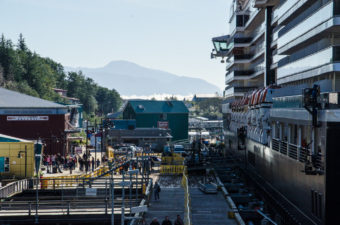
How safe are cruise ships like the Oosterdam when they’re docked in Juneau? (Photo by Heather Bryant/KTOO)
Emergency officials in Juneau are testing their response to a cruise ship security threat today.
Juneau Emergency Programs Manager Tom Mattice would only say that the drill involves a cruise ship and some type of large-scale security event. He declined to say what the exact scenario is.
“Because when you know what the event is ahead of time you come with your guns loaded to take care of a situation,” Mattice says. “What happens if a cruise ship crashes tomorrow? What are we going to do? We don’t spend 24 hours preparing for that. It just happens. That’s the way we exercise. It’s the way things happen in the real world.”
The exercise will take place at the AJ Dock downtown between 8 a.m. and 2 p.m. While there won’t be an actual cruise ship involved, about 40 volunteers will play the role of victims, who will be fake-rescued by real-life paramedics, firefighters and police. The Coast Guard and relief organizations like the American Red Cross will be involved in the scenario as well.
Mattice says the drill will test the communication of participants.
“When you get a large-scale event like this it’s much more than just the city working internally,” he says. “It’s the city working with its partners in response, whether that be the hospital or the Red Cross or other participants. So it’s not only how we individually coordinate, but how we coordinate and communicate together that’s really tested.”
Ensign Dwight Shaffer with Coast Guard Sector Juneau’s Response Division says anything from an oil spill to a mass rescue of a passenger boat can qualify as a maritime security threat. The agency has numerous response plans for different scenarios, and Shaffer says Coast Guard personnel are expected to know which plans to activate and when.
“They typically review them around four to five times a year, but it’s an ongoing cycle,” Shaffer says. “They’re constantly working them and making them better.”
Mattice says the city has its own Emergency Operations Plan, which gets reviewed and updated annually. While an earthquake or an avalanche might be more likely in Juneau, he says a cruise ship incident is still worth preparing for.
“We’re fairly fortunate in Juneau, it’s not number one on our radar, but we definitely don’t ignore it,” says Mattice.
Juneau gets about a million cruise ship visitors every summer. The first ship of the 2014 season is expected in less than a month. Cruise line officials declined to comment for this story.
Industry critic Chip Thoma with the group Responsible Cruising in Alaska agrees with Mattice that there’s not much to worry about. But he thinks any serious maritime security event would effectively end cruise ship activity in the state.
“Any serious incident would have a severe impact on the cruise ships, because there’s just no way that they would be able to guarantee the security coming out of Vancouver or Seattle,” Thoma says.
During the drill, at about 1:15 p.m., KTOO is expected to broadcast a test of the emergency alert system.
Close
Update notification options
Subscribe to notifications
Subscribe
Get notifications about news related to the topics you care about. You can unsubscribe anytime.