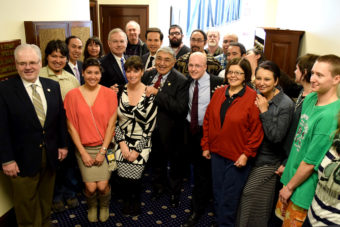
Rep. Jonathan Kreiss-Tomkins (front row, fifth from left) poses with supporters and co-sponsors of HB 216 shortly after the legislation passed the House. The bill would symbolically make 20 Alaska Native languages official state languages along with English. (Photo by Skip Gray/Gavel Alaska)
Rep. Jonathan Kreiss-Tomkins, D-Sitka, speaks in the Alaska House of Representatives on April 16, 2014. (Photo by Skip Gray/360 North)
Rep. Charisse Millett, R-Anchorage, speaks in favor of HB 216, which she co-sponsored. (Photo by Skip Gray/Gavel Alaska)
Rep. Benjamin Nageak, D-Barrow speaks in favor of HB 216 in his native language of Iñupiaq. (Photo by Skip Gray/360 North)
With less than a week to go in this year’s session, a bill that would symbolically recognize 20 Alaska Native languages as official state languages moved a step closer to passing the Alaska Legislature on Wednesday.
The House of Representatives approved House Bill 216 on a 38-0 vote, sending it to the Senate, where it’s scheduled to be heard on Thursday by the State Affairs Committee.
Supporters clapped from the gallery as lawmakers pounded their desks in approval after House Speaker Mike Chenault announced the bill had passed.
Rep. Jonathan Kreiss-Tomkins, D-Sitka, said in a House floor speech that even if the bill is largely symbolic, it’s still important to honor Native languages.
Eyak is one of the languages recognized in this bill. The last fluent speaker of Eyak passed away five short years ago,” said Kreiss-Tomkins, HB 216’s prime sponsor. “There are several other languages that are on the brink, have just a handful of fluent speakers left in Alaska.”
Kreiss-Tomkins said he hopes to someday learn Tlingit, one of three indigenous languages in Southeast Alaska.
Rep. Charisse Millett, an Anchorage Republican and co-sponsor of the legislation, said she regrets she never asked her Inupiaq grandmother to teach her the language.
“She told me stories of fish camps, and told me stories of moving from town to town to live a subsistence lifestyle, picking berries,” Millett said. “But I never learned the language.”
Millett said she hopes recognizing the state’s original languages will empower young people to overcome the shame her grandmother and mother felt about being Alaska Native.
“To engage in conversation, learn the language, the heritage of their elders. Learn the stories of what Alaska was, so they know how to make Alaska a better place,” she said.
The legislature’s only fluent speaker of an Alaska Native language is Rep. Benjamin Nageak, D-Barrow, who delivered about half of his remarks in Inupiaq. Nageak said the bill acknowledges indigenous languages have been spoken in Alaska since before European contact.
“Most of our languages are still alive, and we need to continue to make sure that those languages thrive and survive,” he said.
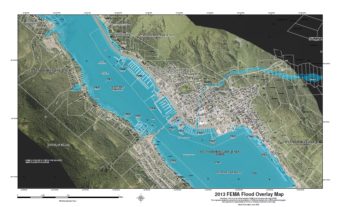
FEMA’s flood map for downtown and West Juneau. The city has been working with property owners and the federal agency to correct problems with the maps that erroneously included some properties in flood zones. (Image courtesy City and Borough of Juneau)
Since the Juneau Assembly adopted new flood maps last summer, boundaries have been redrawn to remove about 60 homes from areas considered flood prone.
“There’s an ongoing effort in our flood program to reach out to the community and work with them, and we have worked with 50 map amendments to date,” CBJ Community Development Director Hal Hart told the assembly on Monday.
Hart says the map amendments will save homeowners thousands of dollars in flood insurance payments.
He also says the U.S. Geological Survey has approved the city’s own LIDAR mapping data. Hart says FEMA and other federal agencies were not allowed to recognize Juneau’s maps until USGS gave its approval.
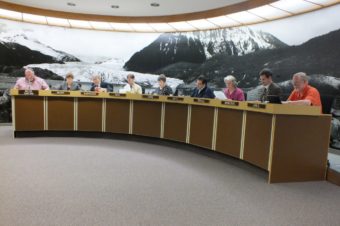
The Juneau Assembly listens to City Manager Kim Kiefer deliver an overview of her two-year budget proposal at a finance committee meeting on April 2, 2014. The assembly is looking to tap capital projects to make up a nearly $12 million budget shortfall. (Photo by Casey Kelly/KTOO)
The Juneau Assembly may use money currently earmarked for capital projects to address a multi-million dollar budget shortfall over the next two years.
For more than 30 years, Juneau voters have approved setting aside 1 percent of the city’s 5 percent sales tax for capital projects like new libraries, swimming pools, and infrastructure.
At a finance committee meeting last week, Assemblywoman Kate Troll requested a list of projects that could be put on hold next year with the least amount of disruption to fully fund the Juneau School District.
“I’m not interested in trying to reign in horses, projects that are already out to bid, and bring those horses back in. I’m not interested in that,” Troll said.
Overall, the assembly asked for a list of projects that could be deferred or scaled back to free up about $850,000 next fiscal year.
A portion of sales tax outside the 1 percent is also dedicated to the city’s capital budget. That’s the money the assembly would like to tap for the projected deficit. Engineering Director Rorie Watt says the proposed budget includes about 20 projects worth an estimated $8.6 million that are not funded by the voter-approved 1 percent tax.
“They’re basically facility maintenance and road and utility maintenance,” Watt said.
While he’s making a list of the projects most feasible to delay or downsize, Watt has a word of caution for the assembly.
Using capital money, it’s a one-year fix,” he said. “So if we’re talking about operating cost problems that are going to recur every year, the sustainable fixes are things like increased property taxes, or increased user fees, or enduring ways to get more money.”
Not all assembly members are in favor of using capital project funds to pay for city operations. Mayor Merrill Sanford said construction workers rely on city projects to make a living, and Assemblyman Randy Wanamaker said he’s wary of putting off too many projects.
“There are things that simply can’t wait any longer for repairs, upgrades and maintenance,” Wanamaker said.
The city has other options for reducing its budget shortfall, including nearly $20 million in savings. In the long-term, some assembly members want to look for new ways of raising revenue, such as a seasonal sales tax or elimination of certain tax exemptions.
The assembly finance committee holds another meeting on the manager’s proposed budget on Wednesday. On the agenda are presentations from the Juneau Affordable Housing Commission, the Juneau Economic Development Council, Eaglecrest Ski Area and the Juneau Airport.
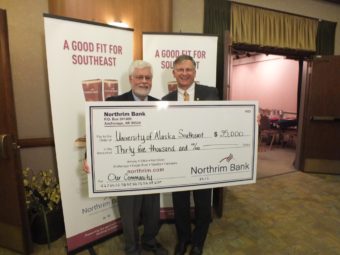
Northrim Bank President and CEO Joe Beedle (right) presents a $35,000 check to University of Alaska Southeast Chancellor John Pugh. The gift will help pay for online courses through the UAS School of Management. (Photo by Casey Kelly/KTOO)
Northrim Bank is giving nearly $240,000 to the University of Alaska to support business programs and economic research.
Chancellor John Pugh says the money will help UAS offer online courses to students in rural communities.
“Many people out there don’t know that we distance deliver all of our business programs,” Pugh said. “So it’s a real accessibility mission for us to get out to smaller communities, and this is going to help support that mission.”
Northrim Bank President and CEO Joe Beedle presented Pugh an oversized check at a luncheon in Juneau on Friday. Beedle acknowledged that the bank gets tax credits for donating to the university. But he says the financial institution also hopes to benefit by having a more highly trained workforce.
“I’m a product of the university myself, and I attribute a lot of my success to the training I got at the university and the introduction I had from the university into banking,” said Beedle, who grew up in Juneau and graduated from Juneau-Douglas High School.
“You’ll see the best economies in the country partnering with universities,” he said.
On April 1, Anchorage-based Northrim completed the purchase of Alaska Pacific Bank of Juneau in a stock and cash transaction valued at about $14 million.
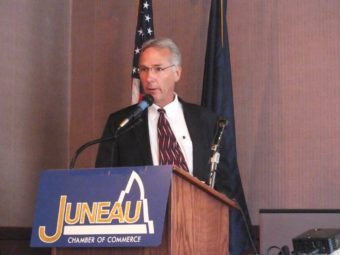
ConocoPhillips Vice President of External Affairs Scott Jepsen speaks to the Juneau Chamber of Commerce on April 10, 2014. (Photo by Casey Kelly/KTOO)
A ConocoPhillips executive says Alaska is still a great place for the oil and gas industry, but future development on the North Slope hinges on maintaining the new oil tax structure approved by the legislature in 2013.
Scott Jepsen, vice president of external affairs for ConocoPhillips Alaska, told the Juneau Chamber of Commerce on Thursday that there’s an old saying in the oil industry.
“If you want to find oil, look where you already found it,” Jepsen said.
Jepsen says ConocoPhillips will spend $1.7 billion on capital projects in the state this year. That includes preliminary work to bring three new drill sites into production by late 2017, as well as exploration for new oil.
“This represents about $600 million more than we spent last year,” Jepsen said. “We’ve hired about 1,750 new jobs to the North Slope to support this scope of work.”
ConocoPhillips is working with BP, Exxon, TransCanada and the State of Alaska to develop a natural gas pipeline. State lawmakers are considering legislation that would advance the nearly $65 billion project.
Jepsen says the key to making Alaska’s gas competitive worldwide is a healthy oil industry, because producers can leverage existing infrastructure and operations. He says the oil tax cut approved by lawmakers last year improved the business climate in the state.
“If it goes the other direction, we will go back and we will look at all the projects we’ve got, all the investments we’re thinking about making,” Jepsen said. “I can’t tell you today which ones we would or would not do, which ones we’d curtail, which ones the scope might be cut back a little bit on, because we’ve got other places that make more sense to invest than Alaska.”
Former state Senator Vic Fischer is a spokesman for the bipartisan group Vote Yes − Repeal the Giveaway, which hopes to overturn the tax cut, known as Senate Bill 21. The group collected enough signatures to put a repeal initiative on this August’s primary ballot.
“We do want oil production in the future. At the same time we feel that Alaska and Alaskans should get a proper share of the benefits deriving from oil production,” Fischer said. “Senate Bill 21 has greatly decreased the amount of revenue the State of Alaska receives and will receive in the future.”
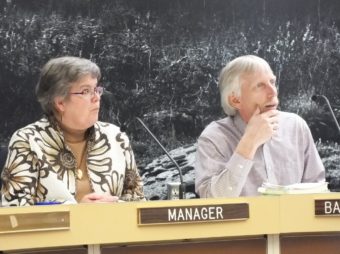
City Manager Kim Kiefer and Finance Director Bob Bartholomew present the administration’s proposed budget to the Juneau Assembly on April 2, 2014. (Photo by Casey Kelly/KTOO)
Facing an estimated $12 million shortfall over the next two years, the Juneau Assembly will dive into City Manager Kim Kiefer’s budget proposal Wednesday evening at the first finance committee meeting since the spending plan was introduced.
While $12 million may sound dire, the assembly has nearly $20 million in savings to work with.
The money is in two separate funds maintained by the city for unexpected shortfalls and emergencies. One of those is known as the fund balance, which accumulates when the city spends less money than it receives in revenue.
“We do have a central treasury, and that money that’s carried forward from prior years is cash, sitting in the CBJ’s bank accounts,” says Bob Bartholomew, CBJ Finance Director.
Bartholomew says the city will have about $8.1 million in fund balance available on July 1, the start of the new fiscal year. Juneau also has a budget reserve, expected to be about $11.8 million in July, for a total of about $19.9 million the assembly could use to balance the budget.
“Juneau is a financially healthy and stable community,” Bartholomew says. “We just got to a point where, our current operating budget, when we lost some significant revenues [and] had some cost increases, we found ourselves with a shortfall. But I think we have lots of resources for the assembly to take a look at over the next seven weeks to decide how to balance it.”
There are strings attached to the city’s savings accounts. The budget reserve is only to be used in emergencies, and currently it falls short of the amount the assembly wants on hand. As for the fund balance, Juneau does not have a policy for how much to keep. But Bartholomew says the administration wants to maintain between $3 million and $4 million to address unexpected cost increases or declines in revenue.
“In talking with the city manager we decided it would be better to propose some other alternatives that did keep some fund balance available at the end of the two-year budget cycle, so that if other unforeseen issues arose we could still deal with them,” he says.
The assembly has already approved using $3.1 million in fund balance over the next two years to pay for negotiated wage and benefit increases for city workers. City Manager Kim Kiefer’s proposed budget calls for using another $1.3 million in fund balance to address the estimated shortfall.
Historically, Bartholomew says, the city has used some fund balance to make its budget pencil out every year. In the past four years the city has spent significantly less than the amount budgeted. Bartholomew says that’s definitely been the long-term trend as well.
“In good years we haven’t needed it. And in years where our revenues didn’t come through or we had one time expenditure increases − say, bad snow years − we would then spend out of fund balance,” Bartholomew says.
The administration is also asking the assembly to raise property taxes to bring in an additional $1.9 million in revenue each year. Bartholomew says the owner of a $300,000 home would pay an extra $132 a year if the tax increase is approved.
Assemblywoman Karen Crane says the administration’s budget is a good starting place for the assembly, which ultimately shapes the final spending plan.
“There are nine ideas about what to do,” she says. “So we will just have to work it out and see if we can come to some consensus.”
Crane, who chairs the finance committee, says all options are still on the table for balancing the budget. While there are savings available, she says the assembly wants to avoid using the budget reserve.
“I think we are in fairly good shape,” Crane says. “It doesn’t seem like it at the moment, but we do have savings. I think we’re going to get some additional money from federal sources next year. I also think revenues are going to go up. But we need to be conservative with the public’s money and how we look at this and what the decisions are.”
Crane says the city budget will also be affected by decisions currently being made by the Alaska Legislature, namely school funding and public employee retirement system contributions by municipalities.
The assembly finance committee is scheduled to meet weekly through May 7 to hear presentations on specific aspects of the budget. Additional meetings will be scheduled after that.
The final budget must be adopted by June 15.
Close
Update notification options
Subscribe to notifications
Subscribe
Get notifications about news related to the topics you care about. You can unsubscribe anytime.