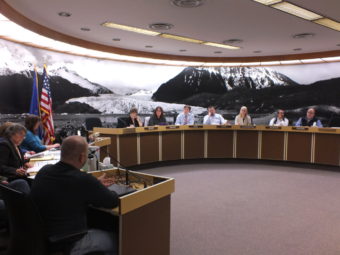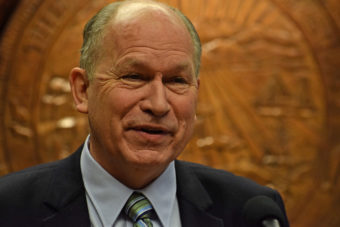
Gov. Bill Walker addresses reporters at a Feb. 5 press conference in Juneau. (Photo by Skip Gray/360 North)
Gov. Bill Walker says he’d like all of his commissioners to live in Juneau, but he’s proud of the team he put together and thinks it’s OK if some of them choose to live in other parts of the state.
The governor last week responded to recent criticism from Juneau lawmakers, who questioned why just two of his administration’s commissioners had committed to living in the capital city. Walker says three have now made that commitment, and three more are seriously considering a permanent move.
In a Feb. 11 letter to Juneau Sen. Dennis Egan and Reps. Cathy Muñoz and Sam Kito III, Walker writes that his cabinet members “must heavily weigh how the decisions will affect their families and find sufficient housing.”
He also notes that he and first lady, Donna, along with numerous senior staffers will make Juneau their permanent home while he’s in office. And the governor reaffirmed his commitment to keeping the capital in Juneau.
Muñoz says she’s satisfied with the governor’s response, but the delegation plans to keep pressing the issue.
“In terms of being most effective and being able to communicate most effectively with your team, it’s better to have them in one location,” she says.
Muñoz says the delegation is also leaning on the administration to keep Alaska Public Offices Commission staff in Juneau. In light of the state’s multibillion dollar deficit, Walker’s proposed budget would shutter the Juneau APOC office and move two of its three employees to Anchorage.
“I believe strongly that that’s not a good idea,” Muñoz says. “I think we need to keep the APOC office close to the legislature and the lobbying community, which by and large is located here in Juneau during the legislative session.”
Juneau lawmakers have long been concerned about capital creep – the slow migration of state jobs away from the capital city.
Dzantik’i Heeni Middle School students celebrated Elizabeth Peratrovich’s life last week with cake. (Photo by Casey Kelly/KTOO)
Today is Elizabeth Peratrovich Day in Alaska, and Juneau school kids have spent recent weeks learning about the Native civil rights leader.
When the territorial legislature passed the Anti-Discrimination Act in 1945, it gave minorities in Alaska legal protections from racial bias two decades before the U.S. Civil Rights Act of 1964.
Elizabeth Peratrovich’s testimony was crucial to overcoming comments like this from Allen Shattuck, a territorial senator from Juneau:
“Who are these people, barely out of savagery, who want to associate with us whites, with 5,000 years of recorded civilization behind us?”
On a recent afternoon at Harborview Elementary School, fourth and fifth graders in the Tlingit Culture Language and Literacy program are rehearsing a shadow puppet play based on Peratrovich’s testimony. Half the kids are actors, reading lines from the territorial senate meeting where lawmakers approved the anti-discrimination bill. The rest are puppeteers, using paper cutouts to cast shadows on a backlit screen.
“I would not have expected that I, who am barely out of savagery, would have to remind gentlemen with 5,000 years of recorded civilization behind them of our Bill of Rights,” says Lyric Ashenfelter, who plays Peratrovich.
Harborview Elementary School students Orion Dybdahl and Lyric Ashenfelter play Roy and Elizabeth Peratrovich in a shadow puppet play based on the Peratrovichs testimony to the Alaska territorial senate. (Photo by Casey Kelly/KTOO)
The 9-year-old says she was chosen for the part because she’s got a good, strong voice, and because she paid attention in class when they learned about Peratrovich’s testimony.
“She helped stop discrimination, and she was such a wide-hearted lady, and she was speaking for her rights,” Ashenfelter says.
Before the anti-discrimination act became law, segregation and racial prejudice were common in Juneau. Movie theaters, restaurants and shops refused entrance to Alaska Natives. Elizabeth Peratrovich and her husband, Roy, faced discrimination in finding housing because they were Tlingit.
It’s a different story today for Ashenfelter, who’s learning to speak Tlingit in school.
“Lyric yóo xat duwasáakw,” she says. “Which means I am Lyric, or my name is Lyric.”
Orion Dybdahl is Roy Peratrovich in the shadow puppet drama.
“Orion yóo xat duwasáakw,” he says. “I am Raven, yéil, Taakw.aaneidí, which is the sculpin clan.”
He adds that it was sad to learn about what Alaska Natives went through before the anti-discrimination act.
“It’s sad that they treated us differently, because where we were from or how we spoke,” Dybdahl says.
Ruby Hughes is the cultural specialist at Dzantik’i Heeni Middle School, where students are eating cake to celebrate Elizabeth Peratrovich’s life. Hughes says a lot has changed since she grew up in Juneau.
Ruby Hughes, cultural specialist at Dzantik’i Heeni Middle School, serves cake to celebrate Elizabeth Peratrovich’s life. (Photo by Casey Kelly/KTOO)
“When I was a kid we didn’t have Tlingit language in the schools,” Hughes says. “Occasionally we’d have an elder come in and they would speak fluent Tlingit. But it wasn’t really taught on the level that it is right now. So I think that’s pretty neat.”
Hughes made a timeline of Tlingit history that’s hanging in the commons at Dzantik’i Heeni. It starts in 1648 – the year Russian explorers first came to Alaska – and includes several entries that show the mistreatment and prejudice Alaska Natives experienced throughout history. The last entry on the timeline shows Lt. Gov. Byron Mallott, who’s Tlingit.
Hughes says Elizabeth Peratrovich helped make that possible.
Sean Purvis, who’s exploring the idea of starting a marijuana-related business, testifies at the Juneau Marijuana Committee’s first meeting. (Photo by Casey Kelly/KTOO)
About 30 people attended the first meeting of a committee formed by the Juneau Assembly to grapple with Alaska’s soon-to-be legal marijuana industry.
Last night’s short agenda mostly called for setting goals and deciding when the committee should meet moving forward.
Assemblyman Jesse Kiehl was elected chair. He asked committee members to start thinking about what issues the group will need to tackle in the coming months.
“My first request is that committee members start flagging things for all of us to consider as a group,” Kiehl said. “As you see them, as they occur to you, let’s start a brainstorm list.”
The committee is expected to deal with land use issues, regulating where and when legal marijuana businesses can operate in Juneau. In January, the Assembly set an Oct. 19 deadline for city officials to figure out local planning and zoning rules.
Members are expected to stay abreast of developments on the state level, where legislators are working on broader regulations governing legalized pot. The group also may look into conflicts between state and federal law, which still considers marijuana illegal. Some members said they would look to communities in Washington and Colorado, states that already have legal marijuana businesses.
Even though it wasn’t on the agenda, the committee took public comments, mostly from pot supporters, who thanked members for taking on the issue. Mendenhall Valley resident Sean Purvis told the committee he’s planning to tour legal pot operations in Washington state.
“I expect to glean a lot of information from these folks down in Washington,” Purvis said. “They plan on opening their books to me. If there’s anything I can share with you guys when I get back, I’m more than happy to do it.”
The committee includes four Assembly members and three Planning Commission members. Besides Kiehl, the Assembly members are Mary Becker, Maria Gladziszewski and Debbie White. The Planning Commissioners are Mike Satre, Gordon Jackson and Bill Peters. Meetings are planned for the second and fourth Thursdays of every month.
Juneau Police have charged a 48-year-old man with assault for allegedly beating another man so severely that he had to be medevaced to a hospital outside the city.
According to a JPD release, Mark Brown was lodged at Lemon Creek Correctional Center after police and Capital City Fire/Rescue responded Wednesday evening to a report of an assault in the 9100 block of Glacier Highway. Two witnesses reported seeing a man beating another man on the sidewalk.
The 54-year-old victim was unconscious and bleeding from several head wounds. Police say he was in “critical care” before being medevaced to an undisclosed medical facility.
Officers say Brown was uninjured. The release describes him as “verbally hostile and threatening to medics and officers” and “significantly impaired by alcohol.”
The investigation into the incident continues.
Also Wednesday, JPD says an 11-year-old girl pointed a handgun at a group of kids her own age.
Officers responded to the incident in the 4000 block of Taku Blvd just before 3 p.m. Wednesday. Police interviewed several children and parents, and seized a gun as part of their investigation, according to a release.
The case has been referred to Johnson Youth Center, which handles juvenile crimes. Police recommended the girl be charged with 3rd degree assault.
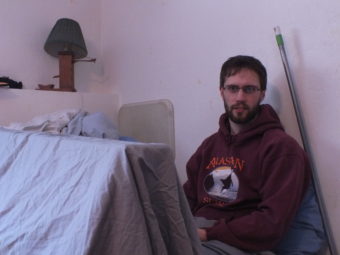
Matt Callahan says he and three friends “were looking for a little bit of harsher conditions” during a recent camping trip that ended with them being rescued from a Juneau mountain. (Photo by Casey Kelly/KTOO)
One of four Juneau hikers rescued off a wind-scoured mountain earlier this month says the group was looking for a bit of an adventure, but may have gotten more than they bargained for.
He sits up in bed, wearing glasses and an Alaskan Brewing Co. sweatshirt. A plastic frame keeps the sheet from touching his feet, which are swollen and purple, covered in blisters from frostbite.
Callahan says the group started their adventure up West Peak on Saturday, Jan. 31, the first day in probably three weeks without rain in Juneau. Temperatures at sea level were in the 20s and 30s.
“It was a beautiful day, but it was really windy,” Callahan says. “And when we got to the top of the mountain it was calm there, and we decided to just camp there.”
The 27-year-old – born and raised in the capital city – says he’s been winter camping maybe a dozen times or more. He says the group met as members of Juneau Mountain Rescue, and was prepared for the elements with warm coats, boots and sleeping bags.
“We were kind of looking for a little bit of harsher conditions,” says Callahan. “And we definitely got more than we bargained for in that respect.”
West Peak Ridge near where Matt Callahan and friends were stranded earlier this month. A Juneau Mountain Rescue team rescued the group on Feb. 2. (Photo courtesy Matt Callahan)
“We’d built a snow wall that was probably about 6 feet tall and 4 feet wide, and the wind ate through it in about an hour,” Callahan says.
About 4:30 Sunday morning, Callahan says the wind ripped up their tent and blew away a bunch of gear, including three sleeping bags and one coat.
At that point they decided to get off the mountain as soon as possible. But the wind was blowing 50 to 60 mph, and they only made it as far as a rock outcropping near their camp, where they took shelter until daylight.
When they tried to move again, Callahan says the wind was blowing probably 80 mph, so they figured it would be better to wait for help.
They huddled behind the rock formation, which he says was about 3 feet tall and 10 feet long.
“We hacked out about a foot of ice, down to the moss below it. But it was still windy in there,” he says. “The wind would whip around the bottom and blow up into it. But it was out of the full strength of the wind.”
Callahan sent their GPS coordinates to Juneau Mountain Rescue by text message, and JMR contacted Alaska State Troopers, the agency in charge of search and rescue.
A U.S. Coast Guard H-60 helicopter crew tried to airlift the hikers Sunday evening, but the wind was so gusty the helicopter was unable to land or get close enough to do a hoist.
A JMR ground team didn’t reach the stranded hikers until Monday morning.
“The high winds definitely was a challenge for us in figuring out a way to get a team there safely,” says Pat Dryer, JMR’s board president, who organized the search.
Dryer says the hikers actually were well prepared and did everything right in planning their trip.
“They left a travel plan with a third party, they were able to communicate to somebody when they did need help, they left with the proper gear, and they knew when to call for help,” Dryer says.
Callahan says he felt relief when JMR arrived, bringing extra clothes and ice tools to make crawling on the ridge more secure.
But he says the most important thing the rescuers brought was food and water, which the group had been without for almost 24 hours. Callahan says the extra nourishment gave them the energy to get off the trail safely.
“I was in a great mood coming down the trail,” says Callahan. “I basically ran down and got to the bottom and hopped in the ambulance to check out my feet and then realized that they were frozen.”
In the rush to gather his gear after the wind blew through their tent, Callahan says he failed to put on his gaiters – waterproof leggings that cover the calf and ankle. His feet got wet after snow got into his boots.
He and fellow hiker Amy Helm were medevaced to Anchorage with frostbite. He says doctors tell him it could be several weeks before he’ll know if he gets to keep all his toes.
“Eventually the tissue will turn into either nice, healthy toe again. Or it will shrivel up and kind of mummify, and that will have to be removed,” he says.
Callahan says Helm is in similar shape, recovering in Colorado with family. Her husband, Craig, also was on the trip, along with Schuyler Metcalf, neither of whom needed to be medevaced.
If he does lose toes, Callahan says so be it.
“I’m told you don’t really need toes,” he says. “There’s a lot of great mountaineers who don’t have toes. The doctor says they’re just cosmetic, but I’d still like to keep them if I could.”
And even though he got frostbite, Callahan says he’s happy no one in the group suffered hypothermia. He says he kept a positive attitude during the ordeal, and is trying to keep the same spirit through recovery.
If they had it to do over again, Callahan says they probably would’ve camped lower on the mountain. He says he would’ve made sure to put on gaiters. And he says, yes, they could have done a better job checking the forecast. But he adds people need to be prepared for the worst, no matter what the weatherman says.
“We knew it was going to be windy,” he says. “But just having a healthier respect for the wind.”
Juneau Police were not amused by a floating object in Gastineau Channel last night that closely resembled a human body.
The object turned out to be made of cardboard, tape and plastic. But according to a JPD release, it had a torso, legs, feet, arms and legs.
Police say a caller reported seeing the object floating in the channel near the Merchant’s Wharf building just before 8:30 Monday evening. An officer responded, but was unable to identify it in the dark.
The U.S. Coast Guard retrieved the object and determined it was not a body. Capital City Fire/Rescue was dispatched as well.
Police spokeswoman Erann Kalwara says JPD is glad no one was injured and says the public should be warned that pranks can lead to “unnecessary use of resources.”
Close
Update notification options
Subscribe to notifications
Subscribe
Get notifications about news related to the topics you care about. You can unsubscribe anytime.