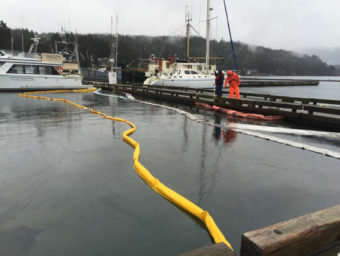
DEC and the U.S. Coast Guard use absorbent boom to contain an oil spill in Statter Harbor. (Photo courtesy DEC)
The U.S. Coast Guard estimates between 50 and 100 gallons of oil spilled into Auke Bay’s Statter Harbor on Sunday.
That’s according to a release from the Alaska Department of Environmental Conservation, which is investigating the spill along with the Coast Guard.
The source of the spill is still unknown.
Absorbent boom, pads and other tools are being used to soak up the oil. The Coast Guard has hired Southeast Alaska Lighterage to complete containment and cleanup.
There are still no reports of wildlife impacts. Alaska Department of Fish and Game and National Marine Fisheries Service biologists have visited Statter Harbor since the spill. Steller sea lions, harbor seals and mergansers have been seen in the area.
With Alaska’s new legal marijuana law going into effect today, the Juneau Assembly has passed an ordinance that defines “public place” for the purpose of enforcing a ban on open consumption.
Streets, sidewalks, parks and places of business are explicitly off limits for people looking to partake in Juneau. The definition also includes, but is not limited to, city-owned parking lots, schools, playgrounds, correctional facilities and common areas of public and private buildings.
Ballot Measure 2, approved by voters in November, said people 21 and older should be allowed to buy, sell, grow and use recreational pot in Alaska. It also said consumption in public would be banned, but failed to define what “public” means.
The Assembly last night unanimously approved the ordinance defining public in Juneau.
State officials are trying to come up with a “public place” definition as well.
The ordinance allows the Juneau Police Department to issue citations to people caught consuming marijuana in public. A first or second violation comes with a $100 fine. Three or more citations could result in mandatory court appearances. But Police Chief Bryce Johnson said that provision would likely be enforced only when officers know someone is a chronic offender.
“The way they do it with alcohol — which is what we’re looking at kind of copying here — is they usually just write the citation for the open container,” Johnson said. “And in order to go back and find out if they’ve already got the convictions, it does take a little while to do that. And that usually does not happen. So we write a lot of people a citation who have multiple convictions, who would have qualified for the graduated fine, but we didn’t know it in the field.”
City Attorney Amy Mead said a judge can levy a fine of up to $500, but the goal is not to get more money.
“The policy reason behind it is to make it a more burdensome process for the person being cited,” Mead said. “No one likes to go to court and appear in front of a judge. That’s the reason why you apply a graduated schedule. So if they continue to violate the same law over and over and over again, eventually you want them to have to go face the judge, instead of just write a check.”
The ordinance also amends the city’s traffic code to prohibit marijuana consumption while driving a vehicle. Drivers also are not allowed to let their passengers use pot. A first violation comes with a $200 fine, a second violation is $300, and three or more violations could result in a court appearance.
Economic development plan adopted, NOAA Task Force report accepted
The Assembly approved an ordinance adopting the Juneau Economic Development Plan last night. The plan becomes part of the Juneau Comprehensive Plan, and Assembly members will look at ways to tackle the broad initiatives it lays out for strengthening and improving the local economy.
Members also accepted a report from the city’s NOAA Task Force, which looked at ways to attract more federal fisheries research jobs to the capital city.
The Assembly also gave the OK to the city’s Lands and Resources staff to negotiate a land swap with Christ Evangelical Lutheran Church that could open up about 150 acres of city property on Pederson Hill to residential development.
State environmental officials and the U.S. Coast Guard are investigating an oil spill at Statter Harbor in Juneau’s Auke Bay.
Sarah Moore is a spill prevention coordinator with the Alaska Department of Environmental Conservation. She says people first noticed a rainbow sheen and heavy, black oil in the harbor sometime Sunday.
“It looks to be some kind of a used motor oil is our best guess at (this) time, and we’re still trying to identify the source,” she says.
The Coast Guard notified DEC of the spill after receiving a report around 7:30 last night. By the time officials arrived, Moore says it was too dark to start cleanup.
She says the sheen was originally estimated at 500 feet by 1,000 feet in size, but it’s hard to tell how much oil spilled. By this morning, she says the heavier oil was mostly collected in the corners of the floats in Statter Harbor.
Moore says a variety of tools are being deployed to soak up the spill.
“We have the sorbent material, which is referred to often as diapers. And it’s that white, thick material that collects just the oil and not water, and so we’ve been using that in a lot of the corners,” Moore says. “We’ve also been using something that’s called snare, which looks a lot like a high school cheerleader’s pompom… And then we’ve also been using just some regular containment boom to keep it in as small an area as possible.”
Moore says the oil most likely came from a vessel. DEC and the Coast Guard are investigating the exact cause.
She says there have been no reports of impacts to wildlife.
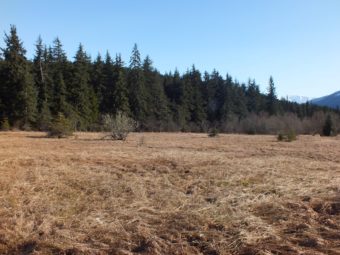
City officials are hoping to get authorization to negotiate a land swap that could open Pederson Hill to housing development. (Photo by Casey Kelly/KTOO)
A proposed land swap between the City and Borough of Juneau and Christ Evangelical Lutheran Church could open up about 150 acres on Pederson Hill to development.
City Lands and Resources Director Greg Chaney says the vision is a single-family residential neighborhood, with more than 100 new homes.
“Generally similar characteristics to traditional downtown layouts like we have in downtown Juneau or in Douglas,” Chaney says. “You know, the ones that date from the turn of the century.”
Last summer, the Juneau Assembly rezoned the city’s Pederson Hill land to allow higher density development. The area is located between the Mendenhall River and Auke Lake, just off Glacier Highway. But there’s one problem.
“There’s a band of private properties between our land and the highway,” Chaney says. “So we need to gain access to that before we can do any kind of proposal for development.”
Christ Evangelical Lutheran Church sits on one of those properties. Chaney says the city has had preliminary talks with church officials about a land swap, and even has what he calls “a very tentative agreement.” The city would get a strip of land owned by the church to build a new road. The church would get an equivalent piece of city property just up the hill.
“Kind of buffer between what they have now and the new development,” says Chaney.
Authorization to negotiate the deal is on the Assembly’s agenda tonight. Assembly members have been working to expand the city’s housing stock.
Dean Dawson with the church says the congregation supports the proposed trade.
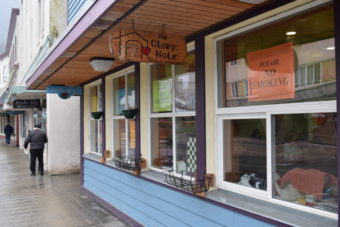
The Glory Hole, Juneau’s emergency homeless shelter and soup kitchen, would have lost about one-fifth of its funding under Gov. Bill Walker’s original budget proposal. (Photo by Casey Kelly/KTOO)
Advocates for the homeless in Alaska are rejoicing after Gov. Bill Walker released an updated budget proposal that restores funding for housing and homelessness services statewide.
The governor had initially zeroed out the funding in light of the state’s multibillion dollar shortfall. But the Alaska Coalition on Housing and Homelessness leaned on the administration to restore it.
It’s mid-morning at The Glory Hole, Juneau’s emergency homeless shelter and soup kitchen.
Ralph Jackson and his girlfriend are sipping coffee, and waiting for lunch to be served in a couple hours. Jackson says they’ve been homeless for about nine months, ever since they got kicked out of an apartment in Petersburg for what he says was a trumped up noise violation. He says The Glory Hole is the first place to really help them out.
“They’re giving us some insight, you know, as to what kind of jobs we can get, and housing especially,” he says.
Ralph Jackson says he and his girlfriend have been homeless for about nine months. (Photo by Casey Kelly/KTOO)
Jackson says he plans to apply for a dishwashing job at a Juneau restaurant. And he says he and his girlfriend hope to get into subsidized housing.
“We’re on a waiting list, and it’s six months to a year… all we can do is just wait,” he says.
In the meantime, Jackson says they’re grateful for The Glory Hole’s services. In addition to help finding jobs and housing, the shelter offers free meals and a warm, dry place to hang out when it’s cold and wet.
Executive Director Mariya Lovischuk says those services would have taken a $96,000 hit under Gov. Walker’s original state spending plan. She says that’s about a fifth of the shelter’s budget.
“If we did not have that funding it would be really, really devastating, because we already operate on a very bare bones budget,” Lovishchuk says. “And I think we do utilize all of the funding sources that are available to us really, really efficiently.”
The governor’s amended fiscal year 2016 budget funds the state’s basic homeless assistance program at $7.7 million. In recent years, that program has covered operating expenses for nearly 40 service providers statewide and helped thousands of homeless individuals and families. The updated budget also includes $1.5 million for special needs housing grants, aimed at helping nonprofits and developers build affordable housing for low income Alaskans.
Sue Steinacher is director of NEST, the Nome Emergency Shelter Team, which gets about two-thirds of its funding from the state.
“At a time where the state’s economic troubles are making life harder for others, it’s really critical that we provide that safety net,” says Steinacher.
Under the initial budget proposal, Steinacher says there was a real possibility the shelter would have closed.
“Given that the governor has put this money back… I feel much more confident about next winter and the shelter having enough operating funds,” she says.
Scott Ciambor co-chairs the Alaska Coalition on Housing and Homelessness. He says members mobilized to make sure Walker’s office knew the importance of the funds to homelessness programs across the state.
“It’s not something that the coalition has had to advocate for in the past. So there was some scrambling, as you would imagine,” Ciambor says.
He says their message was simple: In a state where affordable housing is hard to develop and doesn’t exist at all in some communities, many people rely on shelters.
“It’s everything from, you know, the chronic homeless population that have been kind of living this lifestyle for a long time,” he says. “But it’s also a lot of families, who just typically need some rental assistance to make sure that they don’t become homeless.”
In a release, Walker’s Budget Director Pat Pitney said taking the homeless money out “was an unintended consequence of submitting a stripped-down capital budget.” She called putting it back in “a cost-effective way to address issues that could be costly for our communities,” including money spent on law enforcement and social services.
Ciambor says the coalition also met with lawmakers in recent weeks. As the legislature continues to craft the final budget for next fiscal year, he says it’s an opportunity for the group to talk about the importance of homeless services statewide.
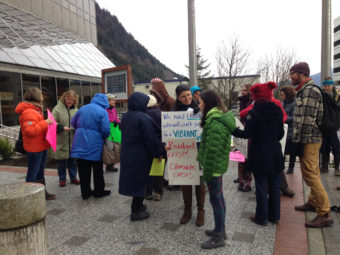
About 25 climate change activists gathered on the sidewalk across the street from the Alaska Capitol on Wednesday to bring attention to the issue and demand more attention from Sen. Lisa Murkowski. (Photo by Casey Kelly/KTOO)
Sen. Lisa Murkowski barely talked about climate change in her annual speech to the Alaska Legislature today.
In response to a question from Bethel Rep. Bob Herron, Murkowski mentioned that President Barack Obama and Secretary of State John Kerry are planning to visit the state later this year, and she hopes they don’t focus exclusively on climate.
“I believe we are seeing changing climate in our state,” Murkowski said. “And we know, you go out to Kivalina, you see the erosion. We see the impacts. But when we talk about the Arctic, when we talk about the issues that we face as a state, it’s more than just climate.”
Meanwhile, outside the Capitol, a small crowd rallied to bring attention to climate change and to demand more action on the issue from Murkowski. About 25 people gathered on the sidewalk across the street, waving signs saying “We need leadership” and “Budget crisis, Climate crisis.”
Rally organizer Danielle Redmond says Lisa Murkowski’s recent votes for the Keystone XL pipeline and against stricter Environmental Protection Agency emissions regulations show she doesn’t take climate change seriously.
“What we need are leaders who will craft policy for a vibrant future,” Redmond added.
Danielle Redmond with the Southeast Alaska Conservation Council and the Alaska Climate Action Network organized the rally. (Photo by Casey Kelly/KTOO)
Now that Murkowski chairs the Senate Energy and Natural Resources Committee, Redmond says she’s in good position to help the U.S. curb emissions. She says it’s important to Alaska’s future that oil production not be the primary driver of the state’s economy.
“Alaska is facing a $3.5 billion budget deficit,” she said. “It’s clear that it’s time to have some very serious, if uncomfortable, conversations about the future of Alaska and our relationship with the fossil fuel industries.”
June Degnan lives in Juneau, but is Yupik and her family roots are in Unalakleet. She says climate change is being felt especially hard in rural communities.
“You can see it in rural Alaska, you can see it in the circumpolar regions of the world that the water levels are rising,” she said.
Degnan says Murkowski needs to acknowledge that climate change is real and begin to do something about it.
“She needs to get with the program to see and look at the scientific aspect of it and the boots on the ground aspect of it and what’s happening,” Degnan said.
Scientists almost universally agree that humans are the primary cause of climate change.
Talking to reporters after her speech to the legislature, Murkowski reiterated that there’s no doubt climate change is real. But she took a more ambiguous stance on the cause.
“It’s not my position to argue how much human beings contribute to it,” she said.
The senator says humans have a responsibility to address the impact emissions have on climate, but it doesn’t make sense to put in place policies that will ruin the economy.
Back at the rally, protesters dropped pennies into a glass jar to symbolize giving their two cents on the cause of climate change.
Redmond says she did not ask for a meeting with Murkowski, who didn’t make an appearance, but she’s happy with the turnout. She says awareness about climate change is growing in Alaska.
“We’re on the front lines, we feel the impacts, but making change is really daunting,” she said.
Redmond thinks as the movement continues to grow, politicians like Murkowski will begin to take notice.
Close
Update notification options
Subscribe to notifications
Subscribe
Get notifications about news related to the topics you care about. You can unsubscribe anytime.