Casey Kelly

Eaglecrest to reopen Porcupine lift this weekend

Porcupine chairlift
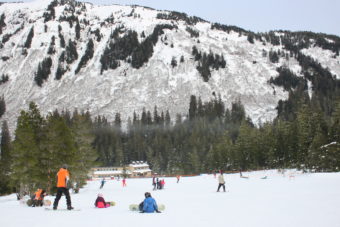
Eaglecrest Ski Area plans to reopen the Porcupine chairlift on Saturday, nearly a month after the ski hill suspended lift operations due to this winter’s warm and wet conditions. (Photo by Lisa Phu/KTOO)

All those snow dances apparently paid off.

Juneau’s Eaglecrest Ski Area plans to re-open the Porcupine chairlift on Saturday.

The city-owned ski hill shut down lift operations last month due to this winter’s warmer and wetter than normal conditions.

Crews used last week’s cold snap to manufacture some snow on the lower mountain, and Mother Nature added a few inches this weekend.

“It’ll be good to actually get out and have people up on the mountain again skiing and snowboarding,” says Jeffra Clough, sales and marketing director at Eaglecrest.

In addition to opening Porcupine, Clough says the Wee Ski and Little Rippers programs for kids ages 3 to 6 will restart this weekend. Saturday is also the annual Winter Fireworks Spectacular at Eaglecrest.

Clough says the Hooter, Ptarmagin and Black Bear chairs remain closed. But she says people should keep doing those snow dances, so they can open soon.

Heroin, meth seizures up in 2014, JPD says

heroin
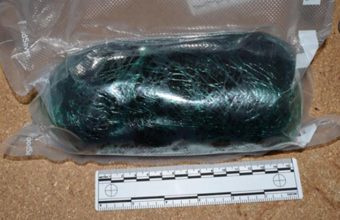
Juneau police seized 4.7 kilograms of heroin in 2014. This picture shows one kilo seized in September. (Photo courtesy Juneau Police Department)

The Juneau Police Department seized more heroin and methamphetamine last year than in 2013, but seizures of illegally trafficked prescription drugs were down.

JPD, working with state and federal law enforcement, seized 4.7 kilograms of heroin and more than 3.6 kilos of meth last year, according to the department’s annual drug statistics report released Friday. That’s seven times as much heroin and nearly five times as much meth as the previous year.

Lt. Kris Sell says the amount of hard drugs on the street probably didn’t change. But officers were able to take bigger chunks of the supply thanks to some high profile busts.

“If you looked at just the numbers, you would think, ‘Oh my goodness, heroin has just exploded in Juneau in 2014,'” Sell says. “And that’s not what we’re seeing on the streets, but we are seeing that we’ve interdicted a lot more heroin.”

methamphetamine, meth
The street value of all the methamphetamine seized in Juneau last year was $635,000. (Photo courtesy Juneau Police Department)

Sell says police made more meth busts early in 2014, but numbers tapered off toward the end of the year.

She says heroin is cheap right now. A tenth of a gram sells for about $100.

Prescription drugs are more expensive, leading to fewer illegal users.

Sell says the department saw a 75 percent decrease in seizures of Oxycontin, Oxycodone, Hydrocodone and Vicodin.

“It’s so expensive now,” she says. “The price of those has gone up with supply and demand. So people have just gone to heroin.”

The street value of all illegal drugs seized in Juneau last year was more than $5.7 million – up from nearly $2 million in 2013. Police also seized more than $109,000 in cash during drug investigations.

All told, JPD’s drug unit handled 105 cases, charged 37 people with 48 crimes, and made 38 controlled buys in 2014.

But Sell says the drug stats only show part of the picture.

“Thefts and check forgeries and shoplifting, so many of those crimes are tied to drugs,” she says.

Painting a better picture of Juneau’s drug problem is why this year’s report includes information on overdoses for the first time. Sell says medical privacy laws can make getting those numbers difficult. But as near as the department can tell, there were 19 overdoses last year, including four from heroin and four from meth.

She says members of the public requested that information be included in the report.

“There’s a lot of rumor about overdoses and how many people are overdosing on what, and that seemed to be a yardstick that the Juneau public wanted,” Sell says.

Walt Sisikin with the National Council on Alcoholism and Drug Dependence and the Juneau Alcohol Safety Action Program says treatment providers see a lot of the same people struggling with addiction over and over again. He says treatment works best when people follow up an inpatient or residential program with outpatient therapies.

“In other words, you go ahead and keep seeing a counselor, you go ahead and work your program in the sense of going to AA meetings or NA meetings, you find yourself a sponsor,” he says.

This will be the last year marijuana is included in the JPD drug report. Voters legalized recreational pot in November and the new law takes effect later this month.

But Sell expects JPD to be just as busy dealing with marijuana related issues, including driving under the influence and underage use.

Juneau lawmakers: Commissioners should live in capital city

Dennis Egan, Cathy Munoz, Sam Kito
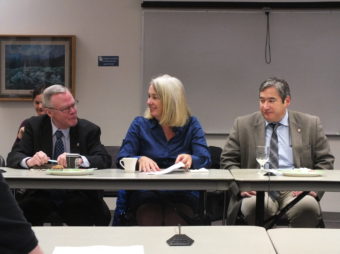
Juneau’s Legislative delegation, Sen. Dennis Egan and Reps. Cathy Muñoz and Sam Kito III. (Photo by Casey Kelly/KTOO)

Juneau legislators want more of Gov. Bill Walker’s cabinet members to live in the capital city.

In a letter sent to Walker on Monday, Sen. Dennis Egan and Reps. Cathy Muñoz and Sam Kito III say they’re concerned that only two state commissioners have committed to living in Juneau. Education Commissioner Mike Hanley is a year-round resident. Fish and Game Commissioner Sam Cotten has said he will relocate for legislative sessions, but owns two houses elsewhere in Alaska where he plans to spend at least part of his time.

Egan says state government works better when high-level officials are in the same place.

“With all state agencies, most of them headquartered here in Juneau, it makes sense to the delegation,” says Egan. “You know, teleconferencing is fine, but a one-on-one, face-to-face with their commissioners works a heck of a lot better.”

The delegation says commissioners who aren’t close to the action in Juneau “risk weakening the management of, and political support for” their agencies, which is especially concerning given the state’s recent budget shortfalls.

The letter also brings up a long-running concern of Juneau lawmakers: Capital creep, or the slow migration of state jobs away from the city.

Gov. Walker does live in Juneau full time. Lt. Gov. Byron Mallott is a longtime resident and, like Egan, a former mayor of the city and borough.

Walker’s spokeswoman Grace Jang says the governor’s office will respond to the delegation’s letter today (Wednesday).

Juneau joins chorus of communities calling for international mine review panel

Tulsequah Mine
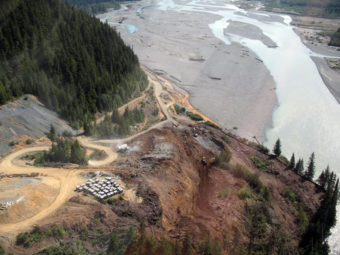
The Tulsequah Chief Mine is the closest Canadian transboundary mine to Juneau. The long-closed mine sits on the Tulsequah River, which flows into the Taku River, which drains out south of Juneau. (Photo courtesy Chieftain Metals)

Juneau has joined a growing number of Southeast communities to call for an international panel to review transboundary mines near the Alaska-British Columbia border.

This week, the Juneau Assembly passed a resolution urging the U.S. federal government to work with Canadian officials to refer transboundary mining projects to the International Joint Commission.

Heather Hardcastle is a Juneau gillnetter and co-owner of Taku River Reds, a small business that sells and markets Alaska salmon. She’s also a critic of transboundary mining projects located near the Canadian headwaters of rivers that flow into or near Southeast waterways.

“It’s the scale, the scope, the speed at which these projects are being developed and constructed,” Hardcastle says.

Last week, a Canadian review panel released a report blaming poor design for the August 2014 failure of a tailings pond dam at the Mount Polley Mine in British Columbia. The open pit, copper and gold mine does not sit near any rivers that drain into Alaska watersheds. But the company that owns Mount Polley, Imperial Metals, also owns the Red Chris Mine on the Stikine River upstream from Wrangell and Petersburg.

Hardcastle says if any of the transboundary mines or mining projects near the Alaska-Canada border pollute Southeast waters, it could devastate the region’s fishing industry, not to mention subsistence gathering and recreational opportunities on the U.S. side.

“These are world-class salmon rich watersheds that are so important culturally and economically to us in Southeast and Alaska generally,” she says.

Juneau is the eighth Alaska community to adopt a resolution calling for the International Joint Commission to get involved with border mines. The commission was established by the Boundary Waters Treaty between the U.S. and Canada for the express purpose of resolving such conflicts.

Hardcastle says the goal is not to stop mining, but rather to give U.S. and Alaska officials an opportunity to provide input on the projects.

“And some of the projects we’ve really had no involvement at all,” Hardcastle says. “So it does feel like they’re being developed without our consultation.”

Mayor Merrill Sanford says the Juneau Assembly doesn’t want to stop Canadian mining either.

“But (we want to) make sure we have a good, strong scientific look at those mines and at what the ramifications of them are as a whole to our side of the border,” Sanford says.

He thinks there may be opportunities for Southeast residents to get jobs working in Canadian mines, or provide training to mine workers. He points to successful training programs developed by the Greens Creek and Kensington mines near Juneau in partnership with the University of Alaska Southeast.

“When they start doing that many mines and that big of mines, they may need to have thousands of people,” says Sanford. “So, I would say that there could be a very good possibility of some people who may want to go back and forth across the border and do some of those different things.”

The resolution will be sent to the U.S. State Department, Alaska’s Congressional delegation and Gov. Bill Walker’s office.

Pot smoke added to Juneau’s indoor smoking ban

Smoking
(Creative Commons photo by Chuck Grimmett)

When recreational marijuana becomes legal in Alaska later this month, pot smokers in the capital city will not be able to toke up inside bars. Private clubs might be allowed later, but for now those are off-limits too.

That’s because the Juneau Assembly last night unanimously voted to amend the city’s indoor public smoking ban to include pot, despite objections from some marijuana advocates.
Of the five people to testify on the ordinance, three were opposed and one had questions.

Ben Wilcox said the city should have designated establishments for pot consumers, arguing it was for their safety and the safety of the public.

“They have bars to consume their alcohol. They need a place to consume this now legal substance, with people who can legally and responsibly serve them and control their behavior,” Wilcox said. “Make them not walk in front of a bus, just like we do with people consuming alcohol when they have a little too much.”

Ben Wilcox
Ben Wilcox testifies to the Juneau Assembly against adding smoking pot to the city’s ban on indoor public smoking. (Photo by Casey Kelly/KTOO)

But anti-smoking activist Michael Patterson, who has chronic obstructive pulmonary disease, urged the Assembly to keep marijuana smoke away from the general population.

“I don’t have a lot of bad feelings about it, you know, but I don’t smoke it myself and I really don’t want to be subjected to it,” he said.

The statewide initiative voters passed in November already outlaws public consumption of marijuana. The local ordinance makes it explicit that smoking pot is not allowed inside public places in Juneau, where smoking tobacco was already banned.

Deputy City Attorney Jane Sebens said municipalities across Alaska are waiting for state officials to write regulations governing the commercial sale and recreational use of marijuana. That includes a better definition of “public place” than the one in the initiative. Sebens argued that adding pot to the public smoking ban was a measured approach, saying it carves out a narrow definition of public places to be used for now.

Assemblyman Loren Jones added that until state regulations are in place, the city won’t know what it can and can’t allow as far as private clubs and other legal marijuana establishments.

“It’s still illegal to sell, it’s still illegal to transport for sale, it’s still illegal to offer for sale,” Jones said. “And until the state comes up with their regulations, we won’t know what we’re allowed to do versus what the state’s going to take control of.”

The marijuana initiative goes into effect Feb. 24. The Assembly has formed a special committee to deal with legal pot issues. It will hold its first meeting later this month.

Innovation required to deal with budget shortfall, Walker says

Bill Walker, JEDC, Innovation Summit
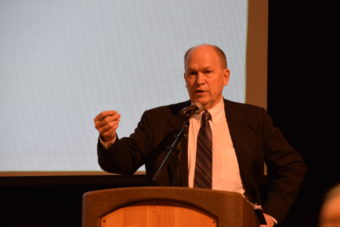
Gov. Bill Walker speaks at the 2015 Innovation Summit, sponsored by the Juneau Economic Development Council. (Photo by Casey Kelly/KTOO)

Gov. Bill Walker says Alaska’s multibillion dollar budget shortfall is an opportunity for residents to show their ingenuity.

Speaking at the Innovation Summit in Juneau on Thursday, Walker shot back at some naysayers in the Alaska Legislature who said the state won’t be able to balance its budget on beer and carrots. That’s a reference to last week’s State of the State Address, where the governor cited two of his favorite examples of Alaska innovation: Beer from the Alaskan Brewing Co. in Juneau and carrots from farmers in the Mat-Su.

“I want a carrot beer of some sort, so I can sort of prove to the legislature that we can do this on beer and carrots,” Walker joked. “But my example was value added, the example I was using was value added. My goodness, what a value added opportunity we have in this state. We export so many of our jobs when we export our raw materials.”

The annual Innovation Summit is organized by the Juneau Economic Development Council. The conference brings together industry leaders, government officials, researchers and others to network and discuss Southeast Alaska’s economy.

Walker says too many Alaskans have grown complacent.

“Our forefathers in this state, they survived because they were innovative, and we need to do the same,” he said. “We’ve gotten a little bit lax in that regard, because once we got money, we just sort of stopped doing that, and started just getting busy counting our money and finding out who gets the last dollar. And that’s not what it’s all about. That’s not what made Alaska great. That’s not what’s going to take us on to the next level.”

Walker’s 13-minute speech touched on several other themes he struck during his State of the State and State of the Budget speeches. With lower than expected oil prices shrinking state revenue, Walker says Alaskans need to get creative.

“At $50 (per barrel) oil – and I may be a little bit optimistic – we can do things that we couldn’t do at $150 oil,” he said.

The Independent Walker says his administration is trying to do its part by bringing together Alaskans of all political parties to do what’s best for the state.

Site notifications
Update notification options
Subscribe to notifications