Jennifer Canfield, KTOO

Water main break leaves some Douglas residents without water

There’s been a break in the water main in Douglas. City Public Works Director Kirk Duncan says the break happened around 3 o’clock this afternoon. The break means residents between John St. and the Lawson Creek bridge have no water service until the main is fixed. A repair crew is on-site but Duncan says there’s no estimate on how long it will take to repair the line.

“The soil over there can have nasty effects on the pipe so we don’t know whether it’s old age or what’s going on but we’ll get a patch on it and we’ll get the water going as fast as we can,” Duncan says.

He says right now they don’t know what caused the break. Duncan said people should be careful when driving through the area and keeping an eye out for crew members. He said no flooding on the road has been reported, but drivers should still be cautious.

Editor’s note: This story has been updated to correct the location of the break. An earlier version said the affected area was between the Douglas bridge and Lawson Creek bridge. 

Gov. Parnell appoints 3 Southeast residents to state boards

Three people from Southeast were appointed to state boards today, the governor’s office announced.

Gov. Sean Parnell appointed Larry Gaffaney to the Alaska Royalty Oil and Gas Development Advisory Board. The Department of Natural Resources relies on the board’s input regarding royalty agreements with the state. Gaffaney is the president and CEO of Huna Totem Corp. He came to Juneau five years ago from New York City where he was CEO and a managing partner of a private investment firm that focused on real estate investments in Silicon Valley.

Wayne Nicolls was reappointed to the Board of Forestry. The board is tasked with providing a forum for people to resolve forest resources issues. Nicolls is from Juneau and has worked for the U.S. Forest Service. He is also a member of the Alaska Outdoor Council, an organization that advocates for equal access to fishing and hunting resources and has lobbied against both a rural preference for subsistence and the taking of Alaska Native lands into federal trust. Nicolls received his bachelor’s degree in forest management from the University of Minnesota and is a certified forester.

Parnell reappointed Bill Moran Jr. of Ketchikan to the Alaska Permanent Fund Corp. Board of Directors. Moran is the president and director of First Bank of Ketchikan. He has been on the board since 2006 and has been chairman of the board since 2010. According to his bio on the Alaska Permanent Fund Corp.’s website, Moran is involved with the Ketchikan Pioneers Home and the BP Community Advisory Board.

The governor also made appointments to the Alaska Housing Finance Corp. Board of Directors, the Alaska Municipal Bond Bank Authority and the Marine Transportation Advisory Board.

Archives at the Walter Soboleff building to be named after Native rights attorney, lawmaker

The Sealaska Heritage Institute announced today that it will name the archives facility at the Walter Soboleff Center after a Tlingit Native rights figure.

William L. Paul Sr. was the state’s first Alaska Native attorney and first Alaska Native legislator. He was active in fighting against school segregation, and for the citizenship rights of Natives and their right to vote. Paul was also instrumental in getting the federal government to extend rights granted under the Indian Reorganization Act to Alaska Natives. The act is credited with fundamentally changing the government’s relationship with Native Americans and Alaska Natives.

The Walter Soboleff building is expected to be completed by the end of this year.

Downtown Juneau welcomes new businesses

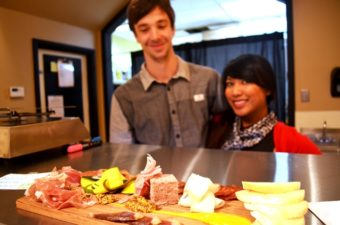
Alex Alf (left) and Aims Villanueva Alf are managers of Panhandle Provisions. (Photo by Jennifer Canfield/KTOO)

A handful of new businesses have opened downtown since this summer and one bar has closed.
Panhandle Provisions is the new gourmet food store and deli from Rookery owner Travis Smith. It opened earlier this summer and is managed by two of Smith’s good friends- Aims Villanueva Alf and her husband Alex. Aims is originally from Juneau and the couple moved back to be closer to family.

Aims Villanueva Alf has been experimenting with candying carrots and lomo. (Photo by Jennifer Canfield/KTOO)
Aims Villanueva Alf has been experimenting with candying sliced carrots and sliced lomo. (Photo by Jennifer Canfield/KTOO)

She specializes in bakery and dessert items, while Alex is in charge of creating the deli’s signature charcuterie. Some of the creations from their kitchen include mortadella, pancetta and duck liver pate. On a recent visit to the store, Alex was starting to make duck speck.

“We’ll pack the duck breast generously with the curing mixture and herbs and spices. The first day we let it go and the second day is called ‘overhauling’- you turn the meat so that it evenly cures,” Alex says. “Then we’ll rinse the cure off, let it dry, then we’ll hang it for two weeks and then we’ll cold smoke.”

Aims has been focused on cannolis. Over the past month she’s offered up cannolis with carmelized cornflakes, banana tamarind cannolis and tiramisu cannolis. She’s also been experimenting with dehydrating and candying thinly sliced meats and vegetables.

“I think the way we approach things and our technique about things, we have our eaters look at it a different way. It’s just a crazy pairing that works,” Aims says.

Mae Wu, pictured with her daughter Audrey, is the owner of Lemon Tree Cafe. (Photo by Jennifer Canfield/KTOO)

In the old B’s Bakery and Bistro on 2nd Street, Mae Wu has opened Lemon Tree Café. Wu first came to Juneau to visit her aunt, who owns Little Hong Kong. While visiting, she decided that she liked the city and decided to stay when she met her husband here.

The menu includes items such as steam buns, noodle soups and moon cakes.

“I’m doing a combination of Chinese and Vietnamese because I was born in Vietnam and grew up in China. I lived right on the border of Vietnam and China,” Wu says.

Another local business, Kindred Post, also opened earlier this summer. Writer and artist Christy NaMee Eriksen took over the space where Miners Post was for six years. The store’s walls have a fresh coat of white paint and Eriksen has filled the shelves with a curated selection of handmade jewelry, art prints and notecards. She says the store is mostly made up of modern items made with traditional materials by independent artists.

Christy NaMee Eriksen is the owner of Kindred Post. (Photo by Jennifer Canfield/KTOO)

“So you have things like Ricky Tagaban’s Chilkat weavings. Using a thousands-year-old  weaving method but making them into iPhone cases. Leatherworks, seal skin jewelry and clean modern design,” Eriksen says.

Eriksen says she hopes to make the store a community gathering place where people can make art and have conversations.

One business in downtown recently closed. The Arctic Bar on Franklin Street closed Monday. The owner was unreachable by the time this story was written. However, we do know that the building is not for sale but the liquor license is.

*Editor’s Note: An earlier version of this story said Mae Wu moved to Juneau after visiting her parents, who own Little Hong Kong. In fact, her aunt owns Little Hong Kong.

Parnell, Walker meet at Juneau Chamber of Commerce debate

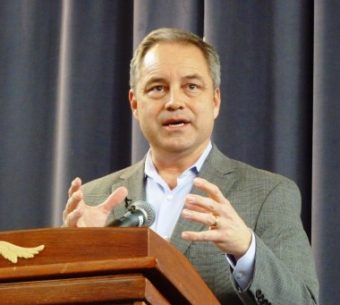
Gov. Sean Parnell and candidate Bill Walker both attended a debate Monday afternoon hosted by the Juneau Chamber of Commerce. Libertarian candidate Carolyn Clift was unable to attend.
Additional funding for continued improvements to the Alaska Marine Highway System is a concern for the chamber.  Walker said he knows how important ferries are to Southeast, but that like all other things funding for improvements would also be on the table when the time comes to tighten the budget. He also said funding Juneau Access, the road out of Juneau, would also have to be considered among numerous infrastructure projects across the state.

Bill Walker (right) addresses a press conference about his decision to join Byron Mallott (left) on a Unity Ticket. (Photo by Anne Hillman/KSKA)
Bill Walker (right) addresses a Sept. 2, 2014 press conference about his decision to join Byron Mallott (left) on a Unity Ticket. (File photo by Anne Hillman/KSKA)

“It’s a great goal,” Walker said. “I look at our fiscal situation, I look at the long-term forecast of deficit spending for the next 10 years, we have to put all of these on the table and find out what can we do? I don’t know that we can do them all.”

Parnell said he supports continued funding for the road and improvements to the ferry system.

The chamber asked the candidates how they would help streamline development projects. Walker said local input is the best way to streamline development and that the Coastal Zone Management program was a way to help with that.

“If we continue to push local input away we’re going to see more and more challenges brought (in the) form of litigation,” Walker said. “There’s no quicker way to slow a project down than to push away local input and that just invites litigation.”

Parnell said that there still are plenty of ways for local governments to comment on proposed development.

“I agree that local input is significant and important and we should not be diminishing it in quality,” Parnell said. “When he mentioned the coastal zone management program that did go away after a legislative resolution and an executive branch resolution was not able to be reached. But local governments and local communities still have a myriad of ways to have local input on permitting issues and disputes.”

When asked about how the lieutenant governor’s office will influence policy decisions, Parnell said he knows that the office  can be a solitary place and that it also can be part of an “inclusive decision making process.”

Gov. Sean Parnell talks about Southeast issues during the Southeast Conference's Mid-Session Summit Jan. 12, 2014. He wants the gas line's benefits to be shared with coastal communities. (Ed Schoenfeld/CoastAlaska News
Gov. Sean Parnell talks about Southeast issues during the Southeast Conference’s Mid-Session Summit Jan. 12, 2014.  (Ed Schoenfeld/CoastAlaska News)

“When it comes down to it, the real question is, ‘Whose agenda controls?’ And it comes down to the constitution,” Parnell said. “The governor has the authority of the people to exercise the powers of the office. You cannot have co-governors in this office. It cannot work that way.”

Parnell also questioned the fairness of the Walker/Mallott ticket. He said those who wrote the constitution intended for a system where voters picked candidates from one party and the other.

“I don’t think they ever planned for what just happened with the disenfranchisement of voters who voted in the other primary,” Parnell said.

The chamber asked the candidates if they supported loser-pay legislation to prevent “frivolous lawsuits” when it comes to environmental permitting for major projects. Walker said the he thinks the current law is sufficient.

“That’s the process we have now. In fact we had the opportunity today to go after attorney’s fees on the litigation filed by the Republican Party against us and we said no,” Walker said. “(Just) because you have the right to do something doesn’t mean it’s the right thing to do.”

Parnell said lawsuits aimed at preventing the permitting of a project should be subject to loser-pay provisions. Currently a litigant who initiates and then loses a “public interest” lawsuit is not required to pay the defendant’s attorney fees. Parnell said that should change.

“We have room to improve there,” Parnell said. “There ought to be some kind of cost to filing frivolous lawsuits and it’s worth examining.”

Juneau Chamber CEO Cathie Roemmich said that the questions for the debate were developed by the organization’s government relations committee and were provided to the candidates ahead of time. Roemmich said it was the first year that the chamber provided the questions in advance and did so to make the debate go more smoothly than it has in previous years.

Media outlets criticize Forest Service for film and photography regulations

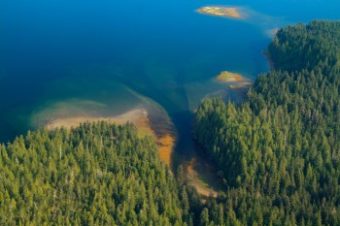
Aerial view of Tongass National Forest
Aerial view of Tongass National Forest (Photo by Alan Wu/Flickr Creative Commons)

As conservationists celebrate 50 years since the passage of the Wilderness Act, a U.S. Forest Service proposal to make certain wilderness area regulations permanent has brought forth accusations that the agency is infringing on First Amendment rights. Nearly a third of the 17 million-acre Tongass National Forest in Southeast Alaska is designated wilderness.

The Forest Service has extended the public comment period on the regulations and chief Tom Tidwell issued a statement saying the regulations do not apply to news gathering activities. Two public media organizations in the Lower 48 disagree and are attempting to organize national opposition.

Forest Service officials say the regulations are based on the Wilderness Act of 1964. Regulations requiring commercial photographers and filmmakers to apply and pay for special use permits have been in effect for four years. Because the regulations expire next month, the Forest Service is proposing making them permanent.

Breaking news situations are exempt from the permitting requirement, however they have to meet the Forest Service’s definition of breaking news. That aside, permits are required and might come with a cost. The Forest Service’s acting wilderness director Liz Close, clarified the regulations to The Oregonian, saying that reporting in support of “wilderness characteristics” would be permitted. The qualification of such reporting is left up to forest supervisors.

And that is particularly troublesome for news people: A government entity determining which stories are worthwhile and don’t require a paid permit, or charging for access on stories that don’t support their mission.

That became the issue for Idaho Public Television a few years ago, shortly after the regulations were implemented. General Manager Ron Pisaneschi says for years their filmmakers were allowed to go into wilderness areas without permits or pre-approval. Filmmakers showed up to document conservation workers in 2010, and were told they needed a permit. They applied and were then told they would have to pay for the permit.

The decision was eventually reversed, but Pisaneschi says it forced the cancellation of the production. In that case, Pisaneschi says the Forest Service official determined it was a commercial use because the filmmakers were not volunteering their time.

“We are licensed as a non-commercial television station by the FCC, the IRS says we are a non-profit entity,” Pisaneschi says. “To make matters even more non-commercial in nature, we are a state agency, we are a state entity, but none of those seem to be sufficient as the guidelines are written currently.”

Pisaneschi says the regulations define news too narrowly, define commercial use too broadly and are open to interpretation.

“It may be fine if the forest is on fire at that given moment, that seems to be an acceptable thing to film,” Pisaneschi says. “But if you’re going to do a long-form documentary about the impact of drought on forest health, that’s not considered breaking news and you would need to get a permit for that.”

Forest Service officials in Alaska did not respond to requests for comment, so it’s unknown how many applications for permits in the state have been submitted and if any have been denied.

Idaho Public Television and Oregon Public Broadcasting have been fighting the regulations for some time now. OPB President and CEO Steve Bass sent out an email Wednesday to public television general managers across the nation – including KTOO’s General Manager Bill Legere – asking them to join the effort.

Bass wrote that the rules are a barrier for public media and create a system where print journalists have unrestricted access to Forest Service wilderness lands, but multimedia journalists must be permitted.

Conservationist and commercial wildlife photographer Adam Andis says the regulations seem less strict than he would have interpreted from the Wilderness Act.

“As a professional photographer I would rather see a stricter limitation that makes it harder for me to take pictures in those areas than to see those wilderness areas lost,” he says.

Andis is on the boards of the National Wilderness Stewardship Alliance and the Alaska Wilderness Recreation and Tourism Association. He says he’s never been required to get a permit for his commercial photography. He said that he’s filmed a documentary in a wilderness area; a Forest Service official agreed to waive the permit fee because it promoted “wilderness character.”

“It’s not necessarily that they’re trying to make value calls on who gets the right to be there and who doesn’t,” Andis says. “Their job is to make sure that there isn’t this mass of people all using this resource in an unsustainable way, so they have to figure out some way to put limits on it.”

Ultimately, there are a few key things that Andis, the conservationist, and Pisaneschi, the public television manager, agree on. Both think that the Forest Service should be more nuanced in their approach to permitting–two people with a camera and backpack will have far less impact on a wilderness area than a full Hollywood crew. Both also agree that allowing the untamed wilderness to be documented and shared promotes the goals of the Wilderness Act.

The biggest difference between the two is that Andis wants the wilderness protected at any cost, even if it means restricting press access, and Pisaneschi sees documenting the wilderness as one of the best ways to protect it.


Site notifications
Update notification options
Subscribe to notifications