Jennifer Canfield, KTOO

State correspondence details a ‘deteriorated’ Nat’l Guard

Gov. Sean Parnell holds a closed-door session with Alaska National Guard members Oct. 19 at Joint Base Elmendorf-Richardson in Anchorage. Colonels, generals and reporters were not allowed into the meeting. (Photo courtesy of Sharon Leighow/Office of the Governor)

The State of Alaska has released letters, emails, and other documents related to the Alaska National Guard scandal (175 MB). A “privilege log” listing why some details in the documents were redacted was also released.

Alaska National Guard emails – 175 MB pdf

Privilege Log – 58 KB pdf 

Copies of all notes, correspondence, memos and emails related to sexual assault in the Alaska National Guard were requested in May by Alaska Public Media. It took until Sept. 26 for Gov. Sean Parnell’s policy director, Randy Ruaro, to deny the request. Records requests are supposed to be fulfilled within 10 days. The state can take an additional 10 days to respond to large or complicated requests.

Alaska Public Media and Alaska Dispatch News sued the state Oct. 8. Two weeks after filing the lawsuit it appeared that the state was willing to release the documents without litigation. A week later the state had only released few of requested documents.

The media organizations advanced their lawsuit Wednesday to force the release of the documents before the Nov. 4 election. Alaska Superior Court judge Gregory Miller ruled on Thursday that the state was to comply with the records requests by Friday at noon. Reporters received a 596-page document around 1 p.m. today.

An initial review of the packet shows a mix of emails, letters, and memoranda. Some are released in full, some are partially redacted, and others are blacked out entirely.

There are numerous redactions in the released documents, and some of the requested documents are not included; many are still under review and are subject to release in the coming days.

The documents cover a period from August 2009, when then-Brigadier General Thomas Katkus expressed interest in leading the Guard, to September 2014, the month a team of federal investigators from the National Guard Bureau’s Office of Complex of Investigation released its damning report. The report documented favoritism, fraud, sexual assault, and violations of victim confidentiality.

A handful of National Guard leaders, including Katkus, and a deputy commissioner for the Department of Military and Veterans Affairs have since been asked to resign their positions.

While key details are missing, the documents do provide some sense of how the Parnell administration handled complaints about National Guard leadership.

“The Command Climate Has Deteriorated”

A number of problems within the National Guard predate the Parnell administration, with an inquiry from 1995 even finding distrust of the chain of command. Concerns escalated shortly after Katkus’ appointment to the adjutant general position in 2009.

Beginning in 2010, a group of four National Guard chaplains – Matthew Friese, Ted McGovern, Rick Koch, and Rick Cavens – approached the Parnell administration with complaints about leadership.

On January 6, 2011, Cavens submitted a letter to the governor describing an “intense pall of despair” within the Alaska Air National Guard as a result of “upper levels of leadership … cut[ting] hope and spirit by manipulation and passive aggressive behavior.” The letter describes the Clear Air Force Station as a location to “store officers of sexual infidelity,” and that the colonel responsible, Donald Wenke, would look the other way when one guardsmen in uniform would “get drunk and make advances on enlisted women.”

A letter dated January 25, from Bob Doehl, a lieutenant colonel who now serves as an aide to Democratic Sen. Mark Begich, expresses concern that senior leadership is retaliating in response to queries from the governor’s office about the command structure.

guard 1 doehl

A September 24 email from Brig. Gen. Chuck Foster, who commanded 176th wing of the Alaska Air National Guard, alleges he is being pushed out of his job by Katkus and asks the governor to help him keep his membership in the Guard.

“I believe that the command climate has deteriorated even further, and unless the course is altered it will not improve,” Foster wrote. After losing his position to Wenke, Foster was transferred to headquarters, where he lasted only three months.

“It was very clear that Gen. Katkus really didn’t want me at the headquarters, that he really didn’t have a place for me,” Foster said in an interview on Friday. “Nizich seemed attentive to what I had to say. He engaged with me, he listened to me, but basically nothing came of it.”

A December 29 letter from chaplain Friese likens participation in the Guard to “an abusive relationship.”

Throughout 2011, Friese operated as the primary conduit for complaints about Guard leadership to Parnell Chief of Staff Mike Nizich. The packet contains 18 separate emails from Friese to Nizich, and a dozen more are identified in a log provided by the Department of Law. Nizich’s responses to the emails were typically brief but timely, particularly toward the beginning of their communication.

When concerns about confidentiality are first raised on February 14, Nizich stressed that no details had been turned over to Katkus nor would they be. On December 22, chaplain Cavens charged that Nizich provided information to Katkus. Nizich denied the accusation then, and today maintains that trust was never breached. In a follow-up email between Nizich and Friese, the two attempt to repair the line of communication, and one chaplain offers “most sincere apologies.”

After a phone call between Nizich and two of the chaplains on December 29, no further records of communication between the chaplains and Parnell’s office appear in the email log.

“A Problem That Could Bite Us Both”

In 2012, the Parnell administration received several inquiries from Sen. Mark Begich’s office about their response to National Guard problems. On January 25, just one month after discussions with the chaplains broke down, Begich chief of staff David Ramseur sent Nizich an email asking to discuss the matter.

“I need to tell you what we’re picking up as it sounds like a problem that could bite us both,” Ramseur wrote.

In March, Ramseur requested another conversation, and this time attached an anonymous letter from a group labeling itself “Friends of the National Guard” and datelined Joint Base Elmendorf-Richardson.

The letter described Katkus as a “corrupt leader” and also criticizes the governor.

“While it is unfortunate what MG Katkus has done, it is even more regrettable that another senior leader in the State of Alaska has overlooked the misconduct. Governor Sean Parnell and his staff were notified of these issues on multiple occasions by more than a dozen mid- to high ranking officers in the Alaska National Guard. While the governor has listened to the concerns of the leaders in the organization, he has failed to investigate the facts surrounding MG Katkus and the corruption within the Alaska National Guard. For example, the following issues were presented to Governor Parnell or his staff: [redacted]”

guard 2 friendsofakng


In April, Ramseur gave Nizich a heads up that the Departments of the Army and Air Force had been made aware of complaints about the Guard, and that the inspector general was looking into them. “Looks like they will be investigating,” Nizich wrote. “Call me.”

guard 3 callme

Little came of it. The team mentioned that there were anonymous reports of “sexual assault victims not coming forward,” but they did not identify any grievous problems with the Guard.

When investigations into the Guard made headlines in 2013, Katkus responded with a dig about Begich, and suggested the junior senator was grandstanding on the significance of it:

“Begich’s statement … is a bit disingenuous. … Their only area of concern in their findings centered on how we did data entry in their new tracking system, which we quickly corrected.”

An inspector general investigation requested by Republican Sen. Lisa Murkowski in 2013 was also fruitless. When the results came back in the spring of 2014, members of Parnell’s staff welcomed them. Stories about the findings were passed on to the governor and posted on the official website. “Here’s an article from the Anchorage Daily News I thought you might like,” the governor’s spokeswoman Sharon Leighow wrote in an email. “Army investigation: No sexual assault cover-ups in Alaska National Guard.”

guard 4 mightlike

It wasn’t until investigators from the Office of Complex Investigations came in at Parnell’s request in February that wrongdoing was uncovered.

In an emailed statement, Nizich notes that the OCI investigation was not the first requested by the Parnell administration.

“In October 2010, I contacted the FBI requesting an investigation into a series of allegations that included: assault, sexual abuse, misuse of resources, drug trafficking and transporting illegal weapons,” stated Nizich. “[The agent] reported to me that there was nothing to the allegations. Despite the lack of findings in that investigation and 3 other federal investigations, Governor Parnell called for a fifth investigation in February 2014 that finally uncovered the serious problems in the Alaska National Guard.”

Our Lane’s Been Investigated

With investigations coming up dry, emails from administration staff in response to National Guard allegations took on a more skeptical tone.

The office regularly received complaints from Chris Bydalek, a former contractor with the Guard. On February 24, 2014, Bydalek sent an angry email with the subject “Sexual Assault in the Alaska National Guard” that aggressively calls out Katkus and accuses the governor of doing nothing. Nizich forwarded the email to deputy commissioner McHugh Pierre.

“I am about ready to fire off a response to this guy that he won’t like,” Nizich wrote. “Call me before I do. Thanks.”

guard 5 fireoff

That same week, Bydalek sent another message accusing Katkus and Parnell of covering up wrongdoing. In a separate exchange about it, Katkus writes that all “the issues in our lane have been investigated” and Nizich responds by asking if they have a photo of Bydalek on file.

In May, Bydalek sent an email to a half dozen members of the administration that describes a female member of the Guard being threatened and mentions Katkus’ name in the context of retaliation. When Nizich forwarded the email on to a federal investigator, he noted it was the “same type of information we heard before without any specific facts to back up the claim.”

Both Katkus and Pierre were asked by the governor to resign after the OCI report substantiated allegations of fraud, mishandling of sexual assault, and misuse of government property.

By the time this story was published, the Department of Law had released an additional 116 pages of records. It is expected to provide more documents Saturday.

State releases documents related to National Guard scandal

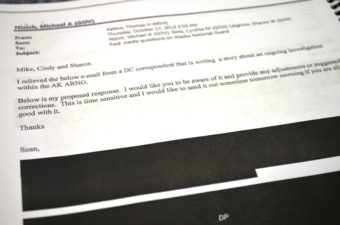
In this email dated Oct. 17, 2013, Maj. Gen. Thomas Katkus seeks input on his response to a reporter's questions. Sean Cockerham, a D.C. based reporter for McClatchy, published a story 10 days later exposing investigations into sexual misconduct in the Alaska National Guard. (Photo by Jennifer Canfield/KTOO)
In this email dated Oct. 17, 2013, Maj. Gen. Thomas Katkus seeks input on his response to a reporter’s questions. Sean Cockerham, a Washington, D.C. based reporter for McClatchy, published a story 10 days later exposing investigations into sexual misconduct in the Alaska National Guard. (Photo by Jennifer Canfield/KTOO)

The State of Alaska has released letters, emails, and other documents related to the Alaska National Guard scandal (175 MB). A “privilege log” listing why some details in the documents were redacted was also released. The state is expected to release more documents over the weekend.

Alaska National Guard emails – 175 MB pdf

Privilege Log – 58 KB pdf 

Copies of all notes, correspondence, memos and emails related to sexual assault in the Alaska National Guard were requested in May by Alaska Public Media. It took until Sept. 26 for Gov. Sean Parnell’s policy director, Randy Ruaro, to deny the request.

Alaska Public Media and Alaska Dispatch News sued the state Oct. 8. Two weeks after filing the lawsuit it appeared that the state was willing to release the documents without litigation. A week later the state had only released few of requested documents.

The media organizations advanced their lawsuit Wednesday to force the release of the documents before the Nov. 4 election. Alaska Superior Court judge Gregory Miller ruled on Thursday that the state was to comply with the records requests by Friday at noon. Reporters received an 596-page document around 1 p.m. today.

This is not the first time reporters have had difficulty requesting documents from the Parnell administration. Last year reporters requested copies of an $80,000 study commissioned by the state to look at the effects of Medicaid expansion under the Affordable Care Act. The Parnell administration maintained that the report was not a public record because it was protected under the “deliberative process privilege.” Seven months later Parnell released the report after he’d made the decision that Alaska would not expand its Medicaid program.

Alaska Public Radio Network’s Alexandra Gutierrez and Lori Townsend discussed the documents Friday on Alaska News Nightly.

Townsend: First off, how complete are the documents. Are they mostly redacted or is there actual information in them?

Gutierrez: While there are some documents that are entirely blacked out, there’s also plenty in there that isn’t. I’m on about page 400 of 596, so I haven’t seen it all, but there is information in here that hasn’t been available previously. You can see about a dozen separate people from the Guard contacted the governor’s office with specific complaints about leadership in 2011 alone. While the administration has listed victim’s privacy as a reason for not sharing e-mails, it’s clear the bulk of the correspondence with whistleblowers had to do with what was going on at the top.

We also see that the governor’s Chief of Staff, Mike Nizich, is responsive, especially four years ago when complaints started coming in. However, with later complaints, specifically from one person viewed as a disgruntled employee, he – and then Adjutant General Thomas Katkus – who is included on some of these e-mails becomes impatient.

What are some of the documents that stand out to you so far?

Oh, there’s a lot. But for one, there’s an anonymous letter from the “Friends of the Alaska National Guard” from 2012 that is described as an “open letter to the Alaska State Legislature.” It calls out the guard leadership, and specifically names Katkus, who was asked to resign two months ago because of problems in the Guard. It also expresses disappointment with the governor and his staff.

“While it is unfortunate what MG Katkus has done, it is even more regrettable that another senior leader in the State of Alaska has overlooked the misconduct. Governor Sean Parnell and his staff were notified of these issues on multiple occasions by more than a dozen mid-to high ranking officers in the Alaska National Guard. While the governor has listened to the concerns of the leaders in the organization, he has failed to investigate the facts surrounding MG Katkus and the corruption within the Alaska National Guard.”

And again, this was from 2012, two years before the governor called for an investigation.

Is there much communication from the governor?

Very little. When the problems with the guard started getting more news coverage earlier year, there was a staff e-mail he sent that expressed disappointment and indignation that people would suggest that he didn’t do enough and that the integrity of the guard is important to him. But there’s one e-mail from June 8, 2014, that was hard, at least for me, to read:

“If you haven’t already, pls have Gen Katkus give direction that McCugh should have absolutely nothing to do with cases where Guard members are under investigation or subject to review–especially as they relate to two people he is personally connected to. No viewing of files, no conversations, etc.”

B1UUtsVCQAAMyQm

The reason this e-mail was difficult for me was because it’s referring to Deputy Commissioner McHugh Pierre, who was asked to resign a full three months later. While the governor never explained the reason for the dismissal, there were reports that it was because Pierre interfered on behalf of a friend’s disciplinary proceeding. There’s no mention of discipline from the Governor for Pierre, or suspension. It just says stop doing that. So if those allegations are ture, that means Pierre was able to stay in the second most powerful position at the Department of Military and Veterans Affairs until federal investigators concluded that the Guard had problems with favoritism and cronyism like that alleged case.

Editor’s note: This story was updated at 7:04 p.m. and 7:27 p.m.

DOJ may intervene in Alaska Supreme Court case

The U.S. Department of Justice may intervene in an Alaska Supreme Court case concerning a non-Native couple’s adoption of an Alaska Native child. In September, the Native Village of Tununak lost its appeal against the State of Alaska and the adoptive couple.
DOJ is trying to determine, does the U.S. Supreme Court’s decision in the Baby Veronica case apply to the Tununak case? Baby Veronica was about a private adoption. The Tununak case is concerned with a state-sanctioned adoption.

Matt Newman is an attorney for the Native American Rights Fund, which has been involved in the Tununak case as a friend of the court.

“I think what is definitely of note and definitely what was a bit surprising is the Tununak decision is now on the radar of the Department of Justice,” Newman says. “Through this extension they’re certainly not committing to anything. They’re not saying ‘we have a brief to file.’ But they’re at least showing that there’s an interest in the case at levels higher than just the bar here in Alaska.”

The fate of a 6-year-old the court calls “Dawn” is at stake in the case. Dawn was placed into foster care as an infant in Anchorage near her mother in the hope that they could be reunited.

That was a deviation from the Indian Child Welfare Act, which mandates a preference for Native family placement. But the tribe and the child’s grandmother Elise agreed–initially. After a year Dawn was placed with a new non-Native family, the Smiths, who are now trying to finalize their adoption of her.

Three years after Dawn first entered the State of Alaska’s custody, her mother’s parental rights were terminated. After the termination the tribe argued that keeping Dawn in Anchorage was no longer warranted and they stepped up their efforts to have Dawn placed with her grandmother in Tununak. According to the September decision, Elise had requested custody of Dawn since the beginning and had made efforts to bring her home into compliance for placement.

During the last appeal the state court had initially granted the tribe a stay of the adoption. Four days later the U.S. Supreme Court issued its opinion in Adoptive Couple vs. Baby Girl, otherwise known as the Baby Veronica case. In light of this, the state court requested supplemental arguments from the parties.  Because the grandmother did not formally file for adoption, the court reasoned that the Baby Veronica decision meant that there was no ICWA placement preference to apply.

A window to appeal the decision to federal court closed Friday, the same day that the DOJ requested its own extension. The DOJ wrote that the “United States has a strong interest in the interpretation of the Indian Child Welfare Act,” and that the department was not aware of the case until after the September decision.

The DOJ has until November 24 to decide if it will intervene in the case. The Village of Tununak’s tribe is represented by Alaska Legal Services Corp.

AFN endorses Begich after hearing from Senate candidates

Candidate for U.S. Senate Dan Sullivan and incumbent Mark Begich met on-stage at the Alaska Federation of Natives Convention in Anchorage Friday. AFN delegates voted Saturday to endorse Begich for re-election. An endorsement of Bill Walker for governor and Byron Mallot for lieutenant governor was also announced.

From the start, delegates were overwhelmingly in support of Begich. Many waved Begich campaign signs from the audience and clapped and cheered every time the senator answered a question. For Sullivan, things got off to a rocky start during the lightning round, which required yes or no answers.

“Do you support the development of the Pebble Mine project?”

Begich said no. Sullivan responded, “I support the process for all economic development.” Before he could finish the sentence a moderator repeated that the answer has to be yes or no and the audience booed him.

Sullivan criticized Begich for being a Democrat because in 2010 the Alaska Democratic Party sued to ban a list of write-in candidates from voting booths. Sen. Lisa Murkowski was a write-in that year, and there were concerns that Alaska Natives whose first language is not English would have a difficult time without the list.

In the end, the Alaska Supreme Court allowed the list. Dan Sullivan was the state attorney general at the time defending it on behalf of the Division of Elections. What he–and Begich–didn’t mention was that the Alaska Republican Party joined forces with Democrats on that issue. Still, Begich tried to distance himself from the leadership of the Democratic Party.

“There’s a process that they elect a chairman, I’m not the chair never have been, just to make that very clear to you Dan,” Begich said.

“I understand what that case was about. The question was very simple: When the list of the write-in candidates were put forward is that electioneering close to the ballot box? That’s what that was. I wasn’t party to that lawsuit, so let me make sure that’s clear.”

Both candidates agreed that Alaska’s subsistence management system was “broken.” Their solutions, however, differed. Begich supports more federal involvement.

“I get requests now from many different parts of the community of Alaska asking for more federal control in the sense of managing the subsistence rights because they believe the state is not listening,” Begich said. “An example of that was when the commercial fishing was closed and subsistence was closed and when they reopened, commercial got the opening first and subsistence did not. I wrote a strong letter to the governor about this, that subsistence rights are a fundamental right.”

Sullivan told the audience that he understands the importance of subsistence. He talked about spending summers at fish camp with his wife, Julie Fate Sullivan, who is the daughter of Mary Jane Fate, a once prominent figure in the Alaska Federation of Natives. He thinks that more state involvement is key to fixing subsistence, not less. At the end of his answer, he defended himself to delegates for his role in representing the State of Alaska in the Katie John case, a case that AFN was involved in for 19 years. AFN saw the state’s appeals of the case as an attack on subsistence rights.

“When I was attorney general I did participate in an element of the Katie John case,” Sullivan said.

“This has been a case going on for decades. It was no personal lawsuit against Katie John; I have the deepest respect for her like I do my mother-in-law. That case was about, when I was involved, the extent of state control over our rivers and as Alaska’s attorney general, I advocated for more state control, not control from the federal government and that’s the way most state officials have done that.”

After the forum, volunteers with signs reading “Follow me to Vote” appeared. The volunteers led people across the street to city hall, where ballots for all precincts across the state were available for early voting.

On Saturday, the final day of the convention, delegates voted in a new co-chair. Tara Sweeney, who was appointed to the position last year, lost to Jerry Isaac, a former president of the Tanana Chiefs Conference in Fairbanks.

Sweeney is a senior vice president for the Arctic Slope Regional Corporation and also the co-chair of the Sullivan for Senate campaign. Some delegates said that they didn’t think an AFN co-chair should be allowed to campaign for any candidate. AFN co-chair Ana Hoffman has been actively involved in the Begich campaign. Hoffman is the president and CEO of Bethel Native Corp. Her term as co-chair will be up next year.

Sealaska Corp. put in all their votes for Sweeney. All the other Southeast groups gave their votes to Isaac. The Southeast region has one of the largest percentages of votes in AFN; most of those votes are held by Sealaska.

Delegates met in an executive session Saturday afternoon to debate two candidate endorsement resolutions. The Walker/Mallott campaign endorsement took less than 30 minutes to be approved.

It took another hour before delegates decided to endorse Begich. Some groups reportedly refused to vote for or against the resolution endorsing Begich, saying that they didn’t want to get involved in the back-and-forth that has been a part of this year’s convention. AFN doesn’t always endorse candidates during an election and the conversations surrounding this year’s senate endorsement have at times been tense.

Once forbidden, Alaska’s Native languages now official state languages

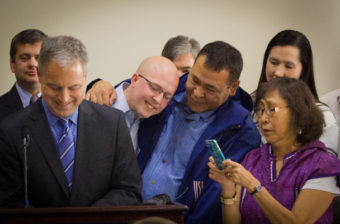
Gov. Sean Parnell signs HB 216 at the 2014 Alaska Federation of Natives Convention. The bill makes Alaska's Native languages official state languages. Looking on as the governor signs is Tlingit language teacher Lance Twitchell, Rep. Bennie Nageak, Rep. Charisse Millett, Lt. Gov. Mead Treadwell, First Alaskans Institute President Liz Medicine Crow, Sen. Lesil McGuire, Rep. Chris Tuck, Rep. Jonathan Kreiss-Tomkins, Rep. Doug Isaacson, Rep. Les Gara and others.
Gov. Sean Parnell signs HB 216 at the 2014 Alaska Federation of Natives Convention. The bill makes Alaska’s Native languages official state languages. Looking on as the governor signs is Tlingit language teacher Lance Twitchell, Rep. Bennie Nageak, Rep. Charisse Millett, Lt. Gov. Mead Treadwell, First Alaskans Institute President Liz Medicine Crow, Sen. Lesil McGuire, Rep. Chris Tuck, Rep. Jonathan Kreiss-Tomkins, Rep. Doug Isaacson, Rep. Les Gara and others. (Photo by Jennifer Canfield/KTOO)

When American missionaries began arriving in Alaska in the 1880s, it was the beginning of a very dark era for Alaska Natives around the state. As Bureau of Indian Affairs and state-sponsored schools were established, things became even worse for Alaska Native languages and cultural practices. Today, elders’ stories about being beaten for speaking their Native language or for practicing traditional dances or rituals are common.
So, fast forward to Thursday when dozens of elder Native language speakers found themselves in a packed room at the Dena’ina Center in Anchorage. Lawmakers and others clapped and cried as speakers young and old declared in their native tongue that their language was now an official language of the State of Alaska.

Kaséix̱ Selina Everson, originally from Angoon, was given the honor to speak first after Gov. Sean Parnell signed the bill.

Tlingit elder Kaséix̱ Selina Everson speaks after Gov. Sean Parnell signed a bill making Alaska's Native languages official languages of the state of Alaska. Former Tlingit Haida Central Council President Ed Thomas and Lance Twitchell look on in the foreground. (Photo by Jennifer Canfield/KTOO)
Tlingit elder Kaséix̱ Selina Everson speaks after Gov. Sean Parnell signed a bill making Alaska’s Native languages official languages of the state of Alaska. Former Tlingit Haida Central Council President Ed Thomas and Lance Twitchell look on in the foreground. (Photo by Jennifer Canfield/KTOO)

“Gunalchéesh, governor, to all the people who are here for our beautiful languages to be recognized after all these years we were forbidden to speak it, and every time we’d remember how we were forbidden,” Everson said. “An elderly gentleman from Angoon, he was 87, every time he spoke about us being forbidden to speak our own language on our own land, he cried like a baby.”

Everson thanked the bill’s prime sponsors Reps. Jonathan Kreiss-Tomkins, Ben Nageak and Charisse Millett.

“For every Native person standing here, in my language I will say gunalchéesh to all of you, all the learners, to the children, gunalchéesh. You’ve made this day an honorable day to honor all the people of Alaska,” Everson said.

Tlingit language teacher Xh’unei Lance Twitchell was also at the bill signing. Twitchell worked with a group of other language learners from around the state to advocate for the bill’s passage, even staging a sit-in protest at the capitol building in the final days of the past legislative session.

After 15 hours of sitting in the capitol hallways and observing lawmakers on the Senate floor go in circles trying to reach consensus on other bills, the protestors were finally rewarded. The legislature passed the Alaska Native languages bill around 2 a.m. on Easter morning.

Xh'unei Lance Twitchell addresses the crowd that had gathered for the signing of HB 216, a bill making Alaska's Native languages official state languages. (Photo by Jennifer Canfield/KTOO)
Xh’unei Lance Twitchell addresses the crowd that had gathered for the signing of HB 216, a bill making Alaska’s Native languages official state languages. (Photo by Jennifer Canfield/KTOO)

Twitchell says not all of the lawmakers were supportive of the bill in the beginning.

“I had a chance to tell them, ‘People are going to remember you for this. Regardless of what side they are on, people are going to remember,'” Twitchell said. “There was a real fear that someday languages were going to be mandated and I don’t see that as a fear. I think a logical step for Alaska is that if you graduate from high school in Bethel you know some Iñupiaq. If you graduate from high school in Juneau you know some Tlingit.”

For the rest of the day at the convention, there was plenty of talk on-stage and amongst delegates about the “historic moment” that they’d all shared.

AFN president publicly criticizes Parnell for appealing subsistence rights case

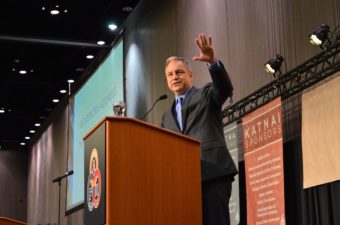
Gov. Sean Parnell gave opening remarks to delegates at the Alaska Federation of Natives Convention Thursday. (Photo by Jennifer Canfield/KTOO)

The head of Alaska’s largest Native organization publicly criticized Gov. Sean Parnell Thursday morning, the opening day of the Alaska Federation of Natives Convention in Anchorage.

Immediately after Parnell’s opening remarks, AFN President Julie Kitka called him out during her report to the convention.

“We began this year under attack. Gov. Sean Parnell and his administration decided to appeal the State of Alaska v. Sally Jewell, or the Katie John case, to the U.S. Supreme Court.” Kitka said. “The governor and his legal team were trying to overturn Native victories at the lower courts and shift the balance between the federal and state government over management of subsistence on federal and public lands.”

The case was an attempt by the state to assert management rights over navigable waters on state and adjacent federal land. At the heart of the issue was the difference between the state’s constitution and federal law. Alaska’s constitution mandates equal access to fish and game for all residents. Federal law gives subsistence hunting and fishing priority to rural Alaskans.

Parnell was not in the room at the time; he left the main room at the Dena’ina Center  to sign a bill in another room making Alaska’s Native languages official languages of the state.

The week after last year’s AFN convention where Parnell also gave opening remarks, the administration announced the state would appeal the Katie John case. AFN made a large effort during that convention to raise funds for their “subsistence war chest.”

Leaders in the organization vowed to fight the state over the matter. The U.S. Supreme Court rejected the state’s petition to appeal the case in March.

“Nineteen years of litigation. Nineteen years you’ve heard year after year at the convention about this. This is a victory that we have earned through a conscious and powerful defense as our rights as a people and we should all be proud,” Kitka said. “On a side note, I have a question for you. If political candidates are asking for your votes, does it matter what their position on subsistence is? If they continually sue Native people in court over our inherent and God-given rights, will we vote for them? (People in the audience said ‘no.’)  Just wanna know.”

The focus of Parnell’s remarks at last year’s convention was digital learning. This year he talked about the state’s efforts to work with tribal courts.

“We listened to what Alaskans said about the need for culturally accepted remedies,” Parnell said. “We said, ‘We must protect the constitutional rights of all.’ And you said, ‘There must be a way to increase tribal involvement.’ And we said, ‘We will find that way together.’ We will work with you and we will continue to do so for as long as it takes because justice is a journey and healing is the prize.”

The State of Alaska intervened in a case earlier this year, challenging a tribal court’s authority to extinguish the parental rights of a person who is not a member of their tribe. In the Simmonds v. Parks case, the Minto tribal court terminated the parental rights of Bessie Stearman, a Minto tribal member, and Edward Parks, a member of the Stevens Village Tribe. Just months before the termination, Parks had beaten Stearman badly enough that she suffered three broken ribs and a collapsed lung. The state asserted that it was trying to protect the Parks’ constitutional rights.

Site notifications
Update notification options
Subscribe to notifications