Jennifer Canfield, KTOO

With Erin’s Law signed, bill sponsors see more work to be done

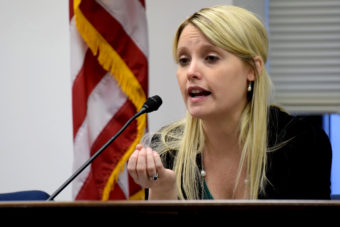
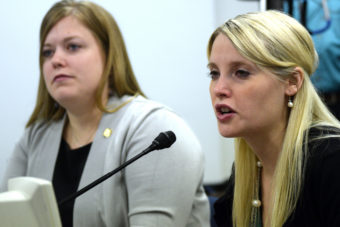
Erin Merryn, a victim of sexual abuse as a child, testified in the House Education Committee on House Bill 233, also known as Erin's Law. Rep. Geran Tarr is the  bill sponsor. (Photo by Skip Gray/Gavel Alaska)
Erin Merryn, a victim of sexual abuse as a child, testified in the House Education Committee on House Bill 233, the version of Erin’s law first introduced by Rep. Geran Tarr in 2014. (Photo by Skip Gray/Gavel Alaska)

Gov. Bill Walker signed the Alaska Safe Children’s Act Thursday in Anchorage. The bill, also known as Erin’s Law, was controversial for some and stalled by a legislature that was at odds regarding the state’s fiscal situation. While the fight over Erin’s Law may be done, two lawmakers who worked on the bill say there is still more to be accomplished.

The Alaska Safe Children’s Act requires school districts to provide age-appropriate child sexual assault, teen dating and youth suicide prevention curricula to all students. It includes a provision adopted from Bree’s Law that mandates teen dating violence education in middle schools and high schools. The bill’s primary sponsor, Rep. Charisse Millett (R-Anchorage) says the act is a catalyst and not the end solution. She says she thinks the legislature is ready to continue addressing Alaska’s high rates of child sexual abuse.

“Now that we’ve elevated the conversation I think most legislators that I’ve spoken with are looking for that next step, and I think the next step is finding a funding source and putting a good, solid program in place that’s good for urban and good for rural Alaska. It’s paramount that we address the core issue,” Millett says.

Rep. Charisse Millett (left), Gov. Bill Walker (center) and Rep. Geran Tarr attend an Alaska Flag Day celebration Thursday where Walker signed the Alaska Safe Children's Act. (Photo courtesy of Geran Tarr)
Rep. Charisse Millett (left), Gov. Bill Walker (center) and Rep. Geran Tarr attend an Alaska Flag Day celebration Thursday where Walker signed the Alaska Safe Children’s Act. (Photo courtesy of Geran Tarr)

Millett says she’s working on a few ideas for legislation that would create a more comprehensive support system for children and teens who are victims of violence. As with Erin’s Law, the issue of funding will be front and center.

A bill recently introduced in Congress would fund the implementation of child sexual abuse and teen dating safety curriculum in states where Erin’s Law or a similar piece of legislation has been adopted. The funding would go a long way to help the State of Alaska, which is currently grappling with an operating budget that’s outgrown available revenue.

During the legislative session, some lawmakers spoke against Erin’s Law, calling it an unfunded mandate and a burden to schools that are trying to operate with limited funding. But Rep. Geran Tarr (D-Anchorage) says people are starting to realize that prevention is the most fiscally prudent solution to Alaska’s problems with violence. Tarr originally introduced Erin’s Law in 2014, and was a co-sponsor of Millett’s bill.

“What everyone is recognizing — and if they haven’t I hope they will soon — these are really the low-cost alternatives,” Tarr says. “When you talk about something like an unfunded mandate I think Jeff Jessee from the Mental Health Trust said it very well this session where he said, ‘The real unfunded mandate is all the problems that come later.’”

The list of problems children face after experiencing violence or sexual abuse at home is extensive. Countless studies have shown that children who are harmed at home are more likely to have emotional and social problems, struggle academically and be involved in the juvenile justice system.

As adults, they are more likely to be re-victimized or become perpetrators themselves. Substance abuse and mental health problems can also worsen without intervention.

Alaska has some of the nation’s highest rates for domestic violence, rape and child abuse and neglect. The Alaska Safe Children’s Act is one of the state’s most substantial pieces of legislation aimed at addressing some of those problems, and Millett says it passed largely because of Rep. Tarr and Gov. Bill Walker, who advocated passage of the bill in his first address to the legislature.

“Credit goes to Geran for starting this battle last year and Gov. Walker for really putting the force behind the legislation. It was an incredible process,” Millett says. “It was obviously frustrating, but in the end it passed and we’re moving forward.”

The Alaska Safe Children’s Act created a task force which is responsible for the law’s implementation. Schools have until 2017 to comply with the law; that’s the deadline for the task force to develop the program’s curricula.


Federal bill introduced to fund Erin’s Law

Erin Merryn, a victim of sexual abuse as a child, spent two days in Juneau speaking to lawmakers. She is campaigning across the country for Erin’s Law -- House Bill 233 in Alaska -- which would require schools to implement sexual abuse education. (Photo by Skip Gray/KTOO)
Erin Merryn, a victim of sexual abuse as a child, campaigns across the country advocating for a law that would require schools to implement sexual abuse prevention education. (Photo by Skip Gray/KTOO)

Three U.S. senators have introduced a bill that would fund the implementation of Erin’s Law in states where it’s been adopted.

The bill would amend the Child Sexual Abuse Awareness and Prevention Act of 1965 and define standards sexual abuse awareness and prevention programs must meet to qualify for funding.

The bill requires the program’s curriculum “be based upon an assessment of objective data” in order to improve student safety and health, and to strengthen parent and community engagement. The program must also consider input from teachers, principals, school leaders and parents.

Programs funded by the grant would be required to undergo a periodic third-party evaluation to assess the effectiveness of the program. Schools would be required to use the results of the evaluation to improve their program.
The final clause in the bill prohibits the federal government from mandating, directing or controlling the programs developed by local schools.

The Alaska Legislature passed a version of Erin’s Law — the Alaska Safe Children’s Act — last month during a special session. The bill was first introduced during the 2014 session by Rep. Geran Tarr of Anchorage. The bill died in committee, but was reintroduced in 2015 by Republicans and Democrats from the House and Senate.

After a thorough reworking and much controversy, the legislature passed the bill introduced by Rep. Charisse Millett, a Republican from Anchorage, during a special session in June.

U.S. Senate Bill 1665 was released just as Congress was breaking for the Fourth of July. Spokespersons for Alaska Sen. Lisa Murkowski, Sen. Dan Sullivan and Rep. Don Young all said the lawmakers were looking forward to reviewing the bill.

Sens. Kirsten Gillibrand, D-N.Y., Dean Heller, R-Nev., and Dianne Feinstein, D-Calif, are sponsoring the bill.

Media awaits release of National Guard emails

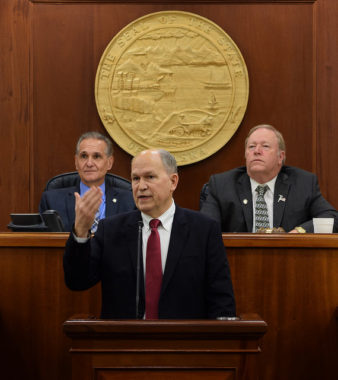
Bill Walker State of State (Photo by Skip Gray/360North)
Gov. Bill Walker promised an investigation into the Alaska National Guard and justice for victims during his State of the State address in January. (Photo by Skip Gray/360North)

The State of Alaska still has not released all documents and emails related to the Alaska National Guard scandal. Alaska Public Media and the Alaska Dispatch News sued the state for the documents last October after the Parnell administration took four months to deny public record requests.

At the time, Gov. Sean Parnell was running for re-election and media outlets argued it was important for the public to know how Parnell dealt with allegations of corruption and sexual misconduct in the Guard.

A federal report in September found serious problems in the Guard, including fraud, favoritism and an overall lack of trust in Guard leadership.

Assistant Attorney General Cori Mills wouldn’t say exactly how many emails will be released, but she says they’ll be available later this month.

“We are a few weeks behind on when we thought we would be getting the documents to the plaintiffs in the National Guard case, but we are looking at releasing those documents to the plaintiffs and having them ready no later than April 24. Hopefully earlier, but definitely no later than the 24th,” Mills says.

John McKay, the attorney representing the media outlets, says the emails are just as important now as they were before the election.

“There’s serious underlying questions about the National Guard, the treatment of Guard members, the standing of the Guard and its reputation and performance that really needed to be addressed. That didn’t end with the election and neither did our interest in the documents,” McKay says.

McKay says the state could and should have released the emails by now. He suspects the state is trying to time the release of the emails with the publication of a report by retired Juneau Judge Patricia Collins.

Collins was chosen by the Walker administration in January to investigate the allegations of sexual assault and harassment in the Guard. Walker campaigned on the issue, saying Parnell was stonewalling to keep alleged wrongdoing out of the public eye until after the election. He said he’d make transparency of public records a higher priority in his administration. Walker has been in office almost exactly as long as it took the Parnell administration to respond to the original record request.

Collins’ report is due by the end of April.

Gov. Walker’s new adviser to focus on rural economy, local governments

Gov. Bill Walker has named Gerad Godfrey as his senior advisor on rural business and intergovernmental affairs. (Photo courtesy Native American Contractors Association)

Gov. Bill Walker named his new rural affairs adviser Tuesday at the Alaska Federation of Natives winter retreat in Kotzebue. Gerad Godfrey’s full title is “Senior Advisor on Rural Business and Intergovernmental Affairs” — a title that Godfrey says is meant to communicate that much of his work will focus on economic development in villages and bringing tribes to the table when the state consults local governments.
Godfrey is an enrolled member of the Native Village of Port Lions tribe and has worked as a director of corporate affairs for Kodiak-based Afognak Native Corporation. He also serves as chair of Alaska’s Violent Crimes Compensation Board and on the Native American Contractors Association board of directors. Godfrey says he excited to be part of a change in how the State of Alaska, tribes and corporations interact.

“I’d say one of the first things I was intrigued by is the opportunity to be involved in a reset between tribal interests and Alaska Native interests and the State of Alaska and the government. That obviously is something that animates me, and I think animates a lot of people, if there’s potential to create a more fruitful relationship and a relationship that reciprocally beneficial to both the state and the Alaska Native community and tribes,” Godfrey says.

Willie Hensley, a former state representative and senator who’s been active in the Alaska Federation of Natives since its inception, says he is pleased with the governor’s choice. Hensley says Godfrey needs to focus on maintaining services and jobs in rural Alaska and working with coastal villages impacted by climate change. Godfrey is coming into the role at an important but difficult time, Hensley says.

“I think it’s wonderful that he’s willing to take on the challenge, because it’s not going to be easy,” Hensley says. “Things have been hard in Alaska, it’s just the way of life up here, but we’ve had 35 good years in which people have enjoyed a much improved life, many conveniences, many services, programs, facilities that could hardly even be dreamed of in my youth. Now, of course, all of that’s under jeopardy because of the nature of our economy and our dependence on oil, so he’s going to have his hands full.”

Godfrey’s access to the governor will be limited for now as the legislature is in session and lawmakers are tackling a major budget deficit. Meanwhile, he says, Lt. Gov. Byron Mallott is very accessible.

“The lieutenant governor, who is an extraordinary authority and resource on Alaska Native issues, will be highly, highly available in the absence of the availability of the governor. So, there will be more access without a doubt and nobody has the governor’s ear any more than the lieutenant governor does as an Alaska Native leader for decades himself,” Godfrey says. “One way or another there will be a good deal of access to the administration between the governor and the lieutenant governor.”

Godfrey will be based in Anchorage and is spending his first month on the job taking meetings and making contacts. He says he may convene a summit of Alaska Native stakeholders in the near future.

Juneau seniors speak out against losing sales tax break

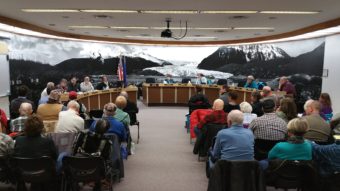
The assembly hears testimony from Juneau residents on the senior sales tax exemption Thursday night. (Jennifer Canfield/KTOO)
The Assembly hears testimony from Juneau residents on the senior sales tax exemption Thursday night. (Photo by Jennifer Canfield/KTOO)

More than a dozen locals told the Juneau Assembly last night to not do away with the senior sales tax exemption.

Many of those same residents also questioned the city’s spending and called on them to look for other ways to cut costs. Only a few spoke in favor of nixing the exemption. Many said they understood the difficult financial situation the city was in and wished the Assembly luck in finding a solution.

Much of the testimony came from seniors frustrated with city spending. The CBJ budget will be about $317 million next year. The city estimates that it loses about $2.8 million in sales tax revenue because of the senior exemption.

Raydene Garrison told the Assembly she was disappointed the last time the sales tax was increased because the Assembly didn’t cut any projects and instead relied on bonding to make up the difference. She asked them to take a closer look at their budget before changing any tax rules.

“I felt like the Assembly fell down on the job,” Garrison said. “I think that we really, as a city, need to look at our spending and see where our priorities are. We have bonded ourselves to death. We have extended our debt considerably and there’s no reason why we should be in that situation.”

Craig Orsborn questioned why the CBJ spends what he says is more than $2 million in unnecessary wage increases for non-union employees.

“These 542 employees do not pay or contribute union dues and do not participate at the union bargaining table, but regardless they receive the same benefits,” Orsborn says. “It would be interesting to know how many CBJ upper-management employees received the same benefits without contributing union dues or participating at the bargaining table. In order to maintain a balanced budget you need to know all the numbers, not just the ones you want the public to see.”

While opposing changes to their tax exemption, some seniors said essential items like food, fuel and electricity should be tax exempt for all residents. Others asked if Assembly members had considered the cost of enforcing the proposed senior tax exemption income limits.

Gail Smith said she was motivated to testify at the meeting because she thought the city had a problem with “aggressive spending,” recalling in 2012 when the city reconsidered building an off-road vehicle park. She said at a Parks and Recreation meeting earlier this week, there was discussion again about the project.

“I don’t see really good extended financial planning happening at the borough and that’s what I really would hope to see,” Smith said. “Just at the (Parks and Recreation) meeting a couple of nights ago people were having the expectation that again we would have some sort of motocross park. We can’t afford that. Where’s the money going to come from for that?”

Several seniors said the city should take a closer look at spending on recreational facilities like the popular Eaglecrest Ski Area. Scott Tiernan disagreed.

“I listen to people say, ‘Well, we have all these recreational facilities, we don’t use them so let’s eliminate them.’ I don’t use some of them now; I used to use them a lot,” Tiernan said. “They’re really important to the younger people here. If we don’t have those we don’t have the middle class either.”

Many seniors warned the Assembly that axing their tax exemption might make them leave Juneau. One of the younger residents at the meeting, 50-year-old Arnold Liebelt, said he was more worried about the “exodus of the middle class.”

“We know what the price of oil is. Things aren’t looking good for the state; things are not going to be looking good for the municipalities,” Liebelt said. “If the middle class can’t get a job, they’re going to leave town and they’re going to take their kids that are in the school district with them and that really worries me.”

Wayne Nicolls told the Assembly that while he does not like buying things on the internet or through catalogs, he would if the senior sales tax exemption went away. Even if it does, he would never consider leaving Juneau.

“I’m not moving no matter how rough it gets,” Nicolls said. “I’m gonna stick it out, (even) if I have to sell pencils on the corner of Seward and Front Street.”

The Assembly also heard brief public testimony on a proposal to increase the maximum taxable value of big ticket items from $7,500 to $14,000. The increase would mean up to an additional $325 dollars in tax revenue on purchases. One business owner told the Assembly he’d lose local customers to Seattle where things are cheaper and no matter what the shipping cost is the same.

Update: Chugiak lawmaker proposes legislature move

April 3, 2014
The Alaska state capitol building in downtown Juneau. (Photo by Skip Gray/Gavel Alaska)

Update | 4:05 p.m. Jan. 8, 2015

Sen. Dennis Egan, a Juneau Democrat, says he thinks the bill “is a crock.”

“I’m really dismayed that he’s pitting one section of Alaska against another,” Egan says.

Through a spokeswoman, Gov. Bill Walker said he typically doesn’t commit on how he’ll deal with legislation before receiving it. But, he added, he doesn’t favor moving the capital.

Original post | 7:27 p.m. Jan. 7, 2015

Sen.-elect Bill Stoltze, R-Chugiak, plans to introduce a bill to move the Alaska Legislature to Anchorage. Stoltze isn’t proposing a full-on capital move. Instead, KTUU reports that the bulk of state government would remain in Juneau and legislative sessions would be held at the Anchorage Legislative Information Office.

“I have always been a vocal advocate for relocation,” Stoltze told KTUU.

This is the second time Stoltze has advocated for such a move. In 2008 he supported a similar bill introduced by Rep. Mark Neuman, R-Big Lake.

Many attempts and discussions to move the capital have taken place since the days of Alaska’s first constitutional convention. According to a brief history compiled by The Alaska Committee, the last attempt to swing the legislature away from Juneau happened in 2002. Voters defeated a ballot measure that required the legislature to meet in the Matanuska-Susitna Borough.

Stoltze’s bill will be introduced as the state grapples to deal with a $3.5 billion budget shortfall and declining oil prices.

Site notifications
Update notification options
Subscribe to notifications