Jennifer Canfield, KTOO

Gov. Walker announces new tribal advisory council

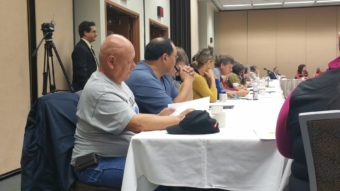
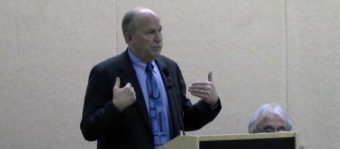
Governor Bill Walker addresses the 4th annual Alaska Federation of Natives and National Congress of American Indians conference at the Egan Center in Anchorage. (Photo by Jennifer Canfield/KTOO)
Gov. Bill Walker addresses the fourth annual Alaska Federation of Natives and National Congress of American Indians conference at the Egan Center in Anchorage. (Photo by Jennifer Canfield/KTOO)

Gov. Bill Walker announced Wednesday the creation of an 11-member tribal advisory council.

“We need to do things differently. We need to do things collaboratively. We need to have the vehicle to have a discussion and bring things to us, and so when we have an issue we have a mechanism to go out to the village leaders to solicit your input,” Walker said.

The council will advise on education, health care, subsistence, energy, public safety, justice, wildlife and fisheries, economic development, housing, language and culture and transportation. There will be one representative for each issue.

Richard Peterson, president of the Central Council of Tlingit and Haida Indian Tribes of Alaska, said he was excited about the announcement. Of all the issues covered by the council, Peterson said energy should be a priority, but land into trust is also something he’d like to see addressed before too long. He thinks it’s an issue of the state recognizing the tribes’ rights.

“Obviously they recognize tribes and our importance, but there’s never been a formal recognition and I think that needs to take place,” Peterson said. “What I would hate is to have all this great forward movement under this administration and then another administration comes in and just ignores (it), and it’s back to the way it was previously when tribes didn’t have the impact that we have now.”

Walker made the announcement Wednesday at the Alaska Federation of Natives and National Congress of American Indians annual conference in Anchorage. Several cabinet members addressed the conference that morning. Walker said he’d like for the meeting with AFN and NCAI to become an annual event for his administration.

Workshops at Elders and Youth Conference aim to connect, educate

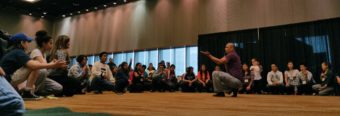
Xeetli.eesh Lyle James, a group leader for the Woosh.ji.een dancers in Juneau, teaches a small crowd of young people during a break out session at the Elders and Youth Conference in Anchorage. (Photo by Jennifer Canfield/KTOO)

IndiGenius  — a play on the word indigenous — is an offering of afternoon workshops every year at the First Alaskans Institute’s Elders and Youth Conference.

“We have storytelling, we have drum making, we have weaving, and in some cases you’ll have elders teaching youth and in other cases youth teaching elders,” said Emily Tyrell, sustainability director for the First Alaskans Institute. “It’s this transference of knowledge whether it’s elders to youth or youth to elders.”

Two years ago, The CIRI Foundation helped FAI acquire more funding for the workshops. Conference participants had asked in previous years for more opportunities to connect and learn through art, and so that’s what the extra funding went to.

Tyrell said it’s important for the youth to embrace their culture’s strengths.

“Oftentimes we hear this message that our people are overloaded with these terrible statistics: high suicide rates, domestic violence,” she said. “Yes, those statistics are true, but there is also a message that we bring forward through our work that we are a beautiful vibrant people and we’ve been on these lands for the last 10,000 years.”

The CIRI Foundation's President and CEO Susan Anderson (right) and Program Officer Nadia Sethi. (Photo by Jennifer Canfield/KTOO)
The CIRI Foundation’s President and CEO Susan Anderson (right) and Program Officer Nadia Sethi. (Photo by Jennifer Canfield/KTOO)

Susan Anderson, president and CEO of The CIRI Foundation, said the idea is that traditional arts give elders and youth the chance to talk about current issues and concerns in the context of an activity their ancestors also took part in.

“It’s about helping people know who they are culturally and through heritage as well as helping them to then succeed in their educational path,” Anderson said.

One of the first agreements attendees at the annual Elders and Youth Conference make is to participate. “In every chair, a leader,” is a mantra repeated throughout by institute staff. Attending IndiGenius workshops is a step toward fulfilling the mantra.

The agreement means a number of things: It calls on participants to actively engage with others and to listen carefully, to speak respectfully and to be open to learning. It guides participants through a series of discussions and activities aimed at fostering communication between the generations and instilling confidence in the younger ones.

There are dozens of workshops to choose from and participation is not limited to Alaska Natives or just elders and youth. Tyrell says the general public is encouraged and welcome to join the conference, which goes until Wednesday morning.

Elders and Youth conference begins today in Anchorage

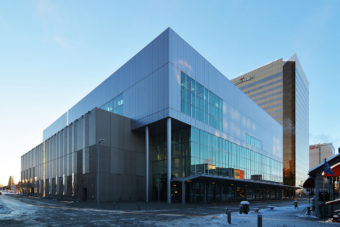
Street-level view of the Dena'ina Civic and Convention Center. (Creative Commons photo by Paxson Woelber)
Street-level view of the Dena’ina Civic and Convention Center. (Creative Commons photo by Paxson Woelber)

The First Alaskans Institute’s 32nd annual Elders and Youth conference begins Monday in Anchorage at the Dena’ina Convention Center. Hundreds of Alaska Natives from across the state, young and old, will meet over the next two-and-a-half days to learn about and discuss a diverse set of issues. This year’s theme is “Not in our smokehouse!”

On the first day, attendees will elect members to the Statewide Elders and Youth Council, participate in regional dialogue sessions and discuss Native languages and conference resolutions.

This year’s elder keynote speaker is Gregory Fratis Sr., who is Unângax from St. Paul Island. (Unângax is traditional alternative to Aleut.) According to the institute, Fratis is involved in teaching his Native language, cultural values and traditions to youth in his village.

The youth keynote speaker is Lacayah Engebretson. The Tlingit, Yup’ik and Athabascan college student from Glenallen is studying education at the University of Alaska Anchorage. She’ll speak to the conference about the importance of Alaska Native educators.

The conference, which is held each year during the same week as the Alaska Federation of Natives convention, is an opportunity for youth to learn about leadership and how to participate in policy discussions and group decision making. Last year about 1,100 people attended the conference.

A live feed of the Elders and Youth conference and the Alaska Federation of Natives convention can be seen on 360 North. Follow KTOO’s coverage of both events here.

Full disclosure: The First Alaskans Institute organizes and funds a volunteer group unrelated to the conference of which Jennifer Canfield is a member.

Walker, Mallott remind PFD recipients of state fiscal situation

Gov. Bill Walker said that while this year's Permanent Fund Dividend is the largest ever, the state is still struggling financially. (Screenshot)
Gov. Bill Walker said that while this year’s Permanent Fund Dividend is the largest ever, the state is still struggling financially.
(Screenshot)

This year’s Permanent Fund dividend is $2,072, the largest ever. Despite the record high, Gov. Bill Walker and Lt. Gov. Byron Mallott were relatively somber and both reiterated the state’s fiscal situation throughout their remarks given ahead of the announcement.

Walker noted the fund was created for a time when oil income could no longer sustain state government and then set the stage for continued discussions on how to address the state’s $3 billion budget shortfall.

“We’re in a bit of a dilemma this year given that with the price of oil half of our income went away and we’re in about a $3 billion deficit,” he said. “This year we’ll be looking at ways of balancing the budget with a plan going forward.”

Walker said this year’s dividend is being issued under unique circumstances — earnings from the Permanent Fund have exceeded overall state earnings from oil.

While this year’s dividend is larger than ever before, he said people who might think “everything is fine” are mistaken.

“While this dividend is going to be welcome in our economy, as it should be, it’s also at a time that our economy is — we’re borrowing of funds to do what we do in this state. It’s a real different scenario; we’ve never been in that situation before,” Walker said.

Lt. Gov. Byron Mallott says now is the time for the state to draw on the Permanent Fund to support state government. (Screenshot)

Suggestions for how to deal with the loss of income due to declining oil prices are varied. Reinstating the state’s income tax and drawing on the Permanent Fund are options that have been discussed. However, drawing from the pot of money that gives Alaskans their yearly windfall is widely considered to be politically unpopular.

Mallott is a former executive director of the fund and former chair of its board of trustees. While in those positions, he said he learned and made decisions based on the premise that the Permanent Fund was created to be spent on government operations when oil production declined.

“Ultimately, the purpose of the fund was help meet Alaska’s fiscal needs, its state revenue needs, when the rainy day occurred, when we needed to begin replacing non-renewable oil wealth with renewable financial wealth. That time is now,” Mallott said.

The fund was created by an amendment to the state’s constitution nearly 40 years ago at a time when about 2 million barrels of oil were flowing through  trans-Alaska pipeline each day. Today, only about 500,000 barrels travel through the pipeline per day. The constitution only requires the state to maintain the fund; there is no requirement for the state to issue dividends.

The Permanent Fund is managed like an endowment. At least 25 percent of the state’s oil royalties are deposited into the fund. Dividend checks, which are issued every year to qualified residents, are calculated based on the performance of the fund over the previous five years. The fund is valued at more than $51 billion.


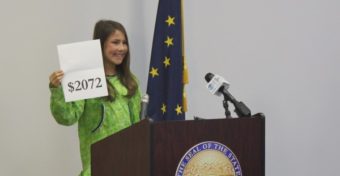
This year’s Permanent Fund dividend is $2,072

This year’s Permanent Fund dividend is $2,072. The governor recruited 7th grader Shania Sommer to make the announcement.

The Permanent Fund is managed like an endowment. At least 25 percent of the state’s oil royalties are deposited into the fund. Dividend checks, which are issued every year to qualified residents, are calculated based on the performance of the fund over the previous five years.

Editor’s note: A previous version of this story incorrectly stated Sommer’s age. We’ve corrected the reference.

Site notifications
Update notification options
Subscribe to notifications