Jennifer Canfield, KTOO

Wasilla lawmaker: Keep education spending in check, cut rural schools

It started as a rumor. Democratic lawmakers and some education advocates have heard about it.

That there are new ideas for changing how the state pays for education isn’t a surprise. That this cost-saving proposal could close 60 schools across the state is.

“Certainly there has been talk that 10 students is, quite frankly — with the technology that we have today and the options that are available — it’s just too expensive,” says Rep. Lynn Gattis.

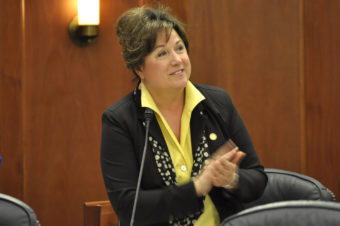
Rep. Lynn Gattis applauds after introducing a guest on the House floor, Feb 26, 2014. (Photo by Skip Gray/Gavel Alaska)
Rep. Lynn Gattis, R-Wasilla, on the House floor in February 2014. (Photo by Skip Gray/360 North)

Gattis is a Republican from Wasilla and chairs the House Education Committee. She’s one of the lawmakers considering introducing legislation to change a number of things about how schools in Alaska are funded. One of her ideas is to increase the minimum threshold for schools to receive full funding. She’s considering proposing 25 students as the minimum, but she’s open to a number higher or lower than that.

“If I was in charge, I would open up those options whether it be virtual schools — I went to school when it was correspondence back in the day and we have come a long way,” Gattis said.

Jonathan Kreiss-Tomkins
Rep. Jonathan Kreiss-Tomkins, D-Sitka, on the House floor. (Photo by Skip Gray/Gavel Alaska)

Rep. Jonathan Kreiss-Tomkins represents a handful of Southeast Alaska communities. The three schools that were closed in Alaska in the last fiscal year were all in Southeast.

The Sitka Democrat said he unequivocally opposes raising the minimum threshold.

“Closing schools, depriving rural kids of a teacher and a traditional education that kids in cities and parents in cities would reasonably expect is not fair or equitable and it’s a complete nonstarter,” Kreiss-Tomkins said.

Hiking the threshold from 10 students to 25 could mean closure for 60 of Alaska’s schools. Typically once a school goes below the threshold and loses most of its funding, the district is forced to close the school, unless it makes the rare decision to siphon funding from other schools it administers. But in this case, pushing funds around may not even be an option. Many of Alaska’s smallest schools are in the same school districts.

The Southeast Island School District, for example, has nine schools; eight of them have fewer than 25 students.

“Even just talk about the possibility to go to 25 is enough to get parents jumpy. Just the talk will close a few schools because it’s hard keeping enough kids there,” Superintendent Lauren Burch said. “Who’s going to move to a community when they think the school might close?”

Burch said three of the district’s schools lost funding a few years ago because enrollment fell under the threshold. He said the district cut spending on basic school supplies and maintenance for buildings and buses to help keep the schools open.

Republican lawmakers say growth in education spending is unsustainable, and must be checked.

Education Commissioner Mike Hanley says it’s not fair to target education for cuts just because it’s one of the state’s biggest expenses. If cuts to the state budget must be made, he said, then education should be a priority to maintain. As an example, he questioned whether education funding was more important than funding for trail maintenance, or maybe as important as funding for law enforcement.

“At some point we have to say we’re not willing to go any lower in education and I don’t know what that number is,” Hanley said. “But at some point we have to (ask), ‘What’s our constitutional responsibility to provide an education? What’s our moral responsibility to supply and provide an education? And can we still meet that obligation with less money?'”

Comments on a possible change in the minimum threshold were included in several speakers’ remarks during the National Congress of American Indians conference with the Alaska Federation of Natives and during the AFN convention. Concerns were mainly focused on how such a change would make rural education less equitable.

Update: Death jolts final hour of AFN convention

Update | Oct. 18, 2:30 p.m.

The man who jumped to his death from the third floor of the Dena’ina Center on Saturday was 49-year-old Anthony Choquette, the Alaska Dispatch News reports.

An Anchorage Police Department spokeswoman wrote in an email to the ADN that Choquette sustained “fatal injuries upon impact.” His next of kin have been notified.

Update | 5:53 p.m. – Jeremy Hsieh, KTOO

Suicide prevention was a topic at the convention on Friday. Jennifer Canfield, speaking on KTOO-FM, said that makes this incident especially painful.

“Just yesterday, John Baker, the musher, announced with Sen. Dan Sullivan, Sen. Murkowski, Rep. Don Young, Gov. Walker — these people were all on the stage in support of John Baker’s initiative where he was signing people up to be wellness ambassadors to watch out for signs of suicide in the people that they love, the people that are around them,” she said.

The initiative came on the heels of a spate of suicides in Hooper Bay.

“This was a topic that was part of the convention, and I just think that makes this all the more hard to absorb,” Canfield said.

Update | 5:08 p.m. – Jeremy Hsieh, KTOO

Anchorage Police Department spokeswoman Renee Oistad says the department is treating the incident as a suicide. She said it was an adult male who jumped, but would not disclose any other identifying information or details.

Original story | 4:59 p.m. – Jennifer Canfield, KTOO

Dena'ina Center concourse
A view of the Dena’ina Center concourse from the third floor. This picture was taken on the second day of the Alaska Federation of Natives convention in Anchorage.
(Photo by Mikko Wilson/KTOO)

In the final hour of the 2015 Alaska Federation of Natives convention Saturday, a man died after falling from the third floor of the Dena’ina Center. His body hit the first floor where hundreds of attendees were gathered. At first it sounded as if a gun had gone off.

On the third floor, many rushed to look over. Police were on the scene within a few minutes. AFN President Julie Kitka and a member of the board of directors spoke with an Anchorage police officer moments later.

The incident was announced to attendees in the main convention room.

Officials cordoned off the scene. Anchorage Police and Dena’ina Center staff evacuated parts of building. Events in the main convention room continued at first, though the convention was already winding down. An evening banquet has been canceled.

Marvin Roberts, a recently released member of the Fairbanks Four, took the stage minutes after the accident.

Co-chair Ana Hoffman invited a gospel singing group to the stage to offer comfort to those still in the main room. A dance group from Juneau finished out the convention.

Earlier, Dena’ina Center and AFN staff accosted an Alaska Dispatch News photojournalist, demanding he stop filming. Attendees on the first floor yelled at people taking pictures. Some tried to force the photojournalist’s camera away from him before APD intervened.

Editor’s Note: A previous version of this story incorrectly referenced a series of recent suicides in Point Hope. We regret the error. 

AFN calls on Walker to free the Fairbanks Four

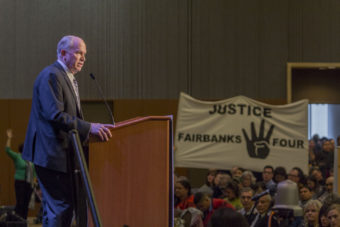
Gov. Bill Walker addresses the 49th annual Alaska Federation of Natives conference in Anchorage. The AFN called on Walker to free the Fairbanks Four. (Photo by Mikko Wilson/KTOO)

The first day of the 49th annual Alaska Federation of Natives convention in Anchorage featured hundreds of attendees yelling their support for four men who say they have wronged by the justice system. As the AFN crowd showed their support, one of the men, George Frese, was preparing to head back into court in Fairbanks.
The Fairbanks Four is Eugene Vent, Marvin Roberts, Kevin Pease and George Friese. The men — three are Alaska Native and one is American Indian — were convicted for the 1997 murder of 15-year-old John Hartman but have maintained their innocence throughout their 18 years in prison.

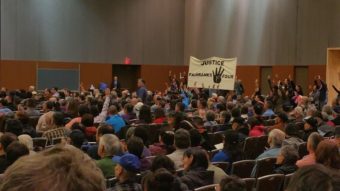
Supporters sporadically yelled out “No more four!” throughout Gov. Bill Walker’s address to the convention. Just before Walker began to mention issues he felt the state hadn’t made enough progress on, about a dozen people entered the main room at the Dena’ina Center with a large cloth banner that read “Justice Fairbanks Four.”

After Walker’s address, AFN co-chair Ana Hoffman took to the podium and invited the organization’s board of directors to the stage. She motioned to Walker — who’d stepped back — to move toward the front of the stage.

“Gov. Walker, we have, on behalf of the board of directors and all of the delegation, we have a very important message for you,” Hoffman began. “Free the Fairbanks Four.”

The Alaska Federation of Natives asks Gov. Bill Walker to free the Fairbanks Four at the organization's annual convention in Anchorage.
The Alaska Federation of Natives asks Gov. Bill Walker to free the Fairbanks Four at the organization’s annual convention in Anchorage.

Each member of the board of directors stretched their arm up into the air and displayed four fingers to represent the four men they believe are wrongly convicted. Most of the crowd followed the board’s lead. Chants of “No more four!” strengthened for a for a minute. Lt. Gov. Byron Mallott stepped forward to join Walker.

As Hoffman continued to speak, Walker acknowledged the audience by nodding his head as he scanned the room.

“As you know Gov. Walker, the Fairbanks Four — Eugene Vent, Marvin Roberts, Kevin Pease and George Frese — have spent the last 18 years in prison for a crime that they did not commit and they deserve to be exonerated,” she said. “With the utmost respect for you, governor, we ask you to make things right and just. We put our faith, hope and love in your wisdom.”

Hoffman invited co-chair Jerry Isaac, former president of the Tanana Chiefs Conference, to take the podium to share a traditional song he’d composed for the demonstration.

“In our Native way, when death suddenly happens we are shocked, we are saddened and we grieve. In this case, there’s no physical death but the forceful taking away of freedom from four young men,” Isaac said. He continued: “We are shocked and saddened and grieving because the facts prove them innocent. The long years of shock and sorrow and the want for freedom and equality fill us with a grief. A grief that is so crippling by its power our only way to express our frustration, our sadness, is to grieve, grieve by a song to express our grief, sadness and sorrow.”

Afterward, Rob Sanderson, Jr. — the village chair for Southeast and 2nd vice president of the Central Council of Tlingit and Haida Indians of Alaska — told the crowd donations were being collected for the men’s legal expenses. The Alaska Innocence Project has been working to secure the men’s freedom for several years.

Victor Joseph, president and chairman of Tanana Chiefs Conference, spoke last before the board left the stage.

“It’s time that these young men come home,” Joseph said. “It could have been any of our children. I want everybody to know I place my trust in the governor to do the right thing and I believe he will. Thank you and ana basee’.”

In an interview with KSKA’s Zachariah Hughes, Walker said he admired the passion of the Fairbanks Four supporters and that he follows the case daily. He said, however, that anything he could do at this point would undermine efforts to have the men exonerated in a court of law.

“Whatever I would do in the way of releasing them from jail, they would still carry with them the question of (whether they’re guilty or not),” Walker said. “What they’re doing now is they’re having an opportunity to have their name cleared, assuming the evidence supports that.”


Utah housing expert who cut chronic homelessness 90% pitches Alaska solutions

Gov. Bill Walker says he’d “love for Alaska to be the first state without homelessness.” With a little inspiration from the state of Utah, some are hopeful that could become reality.
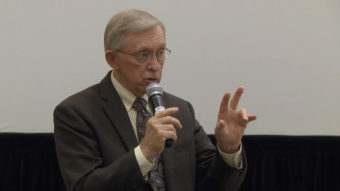
Lloyd Pendleton, director of Utah's Homeless Task Force, addresses the Alaska Coalition on Housing and Homelessness annual conference. (Video still courtesy of 360North)
Lloyd Pendleton, director of Utah’s Homeless Task Force, addresses the Alaska Coalition on Housing and Homelessness annual conference. (Video still courtesy 360 North)

In 10 years, the number of people who are chronically homeless in Utah dropped from 1,964 people to 178. Lloyd Pendleton, director of Utah’s Homeless Task Force, was a guest at the meeting of Alaska Coalition on Housing and Homelessness annual conference. He said the solution was relatively simple — Utah used the Housing First model.

If funding is the problem, Pendleton suggested that Alaska’s Permanent Fund dividends could be put to a higher use, which Corrections Commissioner Rob Taylor, and the audience, found amusing.

“You’re not talking about our checks are you?” Taylor asked.

“Yes he is!” yelled a woman in the audience.

“I guess that’s what you call them,” Pendleton replied. “So, you pay no sales tax, you pay no tax. The rest of us down in the Lower 48 do it without issue. I’m just saying, you have an opportunity to rethink your whole structure.”

Short of implementing new taxes or doing away with PFD checks, Pendleton noted that Alaska is still in a good spot to make progress on a housing initiative. He noted that state leadership and the coalition are actively working toward a solution.

Gov. Bill Walker addresses the Alaska Coalition on Housing and Homelessness Annual Conference. (Video still courtesy of 360North)
Gov. Bill Walker addresses the Alaska Coalition on Housing and Homelessness Annual Conference. (Video still courtesy 360 North)

In his address to the conference Wednesday, Walker said a recent visit to the Cold Climate Housing Research Center in Fairbanks opened his eyes to new technologies that can help residents mitigate expensive winter heating bills.

“It’s not any one particular region. It’s statewide. We need affordable housing. In some locations in our great state in the winter, multiple families move together to live in one house so they’re heating one house rather than four houses. (It’s) quite a challenge,” Walker said. “There’s no place else in the United States that does that, that people live in those conditions.”

The state will hold a housing summit in January, which Walker hopes will “identify what the state can do to help local communities address their housing needs.”

Site notifications
Update notification options
Subscribe to notifications