Jeremy Hsieh

Local News Reporter, KTOO

I dig into questions about the forces and institutions that shape Juneau, big and small, delightful and outrageous. What stirs you up about how Juneau is built and how the city works?

Retiring Juneau teacher denied leave cash-out, district says he missed deadline

Kevin Hamrick 2017
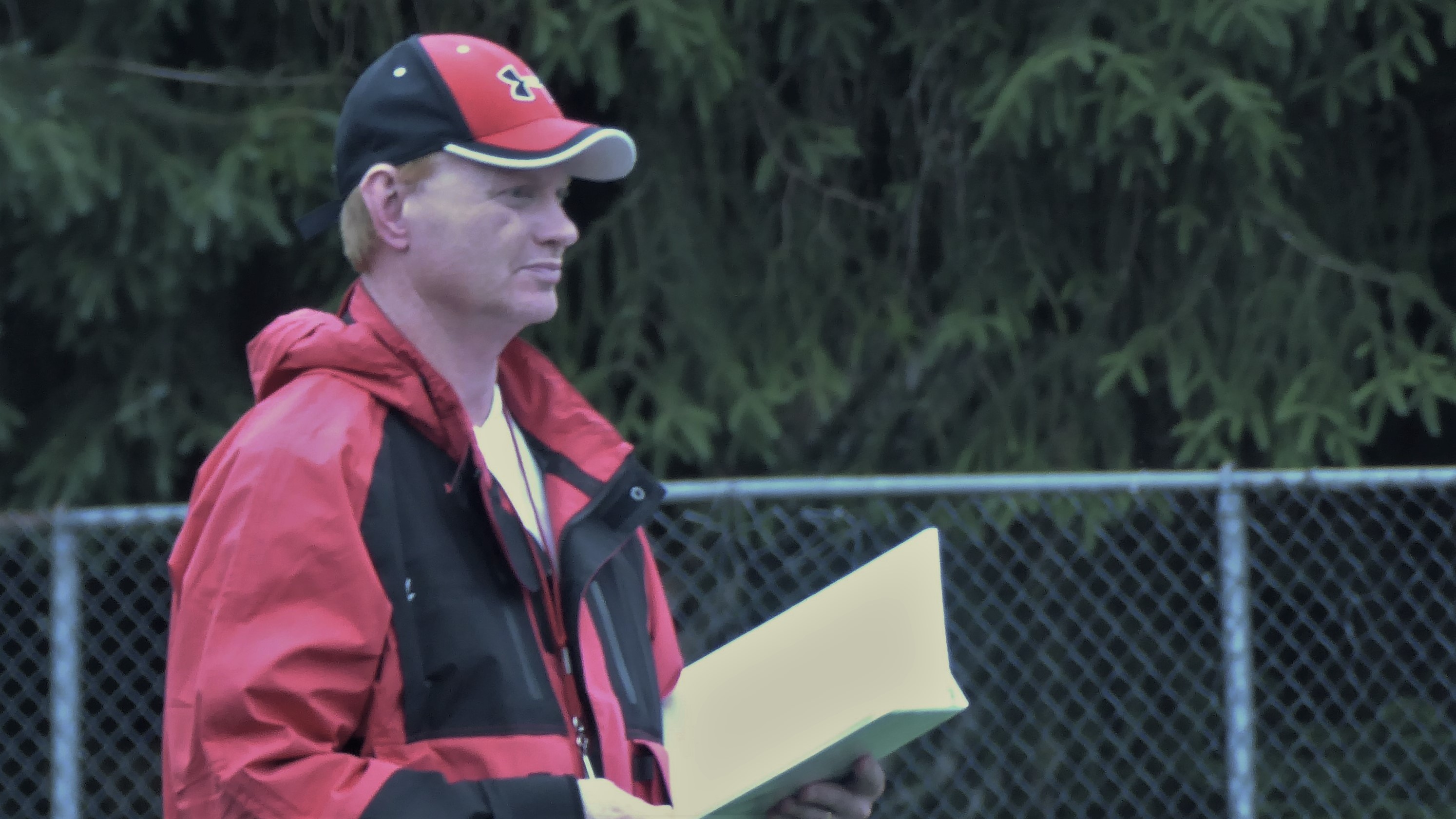
Coach Kevin Hamrick oversees a Crimson Bears practice on July 28, 2017, at Adair-Kennedy Memorial Park in Juneau. Hamrick recently retired from teaching but found himself in a bureaucratic beef with the Juneau School District over $750. (Quinton Chandler/KTOO)

Juneau coach and teacher Kevin Hamrick recently retired from the Juneau School District after putting in almost 30 years as an educator. As he finished up his final days teaching summer school classes, he found himself in a bureaucratic beef with the district over $750.

He filed a grievance.

Hamrick first started working for the Juneau School District in 1992. His last day of work was during summer school on June 28.

He had five days of personal leave leftover and thought he could cash it out under a policy in the teachers’ labor contract with the district.

“After you serve the district so long and you ask for your cash out of your leave, that $750, and they deny it, it’s like, ‘OK, yeah, thank you. Have a nice retirement,’” Hamrick said.

The cash option gives teachers a reason not to use up all their leave just for the sake of using it up, which generally means instructional benefits for students. It also helps the district save money by not needing to hire substitute teachers as often, and the payout rate is much lower than a teacher’s salary for a day. A teacher at the bottom of the pay scale earns about $285 a day. The leave policy pays out $150 a day.

“It was designed to be an incentive not to take it, and they’re turning it into a punishment for not taking it,” Hamrick said. “So that was my main grievance, you know? I did what was best for the kids because they’d missed enough school last year, in-person teaching, and I wasn’t going to, you know, use up my last five days.”

But district officials all said no, he couldn’t cash out those five days of unused leave.

Bridget Weiss is the superintendent of the Juneau School District.
Bridget Weiss is the superintendent of the Juneau School District. (Photo courtesy of Bridget Weiss)

“Mr. Hamrick referred to the intent. Intent is not how you manage a contract,” said Superintendent Bridget Weiss, during a hearing on Hamrick’s case on July 6 with a panel of Juneau School Board members. “Intent is how you write language for sure.”

Language that the teachers’ union and district both agreed to in their labor contract. The cash-out policy sounds straightforward: “Teachers can cash out unused leave at any time during the school year at a rate of $150 per day, prorated.”

Basically, Weiss said he missed the “during the school year” deadline, which was May 24. That’s also when Hamrick’s regular teaching job officially ended. Teaching summer school is a separate job.

“What’s important is that we honor that language and the role of contract, versus what feels fair, perhaps, or those kinds of things,” Weiss said. “This is really about contract language and adhering to that contract language.”

One school board member asked Weiss how often personal leave is forfeited. She said she could only recall one other similar situation. KTOO also requested data on how much leave has been forfeited in recent years. A district official said the request is pending.

The school board said intent does matter to them and recommended the administration take a deeper look into whether the policy is supposed to let teachers forfeit their leftover leave time when they stop working for the district.

In its report, the hearing panel concluded that the policy applies to teachers who are coming back to work another school year to carry their leave forward. “It is silent regarding situations where an employee retires, resigns, or is otherwise terminated after the school year,” the report states.

“I’ve negotiated, been a part of these negotiations for years,” said long-time school board member Brian Holst, who chaired the grievance hearing panel. “I don’t recall the context being that we also wanted to stop somebody from cashing out at the end of their service.”

The full Juneau School Board met Tuesday to consider the panel’s recommendations. It didn’t make a final decision. Hamrick made procedural errors in the grievance process, so the board referred Hamrick back to an earlier step with the administration.

Hamrick said he was surprised but happy with the board’s call. He intends to continue through the grievance process.

Leadership with the teacher’s union, Juneau Education Association, declined to comment. But Hamrick said he heard from union members who say they’ll fix the policy in the next contract.

“Hopefully …  since I made a big enough noise about it, at least now it’ll benefit somebody in the future,” he said.

The labor contract between the school district and the teachers’ union is up for renegotiation in December.
Juneau just had its highest new COVID-19 case rate ever

Update | 9:37 p.m.

The Juneau Assembly unanimously reenacted its emergency measures to combat COVID-19. They are now in effect until Oct. 31. 

The measures were adopted with one last-minute change based on a suggestion in public testimony. The Assembly decided to ditch the possibility of $25 fines for breaking the rules. 

Original story | 10:45 a.m.

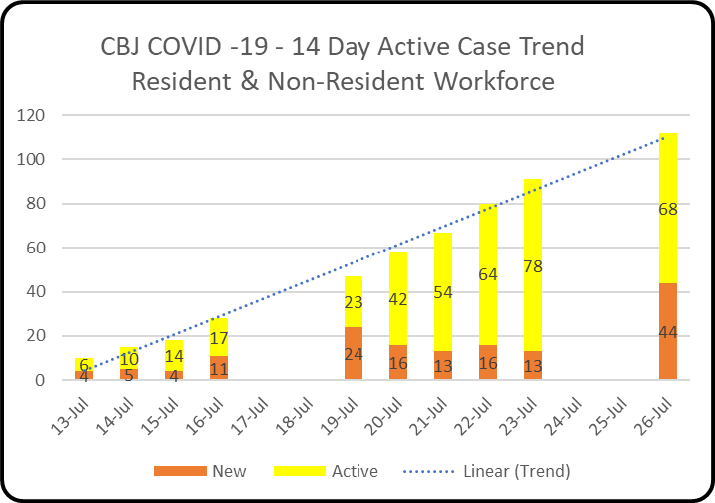
A graph from the July 26, 2021, weekly report on COVID-19 from the Juneau Emergency Operations Center. (Image from City and Borough of Juneau report)

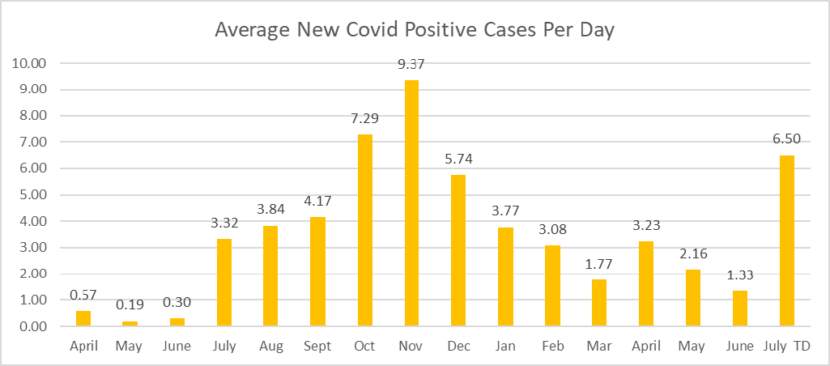
In Juneau, there were more new cases of COVID-19 identified in the two weeks that ended on Sunday than any other two weeks since testing and tracking began.

That’s according to Deputy City Manager Mila Cosgrove’s latest weekly report on COVID-19 in the capital city.

People who were fully vaccinated accounted for 30% of those cases. The rest were among the unvaccinated, who reported worse symptoms. Two people are in the hospital with active cases.

Cosgrove’s report said the state Division of Public Health is beginning to have difficulty with timely contact tracing. It’s a key public health tool for containing the spread.

The Juneau Assembly will consider reenacting its emergency measures to combat COVID-19 at a special meeting Wednesday evening.

The emergency measures in effect now in Juneau are set to expire on Saturday. These are the rules that ratchet up and down with the community’s COVID-19 risk level about masking, how many people can get together and how businesses operate.

Just Friday, emergency officials raised the risk level from minimal to moderate, which cuts indoor capacity at restaurants, bars, gyms and personal services businesses down to half. Masks continue to be mandatory indoors and in crowds for the unvaccinated.

The emergency measures the Assembly will consider tonight include a few changes from the ones that are expiring. Under the moderate risk level, people who are fully vaccinated would be strongly encouraged to mask up indoors.

That fits with new masking guidance the Centers for Disease Control and Prevention announced Tuesday for people who are fully vaccinated. The CDC said it reflects what they’ve learned about the more contagious delta variant of the disease.

The CDC’s new guidance also led the executive council of the Central Council of Tlingit and Haida Indian Tribes of Alaska to go virtual with its annual Tribal Assembly. The 86th Annual Tribal Assembly convenes online on Sept. 30.

Size limits for group activities where everyone is fully vaccinated would be relaxed under the new rules.

There’d also be a new tier to the color-coded risk levels: Green, fully open. Going green hinges on one condition: when at least 97% of Juneau’s entire population can be vaccinated — though not when 97% actually are vaccinated. Since the end of April, the goal had been to hit a community-wide vaccination level of 70%. Vaccination rates plateaued this summer a few percentage points short of that goal.

As proposed, the new emergency measures would expire Oct. 31. Adopting emergency legislation like this requires at least six of the nine Assembly members to vote yes.

A graph from the July 26, 2021, weekly report on COVID-19 from the Juneau Emergency Operations Center. (Image from City and Borough of Juneau report)

Cruise industry group shares numbers for short season, addresses COVID measures

Renee Reeve of CLIA Alaska 2021 07 22
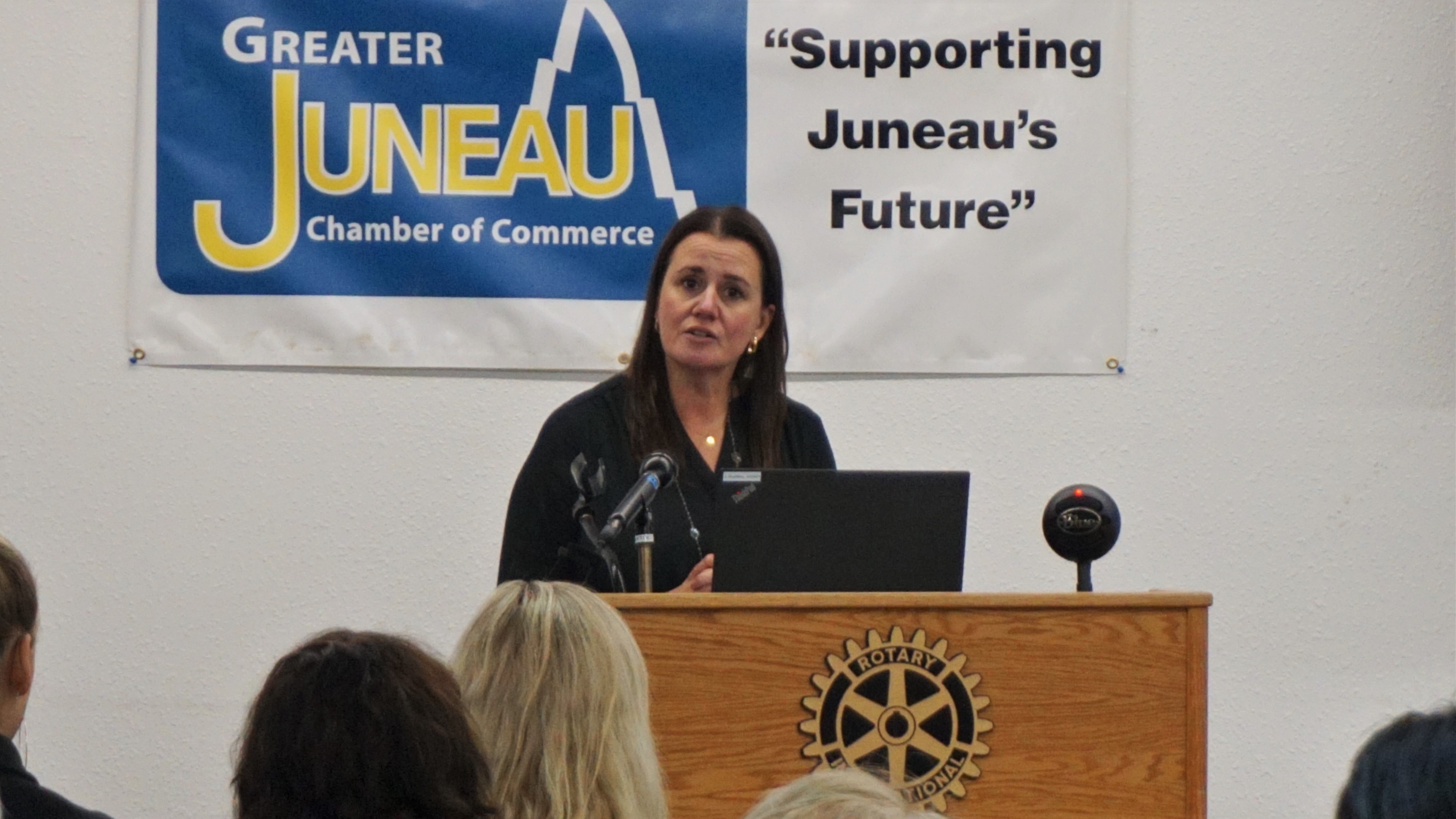
Renée Reeve, vice president of government and community relations for Cruise Lines International Association Alaska, speaks during a Greater Juneau Chamber of Commerce event in Juneau on Thursday. Of the 2021 cruise ship season, she said, “It’s not going to look the same, but it sure does feel good to be back.” (Jeremy Hsieh/KTOO)

On Thursday, cruise industry representatives visiting Juneau shared what to expect from this year’s short season and how cruise lines are handling COVID-19.

“It’s not going to look the same, but it sure does feel good to be back,” said Renée Reeve, vice president of government and community relations for Cruise Lines International Association Alaska. Its 17 member lines bring almost all of the cruise ship passengers to the state.

Reeve said there are nine big ships visiting Southeast Alaska this year, with 78 voyages planned. In 2019, there were 39 big ships with more than 500 voyages.

Passenger projections are fuzzy because cruise lines only got the regulatory green light in June. Booking time was limited, and the ships probably won’t sail at full capacity.

Reeve also discussed COVID-19.

“As we all know, our COVID numbers are rising across the state of Alaska right now,” Reeve said. “We at CLIA Alaska are committed to monitoring that with our member lines so that as the situation evolves, we can respond appropriately.”

She said most of the ships that will be in Alaska this season will have at least 95% of their passengers and crew vaccinated to meet a Centers for Disease Control and Prevention requirement to sail.

Royal Caribbean is the exception. It markets to families with children who aren’t eligible for COVID-19 vaccines. Its ships, including the Serenade of the Seas that’s sailing in Southeast Alaska now, will have lower vaccination rates. But they’ll also operate under stricter CDC requirements for things like masking, physical distancing and meal service.

Lanie Downs of CLIA Alaska
Lanie Downs, senior director of community relations and public affairs for Cruise Lines International Association Alaska, speaks during a Greater Juneau Chamber of Commerce event in Juneau on July 22, 2021. (Jeremy Hsieh/KTOO)

Regardless of vaccination rates, CLIA Alaska has asked its lines to participate in weekly briefings with port communities on COVID-19.

“So, if your community decides that it’s time to bring masks back? We want them to know that before their ship comes to port so their passengers are aware of that,” Reeve said.

Lanie Downs is senior director of community relations and public affairs. She said surveys have shown that cruise ship passengers are seeking COVID-conscious policies.

“The passengers that are coming on the ships actually wanted to those, you know, the high vaccine rates,” Downs said. “They don’t mind mask wearing, they don’t mind social distancing. They’re prepared for that, and they understand it.”

Reeve and Downs spoke during the Greater Juneau Chamber of Commerce luncheon on Thursday.

Glory Hall shelter moves out of downtown Juneau

Exterior of new Glory Hall on Teal Street
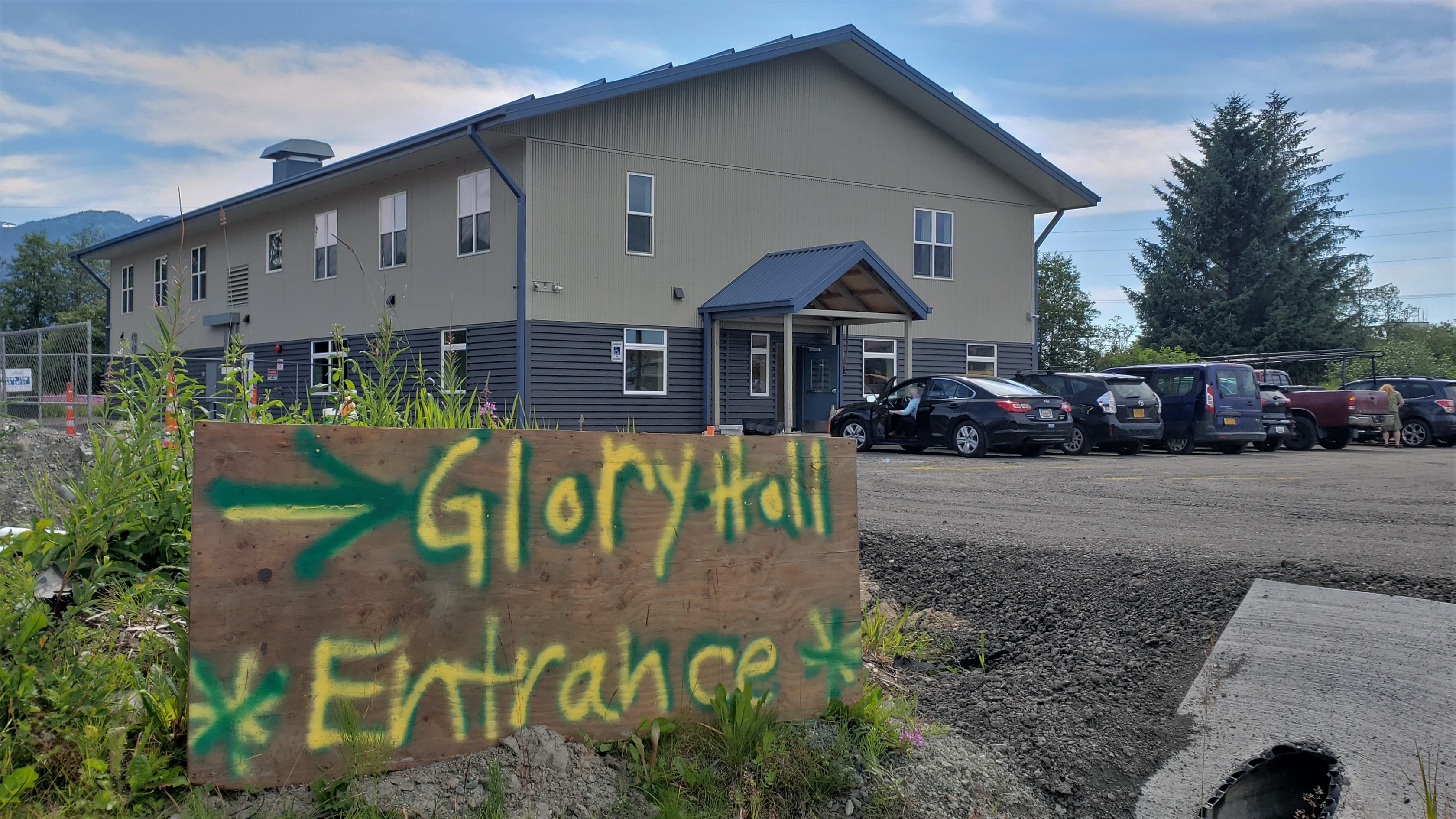
There’s still work to be done inside and out on the new Glory Hall emergency shelter and soup kitchen on Teal Street in Juneau, pictured here on Tuesday. The nonprofit intends to shut down its services downtown by Friday and transfer them to this location. (Jeremy Hsieh/KTOO)

By the end of the week, Juneau’s downtown emergency shelter and soup kitchen plans to be serving all of its patrons at its new facility on the other side of town. That means big changes for the patrons. 

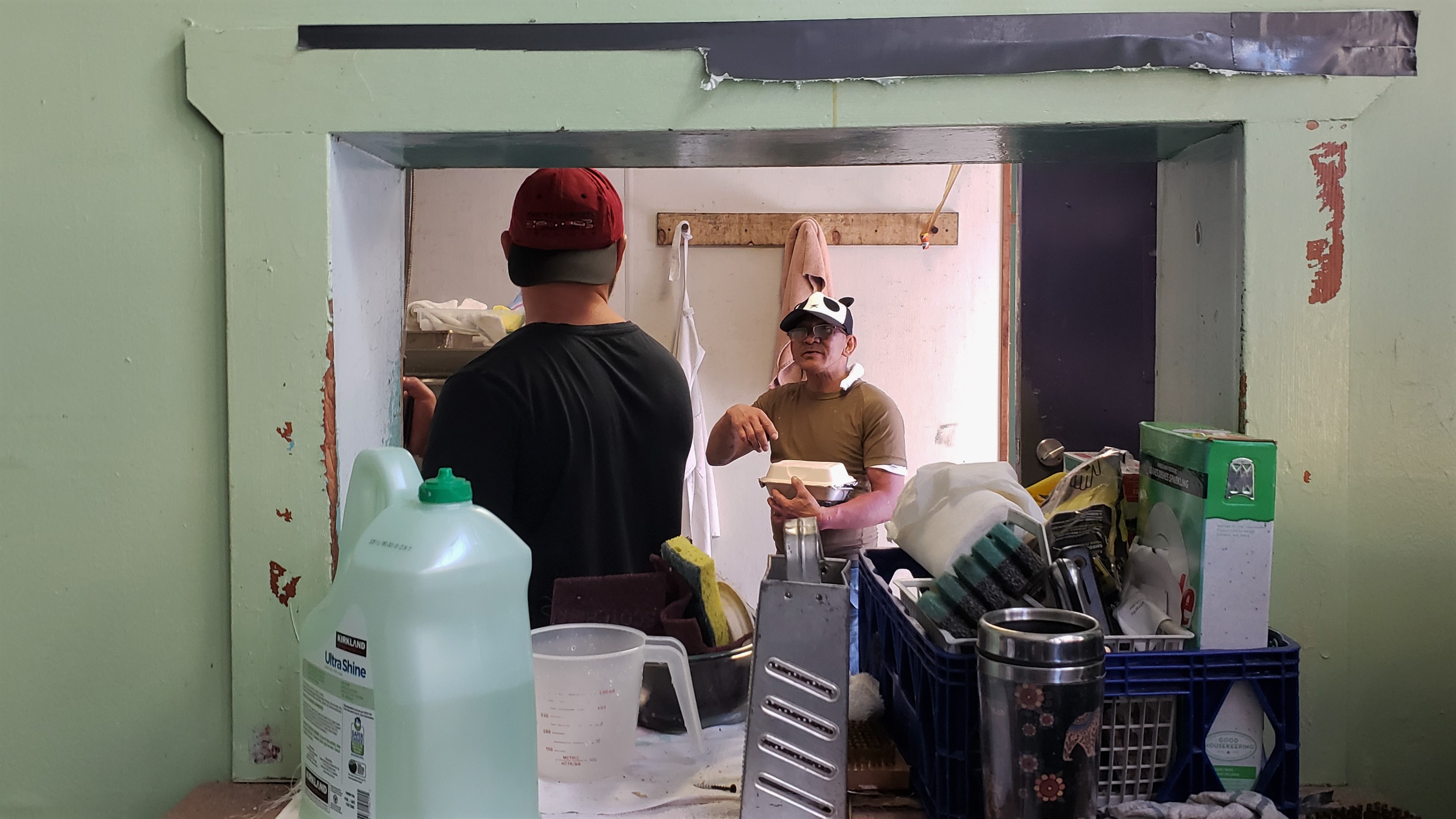
Robert Pedrena works at the Glory Hall as a cook and cleaner. The new kitchen isn’t ready yet, so he’ll still be cooking downtown for awhile in a mostly empty building. But meals will be delivered to the new building beginning Thursday evening. 

Robert Pedrena and Josh Poor 2021 07 20
Glory Hall cook Robert Pedrena discusses lunch with volunteer and patron Josh Poor in the kitchen area of the Glory Hall in downtown Juneau on Tuesday. The old building’s kitchen will still be in use for awhile until the new building’s kitchen is finished. (Jeremy Hsieh/KTOO)

Space is tight in the kitchen area. In the day room, where meals used to be served and people relaxed, Pedrena’s voice echoes. Not because it’s especially big, but because it’s empty. It’s been closed since the pandemic because it’s too cramped to keep enough distance between people to meet health guidance for limiting the spread of COVID-19.

The shelter has been renting a bigger space next door as a day room and to serve meals. It will shut down this week, too, as the new space opens on Teal Street near the airport. 

Upstairs at the old Glory Hall, there are three communal dorm rooms with bunks for about 30 people. There’s only enough space to get to and from the bunks. 

Out the back door, one of the last people staying here after capacity was cut because of COVID is waiting on some laundry. He introduces himself: “Gerald S. James, nickname is Speedy.” 

Gerald "Speedy" James
Glory Hall patron Gerald S. “Speedy” James poses for a photo outside the emergency shelter in downtown Juneau on Tuesday. He’s one of the old building’s last residents, and will be one of the first new ones at the nonprofit’s new building on Teal Street across town. (Photo by Jeremy Hsieh/KTOO)

James says he works part-time in the evening and has been helping a bit with the Glory Hall’s move. He’s a little sentimental about the old building. 

“Being here has changed me,” he said. “When I was working? I was alcoholic.”

As he tells it, his life took a bad turn a few years ago after he lost a restaurant job in town that he’d had for decades. He says he was drinking a lot of hard alcohol and living on the streets.

“And it’s scary when I look at that, ’cause I remember once, I went through that stage — shakes. The shakes are the worsest thing to ever happen in the morning. ‘Cause you’re trying to grab a glass, your hand is like that —” James holds his hand out and moves it like he has a tremor — “you can’t even hold onto it unless you have your other hand behind it.”

He says he started staying at the downtown Glory Hall a few years ago. He’s still drinking but says he gets by with beer now instead of hard liquor. He says he’s tapering himself down. 

“I started to realize, I don’t want to be like this. I don’t want to be like this,” James said. “I want to live a long life. I’ve got kids, got my grandkids.” 

The Glory Hall used to deny entry to people who failed a Breathalyzer test. That condition was suspended during the pandemic. It hasn’t been decided yet if it will come back.

When he’s done with his laundry, James says he’d figure out how to make the move to the new Glory Hall. 

“I got to head out the road and go grab my stuff and talk to the guys inside and see about another place. … So I got to find out about that, and I got — I guess I got a room,” he said.

He does, one of 42 at the new Glory Hall. James has a relative in town who helps him get around, but at the new place, he’ll be near a bus stop and have access to a shuttle service the nonprofit is running. 

Work is still underway at the new Glory Hall. On Tuesday, one shelter worker who has some carpentry skills was using an impact driver to put together coat racks for the new rooms. 

Teal Goodsell at new Glory Hall
The Glory Hall’s Teal Goodsell shows off coat racks she made in the emergency shelter’s new day room for the bedrooms on Tuesday. She’s a community support specialist, but says she happens to have some carpentry skills. (Photo by Jeremy Hsieh/KTOO)

The new building feels kind of like a college residence hall. On the ground floor, there’s the day room, kitchen, storage and office space. Plus an elevator;  the old Glory Hall was not wheelchair accessible. 

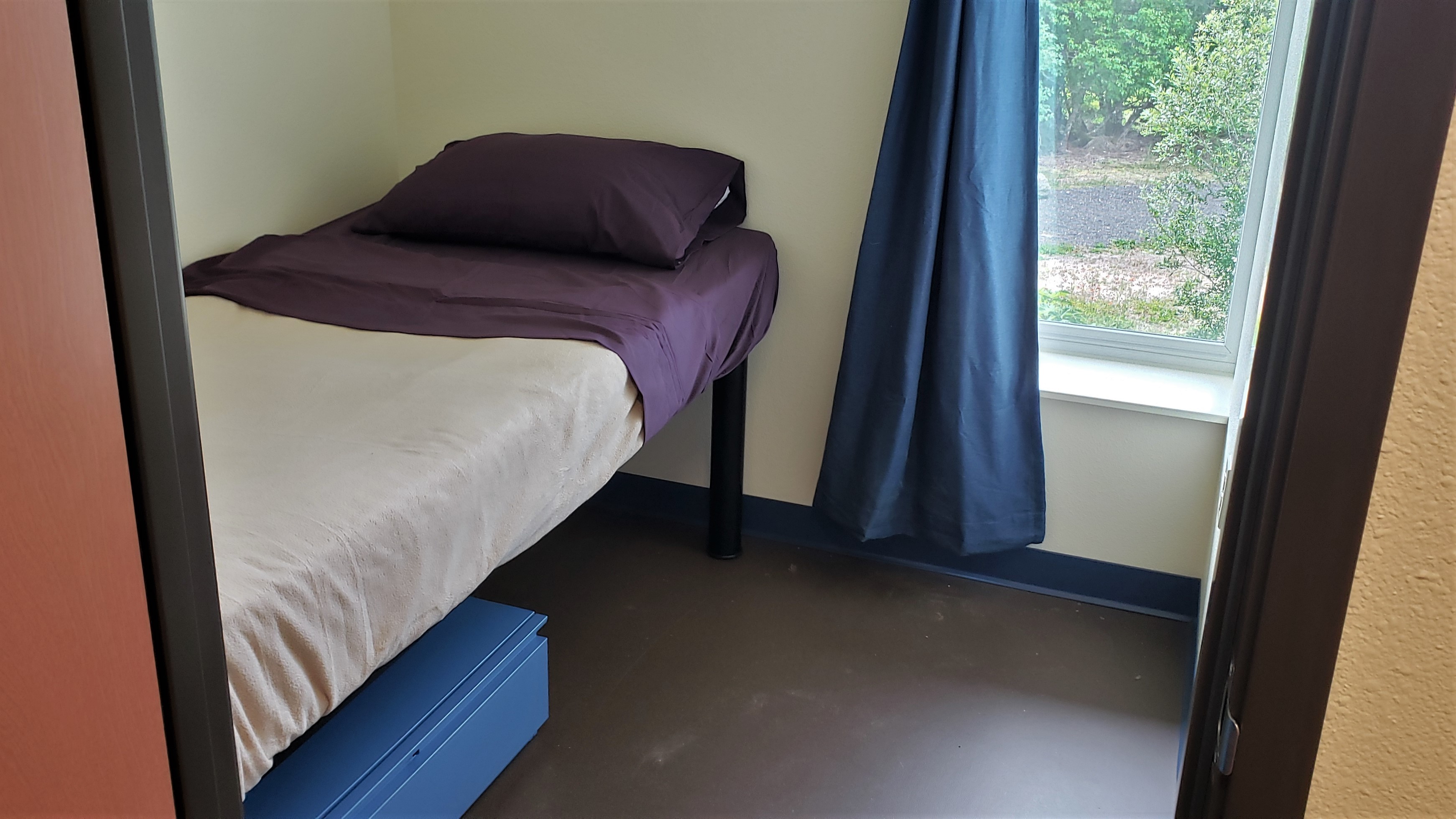
On the second floor, there’s a laundry room, a hallway of individual bathrooms and showers, and the bedrooms. Some have curtains up temporarily, where doors will eventually go. The rooms are small and spartan, but they’re individual rooms — no bunks. 

new Glory Hall bedroom
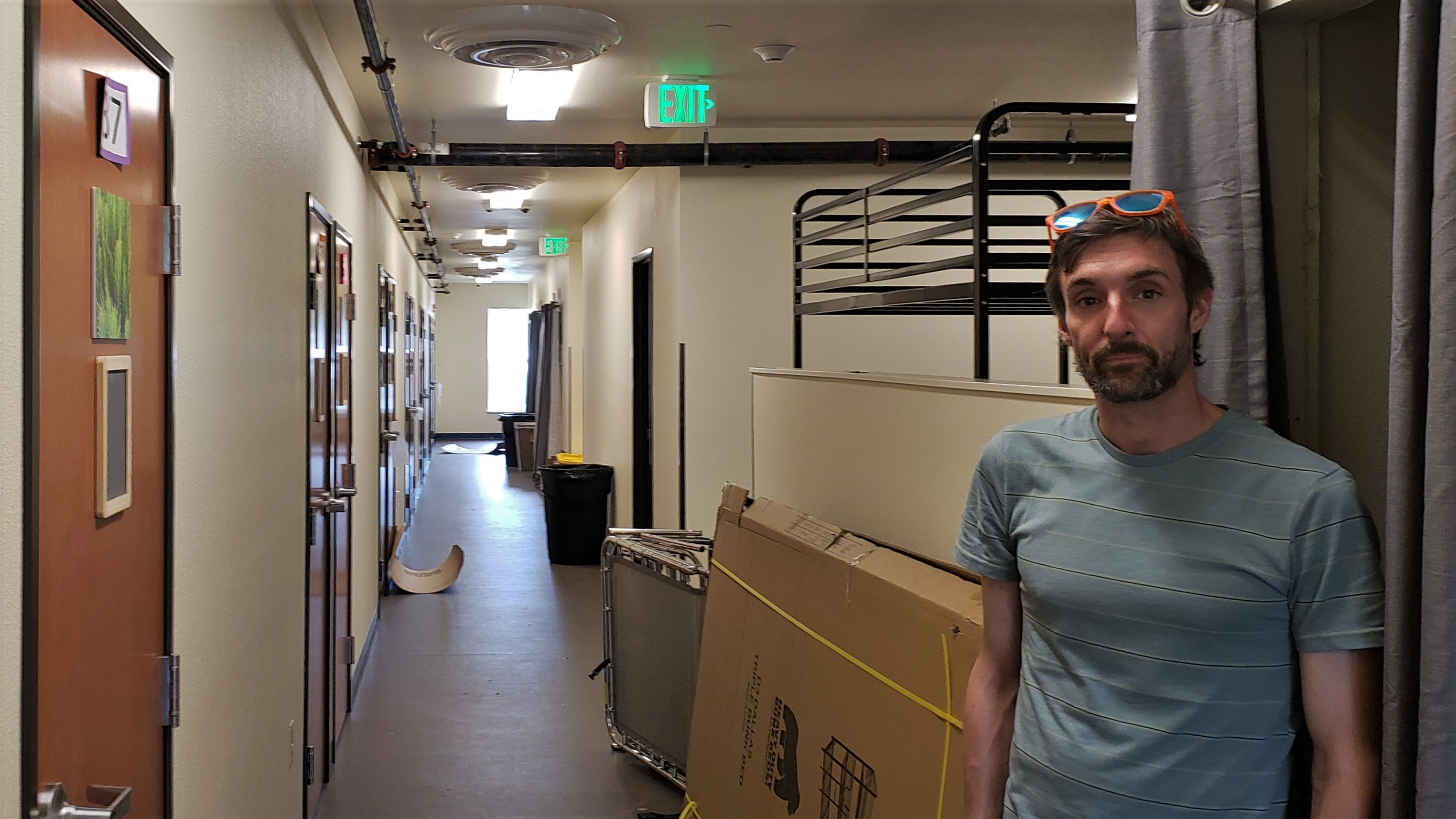
The new Glory Hall emergency shelter and soup kitchen on Teal Street in Juneau has 42 individual bedrooms like this one, pictured on Tuesday. The old shelter in downtown Juneau had three communal dorms, packed with bunk beds with space for about 30 people. (Photo by Jeremy Hsieh/KTOO)

“I think giving people their own space is going to be huge for, you know, people’s mental health and well-being,” said Luke Vroman, the Glory Hall’s program manager. “Like, I think a lot of these people are never alone at this point, you know? They sleep either at the warming shelter, at the Glory Hall, in rooms with people, and then they hang out all day in the Glory Hall. And maybe the only, you know, 10 minutes they get alone every day is like, going on a walk or something.”

Luke Vroman in dormitory area of new Glory Hall
The Glory Hall’s Luke Vroman gives a reporter a tour of the dormitory area of the new emergency shelter on Teal Street in Juneau on Tuesday. Some of the bedrooms, like the one on the right, have curtains up temporarily until doors are installed. (Photo by Jeremy Hsieh/KTOO)

Vroman says it’s more dignified. The residents will have their own room keys, plus locking storage inside for extra security. 

“Which is a big thing because theft is huge at the Glory Hall,” he said. 

But the new Glory Hall is still an emergency shelter. 

“We’re still trying to, like, get people in and out to something better as fast as possible,” he said. “But the reality is, it sometimes takes awhile. So we’re allowing people to, like, make themselves at home, a little bit. … Ideally, people are going to be here for like, 6 months or less. But sometimes it doesn’t work out that way.” 

Outside, the grounds still need a lot of work. Patrons can earn a little money picking up trash, volunteer replanting the vegetable garden, even work on the Jordan Creek restoration project. 

An empty lot next door will eventually become a social services hub, where it’ll be easy to connect the Glory Hall’s patrons with different agencies that serve them. 

Teal Street Center lot by new Glory Hall
Fireweed blooms around a sign marking a lot where the Teal Street Center will be built in Juneau. It’s intended to house social service agencies near the new Glory Hall emergency shelter and soup kitchen in the background so its patrons can connect to services easily. (Photo by Jeremy Hsieh/KTOO)

“The facility’s really amazing, and I think what it means to me is the ability to provide folks with a space that’s not traumatizing, and that’s beautiful,” said Mariya Lovishchuk, the Glory Hall’s executive director. 

She says moving people into the new building is like a dream come true that’s taken years of work from many people in the community. A grand opening event is in the works. 

The fate of the building downtown hasn’t been settled. Lovishchuk said the nonprofit is considering selling it. It’s also considering turning the upper floors into affordable apartments, with some other function on the ground floor.

As the visitor industry returns, Juneau considers hiring a tourism manager

Tourists off the Norwegian Sun book a Mendenhall Glacier tour near Juneau's waterfront on one of the last days of 2014's tourism season. Passenger numbers were similar to last year's. (Photo by Ed Schoenfeld/CoastAlaska News)
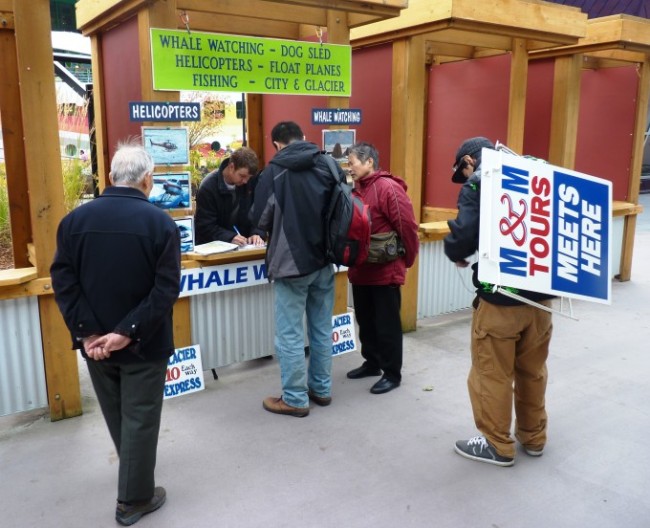
Tourists off the Norwegian Sun book a Mendenhall Glacier tour near Juneau’s waterfront on one of the last days of the 2014 tourism season. The city is looking at establishing a tourism management office to better coordinate all of the independent tourism-related activities the city manages.  (Photo by Ed Schoenfeld/CoastAlaska)

On Monday, the Juneau Assembly took one of its first substantive steps to follow through on a task force’s recommendations for managing the visitor industry.  

The first recommendation in the Visitor Industry Task Force’s final report (completed in March of 2020) was to establish a tourism management office in the city government, which means creating a new position for a tourism manager. 

“We have a mosaic of management on the waterfront, between Public Works, Parks and Rec, and Docks and Harbors, and it can be clunky, but it can work quite well, as well. And it requires a lot of coordination,” said City Manager Rorie Watt. 

Centralizing would mean the city could more easily work with the cruise industry with a holistic view. 

The position description hasn’t been written up yet, but Watt said there’s one specific duty that would give the city better leverage with the cruise ship industry. 

“The lynchpin though, I think for the success of a tourism manager is … that they have a role in the scheduling of the docks,” Watt said. 

The city owns two of the four berths large cruise ships can tie up to but largely leaves scheduling and logistics up to a private business that works with the cruise lines. 

Watt is working on budget legislation to pay for the position. That will still have to go through a public hearing process and Assembly vote before it’s final. He estimated $150,000 in cruise ship passenger fees would be enough to fund the position once hired through next June.

He said he hopes someone will be hired by September.

From burgers to buildings, supply chain woes are hitting Alaska

McDonald's in Juneau
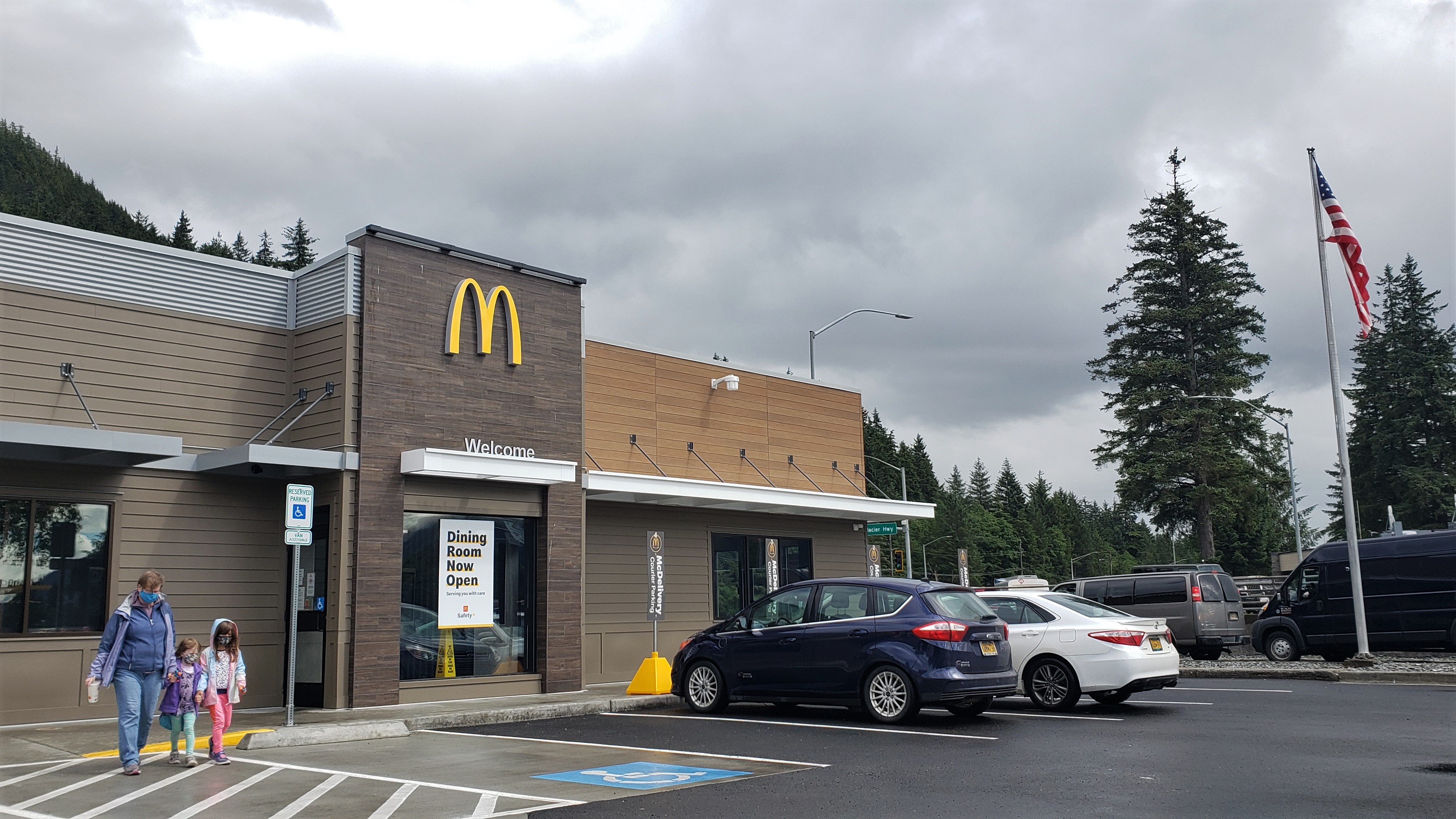
Juneau has one McDonald’s, pictured here on July 9, 2021. While many local restaurants have had to raise their prices to deal with supply chain issues, the price of a McDonald’s quarter pounder with cheese has only gone up 10 cents since 2019. (Photo by Jeremy Hsieh/KTOO)

Alan Brown moved to Juneau recently from Nashville, Tennessee, and he’s got a little sticker shock going through the drive-thru at McDonald’s in Juneau. He orders a McNugget meal and the guy on the other side of the speaker tells him his total, and to have a good day. 

“So $10.17’s my total. At home, it would’ve been like, $7 and change,” Brown says.

Brown isn’t an economist, but he did a thing economists like doing with McDonald’s menu — he compared the price of an identical product in two different markets. The menu is also a handy way to track inflation in one place over time. 

The Economist magazine has its Big Mac index. But for decades, state economists have gone with the quarter pounder with cheese, occasionally highlighting what it costs in different Alaska communities in the magazine Alaska Economic Trends. Spoiler alert for the July issue: It’s $5.49 in Juneau, up 10 cents from before the pandemic in 2019. 

This issue of Trends focuses on spikes in the cost of living, and attributes a lot of that to supply chain problems related to the pandemic. There was deflation last year amid lockdowns, but now the world is reopening. 

McDonald’s wouldn’t answer questions for this story. But a local food truck business that specializes in burgers shared what’s driven its first price increases since opening in 2014. On social media last month, Pucker Wilson’s said its supply costs have more than doubled since January. So, the prices of most menu items went up by $1. Pucker Wilson’s cheeseburger is now $10.

Restaurants generally operate on thin profit margins, so they’re especially sensitive to changes in food prices. Plus, staffing is tough right now, and there are fewer customers around with a short cruise ship season. 

“This is by far and away the hardest thing that we’ve ever had to deal with,” said Reecia Wilson, the main owner of five downtown Juneau restaurants, including Hangar on the Wharf.

Wilson said market conditions led her to leave two of her seasonal restaurants closed this summer and raise prices.

“It’s difficult to manage your day-to-day operations and just get through the day, let alone worrying about having to reprint your menus, and pay attention to the inflation as we lean into a very different business model,” she said. 

Wilson said prices are up across the board, with meats and seafood especially. She hopes the supply chain problems are temporary and that she can rebuild her businesses. 

Meilani Schijvens, who runs the economic publications firm Rain Coast Data in Juneau, summed up her take on what’s going on. 

“I think that most people — most organizations — miscalculated how quickly once people got the vaccines, and once the vaccines were distributed — how quickly sort of normal life would return, and so, normal demand,” Schijvens said. “And so you just see a lag. And you see it locally, nationally, globally, in terms of getting the supply chains up to the level of the demands that we are now having.” 

Burgers and menu prices are one indicator of supply chain issues. Schijvens highlighted another price-related indicator, often measured by the millions. 

“So we’re seeing a lack of building supplies. We see that locally with our building projects, our construction projects, have gotten really expensive, really fast,” she said. 

The Alaska Department of Transportation and Public Facilities does a lot of construction, and Christopher Goins is the DOT construction engineer who estimates he’ll oversee more than $140 million in the department’s construction contracts across the region this season. 

“We’re definitely seeing price fluctuations, a lot of prices going up, materials shortages in general, across the board,” Goins said. 

The way competitive bidding on government contracts goes, construction companies doing work now likely locked in what they’re being paid months ago, or even years ago for multi-season projects — before materials prices went wild. 

“Yeah, so (for) the most part, our state of Alaska contracts really don’t have what we call ‘escalation clauses,’” he said. “When a dollar amount comes in, it’s pretty much a fixed dollar amount for that contract.”

Goins said the department has been willing to give contractors extra time. But it’s on them to factor risk into their bids, which Goins is seeing for projects in the bidding stage now. 

When bids come in higher than budgeted, there’s only a few options: Ask policymakers for more money, scale projects back to fit the budget or don’t build. 

“So, that’s the harsh, hard realities of the budgeting process from our end,” Goins said. 

It’s pretty much the same story with Goins’ counterpart at the City and Borough of Juneau.

Looking forward, Goins has hopes, but no certainty. 

“I don’t think we’re through this inflationary blip, if it is a blip,” he said. “And hopefully, the markets, as the country gets back to producing and the world gets back to producing, we hope that some of those higher spikes will begin to fall.”

The industry group Associated General Contractors of America has said the materials and supply chain problems may put some firms out of business and add to the industry’s high unemployment rates

Site notifications
Update notification options
Subscribe to notifications