Jeremy Hsieh

Local News Reporter, KTOO

I dig into questions about the forces and institutions that shape Juneau, big and small, delightful and outrageous. What stirs you up about how Juneau is built and how the city works?

Signature gathering falls short for ballot initiatives to limit cruise ship traffic in Juneau

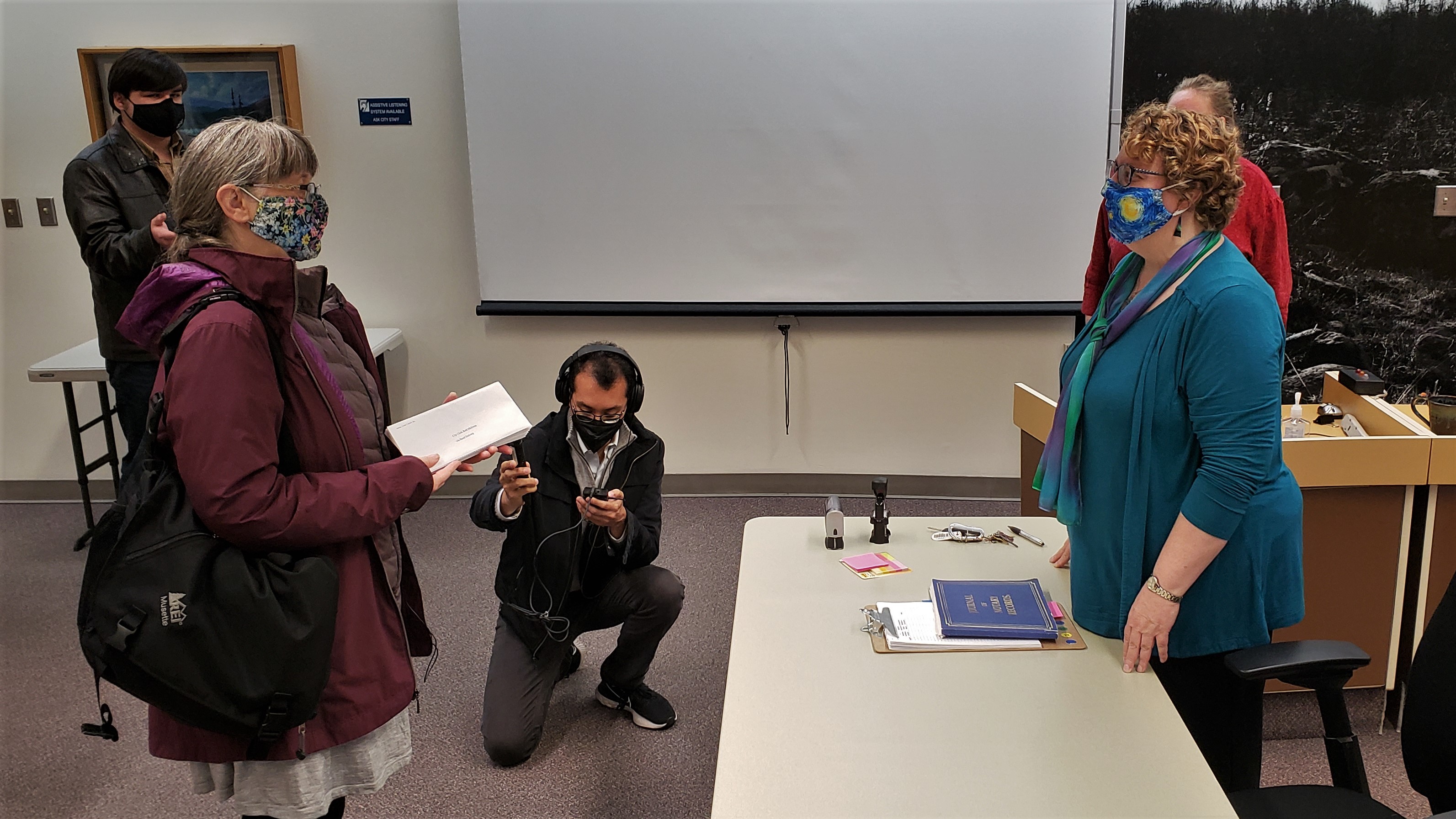
Karla Hart of Juneau Cruise Control delivers letters addressed to the Juneau Assembly regarding cruise ship impacts to City Clerk Beth McEwen at City Hall in Juneau on June 2, 2021. The group wasn’t able to collect enough signatures by the deadline that day to advance ballot questions Hart proposed to limit cruise ship traffic in Juneau. (Photo by Jeremy Hsieh/KTOO)

A group of Juneau residents who want to limit cruise ship traffic in town didn’t get enough signatures to advance any of their three proposed ballot initiatives. Now that group and their opponents are both looking to city officials for what comes next.

Wednesday was the deadline to turn in petition signatures of qualified Juneau voters. Instead of turning in booklets with thousands of signatures to the city clerk, Karla Hart delivered letters addressed to the Juneau Assembly.

“We have submitted a letter to the Assembly that we will not be submitting the petitions,” Karla Hart said at a press conference Wednesday morning after meeting with the city clerk. “While we got a substantial number of signatures, we didn’t meet the target to get onto the ballot.”

Hart wouldn’t say how many signatures they managed to collect. Her group, Juneau Cruise Control, needed about 3,000 for each of their three proposals to go forward.

Hart wouldn’t say how many signatures they managed to collect.

“We’ve collected a substantial number of signatures, but we did not collect enough,” Hart said. “The weather and the pandemic were daunting foes. We’re confident, with a little more time, we could have achieved the number.”

The group wanted to ban cruise ships between 7 p.m. and 7 a.m., and on Saturdays. And then beginning in 2026, ban cruise ships over a certain size.

The letter Hart’s group submitted asks the Juneau Assembly to impose some limits, and for the cruise ship companies and tour operators to voluntarily limit their impacts.

“We’re going to give the city the chance, and the industry, to do the right thing,” Hart said. “And if they don’t, we’ll be back. Well, we’re not going away at all. We’ll be around.”

Hart said industry opposition and a counter-campaign also made signature gathering difficult. The group claims in its letter that some people were supportive but wouldn’t sign because they feared blowback in their job or at their business or with their friends, neighbors and relatives.

After meeting with the clerk at City Hall, the group took press questions under a park shelter across the street. There weren’t any big cruise ships in town, but Hart kept getting interrupted by trucks hauling shipping containers.

“These guys must be really happy there’s no cruise ships right now!” she said as one truck passed.

Over the noise, supporter Pat White asked, “Can you imagine, buses, this, tourists?”

Laura Martinson is a downtown gift shop owner and co-chair of Protect Juneau’s Future, which ran a “don’t sign” campaign. She says her group was overwhelmed with gratitude.

“I don’t think any of us expected this kind of groundswell of unity across the community and we really heard the resounding voices of stakeholders far and wide,” Martinson said.

Martinson said that includes local business owners, employees, Native corporations, unions and citizens without tourism ties concerned about a sustainable future for Juneau.

Martinson said the failure of the ballot initiatives clears the way for discussion and work to continue on managing the growth of the visitor industry.
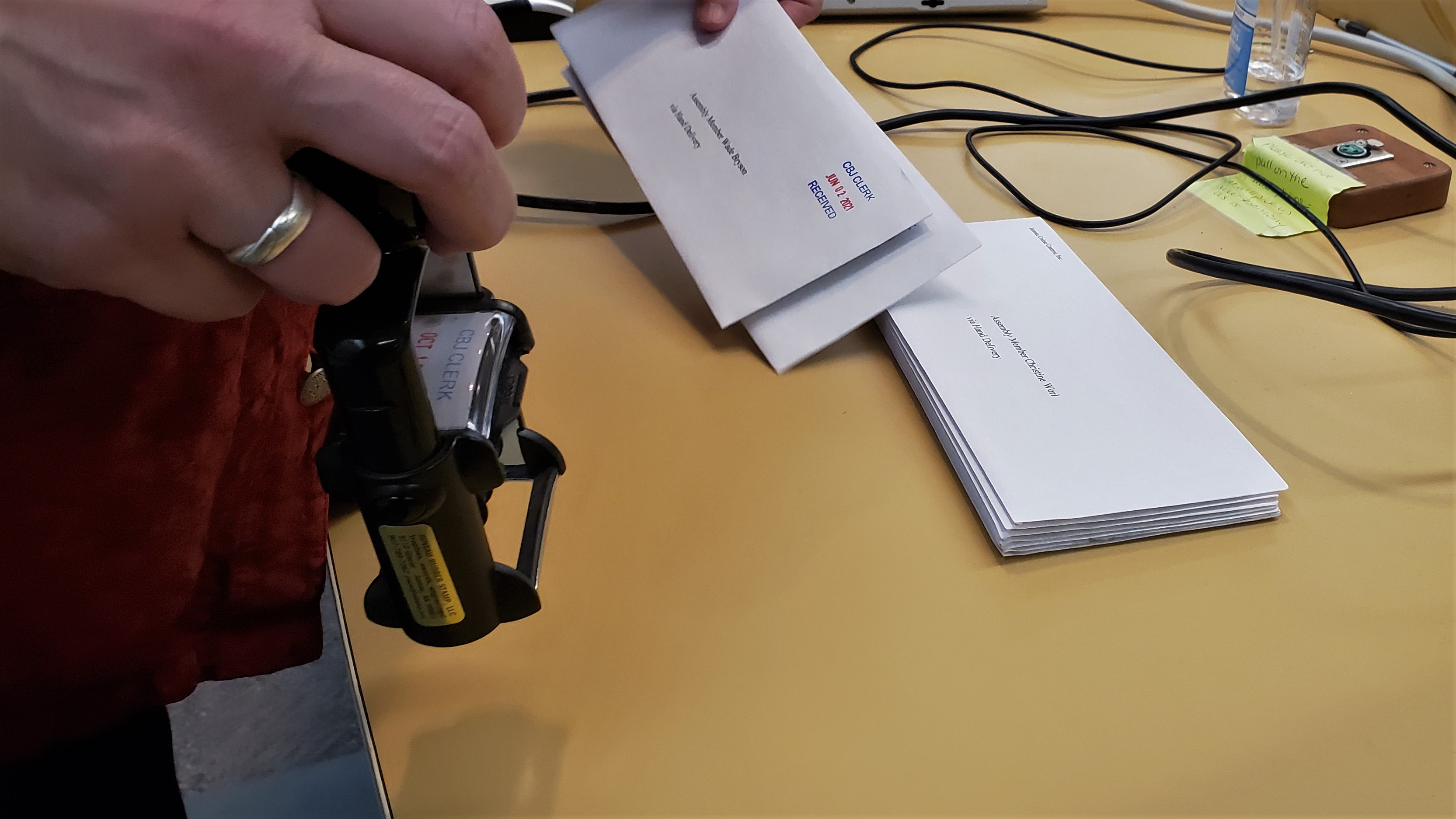
Deputy City Clerk Di Cathcart stamps letters
Deputy City Clerk Di Cathcart stamps letters addressed to the Juneau Assembly asking for action to limit cruise ship impacts from Juneau Cruise Control at City Hall on June 2, 2021. (Photo by Jeremy Hsieh/KTOO)

City officials are beginning to work through a long list of recommendations from the Visitor Industry Task Force, whose work got put on the back burner when the pandemic struck last year.

“The visitor industry task force did an enormous amount of work to lay the groundwork on how we should proceed and how we should best manage our industry going forward,” Martinson said.

Assembly member Carole Triem chaired the task force. She said some recommendations, like extending seasonal barriers along sidewalks that keep pedestrians out of the street, have already been implemented. And she said the Assembly will be ready to discuss creating a city staff position focused on tourism impacts soon.

Meanwhile, Hart said volunteer support for her group grew from a handful of people at the beginning of the ballot initiative process, to perhaps 50 now.

“Next time, we’ll start with a lot more power. If there’s a next time,” Hart said.

Her supporters chimed in, “There will be! There will be a next time!”

“I still have hope the Assembly will do the right thing,” Hart said.

City codes may bar Juneau Cruise Control from trying ballot initiatives again for at least six months. Hart said that’s fine by her.

Editor’s note: This story has been expanded with additional comments and context. 
Juneau Assembly formalizes land acknowledgments and improves meeting access

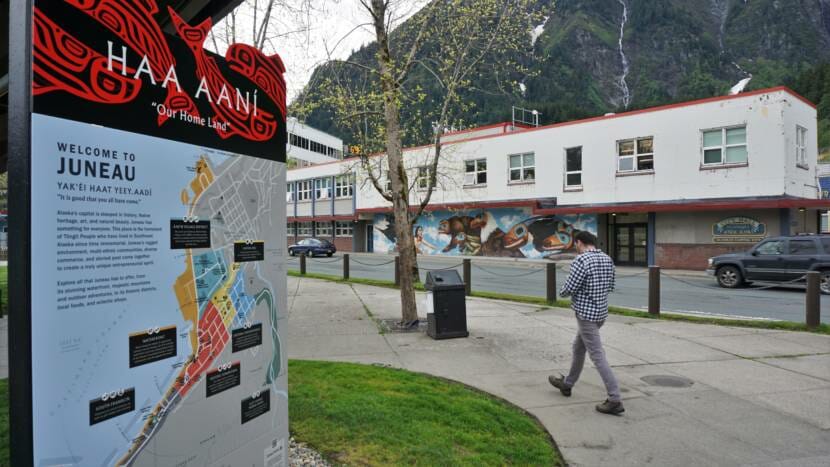
A pedestrian walks past Juneau City Hall on June 1, 2021. The Juneau Assembly recently incorporated indigenous land acknowledgements into their meeting procedures. (Jeremy Hsieh/KTOO)

The Juneau Assembly got together in-person, mostly, for its regular meeting last week for the first time in over a year. One member was still participating through Zoom — but not because of the pandemic. She was out-of-town on city business.

During the meeting, the Assembly adopted new rules that institutionalized how that member was participating, among other pandemic meeting practices. Now Assembly members and the public can keep watching and participating in meetings remotely after the pandemic is over. 

The new rules also include Indigenous land acknowledgments. 

At the beginning of some Juneau Assembly meetings, right after the Pledge of Allegiance, you may have heard something like what Assembly member Christine Woll read on May 24: 

“We want to take this opportunity to acknowledge the City and Borough of Juneau is on Tlingit land. And to honor the A’akw Kwáan and T’aaḵu Kwáan, the Indigenous people of this land. For more than 10,000 years, Alaska Native people have been and continue to be integral to the well-being of our community. We are grateful to be part of this community, and to honor the culture, tradition and resilience of the Tlingit people. Gunalchéesh.”

Assembly members started making land acknowledgments at their regular meetings a few months ago, about the same time they were participating in dialogues on racial equity with the First Alaskans Institute.

The Assembly’s land acknowledgments haven’t been consistent, but now that it’s in the rules of procedure, they are supposed to be.

Rhonda Butler is the Camp 2 president of the cultural and civic group Alaska Native Sisterhood in Juneau. She’s of Haida descent, Raven Double Fin Killer Whale of the Yak Laanas clan, and the grandchild of a Tlingit L’uknax.ádi Raven Coho.

“It makes me feel good inside that recognition is being given appropriately and respectfully to the people that resided here prior to Western civilization coming in and changing things for us,” Butler said. “So that’s very nice, a very nice respectful touch from the city of Juneau.” 

Butler said land acknowledgments are becoming more common in the community, which she sees as a sign of better awareness of Alaska Native cultures. 

The package of rule changes were originally about updating options to access city meetings. In committee last month, Assembly member Alicia Hughes-Skandijs asked for the land acknowledgment piece to be added. 

The committee voted yes, 6-3. Assembly members Loren Jones, Michelle Hale and Mayor Beth Weldon voted no. 

Weldon and Hale said they wanted to spend more time fine-tuning the wording, among other things. 

Jones didn’t have much to say before his vote. 

“I will be voting no. I don’t think we need to do the land acknowledgments,” he said. 

Reached later, he declined to discuss his vote. He said it was too controversial. 

The Assembly later passed the entire package of rule changes unanimously. 

The other changes improve meeting access for members participating and the public, even after in-person meetings resume. 

“After going through all our meetings on Zoom, we realized that Zoom was probably going to be a component of our meetings from here on out,” Mayor Weldon said. 

References in the old rules to allow for limited telephone participation have been swapped out for remote participation. 

“It allows our members who are not present a better way for them to come in, rather than the teleconference, which was very difficult to call in and be an active part of the meeting. And it also allows some of our public another option to testify,” she said. 

Also, Assembly meetings now generally must be broadcast live. That applies to full Assembly meetings, Assembly committees and some other local, public bodies, like the Planning Commission and Eaglecrest Ski Area Board. 

As the pandemic escalated last year, the Assembly temporarily suspended requirements for meeting in person and began webcasting video of meetings over Zoom and sometimes Facebook Live

Weldon highlighted one more benefit that comes with broadcasting the meetings: closed captioning. 

City Clerk Beth McEwen said before the pandemic, she would sometimes hire sign language interpreters to work meetings live, when requested. But that didn’t work very well over Zoom. So now McEwen hires captioners to accommodate people with hearing impairments. 

Juneau property tax rate to stay flat under city budget that’s nearly finished

property tax bills
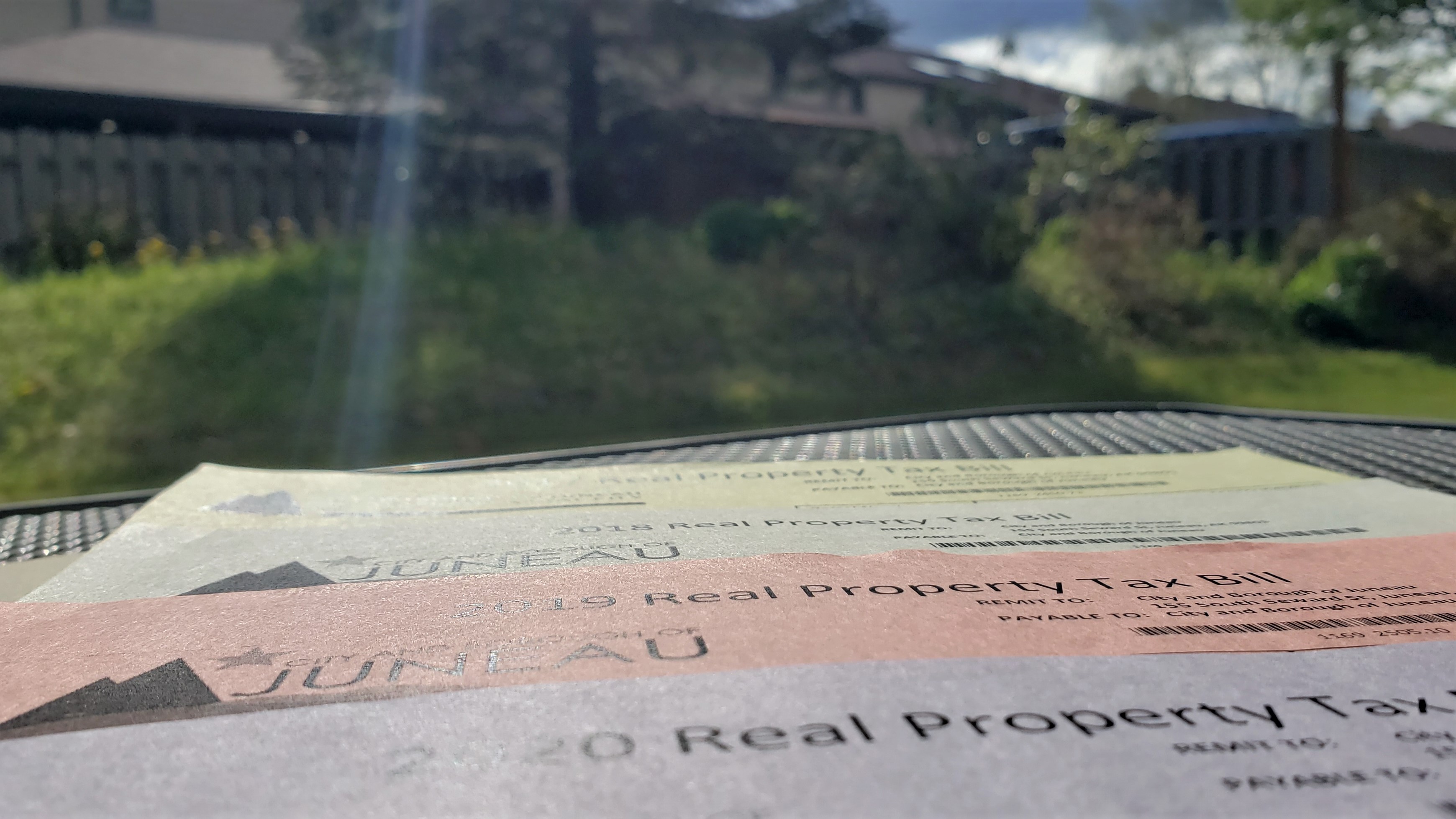
The City and Borough of Juneau’s property tax bills, like these from 2017 through 2020, come in a variety of paper colors. Property tax bills are calculated by multiplying the mill rate — 10.66 in recent years — by a property’s assessed value. (Photo illustration by Jeremy Hsieh/KTOO)

After considering raising then lowering the local property tax rate, the Juneau Assembly decided to keep it the same.

Property tax bills are calculated by multiplying the mill rate the Assembly sets by a property’s value, as determined by the Juneau Assessor’s Office each year. Ten mills is the same thing as 1%. The property tax rate on most real estate in Juneau is 10.66 mills. For a typical $300,000 home in Juneau, the annual property tax bill works out to $3,198.

City officials began the budget process this year with a lot of uncertainty about federal aid, the pandemic and the cruise ship season. The city manager proposed raising property taxes by .2 mills, and burning through about $7.8 million — a fifth of the city’s savings — to keep the city government running over the next year. 

In light of federal pandemic relief money and higher-than-expected property values that became clearer over the spring, city finance officials still expected a several million dollar gap between income and spending — but a significantly smaller one at $2.8 million. 

That prompted the Juneau Assembly last week to reject the manager’s proposed tax increase and debate lowering the property tax rate to 10.56 mills. That would save a property owner $30 on a $300,000 home. 

Assembly member Michelle Hale suggested the tax cut. 

Michelle Hale

“If not now, then when?” Hale asked. “We are in the second year of recession. We’ve had incredible benefit from the federal government to keep us whole, really. But we are in the second year of a worldwide pandemic. We’re coming out of it now. We expect to be more out of it next year, financially in particular. And that’s why we have reserves.”

Hale said she didn’t have financial relief for property owners in mind. Instead, she said she just didn’t want the government to raise more money than it needs. 

Hale didn’t get enough support to lower the property tax rate. Her motion failed in a 3-6 vote. Hale, Greg Smith and Wade Bryson voted yes. Members Loren Jones, Christine Woll, Alicia Hughes-Skandijs, Maria Gladziszewski, Beth Weldon and Carole Triem voted no. 

But, Assembly member Maria Gladziszewski’s push to keep the property tax rate flat passed unanimously. 

Maria Gladziszewski (Photo courtesy Maria Gladziszewski)
Maria Gladziszewski

“There’s still uncertainty in revenues that we’re facing, we still have a deficit,” Gladziszewski said. “But I absolutely believe it’s responsible to collect enough revenue, pay for the new thing that you’re doing. And we are doing a new thing, and that’s child care.”

She was referring to a subsidy program for child care businesses that’s intended to increase child care availability and affordability in Juneau. 

City finance officials project the near-final tax rate and budget would burn through about $5.7 million of the city’s savings over the next year. 

There are several pieces of the city’s budget that the Assembly will have to adopt over its next few meetings. Monday night, the Assembly plans to adopt the Juneau School District’s budget. On June 14, it plans to adopt the city’s overall operating budget, a capital budget and the property tax rate. 

Newscast – Friday, May 21, 2021

In this newscast:

  • A family member of the missing Geraldine “Gerry” Nelson says the 78-year-old woman has been found,
  • the special legislative session begins in Juneau,
  • about 1 in every 10 Alaskans were in a household that applied for a massive pandemic rent relief program,
  • the Rasmuson Foundation names Juneau writer Ernestine Hayes its 2021 Distinguished Artist, and
  • YouTuber NuttyNu gains a following showing the grittier side of Anchorage.

Pandemic rent relief program received applications for about 1 in every 10 Alaskans

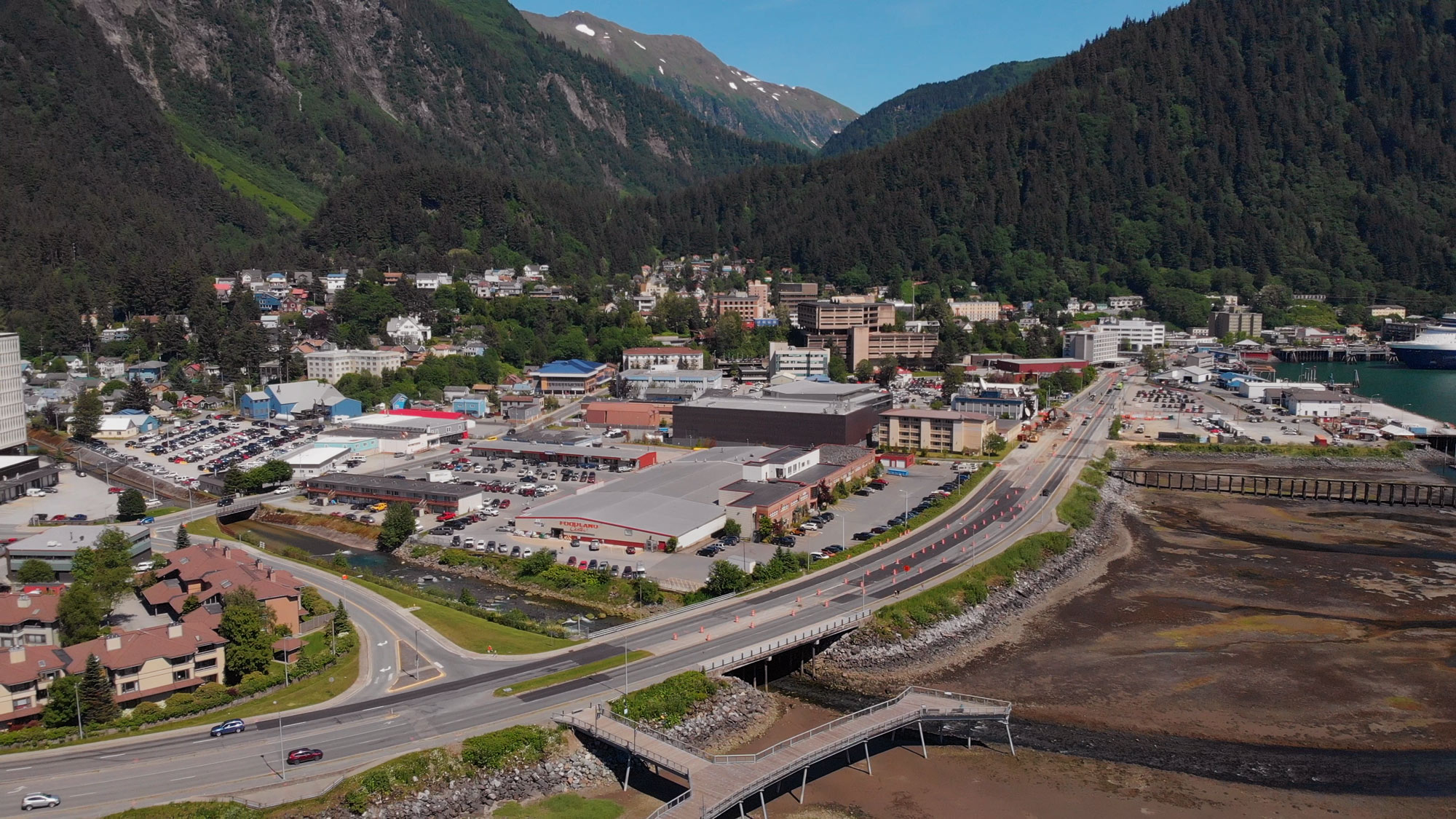
Juneau's Willoughby District on June 25, 2019.
Juneau’s Willoughby District on June 25, 2019. (David Purdy/KTOO)

About one out of every 10 Alaskans were in a household that applied for a massive pandemic rent relief program earlier this year.

Since the application period for the federally funded program closed in early March, a small army of nonprofit housing and tribal employees have been processing some 25,000 income-qualified applications to cover up to a year of rent and utilities.

Daniel Delfino directs the planning and program development department at the Alaska Housing Finance Corp., which is administering the program.

They anticipated a lot of applications after a different relief program was swamped last year, so they built their paperwork and review process with speed in mind. Delfino said they even used stopwatch tests to gauge how quickly workers could process different versions of the paperwork.

From the administrative side, that’s worked out well. But it’s a little different from applicants’ perspective.

“Well, uh, it’s a mix,” he said. “So the folks that have received money, I think in large part are happy. The folks that are still waiting for money, it’s no consolation to them that we’re one of the fastest states in the country to get the money out the door if they can’t pay their rent or their utility bill.”

Of the 25,257 applications that cleared the initial income and documentation hurdles, about 60% remain to be processed.

The program is getting about 600 to 800 calls a day, Delfino said, mostly from people checking their status. A status checker on their website is also getting about 800 unique user visits a day.

That includes Karla Pineda.

“It looks like it’s a little slow, because I think I’ve been waiting for, like, three months already,” Pineda said.

She’s a single mom who’s come to Juneau seasonally for about 9 years. Last year, she made Juneau her home year-round.

She said getting this help will be a big deal for her. She’s been able to make her rent by working for a company cleaning homes, and as an on-call assistant aide at the Juneau Pioneer Home, but she can’t really save money.

“As you know in Juneau, it’s not that cheap,” Pineda said. “The rentals are expensive, especially if you want to live in a secure place, especially with a kid, it’s not easy to find.”

There’s a big bucket of federal cash available for the program, about $242 million. That figure represents a combination of AHFC’s share, pooled with similar funds for the Municipality of Anchorage and 148 tribal entities that AHFC is administering the program for. The bucket is so big, state housing officials think it’s enough to pay rent for everyone eligible for a year.

Here’s a quick look at the numbers so far. In Juneau, AHFC says about $1.2 million has been paid out on behalf of 586 Juneau households. Another 901 Juneau applications remain in the queue. Statewide, about $26 million has been paid out so far on behalf of more than 10,000 households.

“That’s what’s happening right now,” Delfino said. “We’re trying to wipe out every past due balance that people have that they walked into the application queue with.”

After overdue bills are taken care of, landlords and utility companies will start getting checks for three months at a time going forward for up to a year.

“I’m not anticipating a challenge exhausting that money,” Delfino said. “We received a massive response. It’s, I believe, over 10% of our state are represented in the households that applied to this program, that’s 78,000 and change.”

And there’s even more federal funding destined for the program that could extend the benefits to up to 18 months.

“Right now, we’re just trying to make sure that we get the first round of money out to the people who haven’t received their first payment yet,” Delfino said. “That’s our big priority, it’s just making sure that we get through the queue first.”

Money for the second phase is pending in the state operating budget bill.

Watch: Juneau officials to discuss newly relaxed masking requirements at 4 p.m.

Juneau officials plan to discuss the recently relaxed masking rules during a community update on COVID-19 at 4 p.m. today over Zoom.

City officials will also discuss COVID-19 case numbers, testing guidance for travelers flying into Juneau and vaccination options.

You can watch here, on the city’s Facebook page, or listen in by calling 1-253-215-8782 or 1-346-248-7799 with the webinar ID 985 6308 5159. The public can ask questions in advance by emailing COVIDquestions@juneau.org.

Anyone age 12 or older is eligible to get vaccinated. Vaccine appointments are available through local health care providers and pharmacies, and pop-up clinics that local businesses and organizations have requested.

As of Monday, city officials were aware of nine people with active cases of COVID-19 in the community.

Site notifications
Update notification options
Subscribe to notifications