I dig into questions about the forces and institutions that shape Juneau, big and small, delightful and outrageous. What stirs you up about how Juneau is built and how the city works?
If everyone is fully vaccinated at an indoor event, everyone can go maskless.
There are no required precautions or attendance limits for indoor gatherings if everyone is fully vaccinated. Likewise for personal service businesses and gyms.
Restaurants and bars still must maintain 6 feet of social distancing. Patrons are still expected to wear masks when they aren’t actively eating or drinking.
Anyone in Juneau age 12 to 18 is welcome at these free clinics — school enrollment isn’t required. For kids 17 or under, they must be accompanied by a parent or caregiver, or get a signed permission form.
As of Wednesday, city officials know of 19 people with active cases of COVID-19 in Juneau.
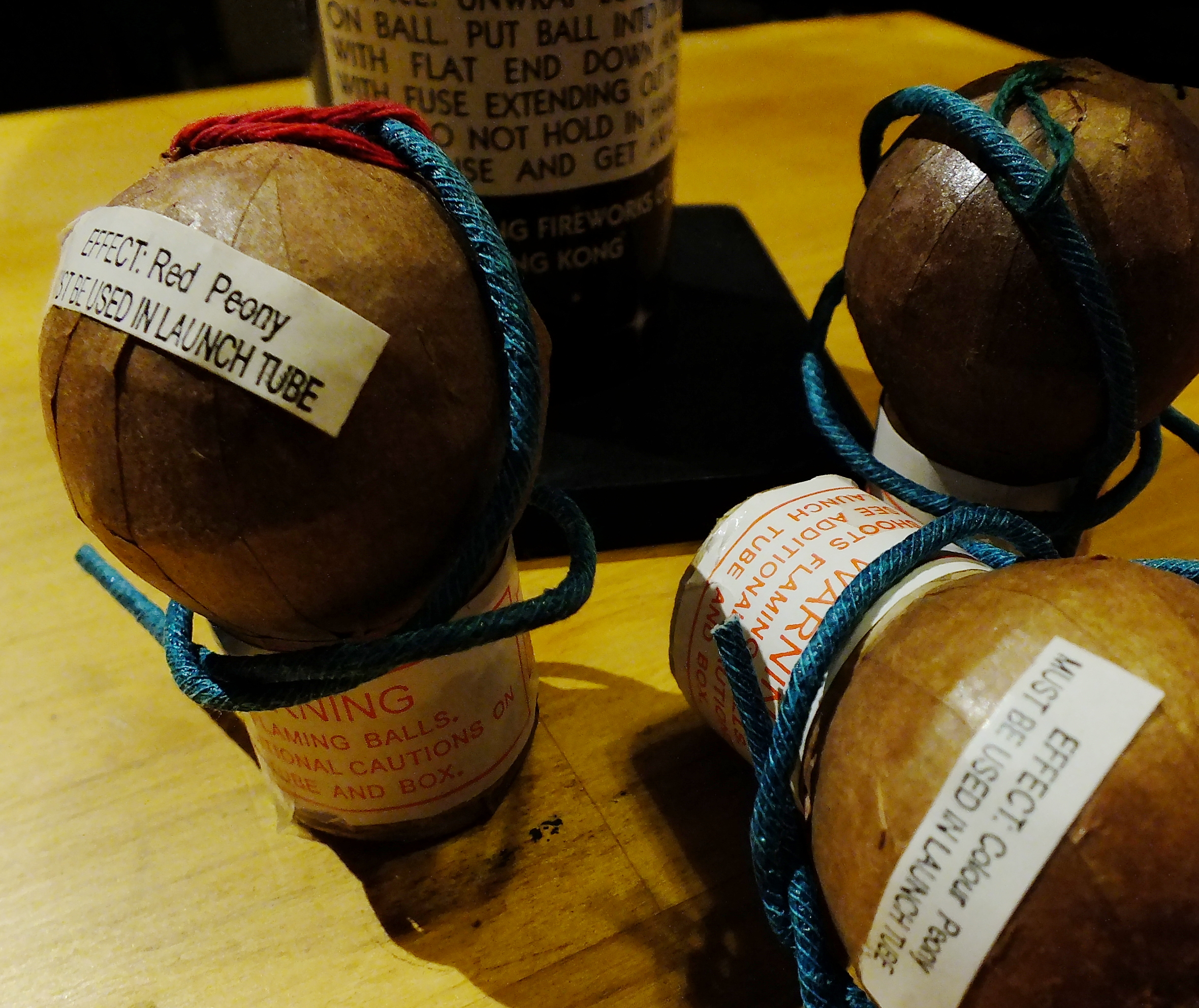
Fireworks like these are considered “shells” in state law. They’re the biggest, boomiest fireworks legal to sell in Alaska, though their use would be mostly banned in Juneau under a proposed fireworks ordinance. (Photo by Matt Miller/KTOO)
The proposal to tamp down on the sale and use of fireworks in Juneau is headed to a public hearing and final vote. It could take effect before the Fourth of July.
The initial draft assembly member Michelle Hale introduced in February was very restrictive. It attempted to ban sales altogether and banned using fireworks — even sparklers — in most populated parts of Juneau 361 days of the year. The version that emerged from committee on Monday is a lot more permissive.
First, sales. In this version, they’re allowed with a city permit in more remote parts of Juneau. And there’s a carveout for federally recognized tribes; the pop-up fireworks shop the Central Council of Tlingit and Haida Indian Tribes of Alaska started last year along Fish Creek Road won’t need a city permit.
Tlingit and Haida Central Council representatives could not immediately be reached for comment.
Now for the fireworks themselves.
The biggest, boomiest types of fireworks that are legal to sell in Alaska are called mines and shells. They’re shot out of a mortar. Regular people could use these only around New Year’s and Fourth of July, and only outside of the city’s fire service area. As far as what’s accessible by road, that basically leaves a few miles of North Douglas Highway, a few miles of Fish Creek Road, and out the road past Cohen Drive.
Small scale fireworks like fountains and sparklers would be fair game to use in town, year-round before 10 p.m.
For noisier fireworks like firecrackers, roman candles and bottle rockets, the proposed policy splits the difference. They’d be OK year-round outside of the fire service area. Around the Fourth of July and New Year’s, they’d be OK in town, too.
The proposal also would limit possession of fireworks to 75 pounds a person.
Some assembly members worried the new policy is too complicated. Assembly member Greg Smith worked on a lot of the policy’s revisions.
“I think there is a way to communicate the type, time and location details to the public in a digestible way,” Smith said. “I think we have a path here towards a good compromise, that will not make everyone happy.”
Assembly member Loren Jones had a very dim outlook of how it will play out.
“I have been in this town and they are not going to stop the fireworks. And it’s gonna boom off West Juneau and into my bedroom, fired off the beach and nothing you put in this ordinance is going to fix it,” Jones said. “So I am a no vote. I think we have overcomplicated this and it should be a complete ban, that’s the only thing that’s enforceable.”
Jones thinks fireworks users will ignore the rules, it’ll be burdensome for police, and fireworks complaints will keep filling Assembly members’ inboxes.
The Assembly Committee of the Whole sent the fireworks policy to the full Assembly in a 7-2 vote. Mayor Beth Weldon and Loren Jones voted no.
The full Assembly plans to hear the ordinance initially Wednesday night, then hold a public hearing and final vote on May 24. If the Assembly sticks to its timeline, the new fireworks rules would take effect 11 days before the Fourth of July.
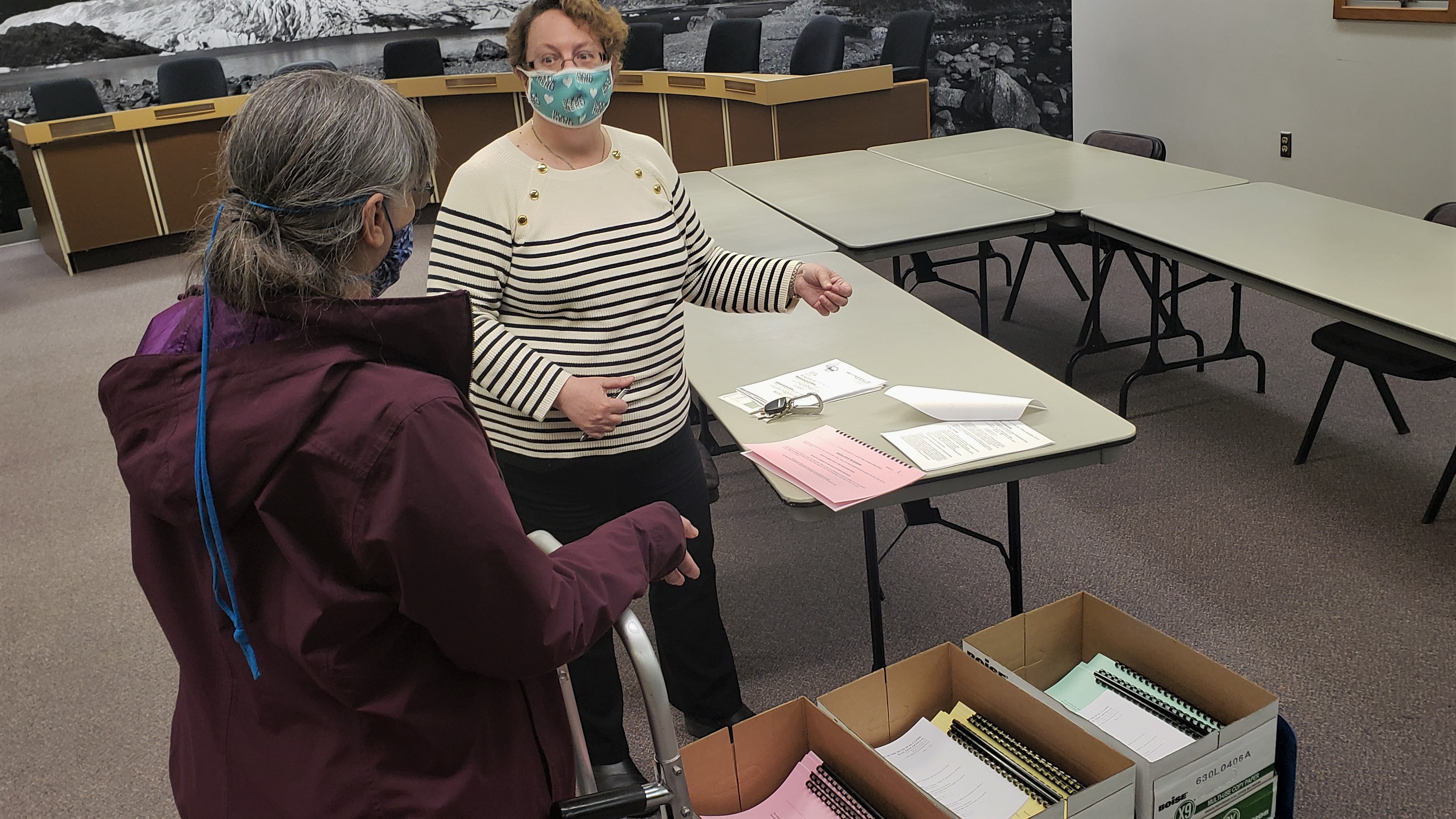
Juneau City Clerk Beth McEwen walks Karla Hart through what’s in the 225 signature gathering booklets she is picking up at Juneau City Hall on Monday, May 3, 2021. To get the questions on the October ballot, Hart and her volunteers will need to collect nearly 3,000 qualified signatures for each question she’s proposing to limit cruise ship traffic. (Jeremy Hsieh/KTOO)
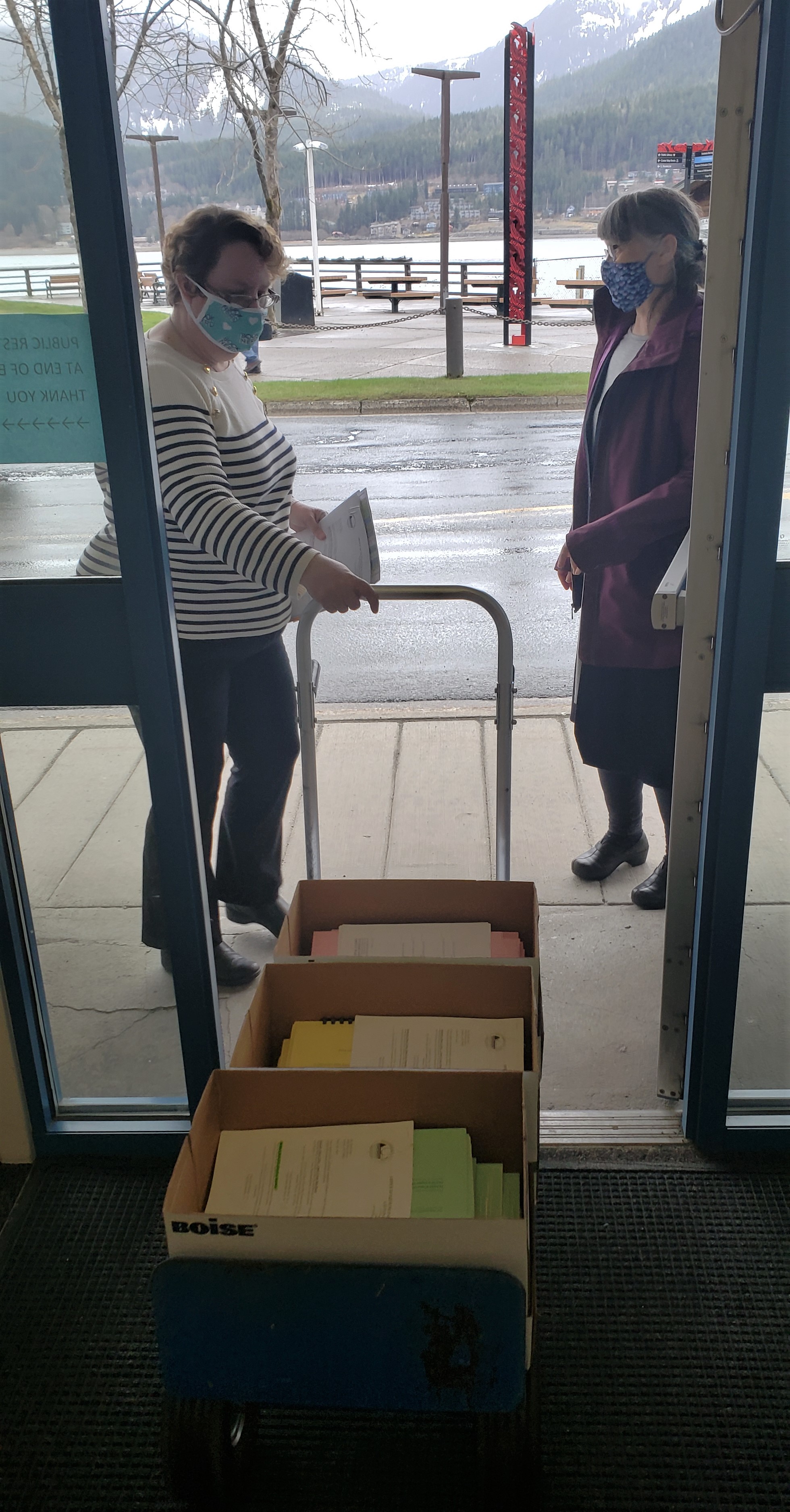
The lead sponsor, Karla Hart, picked up the official signature booklets at City Hall on Monday. City Clerk Beth McEwen helped deliver 225 official signature gathering booklets to Hart’s Honda hatchback outside City Hall.
Juneau City Clerk Beth McEwen helps wheel 225 signature gathering booklets out to Karla Hart’s car at Juneau City Hall on Monday, May 3, 2021. (Jeremy Hsieh/KTOO)
Volunteer Steve Krall got the first few booklets.
“You can be number one, eh, Steve?” Hart said.
“Oh boy, that’s exciting,” Krall deadpanned. “It’s a great thing for somebody who doesn’t like talking to people to be doing.”
Hart said that sentiment is pretty common among the volunteers.
“A lot of people who do this, including myself, are driven by our passion. But it’s not necessarily in our nature … walking out and talking to lots of people,” Hart said.
If people support these limits, it’s at least partly because they’re not into big crowds.
Hart is proposing three amendments to the city’s charter targeting cruise ships. One would make Juneau off limits between 7 p.m. and 7 a.m to ships with passenger capacities over 250. One would ban those same ships on Saturdays. And one would ban all cruise ships over 100,000 gross tonnage, beginning in 2026.
If all three were in effect next year, the local opposition group Protect Juneau’s Future has roughly estimated they would cut passenger visits to Juneau down to a quarter of what’s expected. The group said that’s a conservative estimate based on the 2022 cruise ship calendar. They got there by dropping big ships, Saturday visits, and ships that arrive after 12:30 p.m. The rationale on the last assumption is that after factoring in logistics to actually get passengers on shore and back aboard, their time left to experience Juneau wouldn’t be meaningful.
The group said the lost cruise ship traffic would have ripple effects beyond the visitor industry. Including lost tax revenue that pays for city services the entire community benefits from.
But Hart said the opposition group’s lost passenger estimate assumes the cruise lines wouldn’t rotate in smaller ships and that cruise lines with smaller ships wouldn’t fill openings the bigger ships give up. Hart said it also assumes sudden changes, but if voters approve the size limit, it wouldn’t take effect until 2026.
“Their job is to make the sky fall, or to make it appear that the sky will fall,” Hart said. “I don’t believe that it will.”
For each of the three proposed ballot questions, Hart and her volunteers will need to get nearly 3,000 qualified signatures by June 2. It’s also possible to get a 10-day extension.
To be valid, a signature must be from someone registered to vote who’s lived in Juneau for at least 30 days before signing.
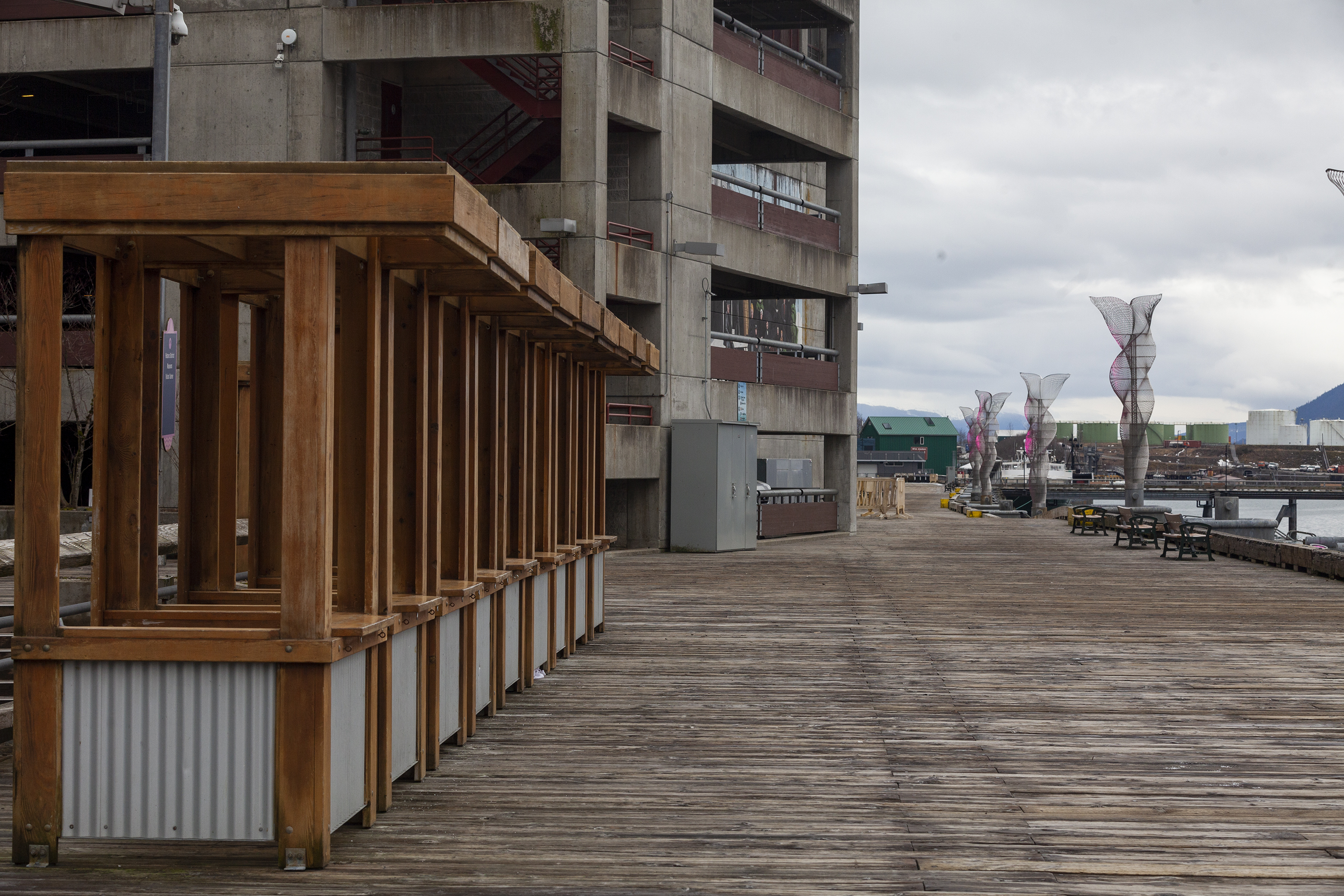
A row of booths used by waterfront vendors during the summer tourist season sit empty on March 21, 2020, in Juneau. They’re likely to stay empty for the summer of 2021, too. (Photo by Rashah McChesney/KTOO)
Norwegian Cruise Line Holdings announced Tuesday that it’s donating $10 million across six Alaska port towns: Ketchikan, Juneau, Hoonah, Sitka, Skagway and Seward.
In its written announcement, the company said it’s making the donation offers directly to each port community to provide humanitarian relief from the ongoing cruise suspension.
“My heart breaks for Alaska and its wonderful people as we face a potential second year of zero cruise operations during the all-important summer tourism season, bringing yet another blow to Alaska’s tourism economy,” CEO Frank Del Rio said in the statement. “Alaska is one of our guests’ most popular cruise destinations and we are doing everything in our power to safely resume operations in the U.S. which will provide much needed relief to the families, communities and small businesses who rely on cruise tourism for their livelihoods.”
The announcement didn’t include the specific dollar figures for each community, and a company representative could not immediately be reached for comment.
But the Sitka Assembly took action last week to accept an offer for $1 million. And Juneau City Manager Rorie Watt said the capital city will be offered $2 million.
“I’m just taking it as a, just sincere good faith effort to try to be helpful,” Watt said. “You know, I think it gets really good symbolic value for them, as well.”
Watt said NCL officials began discussing the donations with him in the fall, well before news broke that some locals were trying to limit cruise ship traffic in Juneau through ballot initiatives.
Watt said there are no strings attached, but the Juneau Assembly will have to accept the money.
The cruise industry as a whole has been mostly unable to sail during the pandemic. But pandemic aside, NCL has been making big infrastructure investments in Southeast Alaska. That includes in Hoonah, Ketchikan and Juneau.
“You know, they’re definitely taking the long view, and they’re trying to develop a system,” Watt said.
The holding company operates Norwegian Cruise Line, Oceania Cruises and Regent Seven Seas Cruises.
The company said it is working through the Centers for Disease Control and Prevention’s process to resume cruises by July 4. It said mandatory vaccinations of all guests and crew are the cornerstone of its plan.
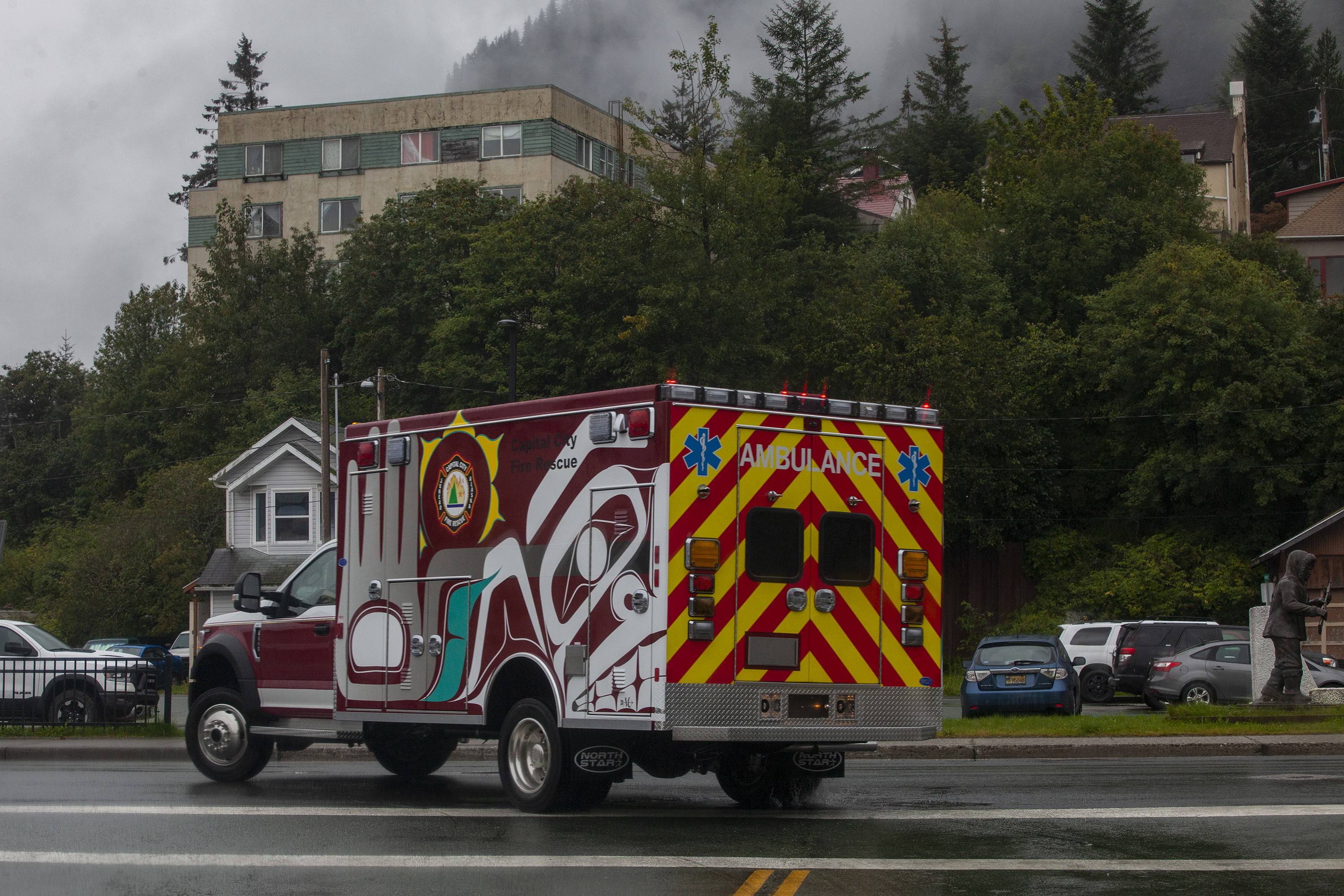
A newly refurbished ambulance decorated with art from Tlingit artists Mary Goddard and Crystal Worl drives through downtown Juneau on August 28, 2020. (Photo by Rashah McChesney/KTOO)
The Juneau Assembly has given its first round of approval for budgets to keep a proactive medical service going for another year and to subsidize child care businesses.
Capital City Fire/Rescue runs the medical service called CARES. It’s short for Community Assistance Response and Emergency Services. It started two years ago when CCFR took over a sleep-off service for intoxicated people that Bartlett Regional Hospital had run.
In response to COVID-19 last year, they started providing more general care and follow-up care in the field to reduce emergency room visits for non-emergency issues.
CCFR Chief Rich Etheridge told the Assembly it’s one of the most exciting programs he’s seen after almost 30 years in fire service.
“This is the first opportunity where we’re able to get proactive and head off problems for not just our agency, but other agencies and community members,” Etheridge said. “And get people the best level of care, and find out the root cause of why they’re needing these emergency services.”
This type of service is sometimes called a community health program or community paramedicine.
Etheridge said these teams often help manage psychiatric issues in the field. For example, he said one paramedic actively seeks out a particular person to administer medication to.
“So that they aren’t having to fight with the police department when the 911 call comes in, and we don’t have to transport them, and then they have to spend time at the hospital,” he said.
In general, Etheridge said of the team members, “They’re really good at de-escalating very agitated people that we meet on the streets and wake up. Overall, they’re kind of that stopgap that fills in holes in the EMS and the mental health system here in town.”
Assembly member Maria Gladziszewski said the approach is great and fits in with bigger conversations around policing.
Etheridge said they have also helped families with end-of-life care before they can get hospice care. That’s meant helping manage pain, or teaching families how to clear their loved one’s airways.
The committee also approved $625,000 for child care programs. Some of that is for training programs for child care workers. Most of it is for subsidies to child care providers, intended to make the economics of running a child care business in Juneau more feasible.
Joy Lyon is the executive director of the Southeast Alaska Association for the Education of Young Children. She shared some highlights that the funding made possible over the last year.
“We only lost one child care who never reopened this past year,” she said. “But other than that they all opened, and actually, three new child care programs opened during this pandemic. So, I think that is pretty remarkable.”
The Assembly’s decisions on these programs are not final. The Assembly plans to hold a public hearing and adopt the city’s overall spending plan and property tax rates for the upcoming fiscal year at its regular meeting on June 14.