KDLG - Dillingham

KDLG is our partner station in Dillingham. KTOO collaborates with partners across the state to cover important news and to share stories with our audiences.
Fat Bear Week delayed after a ‘beloved bear’ dies on camera

Bear 402 with her spring cubs in 2018. (Photo courtesy Maurice Whalen via Katmai National Park and Preserve)

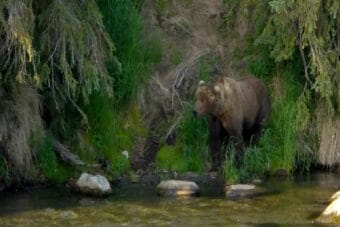
In a shocking live broadcast, one of Katmai National Park’s celebrity bears killed another — just before the start of Fat Bear Week. Viewers from all over the world watched via the live nature cam network explore.org.

The attack took place at the mouth of the Brooks River at roughly 9:30 a.m. Monday. Video footage shows bear number 469 attacking bear number 402 and apparently drowning her after a struggle. He then dragged her body to shore, presumably to eat.

Mike Fitz, a naturalist with explore.org, moderated a livestreamed discussion after the attack.

“402 was a beloved bear by each and every one of us,” he said during the discussion. “Honestly, I think we are all at a little bit of a loss of words.”

Fitz doesn’t know why bear 469 attacked, expending valuable energy. But he said it appeared to be a predatory act.

“I don’t think his behavior is abnormal. It’s well within the spectrum of what we can expect bears to do to one another,” Fitz said. “But how common is this sort of thing? It’s not something that we expect to see.”

The discussion attracted nearly 26,000 viewers. They flooded the comments section with messages like “hugs to all with broken hearts” and “so grateful for the time 402 spent with us.”

Bear 402 was the mother of eight litters and a favorite of bear cam fans going into Fat Bear Week. The annual competition celebrates the bears’ success in fattening up for hibernation. Fans vote for the bear that’s put on the most weight over the summer.

402’s death delayed the release of the Fat Bear Week bracket, which would have come out Monday. The release was rescheduled for 11 p.m. Tuesday.

Bristol Bay sees smallest sockeye sizes on record, despite large run

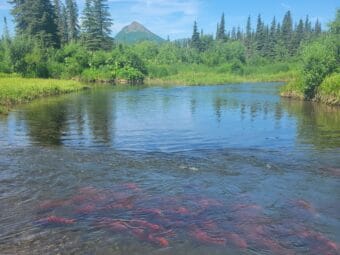
Returning sockeye salmon in a stream near Lake Aleknagik on Sunday, July 21, 2024. (Meg Duff/KDLG)

This year in Bristol Bay, fishing crews have noticed that sockeye salmon were on the small side — an observation confirmed this month by the Alaska Department of Fish and Game.

Fish and Game officials say that at this point in the 2024 season, the sockeye returning to Bristol Bay are on average the smallest they’ve ever seen. This continues a decades-long trend.

So far, the average weight of Bristol Bay sockeye was 4.2 pounds this year. Fish and Game biologist Stacy Vega said that’s the smallest average weight on record.

“Fish are smaller, weigh less than, than they have in the past and against our historical averages,” Vega said.

The exact number could change a bit by the end of the season, but Vega expects it will stay low. That smaller fish size also means a smaller overall catch. By mid-July, Vega said, fishing crews had hauled in almost 130 million pounds of fish. That’s almost 70 million pounds less than this time last year.

Vega said that all kinds of factors go into fish size. The same is true with humans. Age is the most obvious: The tallest toddler is still shorter than the shortest teenager.

But other things also matter: How tall were your parents and grandparents? Did you grow up with enough to eat, or did you experience hunger? And then there are the less obvious things. Over many generations, hotter or colder climates can also impact our body size.

As with humans, so with fish.

“There is nature and nurture to all things that grow,” Vega said.

“Different water temperatures mean not just availability of different food types, they also mean how well you metabolize that food. So temperature, food, wind, currents — there’s so many things that go into how fish grow and how old they get,” she said.

This year, Vega said, the biggest factor for returning sockeye was their age.

“So what we’re seeing here as an overall decrease in weight of fish is a factor of a lot of young fish coming back this year,” she said.

Most of the fish that came back this year are fish that spent one year in the lakes and two years in the ocean. But not all of the fish that came back were the same age. Fish and Game tracks four major age classes. This year, as of July 18, each age group is the smallest they’ve seen, compared to historical data that goes back to the 1970s.

Almost three-quarters of the fish spent one year in the lakes, then two years in the ocean. That age class weighed 3.9 pounds on average. Similar fish that stayed in the ocean an extra year came back heavier, at 5.3 pounds on average.

A smaller group of fish spent an extra year in the lakes before swimming out to the ocean; those fish were just a tenth of a pound heavier than their counterparts, at 4 pounds for fish that stayed in the ocean two years and 5.4 pounds for fish that stayed for three.

For each of those four age classes, Vega said, “We saw the smallest and lightest size of fish we have ever seen in our history. Not by a huge margin — it’s not pounds and pounds — but it definitely is the smallest we’ve ever seen. 2020 was a close second.”

Since 2015, Vega says, more fish have been returning on average. One hypothesis for smaller fish sizes is that when more fish survive early on, there’s less food to go around as they grow. Each fish gets less to eat, and they grow up smaller.

“Ocean conditions, lake conditions, food availability — all that factors into the size of fish and how many return. So it’s all intertwined. But certainly with really big runs we see smaller fish,” Vega said.

And sockeye aren’t just competing with each other. They’re also competing with other species, like pink salmon. Greg Ruggerone, a scientist at the University of Washington, has been testing the hypothesis that pink salmon affect the annual growth of sockeye salmon in the ocean.

Researchers can’t remove all the pinks from the ocean to see what happens to sockeye. But they don’t have to. Because something similar happens naturally: every other year, the number of pink salmon skyrockets.

“Because they have a biennial pattern of abundance: very high abundance and odd numbered years and lower abundance and even numbered years. Sometimes, in some regions, that difference is 25 times more abundant in odd numbered years,” Ruggerone said.

Unlike sockeye, pink salmon stay in the ocean for a set number of years: Odd year and even year populations don’t usually mix. Over the years, one of those populations got big, and one stayed small, so every other year, sockeye have more competitors.

Ruggerone suspected that those competitors might have an impact on sockeye size. With Peter Rand of the Prince William Sound Science Center, Ruggerone analyzed sockeye from the Gulf of Alaska and from Egegik in Bristol Bay for a study in the ICES Journal of Marine Science.

Ruggerone says the data suggest that all of those pinks are indeed having an impact on sockeye size.

“In odd-numbered years when pinks are very abundant, the growth was low. And in even-numbered years, when there were fewer pink salmon, growth during the second and third years at sea was relatively high,” Ruggerone said.

Ruggerone said that pattern is just oneof many factors that made this year’s sockeye smaller. But he said it’s an important factor to keep an eye on, because the number of pink salmon has been growing over time.

Partly, that’s because of hatcheries. But it’s also because wild pinks have been doing really well.

“Going back to the early 1950s, there’s a very strong correlation between pink salmon abundance and the ocean heat index,” Ruggerone said. “Pink salmon are climate change winners.”

Sockeye have also been doing well in terms of the number of fish, despite their shrinking size. But for other salmon species, that abundance of pinks may be a bigger problem. Ruggerone says that complicates traditional management wisdom.

“Fisheries managers, we’re taught to promote abundance in the wild populations, so that there are more fish for fishermen to catch. But here’s a situation where the pink’s are doing extremely well with climate change, and other species are not doing so well,” Ruggerone said.

Now, he says, some people are beginning to question whether maximizing wild pinks for future abundance is still the right approach.

Ruggerone said there will be fewer pinks next year, so sockeye will have less competition for food. Plus, many sockeye that did not come back this year will see another birthday, so Vega said Alaska fishers can also expect more older fish. Both factors may mean larger sockeye next year in Bristol Bay.

Supreme Court’s trawl bycatch case casts a wide net

Fishing boats in the Naknek River. (Jaylon Kosbruk/KDLG)

A recent U.S. Supreme Court decision could have important implications for fisheries in Alaska.

Last month, the Supreme Court overturned a legal principle called Chevron deference. For 40 years, that principle gave federal agencies wide authority to interpret the gray area in laws passed by Congress. Now, more of that authority will go to judges.

The decision came after a legal battle over who should pay for bycatch monitors on trawl boats. The potential effects extend to all federally regulated industries — including fisheries.
Many trawl boats are required to have bycatch observers onboard. And in Alaska, the North Pacific Fisheries Management Council can have trawl boats pay for those observers. That’s the law. It’s spelled out in the Magnuson-Stevens Act, which governs commercial fishing.

But that act is not clear on who should pay for bycatch observers elsewhere. In the Atlantic, a federal agency created a similar funding program and a trawling business sued.

“And so (the National Marine Fisheries Service) used its agency authority to interpret the statute and fill in the gap and say, ‘Well, you know, we’re going to do what we do in the North Pacific region here in the Atlantic region.’ And the court said, ‘Nope, you can’t do that,’” said Anna Crary, an environmental lawyer at the firm Landye Bennett Blumstein LLP in Anchorage. She’s been watching that court case.

That Supreme Court decision, in a case known as Loper Bright, was a reversal. Forty years ago, in an environmental lawsuit called Chevron vs. Natural Resources Defense Council, the Supreme Court established a legal doctrine known as Chevron deference.

That doctrine said that when federal laws are vague, federal agencies should fill in the gaps, and courts should defer to the expertise of those agencies. Crary says that understanding of agency power has become a baseline assumption.

“Administrative law, unbeknownst to many people, really forms the backbone of what we perceive as our everyday life, as modern society. But the extent to which this decision destabilizes that, I think is quite profound,” Crary said.

Now, legal analysts say it will be easier to challenge federal agency decisions — and to win. Crary says that challenges could play out in the agencies that set safety standards for everything from drugs to airplanes. It could also make regulations by the North Pacific Fisheries Management Council or the National Marine Fisheries Service easier to challenge.

Crary is also watching for challenges to decisions by the Federal Subsistence Board, which carries out subsistence fishing rules under ANILCA. And, she thinks the ruling could give a boost to lawsuits that challenge the very existence of that board, since it was created by agency regulation and not by law.

“It’s not just the time, place and manner regulations, but it’s the actual regulations creating the Federal Subsistence Board itself. I think we will probably see a challenge to those regulations that follows the blueprint of what the Supreme Court laid out here in Loper Bright,” Crary said.

Crary says the impact of the loss of Chevron deference will depend on the context, “Chevron was, you could use it as a sword, you could use it as a shield.”

In Alaska, questions about how much power federal agencies have are important for all sorts of projects that could impact salmon habitat. Siobhan McIntire is a lawyer at Trustees for Alaska, whose work includes lawsuits opposing Pebble Mine, which many Bristol Bay fishermen see as a threat to salmon.

“If we’re, for example, in a plaintiff’s posture and holding agencies accountable, the overturning of deference to agencies could be positive for our clients. On the other hand, if we’re in defensive posture, seeking to uphold an agency action, then the opposite could be true,” McIntire said.

McIntire said it’s too soon to say what impact last month’s Supreme Court ruling will have on Pebble Mine or in other lawsuits.

“This decision really cuts both ways, and we can’t project into the future as to what that will look like from here,” McIntire said.

Under the Dunleavy administration, the State of Alaska has been fighting a number of federal agency decisions, including a decision by the Environmental Protection Agency to block Pebble Mine.

Commissioner John Boyle, a Dunleavy appointee, leads the Alaska Department of Natural Resources. He says they are starting to look at what the ruling could mean for a variety of legal challenges.

“We can really look at that in the context of looking at environmental laws that have been passed, the Endangered Species Protection Act, the Clean Water Act, the Clean Air Act, etc. The onus is really now on Congress to be more specific in what they want the agencies to do,” Boyle said.

Boyle said Loper Bright might reinvigorate the state’s effort to limit which streams and lakes are subject to federal wetland protection under the Clean Water Act. That’s the law that the EPA used to block Pebble Mine.

“What may or may not constitute a water of the United States becomes a very big deal again, because it can be the difference between being able to see a successful development project move forward or not. So the state has been very interested to better define and narrowly tailor what constitutes a water of the United States to remove as much federal entanglement as we possibly can,” Boyle said.

The Loper Bright decision will also require judges to decide more highly specific and technical questions. Boyle said maybe that’s a good thing.

“So it will cause uncertainty, there’s no question about it. And I’m sure there’s going to be all kinds of new litigation and all kinds of new case law that’s going to feed into to what extent does a court defer to a federal agency but I don’t think reining in the powers of federal agencies in particular is necessarily a bad thing at this juncture,” Boyle said.

Loper Bright is not the only recent Supreme Court case to limit federal agency power. In 2022, West Virginia v. The Environmental Protection Agency also limited how agencies could interpret laws in a way that echoes the reversal of Chevron deference. Another ruling this summer, Corner Post v. Federal Reserve, makes it possible to challenge federal agency decisions for longer. Both of those rulings may also impact fisheries.

State grants will fund two maritime history projects in Bristol Bay

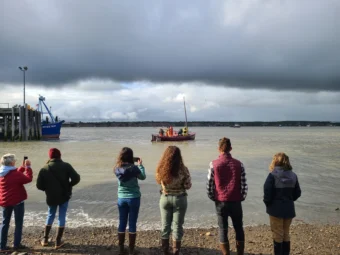
A crowd gathered in Naknek to watch the historic sailboat launch for a morning of fishing. (Corinne Smith/KDLG)

For State Historian and Deputy State Historic Preservation Officer Katie Ringsmuth, Alaska is linked to maritime history – a history dating back thousands of years to when Asia and North America were connected by Beringia.

“So much of Alaska history really is under the umbrella of maritime history,” she said.

The Alaska Maritime Heritage Preservation Program from the state’s Department of Natural Resources is seeking to preserve some of that history. Ringsmuth said the program received federal funds and is now regranting those funds to communities across the state.

“This program helps to preserve maritime resources, whether it’s buildings or whether it’s more educational [activites],” Ringsmuth said. “Really, it’s about helping to remind the rest of the country how important Alaska is in defining its maritime north.”

In total, the program is funding fifteen projects with the grant money. It aims to have most of the projects complete by June of 2025. The program’s website states that these projects were chosen based on grant criteria from the National Park Service.

Axel Widerstrom, cabin boy on Star of France 1919. (National Maritime Museum, San Francisco)

$48,000 will go toward two projects in Bristol Bay. The region has nearly 140 years of commercial fishing history.

The larger of the two grants, totaling $38,000, will support sailing a restored double-ender sailboat from Naknek to Dillingham. This funding is split between the Bristol Bay Heritage Land Trust — a conservation group — and the Bristol Bay Historical Society.
Tim Troll, the Heritage Land Trust’s executive director said the grant funds phase two of the sailboat’s journey. In 2022, the organizations restored the boat and a crew sailed it from Homer to Naknek to commemorate the end of the commercial fishery’s sailboat days. Until 1951, the fishery only allowed sailboats. With the introduction of engine- powered boats however, Troll said that the double enders were quickly retired.

“We’d also like to take [the boat] over to Dillingham which is where the Bristol Bay commercial fishery got started in the Nushagak Bay back in 1884. So that seems appropriate to get the boat over there so people can see it and get in it and sail with it,” he said.

Troll said the aim is to get the boat on its journey to Dillingham by this summer. It takes roughly a day’s journey to sail there, he said, depending on the winds and tides.

The Bristol Bay Heritage Land Trust won the smaller grant, $10,000, as well. The money will fund a project to compile and digitize a historic account from Axel Widerstrom who took photographs as he traveled from San Francisco to Bristol Bay on his father’s ship.

“He was a young man in 1919. His father was the captain of the Star of France, one of the great Star [Fleet] ships [of the Alaska Packers’ Association], and he had a camera with him,” Troll said.

Troll said that Widerstrom completed taped interviews in 1976 that ended up in the National Maritime Museum in San Francisco. The tapes are gone, he said, but the grant money will give the opportunity to travel to California to collect the transcripts and photographs and to digitize them.

Star of India at anchor off Dillingham, circa 1920. (Sam Fox Museum)

Troll said he thinks creating a record is relevant, as many families in the region have ancestors who came up on ships like the Star of France.

State Historian Katie Ringsmuth said she thinks it’s important to keep providing communities with the funds they need to protect their maritime history.

“This allows at least some money to go into communities so they can help preserve those resources, study them and interpret them and share them with the rest of the public,” she said.

She said she hopes the success of this year’s projects will lead to more grants that the program can distribute, so communities can continue to preserve their maritime heritage – from Indigenous technology to historic canneries.

Chignik avalanche leaves community without power for 4 days

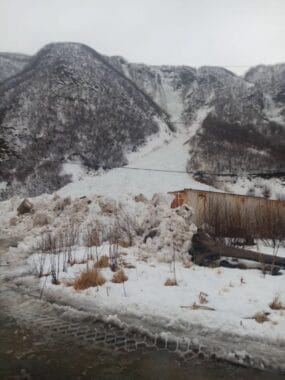
A view of the avalanche in Chignik. February, 2024. (Courtesy of Robert Carpenter)

An avalanche spilled across one of Chignik’s main roads on the night of Feb. 16, cutting off some homes and the airport from the rest of the community. Chignik’s mayor, Robert Carpenter, said that there were no deaths or injuries from the avalanche, but that it did destroy a power box, leaving the community’s roughly 100 residents without power. The community lost phone service as well.
“It pushed a container across the road and almost into the slough. Also, [it pushed] a flatbed truck and a skiff, which was in pieces, and [it] took out a power box that controlled power to the main part of town,” he said.

Avalanche debris in Chignik. February, 2024. (Courtesy of Robert Carpenter)

Carpenter said that a city crew was able to clear the avalanche debris off the road a few hours later and the city began to speak with state emergency services the next morning. He said the community had to wait several days before linemen could get to Chignik to repair the damage to its power system.

Chignik’s runway was too soft to land planes at the time, so the Alaska Department of Transportation arranged for a repair crew to travel to the community by helicopter.

Bad weather prevented the crew from reaching the community for four days; the crew restored power on Tuesday evening. Carpenter said that the phone service company GCI also arrived on Tuesday and restored service later that night.

While they waited, the community relied on small generators for power. Carpenter said it took a couple of days to distribute the generators which came from the city, Chignik residents and the nearby community of Chignik Lagoon, who sent them by boat.

Carpenter said that Trident Seafoods sent a tender from Sand Point as well as some food and water. The tender was available to ferry people from point to point, he said, but did not need to.

He said that residents with Starlink, a satellite internet service, helped keep the community connected to the outside world.

Lana Anderson is a temporary office worker for the city. She said that with the small generator, her family prioritized what they needed to power at home.

“We couldn’t have all our appliances on. We alternated between the most important things,” she said.

Avalanche debris in Chignik. February, 2024. (Courtesy of Robert Carpenter)

Anderson said they transferred power back and forth from their heater to their freezer. For a couple of hours, she said, her family turned off their heat to use the internet.

The avalanche came after two days of heavy snow followed by two days of heavy rain. Gabriel Wolken with the Alaska Division of Geological and Geophysical Surveys said those conditions are ideal for generating an avalanche.

“If there’s a recipe for generating an avalanche, you need to have a slope of a certain angle, you need to have a snowpack with weak layers involved, and a trigger is necessary,” he said.

Wolken said that those weak layers of snow get buried in the snowpack and they can act as a sliding surface. He said that subsequent heavy snow, heavy rain or blowing snow can then an trigger an avalanche.

Mayor Robert Carpenter said now that power and phone service have been restored and the road is open, the community doesn’t need anything except reassurance they can use that road safely.

“People are concerned safety-wise of traveling that road. We’re trying to keep traveling down to a minimum,” he said. “If you don’t need to travel on it, don’t. But it is a lifeline to the community because the airport is on that far side.”

Carpenter said Chignik is working with the state to assess the risk of further avalanches.

In Bristol Bay, shock and concern follow move to nix management council for nation’s largest state park

The view from the mouth of the Agulawok River, June 7, 2022. (Courtesty of Brian Venua)

Gov. Mike Dunleavy has released an executive order eliminating the management council for the country’s largest state park, Wood-Tikchik State Park in Bristol Bay.

The executive order states that eliminating the Wood-Tikchik State Park’s management council is in “the best interests of efficient administration.” It came as one of 12 executive orders sent to the legislature this month.

Bryce Edgmon said the orders are not typical. Edgmon is Region 37’s House Representative, which includes Bristol Bay and Wood-Tikchik State Park.

“Each executive order is tied to removing a board or commission and it seems laborious and time intensive,” he said. “The usual way would be to go through the public process and involve the legislature. But Gov. Dunleavy has decided to do it very differently and I think very divisively.”

Eight of Dunleavy’s other orders called for the elimination of boards and councils this year, including the Chilkat Bald Eagle Preserve Advisory Council.

Wood-Tikchik State Park is the largest state park in the country, spanning about 1.6 million acres. It is also the only one in Alaska with a management council appointed by the governor.

The seven-person council was formed in 1978 and consists of representatives from nearby village and city councils, the region’s Native association and state officials to advise the government. Three members are nominated by the village councils of Koliganek, New Stuyahok and Aleknagik respectively, one member is nominated by Dillingham’s city council and one is nominated by the Bristol Bay Native Association. The council also includes the Commissioner of the Department of Natural Resources and the Commissioner of the Department of Fish and Game.

Cody Larson is the current chair and represents the Bristol Bay Native Association on the council. Larson said the council met the Friday before the executive order was announced but was not given any notice of its elimination.

“We didn’t have it on our radar, so we weren’t able to put it on the meeting agenda at that time,” he said.

Wendy Sailors, a spokesperson for the Alaska Division of Parks and Outdoor Recreation, said in an email that as executive orders are confidential until they are issued, the orders were not announced.

Larson said that the council has served as somewhere the park receives input from the public on a range of topics and is a space for users to meet.

“Over the past 45 years the park has been a consistent space for the public to provide input and it has also been in the position to encourage park operations,” Larson said.

Board member Dolores Larson, whose Yup’ik name is Myuuraq, represents the Village of Koliganek. She said she thinks it is important to have representation from around Bristol Bay making up the council.

“We live here,” she said. “We know what goes on in the park as well as the region and I believe it’s really important to have tribal representation.”

She said she is concerned that eliminating the council and transferring the park’s responsibilities solely to the Department of Natural Resources and the Department of Fish and Game may make the land more vulnerable to development.

“My biggest concern is that the area will be more open to resource development if it’s led by DNR or Fish and Game,” she said. The park is protected and it should remain that way indefinitely.”

In a written statement to KDLG, Larson wrote that transferring the council to the Department of Natural Resources would be a detriment to the region and the park.

“Our local and tribal representation on the current board play a vital role in the management of the state park that reflects cultural and traditional values and the protection of our valuable resources,” Larson wrote.

The Wood-Tikchik State Park Management Council held a meeting on Feb. 1. A draft of the council’s minutes from the meeting says that the Department of Natural Resources’ Division of Parks and Outdoor Recreation’s director Ricky Gease stated that public input would be received through a citizen advisory board as in other state parks.

Larson wrote that the proposed board would streamline important processes regarding the park.

“And local and Tribal representation would not be put in the statute if it is transferred to the Department of Natural Resources,” she wrote in her statement to KDLG.

Former Board Chair Robin Samuelson also voiced concern that the land might be more available in connection to mining interests.

“I don’t know why he’s doing it. I don’t know who’s pushing him. But I know that there are mining interests that have filed north of the park,” he said.

Samuelson was on the council for more than a decade.

“The park service and laymen board…we had our problems but we always worked out the problem and we always protected the resources in the park, especially the streams and fish,” he said.

The spokesperson from the Alaska Division of Parks and Outdoor Recreation, Wendy Sailors, said in an email that any changes to the park’s management plan must go through a public comment period and meetings must be held in affected communities.

KDLG requested a comment from the governor but was referred to the language in the executive order by the Department of Natural Resources.

Representative Edgmon said the news of the elimination came at a busy time.

“There’s a lot of things going on here in the first few days, but it’s not been lost on me and a bunch of other legislators that these executive orders really need to be looked at very closely and hopefully rejected,” he said.

Legislators have sixty days from the order’s introduction to override it, which would require a majority vote against the order in a joint session. The order was introduced January 16.

Site notifications
Update notification options
Subscribe to notifications