KDLG - Dillingham

KDLG is our partner station in Dillingham. KTOO collaborates with partners across the state to cover important news and to share stories with our audiences.
Active shooter incident at Dillingham’s hospital leaves no reported injuries

Kanakanak Hospital in Dillingham. January 15, 2024. (Christina McDermott/KDLG)

Dillingham’s Kanakanak Hospital had an active shooter early on the morning of Jan. 14, according to a press release from the Bristol Bay Area Health Corporation. No injuries were reported.

Jennifer De Winne, the Bristol Bay Area Health Corporation’s chief operations officer, said in a call to KDLG that the shooter unsuccessfully tried to enter the hospital’s emergency department. She said doors were locked at that time of day per hospital protocol, but the shooter fired several shots with a shotgun, including at cars parked near the hospital.

De Winne said that multiple members of the hospital’s staff called 911 immediately, and that the hospital followed its active shooter protocols.

She said the shooter eventually fled the scene on a four wheeler and was arrested by Dillingham police further down the road.

The hospital staff, De Winne said, have already met to review the incident and will conduct a formal review this week.

The Dillingham Police Department did not reply to a request for comment in time for this story.

This is a developing story and will be updated as necessary.

Fewer restaurant workers could mean lower profits for seafood processors

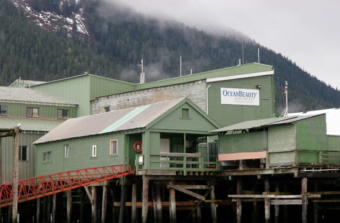
Ocean Beauty’s seafood processing plant in Petersburg
An OBI Seafoods processing plant in Petersburg in 2019. (Photo by Joe Viechnicki/KFSK)

Six Seven, an upscale restaurant located in Seattle’s historic Edgewater Hotel, serves Northwest cuisine with a focus on fresh seafood. The eatery sources some of that product from Alaska’s fisheries, which provide more than half of the country’s wild-caught seafood according to the Alaska Seafood Marketing Institute.

The restaurant is open seven days a week, but the hotel’s general manager, Ian McClendon, said that he has noticed that other fine dining spots are operating for fewer hours.

“I would say several high-end restaurants that used to be open seven days a week down here at the waterfront are not open full time,” he said.

As restaurants reopened to in-person dining after pandemic closures, they struggled with staffing shortages. According to the National Restaurant Association, at the start of this year, 80% of restaurant operators reported they had a hard time filling open positions.

McClendon said Six Seven has kept staff due to their union contracts. But the Bureau of Labor Statistics reports that leisure and hospitality job openings are near 20-year highs.

And one seafood processing executive said all those openings are hurting their bottom line. Mark Palmer is the CEO of OBI Seafoods, which operates 10 processing plants throughout Alaska.

In a November meeting hosted by the United Fishermen of Alaska, Palmer said that restaurants are operating with a smaller wait staff, selling fewer dishes for higher prices.

“Some of them have identified a new business model that doesn’t move more pounds of product. They move less, and it’s just as profitable,” he said.

That new model means they’re buying fewer fish from processors like OBI.

Last year, a presentation from DataEssential for the Alaska Seafood Marketing Institute showed that Alaska seafood had a much higher median price point in fine dining institutions than the overall seafood average — $33.00 per dish compared to $19.95.

Palmer said that many processors have traditionally depended on their sales to fine dining restaurants like Six Seven to turn a profit.

“We rely on fine dining. We rely on white tablecloths. And that’s where we really can drive margin and that’s where a lot of premiums are paid,” Palmer said.

University of Alaska Anchorage emeritus professor of economics Gunnar Knapp has studied fisheries for decades. He said restaurants have adapted to having fewer workers by catering to this smaller clientele.

He said grocery and fish markets are also changing what and how much they buy to adjust to having fewer workers.

“Similarly, on the retail side, they’re trying to do less that involves labor, and this can affect the mix of products they want to buy and have to stock and so on,” Knapp said.

These changes, Knapp said, come as many processors are contending with a shifting international market, including a shrinking amount of frozen salmon sold to Asia. Knapp said processors are paying to hold large quantities of some products.

“The longer that they have to hold those fish, the higher their storage costs, but also the higher their interest costs from borrowing,” he said.

Knapp said that in the future, retailers are likely to return to buying larger quantities of available fish like sockeye salmon.

“Eventually, some stores will say, ‘Hey, we can sell more,’ and ‘All those other stores are keeping their prices high. We’ll buy a sockeye salmon, and offer consumers this cheaper price that the other stores aren’t passing along,’” he said. “Then the other stores have to price match, and then prices get into adjustment.”

Restaurant job openings have started to come down from last year’s peak. But a return to more normal labor levels may not be the whole picture.

At the Edgewater Hotel, McClendon said that even with a full restaurant, staff are buying less from Alaska because of continuing supply line constraints and occasional lack of availability for catches like crab. He said that the restaurant, which is part of a larger hotel network, tries to buy in bulk from vendors. Now Six Seven has to source from more groups.

“Pre-pandemic, we had a pretty strict routine. Coming out of [the] pandemic, we’ve never had this many seafood vendors,” he said. “So we’re having to find more people. It’s harder for us to find products than it used to be before the pandemic.”

Some processors have called for legislative change to help address challenges the industry is facing, including liquidity issues. That change could include involving the U.S. Department of Agriculture or providing low-interest financing solutions. For now, processors and their clients will have to continue to grapple with the challenges of labor shortages and a fluctuating market.

In Bristol Bay and beyond, organizers push for change in tackling MMIP cases

The Curyung Tribal Council building in November 2023. (Christina McDermott
/KDLG)

In Bristol Bay, family, friends and community members have not stopped thinking about Kelly Coopchiak. After the 25-year-old from Togiak went missing in October, search and rescue teams and the Alaska State Troopers spent two weeks looking for her.

Eventually, Troopers stopped the active search for Coopchiak and stated they did not suspect foul play. People from her community criticized the Troopers’ actions on social media, calling for a closer investigation into her disappearance.

Coopchiak is one of dozens of missing people from the region. Nationwide, Indigenous people constitute 3.5% of entries in the National Missing and Unidentified Persons System (NamUs), although they are only about 1% of the U.S. population, according to a 2023 Congressional Research Service report.

The Bureau of Indian Affairs indicates that case data has been missing from NamUs. A 2016 study by the National Crime Information Center found that of 5,712 reports of missing Indigenous women and girls, only 116 cases were logged in NamUs. Alaska ranks fourth nationwide in the number of missing and murdered Indigenous people cases by state, according to a 2018 Urban Indian Health Institute report.

Charlene Aqpik Apok is the executive director at Data for Indigenous Justice, a statewide organization that has documented missing and murdered Indigenous people for about five years.

“We know from our families and our communities that this has been happening for a really long time,” Apok said. “Our understanding is violence is not inherent from our Indigenous communities, and that this is rooted in a history of … ongoing colonialism.”

Apok said victims’ families have often been the main – and sometimes the only – advocates for missing and murdered Alaska Native people, and that it can take years for families to know if anyone will be charged in these cases. That puts the burden of communication and advocacy on individuals, rather than an institution. Further, Apok said families must also contend with troopers who mishandle investigations and meet relatives with skepticism when they provide context for a case.

Apok said that before 2018, no one institution had put together a complete statewide list of cases involving missing and murdered Indigenous persons. That year, she said, families came forward to share their stories.

The testimonies helped inspire Data for Indigenous Justice. She said the data it has collected in the years since has helped to show the scope of these cases.

The Alaska Department of Public Safety followed suit and began to put more effort into tracking MMIP cases. In 2022, the department began assigning investigators to focus solely on cold cases for missing and murdered Indigenous people. There are now four.

This summer, the department published its first quarterly report with a categorized cause for each case. Most of the listed MMIP cases are marked as “environmental,” defined as non-suspicious outdoor deaths or disappearances where human remains are not located.

But Apok said families still have to push to get updates on their case, and that needs to change.

“I think it should be really clear that law enforcement needs to be coordinating (with families),” she said. “Right now, the labor of that is falling on families who are grief-stricken and already trying to deal with their loved ones either being missing or murdered.”

Apok said Data for Indigenous Justice has called on law enforcement to give families regular updates on MMIP cases. She said the organization also wants to see better cultural training for law enforcement to improve communication in Native communities and for more tribal court funding.

Data for Indigenous Justice, Apok said, supports the push for federal-level change to how law enforcement reports these cases, including mandating that law enforcement enter the names of missing people into NamUs.

“It would need legislation and congressional support as it’s a federal initiative,” she said.

Apok recommends that in a missing-person event, families appoint one member as a single contact to keep track of all case information. She said that keeping a case open is important to its continued investigation. That means family or advocates need to frequently engage with law enforcement, with the opportunity to ask questions and have Troopers document all the information they provide.

In recent years, the federal government has also started to dedicate resources to address the number of missing and murdered Indigenous person cases. In 2021, the Department of Justice created a pilot program in Alaska to take on what it has called the “MMIP crisis.” It provided a framework through which participating communities could create response plans. The Curyung Tribe in Dillingham was one of three tribal communities that volunteered to participate.

Courtenay Carty, whose Yup’ik name is Paluqtaq, was the tribal administrator at the time and has served as a liaison between families, law enforcement, and the media for MMIP cases. She said the Curyung tribe was the first in Alaska to adopt a community action plan.

“Our tribe cares very much about working to understand the data and working with all of our community partners in order to begin addressing (the problem),” she said. “The plan was developed to be a living document to be revisited as necessary.”

Carty said the tribe, law enforcement, Dillingham Search and Rescue, KDLG Radio and regional organizations coordinated to build the local plan. It outlines how the community should respond in the wake of a missing or murdered person emergency. Ultimately, the hope is that it will prevent future MMIP cases by helping create a community with strong support systems.

Curyung’s community action plan also supports a holistic approach to healing, including culturally inclusive medical and behavioral health services. Carty said that the plan leaves the definition of culturally appropriate healing open so it can adapt to best suit a victim’s family.

“Whatever the culture is of the family to whom is being served by the plan and receiving response services, their cultural values need to be heard – not just respected, but incorporated into what that response looks like,” Carty said.

Curyung’s plan focuses on Dillingham, but Carty said that a community response plan needs to be created for all of Bristol Bay. She said organizations around Bristol Bay can fund a regional worker to serve as a point of contact in MMIP emergencies, and potentially partner with SAFE, a regional network of domestic abuse shelters, to provide support services to families.

In June 2023, the U.S. Department of Justice launched a missing and murdered Indigenous persons outreach program, which created five regional coordinators and six regional assistant U.S. attorney positions across the United States. A written statement from the U.S. Attorney’s Office, District of Alaska said the role of the Alaska regional coordinator is to inform communities about available federal resources, assist with the development of community action plans and generate conversation about the procedures surrounding MMIP cases with relevant parties.

Carty said Alaska’s branch of the Department of Justice has facilitated regional talking circles in some areas, but as of November 2023, there has not been one in Bristol Bay. She said the region needs one.

Additionally, she said local law enforcement and other organizations within Dillingham need to better integrate into Curyung’s plan, so to address high turnover and the constant need for training.

“Now because of turnover at the tribe, and apparently…turnover at other agencies, this plan is sitting dusty on a shelf and our people are still missing,” she said.

Carty said that people can be uncomfortable talking to law enforcement, so a public event could build better relationships between law enforcement and community members.

“If we had more community dialogue, perhaps between our caretakers and peacekeepers and us people, that could improve things,” she said.

Carty added that the plan’s developers may need to regroup. “Maybe the team that developed this plan needs to call a meeting,” she said.

She also said she sees the opportunity for more preventative activities on violence against Indigenous people, like promoting events on healthy relationships.

It can be challenging not to become numb to the number of missing and murdered Indigenous people in Alaska, Data for Indigenous Justice’s director Apok said.

“We’re trying to deal with something huge and complex. We’ll also live facing it each and every day,” Apok said. “It is really hard for our families and our communities. And I know that we’re going to see it through. We are not going to not look for our people.”

If someone goes missing, law enforcement says you do not need to wait any amount of time to report them. Call 911 or the State Trooper line at 907-451-5100.

Find more information on the Missing and Murdered Indigenous People Tribal Community Response Plans, resources for training and educational material by contacting Alaska’s Missing and Murdered Indigenous Persons Coordinator Ingrid Cumberlidge at Ingrid.Cumberlidge@usdoj.gov or 907-306-0669.

Get in touch with the author at christina@kdlg.org or 907-842-2200.

Longtime fisherman reflects on his career in Bristol Bay

Dan Barr while fishing. (Courtesy of Dan Barr)

Dan Barr is eighty-one and a half years old. He fished Bristol Bay for just about half his life.
“It’s been just such a great part of my life,” he said. “Every year I came home, it was like [I got] to live out something new that got loose in me.”

Barr spent much of his career finding ways to connect different people with each other. For over two decades, he was president of the Bristol Bay Driftnetters Association — an organization formed in the 1980s that aimed to unify the fleet. There, he helped publish newsletters about issues around the fishery, like practices in the Pacific Ocean that affected Bristol Bay.

Throughout the 1970s, 80s, and 90s, vessels in international waters cast nets that were up to 40 kilometers long, collecting millions of salmon that were otherwise on their way to the region to spawn. This is called high seas interception. The practice also results in high levels of bycatch. Nets can trap everything from whales and sharks to seabirds.

Barr worked with interest groups and pushed for federal legislation to address the problem.

The fishing vessel the Slam Dunk. (Courtesy of Dan Barr)

In 1992, he formed a coalition that helped pass the High Seas Driftnet Act, which aimed to restrict large-scale driftnet fishing in international waters.

He said he worked with dozens of conservation and user groups like Greenpeace as well as sports and other commercial fishers.

“And so I dreamed up the issue of: ‘let’s get a coalition of sports, environmental, and commercial’ and we got 29 organizations to sign on. And we wrote a letter to each U.S. senator,” he said. Barr said that despite some initial pushback, they garnered the support to pass the act.

The act restricts net size at sea and makes it illegal to import fish harvested with large drift nets. It has brought more visibility to both the bycatch and fish interception issues that affected the health — both ecological and economical — of the fishery.

Barr attributed their success to collaboration. He said he coordinated with people who traveled around the country and internationally to help document the extent of the bycatch and overfishing problem, and later, enforce the act. Barr said team members did everything from discussing the issue with Russian border guards to identifying pirating vessels in Kodiak.

“We live in a world that’s made some gains in some constructive things they’re doing,” he said of the act. “And it’s one of the things that came out of Bristol Bay.”

Barr also worked within Bristol Bay. He started an open radio channel for the Ugashik district where fishers could talk to each other about important issues during slow hours.

“We got on one of the local VHF frequencies and said, ‘spread the word,’” he said. “Every night we’d go through and talk about what we knew about Bristol Bay, what we knew about what was happening in the north Peninsula, what we knew about the high seas, what about safety…”

Barr (center) with his sons, Daniel and Kieran, who now run his vessel, the Slam Dunk. (Courtesy of Dan Barr)

He said some discussions on the radio lasted three hours.

Barr also helped secure an exception to Coast Guard regulations in Bristol Bay, so that people could substitute personal emergency beacons for regular ones. He said the change made carrying a beacon more accessible, due to its lower price. Personal beacons are registered to an individual.

“It meant that people might buy one where they otherwise wouldn’t just for the extra safety,” he said.

Barr says nearby communities later started using the beacons on snowmachines.

Through it all, Barr said his favorite part about fishing in Bristol Bay was spending time with his family and connecting with friends.

“The greatest part was fishing with my family. We had ten members fish in Bristol Bay,” he said.

Now, he reflects on the people he met here.

“I mean, the amazing people there, and the people that have retired have become longtime friends that are really quality people. It’s the people aspect first,” he said.

Today, Barr is battling cancer in Seattle. His son fishes on his former vessel, the Slam Dunk.

Heft, fluff and salmon: Katmai’s Fat Bear Week finals are upon us

Brooks Falls at Katmai National Park and Preserve (Brian Venua/KMXT)

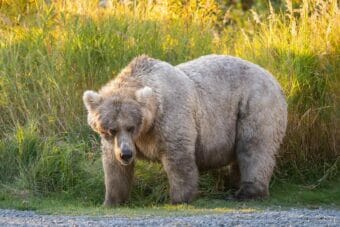
Voters from around the world will decide the winner of Katmai National Park’s Fat Bear Week. Returners and newcomers alike spent the summer catching salmon and packing on pounds before hibernation.

Park staff don’t measure bears with a scale though. Park spokeswoman Cynthia Hernandez says that like beauty, fatness is in the eye of the beholder.

“We rely on visitors and viewers of the bears to decide who is the fluffiest, who has put on the most weight since July,” Hernandez said. “You can compare who looks to be the heaviest right now, who looks to be the most round, or who you think is the cutest.”

Fatness, Hernandez says, is a measure of survival success before bears hibernate, when they sometimes lose up to one-third of their body weight. Female bears, too, are more likely to have cubs if they gain enough weight during the summer.

On Monday the park’s bracket was down to its final four, with votes being taken until 5 p.m. Alaska time to determine Tuesday’s competitors for fattest bear.

This year’s contenders included newcomer Bear 806, a year-old cub who won the Fat Bear Junior contest earlier this month. 806 went against Bear 32, Chunk, who has a distinctive muzzle scar and hefty hind quarters. Chunk won, and is in the finals now.

Bear 128, Grazer. (Katmai National Park and Preserve)

Bear 128, Grazer, Hernadez says, is another fan favorite. She’s recognized by a round belly that hangs in the water when she fishes. Bear 128 is known for confronting much larger bears to protect her cubs.

Hernandez says past winners are also popular. Bear 435, Holly, won in 2019. She adopted and raised a cub alongside her own in 2007, and is back in the running.

“She is looking splendid this year as well. She’s a large adult female and her ears are blonde and we love to see her come back every year,” she said.

Bear 435, Holly. (Katmai National Park and Preserve)

Of course, the old man of the falls and four-time champion, Bear 480, Otis, has returned. The 27-year-old bear lost to Bear 901 on Friday.

Bear 901, with her blond, triangular ears, is about 20 years his junior.

The famous Brooks Falls is a prime fishing ground for hundreds of bears. According to Hernandez, bears prefer different spots of the salmon-rich area, sometimes depending on age and skill.

“Due to the geology of the space, the short six-foot fall, there are several opportune spaces for the bears to fish. So there’s a location called the Office, which is on the lower section of the falls where some of the salmon congregate. It’s shallower there,” she said.

Bear 480, Otis. (Katmai National Park and Preserve)

Hernandez says older bears, like Otis, tend to fish in the Office. Younger bears, on the other hand, are a little more active.

“Some of the younger bears who may not know the most efficient fishing methods will hang out a little further downstream and run and try to catch the fish as they’re swimming,” she said.

Fat Bear Week graces the social media feeds of hundreds of thousands of fans with images and videos of the park’s fluffy carnivores. But Hernandez says the week also celebrates Katmai’s robust ecosystem.

“There’s so much to celebrate this week. Not just the fat, amazing, cute bears but also the health of the park and the ecosystem and Bristol Bay – the waters that feed into the Katmai ecosystem and in the Brooks River. It is one of the largest and healthiest salmon runs left on the planet,” she said.

Fans can vote for the 2023 winner at fatbearweek.org.

Images of Bear 128, Bear 435 and Bear 480 were taken with permission from: https://www.nps.gov/katm/learn/fat-bear-week-2023.htm

Qayassiq’s walrus hunt, once banned, now carries traditions of sharing and management to the next generation

A group of walruses on a flat rock at Qayassiq. June 2022. (KDLG photo)

Thirty miles off the coast of the village of Togiak in Southwest Alaska sits Round Island, known in Yugtun as Qayassiq. Surrounded by the Bering Sea, the island’s steep, grassy slopes are covered in shrubs, lichen, and wildflowers, ending in rocky beaches. Seabirds like kittiwakes, murres and cormorants nest here in the spring and summer. During that time, the island becomes home to thousands of massive white-tusked Pacific walruses, which swim to its beaches to rest after the breeding season.

Frank Woods, who is Yup’ik, first hunted walrus at Qayassiq in 1997, though his family has harvested walrus there for generations. “It was an El Niño year, it was really warm in October. Beautiful weather,” recalled Woods, who lives in Dillingham and now works at the Bristol Bay Native Association.

Qayassiq had “the most concentrated herds of walrus in the Bay, and that’s where they traditionally hunted,” Woods said. During that season, 15 walruses were harvested, and the hunts didn’t seriously disrupt the haulout.

Native people in Bristol Bay have harvested walrus at Qayassiq for thousands of years for food, clothing, tools and artwork. But they weren’t always able to hunt there. For decades, starting in the 1960s, the state banned hunting at the island as part of its efforts to preserve walrus habitat. It did so without consulting the tribes, even though state policy cut off their access to traditional hunting grounds. As a result, tribal leaders had to fight for years to regain access to the hunt and in doing so, created a model for communities to act as equal management partners that still exists today.

Woods’ 1997 hunt came soon after the ban was lifted. It was one of the first in more than 30 years. He wanted to go because of his family.

“My family still loves walrus,” he said. “And it was like a spiritual experience to actually have that – being able to take an animal, harvest it efficiently, and then dish it out to the community when you get back.”

Walruses rest on one of Qayassiq’s beaches. June 2022. (Izzy Ross/KDLG)

A sanctuary for walrus

Over the past two centuries, Alaska Native walrus hunting traditions like those in Woods’ family have faced acute threats. In the 1800s, commercial hunting – especially by non-Native whalers – decimated the species, and as a result the federal government banned commercial hunting in 1941. After Alaska became a state in 1959, it also took extreme measures to conserve walrus habitat – without differentiating between who was responsible for the plummeting populations.

In 1960, the Alaska legislature created the Walrus Islands State Game Sanctuary in Bristol Bay and took over management of seven islands in the area. The state banned all hunting at Qayassiq, one of the main walrus haulouts in North America.

During this process, however, the state didn’t hold hearings in Togiak or any other Bristol Bay village before making the decision. This was consistent with the state’s approach to conservation at the time, according to State Lands and Refuges Manager Adam Dubour, who stepped into the role in 2022.

“I think opinions and attitudes and practices in the 1960s were a lot different than they are now,” he said. “I wouldn’t be surprised if there wasn’t any formal consultation with those groups.”

Peter Lockuk Sr, who serves on the Togiak Traditional Council, recalls how the sanctuary was created with no communication between the state and the tribe.

“The community of Togiak never knew Qayassiq Island became a sanctuary. People never knew of it, and some folks got arrested,” he said. “They got in trouble for it, to go down and get walrus.”

The closure lasted for over 30 years.

Read more: The Round Island Walrus Hunt: Reviving a Cultural Tradition

A community effort

Walrus hunting revolves around the community — providing food, but also teaching new hunters how to harvest safely and efficiently. Hunts are grounded in cakarpeknaki, or “with respect and without waste.”

Lockuk said if crews haven’t hunted for a time, the excitement to go out can be palpable.

“You could notice when people are getting restless: ‘When, when, when is that walrus hunt going to be happening?’” Lockuk said.

People used to travel in skin-covered kayaks to hunt walrus at Qayassiq, which means “a place to kayak” in Yugtun.

Now, 18-foot skiffs are common, and depending on where they are, some hunters even use 32-foot power boats to get the walrus back to town. Anywhere from five to 20 people can make up a hunting crew, and they need to decide ahead of time who will shoot, who will drive the boat, and how exactly to wrangle the carcass of a two-ton walrus.

“You got to have everything planned, because to us, it’s a big thing. And it’s only seasonally,” said Mickey Sharp, a Twin Hills hunt captain and a commissioner on the Qayassiq Walrus Commission. (Sharp hunts at another island in the sanctuary and hasn’t been hunting at Qayassiq yet, though he hopes to go one day.)

It takes about two hours to get to Qayassiq from Togiak, riding out into the Bering Sea across open water, which means calm conditions are best.

Daryll Thompson, who has participated in Togiak’s community hunts on and off for years, said it’s better to show newer hunters how to hunt on beaches. It’s easier, and they can choose which animals to kill and butcher quickly.

“It’s a little bit more adventurous when they’re all in the water,” he said. “You got to take your boat and get up and get the good shot, and then you got to harpoon them. With a harpoon, you keep them from sinking, and you can retrieve the animal.”

Hauling a walrus onto a boat can be like “dead weight lifting,” Sharp said. It’s also important for the crew to start gutting the walrus immediately. Otherwise the meat can spoil. Working nonstop, several crew members can butcher a walrus in a few hours.

“It’s just really a lot of work,” Sharp said. “Holy, yeah. It makes butchering a moose like a piece of cake.”

After a successful hunt, the crew will bring the meat back to the village, where it can feed people all year. “We help each other and cut it up into smaller pieces. So we could distribute first of all to the elders, and to the folks that can no longer hunt,” said Lockuk.

Mickey Sharp’s son, Ivan, quartering walrus meat to give away in Twin Hills. (Photo courtesy of Mickey Sharp)

Fighting for the hunt

In the decades following the 1960 hunting closure at Qayassiq, the Togiak Traditional Council and other tribes in the region went through the state’s regulatory system and federal courts to regain access to walrus hunting.

The state limited walrus hunting in western Bristol Bay until 1972, when the federal Marine Mammal Protection Act passed. That act acknowledged Alaska Natives’ right to hunt walrus and other marine mammals as long as the populations were healthy.

But the state regained management authority of Pacific walruses several years later, and again limited hunting outside the sanctuary in western Bristol Bay. The people of Togiak sued, challenging the state’s authority to do so. They won in 1979, when the court ruled that the federal law means Alaska Native people must be allowed to hunt. Because the state held that its constitution couldn’t include such exemptions, walrus management in Alaska returned to the federal government.

Peter Lockuk Sr. stands outside the Togiak Traditional Council office in Nov. 2022 (Izzy Ross/KDLG)

Still, because Qayassiq was in the state game sanctuary, the state was able to keep it closed to hunting.

In 1991, Togiak’s elders petitioned the state Board of Game for a limited hunt on Qayassiq. They had to petition three times to get the hunt authorized. Larry Van Daele, who worked as the regional wildlife biologist in Bristol Bay at the time, said some of his superiors told him not to work with people there. But he thought there was room to compromise.

Recalling the state’s hardline approach, Van Daele said his supervisors would say “they’re going to tell you that they have to be able to hunt on Round Island, because that’s their traditional area. Say no, you can’t have that. Hunt anywhere else you want, but don’t come to Round Island, because that’s illegal to go there.’”

After one rejection of a proposal to establish a subsistence hunt on the island from the state Board of Game, two Togiak residents – Marie and Adam Arnariak – went out to the island and shot a walrus in civil disobedience. That became known as the Arnariak Case, which challenged the state’s authority to regulate walrus hunting at the sanctuary. The case — and the potential of an unauthorized hunt at the island — further pressured government agencies to negotiate with hunters.

Finally, in 1995, tribal leaders from Togiak and other villages successfully advocated for the state to reopen a subsistence hunt. Now, Alaska Native commissioners on the Qayassiq Walrus Commission manage a fall hunt every year on equal footing with state and federal agencies.

“Co-management meant you had equal say in what was going on,” Van Daele said. “That’s what walrus on Round Island ended up being, was a true co-management program.”

A work in progress

At last May’s Qayassiq Walrus Commission meeting at the Bristol Bay Native Association in Dillingham, commissioners gathered around a conference room table near a large screen that displayed the names of the co-management partners. At the far end of the room was a Ziplock bag of herring eggs on kelp that someone had brought from Togiak. A hunter had supplied fresh beluga muktuk, and there was also soy sauce, crackers and salmon dip.

The commission was working to change the hunt dates so that hunters could go out to Qayassiq earlier in September – an effort to avoid some of the stormy fall weather. Members were also re-upping a resolution to restrict the trawl fishery near Togiak to address long-standing concerns about the fleet’s impact on clambeds that walrus feed on.

Understanding how to be part of decision-making within co-management is vital, said the Dillingham hunter Frank Woods, who sat in on the May meeting.

“This type of activity is just as important as the subsistence activities outside the room,” he said in an interview after the meeting.

The Eskimo Walrus Commission is another Alaska Native organization pursuing that work. It was part of the task force that examined the potential of renewing a hunt at Qayassiq in the 1990s and eventually signed the co-management agreement when resurrecting the hunt.

Randy Alvarez speaks during a Bristol Bay Marine Mammal Council meeting, as Moses Toyukak and David Williams, right, listen. May 2023. (Izzy Ross/KDLG)

As communities adapt to the changing climate, the need for Alaska Native organizations to have sufficient support and funding is greater than ever. Sea ice is melting, meaning that female walruses must travel further in order to calve on ice floes. Along with a shrinking habitat, less sea ice means more shipping traffic.

“The issues that we’re facing are becoming bigger and more broad, because we’re also experiencing climate change effects on our communities and the environment,” said Vera Metcalf, the executive director of the Eskimo Walrus Commission. She had just returned to Nome after a June trip to Washington, D.C. to talk with the congressional delegation about funding for co-management agencies.

Read more: 2019 Marine Mammal Commission co-management report

Renee Roque, subsistence outreach specialist for the Bristol Bay Native Association, coordinates the Qayassiq Walrus Commission meeting in May 2023. (Izzy Ross/KDLG)

The ability to meaningfully participate in co-management – traveling to meetings, giving public comments, and conducting research – is closely tied to capacity as well. For instance, Metcalf has sometimes been the commission’s only full-time staff member. She said the responsibilities of co-management must be shared equally by partners in order to best serve Alaska Native communities and the species they rely on.

“We’re facing harmful algal blooms, shipping disturbances and all these things that are affecting us, and we want to ensure that the walrus population and other marine mammal resources are healthy,” she said. “If the environment is healthy, so will our communities remain healthy.”

A hunter looking toward a group of walruses on Hagemeister Island, off the coast of Togiak. (Photo courtesy of Mickey Sharp)

Looking ahead

At 27 years old, David Williams of Ekwok is the youngest member of the Qayassiq Walrus Commission. At the May meeting, he and other members talked about organizing a joint hunt between Bristol Bay communities and involving more young hunters.

“If we could get 20 hunters within the region as one joint hunt, and get 20 walrus for all of our communities, I think that would definitely help everybody here, especially the elderly,” Williams said. “Personally, I would love to get my very first walrus and provide my community with my very first walrus.”

Another key part of sustaining co-management is teaching and involving young people. Last October the Eskimo Walrus Commission held the Young Hunters Walrus Summit, the first of its kind.

Metcalf, the executive director, said the idea for the hunters summit came after she heard about a young fishermen’s summit at the Alaska SeaGrant Advisory meeting.

Along with a focus on laws around co-management, Metcalf said, she also wanted the discussions at the summit to help prepare the young hunters to respond to environmental changes and meaningfully engage in management.

The fundamental purpose of the walrus commission, Metcalf said, is to protect their right to harvest walrus for food and ivory for artwork. She said there are extensive traditional practices around harvesting and sharing the harvest, and doing those things helps to strengthen communities’ traditional values.

“One of our goals is local self-regulation of walrus harvest management,” Metcalf said last year. “Helping to ensure our Indigenous food sovereignty and security is there for us for many years, well into the future.”

Three walruses in the water around Qayassiq. June 2022. (Izzy Ross/KDLG)

This story was made possible through a field reporting grant from the Institute for Journalism and Natural Resources.

Site notifications
Update notification options
Subscribe to notifications