KDLG is our partner station in Dillingham. KTOO collaborates with partners across the state to cover important news and to share stories with our audiences.
The Aleutian Express in Chignik after the 2015 salmon season. (Courtesy of John Clutter)
This summer, an unusual looking salmon tender is anchored in the Naknek-Kvichak District. The Aleutian Express is a historic, three–masted schooner that came sailing up from Washington State for the Bristol Bay sockeye season. With three masts and filled sails, this iconic vessel has been instrumental in many chapters of Alaskan history.
Owner John Clutter first laid eyes on the boat in Chignik waters in 1993. He’s captained the vessel across Alaska and the Pacific Northwest for the last eighteen years, and he says it’s become recognizable in many ports and across many generations.
“So this guy was standing there looking up to the boat.” Clutter said. “He had a son with him about 10 years old, and he pointed up to the boat. He said, ‘That’s the coolest boat in Alaska. My dad told me that and his dad told him that.’”
The Aleutian Express was originally built in 1912 as a fire boat for the city of Portland, Oregon. There, the vessel started out under a different name: the David Campbell, in honor of the City’s late fire chief.
“The keel was actually probably laid right about the time of the Titanic sinking,” he said. “And it was commissioned a year before that. But they actually started building in 1912 and it was fully operational then for the City of Portland sometime in late May that it actually got underway as a fireboat.”
Clutter says in 1912, the boat’s history started off with a bang.
“The first operation, I guess they couldn’t get the boat out of gear and they crashed into the bridge. And I think that dent is still in the bow,” Clutter said.
A postcard depicting the original vessel, then named the David Campbell. (Courtesy of John Clutter)
Over the last hundred years, the ship has had many different names and lived many different lives. It’s been a fur trading boat in the Aleutian Islands, an oil tanker in WWII, a tow boat on the Columbia River, and a crabbing boat in the Bering Sea. Most recently, Clutter has captained the Aleutian Express as a salmon tender in Bristol Bay.
Since 2004, Clutter has retrofitted the 125 foot historic boat to bear resemblance to the ship’s rigging in the 1920s.
“The boat, it had a couple of douglas fir masts where they cut them off to give them more of a tow boat look. And so it did have masts on it up until the early 1970s. And then I just decided to put the masts back but I made these out of galvanized pilings,” he said.
He says on long voyages, he’ll set a jib sail in addition to using the engines.
“That jib alone would move the boat at three knots, just one big jib dragging the props. So it’s actually pretty efficient,” Clutter said. “And now that I have a mizzen boom built, I do believe it’ll make five to seven knots under the right conditions.”
He says sails not only help with speed, but cut down significantly on fuel use and carbon emissions. On one voyage from Alaska to Washington, Clutter calculated just how much.
“I crossed the Gulf, took it down to Port Orchard, Washington and made it in a week and I pretty much ran on one of the engines and sails. And I figured I’d saved about 1500 gallons of fuel on that one week run,” he said.
Clutter says the challenges of owning and operating a historic vessel are extensive, but with his restorations, he hopes the Aleutian Express will be a working boat for generations to come.
“It’s a great sea boat, I mean, this is an incredibly smooth ride. They just don’t build it like this anymore,” Clutter said. “I kind of see myself as a curator. With the work I’ve done in the last 18 years on this boat. It’s good for another 50.”
This season, the Aleutian Express is anchored at the Y on the Naknek River, working as a tender bringing loads of sockeye salmon from the water to Naknek’s docks. So keep your eyes peeled on the water this summer, for a 3-masted schooner coming around a bluff—a living piece of Alaskan history.
Fishing crews anchored at the Naknek River mouth in protest on July 20, 2023. (Photo by Jack Darrell/KDLG)
By 9 a.m. Thursday, over 100 boats were anchored in the Naknek River entrance, some after a night of fishing the Naknek-Kvichak. Ivan Basargin of the fishing vessel Top Notch was one of them. He was there to join the demonstration against this year’s low price.
Basargin has fished in Bristol Bay since the late 1980s and builds fishing boats in the offseason. Standing in the wheelhouse of a boat he built, he said this year’s low-price hit hard.
“I’m going to pay my workers. I’m going to pay my bills. As far as living expenses, I haven’t decided yet. This fifty cents that I get, when I get home, it’s going to be a wash. I’m not going to have any money in the bank saved,” he said.
Organizers of the protest are calling on processors to reconsider and improve the base price this season from fifty cents per pound — less than half of last year’s price.
Without change, many fishermen say it’s unsustainable for the industry, and some say they will go home in debt. Basargin said he was out on the water protesting because he feared accepting this year’s low base price will set a precedent.
“If they know we can fish for fifty cents, we’re going to get paid thirty cents next year,” he said. “That will happen if we don’t do anything. Like today — this is a peaceful protest. We’re not trying to block people or anything. We’re just trying to show the world that we’re hurting, and we need some help.”
Basargin said processors claim they are struggling financially, too, but he hasn’t seen evidence of this struggle.
“After a record fish catch last year, processors are complaining they are losing a lot of money. I see processors expanding. I see them buying other companies out,” he said. “If you look at the scenario, it kind of seems like they are putting a burden on us. They’re adding up their profits and expanding operations.”
Trident Seafoods was the first to post that base price on Sunday, with some handling incentives: fifteen cents for refrigerated seawater and ice, and for the drift fleet five cents for floating and ten cents for bleeding. North Pacific Seafoods announced the same a few days later, along with Peter Pan Seafoods, who is also offering a twenty cent bonus for “late season” fishing beyond July 18.
Protest organizers also called for processors to resume posting a base price ahead of the season. In recent years, Peter Pan Seafoods posted a price in mid-June, which was welcomed by fishermen. This year, processors did not release a price in Bristol Bay before fishing started. Fran Kaul, a longtime captain, says with prior knowledge of the low price, fishermen may have planned differently.
“It’s very interesting that the price came out pretty much at the very end of the season. They had all our fish, right? The fish had been caught. And then Trident posts fifty cents a pound,” she said.
Cheyne Blough has been fishing in Alaska for 35 years. He fishes for Trident and helped organize this protest, prompted by Trident’s price announcement letter to the fleet. His children crew on his boat in the summers, but he has discouraged them from buying into the fishery.
A Bristol Bay radio group protest processors in the Naknek River on July 20, 2023. (Photo by Jack Darrell/KDLG)
“The last thing you want is your children to get strapped to hundreds of thousands of dollars worth of debt, and then have the rug pulled out from under them,” he said. “And that’s what’s going on. I didn’t think it would happen quite this way, quite this fast.”
Adjusted for inflation, this year’s base price is the lowest recorded price in nearly 40 years, since 1984. Without adjustment for inflation, this year’s price is still the third lowest — the lowest was in 2001.
But Blough says he’s seen the quality of the fish sold to processors improve over that time. That’s due to fishermen’s investment in equipment and labor, according to Blough, but it’s not reflected in prices offered by the processors.
“We’ve been asked to make expensive capital improvements — a regular RSW (refrigerated seawater) system, we hire an extra deckhand so we can bleed the fish. They have quality control people on every tender going ‘your fish is good, your fish is bad, you need to do better,’” he said.
Blough says fishermen bear the cost of these improvements, but don’t benefit from the resulting revenue.
“And what do we get in return? We get half the price. And in my opinion, the processors need to do better. I cannot believe I’ve been fishing for 35 years, and I’m fishing for less base price than I did when I was in my teenage years,” he said.
Kelly Stier on the F/V Honey Badger says processors are taking advantage of fishermen, knowing they have few choices for buyers in the region.
“We’re out here, and the processors know that. They have us, and it does take a lot of infrastructure and they do have expenses on their side of things, but I think they’ve taken advantage of us because they know they have us backed into a corner,” he said.
Anna Mounsey is a new skipper on the fishing vessel Syren. She says younger members of the fleet, like herself, are questioning if this industry is worth buying into.
“As a new fisherman, new skipper, trying to make it in this fishery just starting out, the unsustainability with overhead and the price fluctuations, (we’re) just seeing if it’s even worth it,” she said. “With how much it fluctuates, not being able to count on making boat payments and all the other expenses that come with just starting out, being young. Watching this graying fleet leave, what hope do us young fisherman have with the vulnerability of this market?”
KDLG made repeated email and phone call requests for comment with the largest processors — Trident Seafoods, OBI Seafoods, North Pacific Seafoods, Silver Bay Seafoods and Peter Pan Seafoods — but did not receive a reply.
Some fishing crews heard the news about prices and ended their season. Others continued fishing, in an otherwise strong season with harvests over 36 million fish to date.
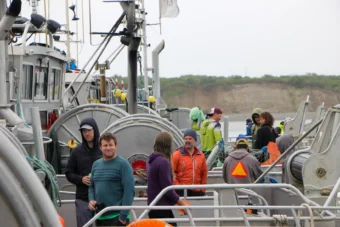
Vessels in the Naknek River entrance. (Photo by Jack Darrell/KDLG)
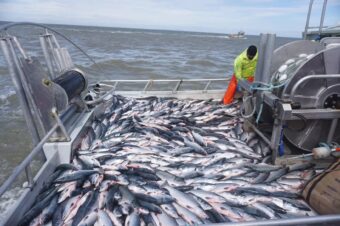
Salmon spread across the deck of a fishing vessel during last summer’s record season in Bristol Bay. (Hope McKenney/KUCB)
Bristol Bay sockeye populations are booming, but what is the tipping point?
This summer is a colder, rainier and buggier season in Bristol Bay, and across Alaska. Meanwhile, last week the world faced four straight days of the hottest temperatures on record, marking Earth’s extreme warming.
The biggest challenge of climate change for Bristol Bay salmon isn’t necessarily warming temperatures right now. Bill Templin, the Alaska Department of Fish and Game’s chief salmon fisheries scientist, says it’s variability.
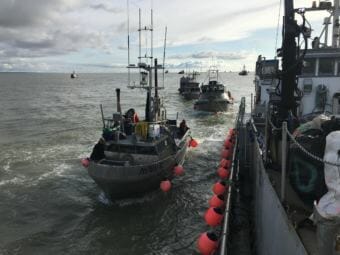
“You know, climate change isn’t just directional. It’s not just that things are warming, it’s also that there’s greater variability in the systems,” he said.
Templin believes these cold, wet, stormy summers are a product of climate change too.
“There can be a wider swing of hot and cold or dryness, drought, flooding, excessive water in the systems,” Templin said. “That variability makes it hard for an organism to adapt to the changes which can lead to reduced productivity from systems that are otherwise healthy, with healthy habitats and low fishing pressures.”
What does that mean for salmon?
There’s some good news. Starting in freshwater, where salmon return to spawn and remain the first year of life, Bristol Bay’s deep lakes provide a natural buffer to temperature changes.
“So it seems like the lakes are really this big buffering mechanism,” said fisheries ecologist and researcher Daniel Schindler with the University of Washington’s Alaska Salmon Program. That’s critical for the salmon’s success.
Freshwater lakes are deep and stratified, meaning temperatures of the water are warmer at the surface going down to cooler at the bottom. Salmon can dive deep and escape warmer surface temperatures. According to Schindler, that means they can return to spawn earlier if ocean temperatures are too warm, like the birth ward at the hospital.
“That allows them to adjust when they migrate in from the ocean, and basically chill out until it’s time to spawn, which is much later in the season for fish that spawn in warm sites within watersheds,” he said.
In other words, the lakes and rivers above Bristol Bay can withstand a bit of temperature change. Salmon can’t regulate their own heat but they are very good at adjusting their depth to find the most comfortable water temperature.
Bristol Bay’s spawning grounds are also seeing a boom in what sockeye are eating – zooplankton.
Schindler believes it may be the “Goldilocks zone” of favorable conditions for sockeye right now. He said the things that salmon eat love that warmer top layer of lakes in Bristol Bay. That means more food for juvenile sockeye, which means salmon leaving for the ocean as big, well-fed fish, which means relatively high survival rates on average.
“So if we look where this might be going over the next 20 years, I think it’s safe to say that the lakes probably are not going to get any colder. Our best estimate is that the productivity of the lakes will continue to increase. This probably won’t translate into any differences in runtime, that’s really most likely affected by conditions they encounter at sea, not conditions they encounter in the lakes,” Schindler said.
That buffer for spawning salmon can only go so far though. What happens when climate change alters water temperature past that “Goldilocks zone?” Schindler suggested we should expect to see changes in the behavior of sockeye.
“Over the long term, with more climate change and more adaptation, we might see changes in spawn and run timing,” he said.
There’s a sci-fi movie trope where someone goes back in time and accidentally does something miniscule that alters the course of space-time in an unforeseeable way. In a way, the cascading and unpredictable effects of climate change in southwest Alaska could be like that. Our ecosystems are unimaginably complex and researchers don’t know what will happen when one factor is tweaked. A snow cap can prematurely melt miles away and flood the watershed, a lake can get a little warmer and suddenly entire industries have to adapt.
For the Bristol Bay sockeye fishery estimated at more than $2 billion, that butterfly effect of climate change could have massive impacts for fishermen and the communities dependent on the fishery.
Templin said most likely, those climate change effects could be seen in the open ocean where sockeye spend most of their life.
“So, we would expect water temperatures in the ocean to have a bigger effect on their size, their survival, and the age that they return,” Templin explains, “because the ocean is a very productive place, and they do most of their growing there. So we would expect temperatures in the ocean to potentially have a bigger effect than freshwater temperatures.”
Of course, there is no open-and-shut case. Templin referenced recent research from the University of Alaska which shows that different species of salmon are associated with different temperatures and locations at sea. This may provide part of the reason why some salmon species are booming while others, like chinook, are under threat. As sockeye are pushed to the top of that climate bubble, other species that respond less favorably to warmer sea surface temperatures begin to tip over the edge.
But what is that tipping point for Bristol Bay sockeye?
Templin believes we have to go back to the lakes to understand what a tipping point may look like.
“Tipping points have been seen in other systems, maybe not the way that we often think of them. But kind of a point where – not a point of no return, so to speak – but where systems flip into a new mode.”
Templin used this example: “You notice how the top foot or two of water is a lot warmer? And when you dive down and get into some really cold water? That stratification of the lake water can be disturbed by a lot. When they get a big windy event and it mixes the water, that changes the way the ecosystem acts. So there’s a tipping point in many lakes. There’s a time during the year when enough of the sun and the wind has stirred it up enough that that stratification breaks down. And the water column becomes more uniform in its temperature.”
When that buffering system in the lakes breaks down, Templin said, so does the ecosystem. Glacial melt, cold water inputs, algae, silt, these are all factors that could contribute to a potential tipping point, the straw that breaks stratifications back.
Templin assured it’s not all doom and gloom yet, the tipping point won’t be tomorrow. Bristol Bay rivers are short and cold and the lakes are hardy.
“But the lakes do provide a lot of buffer. They form kind of these cold water reservoirs, as well as the ability for lots of fish to to survive, thrive and grow juvenile salmon within these lakes,” he said.
When asked if Fish and Game is keeping an eye on climate change and the future volatility of Bristol Bay watersheds, Templin said the department is more focused on management.
“The department is not necessarily a research organization like a university. Our responsibility is to manage and to manage for the benefit of the people in the state and the sustainability of the systems. So most of our research has to do with improving management and understanding the species.”
Alaska fisheries managers are tasked with managing the fast-paced, dynamic Bristol Bay runs each year, and that will also mean adapting to climate changes in the future. The only thing we know for sure is that tomorrow, for better or worse, whether a fisher or a fish, Bristol Bay industries and ecosystems must adapt together.
Fishing boats line up at the salmon tender the F/V Muskrat in 2018 to drop off their catch. (Photo by Mitch Borden/KMXT)
A prominent fisheries journalist is calling into question the transparency of how much Alaskan salmon fishermen get paid for their catch.
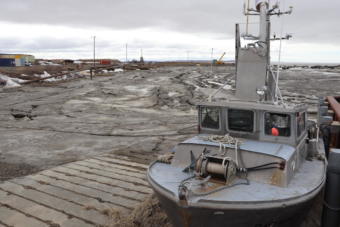
John Fiorillo is the executive editor of Intrafish, a global news bureau covering seafood, commercial fisheries and aquaculture industries worldwide. He argues that the secretive nature of price setting in Alaska salmon fisheries strains the relationship between fishermen and processors, and puts everyone on precarious financial footing.
Fiorillo joined KDLG’s Corinne Smith to talk about why seafood companies don’t usually set a base prices, and why he thinks it’s time for a change.
Listen:
John Fiorillo: Yeah, it’s more cultural and tradition, then there’s a great reason for it, I guess you would say it’s been the way it’s always been. It’s been that kind of situation. And it’s been hard to change, because the processors have the upper hand. In a lot of cases, the fishermen are independent, but they deliver to the processors, and subsequently, they have to get paid. And processors have been setting the price for years and years and years. And it’s just been the way it has been.
Corinne Smith: Some companies have set a price ahead of the season, like Peter Pan Seafoods for the past two years. And what was the impact of that? Like, what were the benefits? And were there any drawbacks for them disclosing a price?
John Fiorillo: Well, Peter Pan had just gone through a sale and new owners, they were trying to make a splash. They were trying to rebuild the fleet that delivered them, particularly in the bay. And so yes, they broke tradition, so to speak. I want to say it was a couple of weeks before the bay really opened, really got going, that they published the price. And everybody followed, which was remarkable, really, to see. It just doesn’t happen, it hasn’t happened, right? So there were no real repercussions. I think they got some good vibes and PR out of it, so to speak. And then again, they did it last year. And it appeared that we were on the road to some sort of preseason price discovery, with everything, but that hasn’t been happening. So we’ll see this year. We’re in the middle of June, if they’re going to do it, I would imagine they do it in the next week to ten days. But we have no knowledge about whether they’ll do it again.
Corinne Smith: So you’re saying it was a gesture of goodwill, and beneficial to the fleet, I know fishermen were pretty happy to hear it. So do you think there were drawbacks to that base price set ahead of the season?
John Fiorillo: Well, I guess the drawback is now we find ourselves in the situation we’re in. So instead of them being able to post, what most people considered a fair, good price the last two years. This year, they would have to go out and post a price ahead of everybody else that is a real slash, I mean, it may be as low as 50 cents a pound. It may be more than that, but it’s not going to be $1.15 like it was last year. So nobody wants to be that company that goes out and puts a price like that out ahead of everybody else. And that probably is the drawback that they could be facing.
Corinne Smith: And then this year, especially fishermen are very frustrated with the rumors of a potential dramatic price drop this year. Can you talk about how this price secrecy affects fishermen and what that uncertainty does to the industry?
John Fiorillo: Yeah, I mean, they’re out there doing what they love. They love to fish, but they don’t know how much they’re going to get paid for their fish. It’s just a very weird dynamic. So over time, it builds anxiety and builds resentment, it builds suspicion. And in a time like we are now, the price is under a major correction, that gets amplified. Now, to be fair to the processors. They too are under a lot of duress this year, they that was a massive, as you know, is a massive haul in Bristol Bay last year, 60 million fish record. All that fish came into the market. Fishermen were largely not put on limits last year, which, you know, with the processors took all the fish and other words, and all that fish head to the market, just as inflation was peaking. Consumers were closing their wallets and being very careful about their spending. And the processors were stuck with all this fish in inventory that they had to carry at a high cost, and they couldn’t get rid of. So the market itself, whether it’s the US market or the market in Europe, which is another strong market for Alaska salmon. There’s no demand, and there still isn’t. Demand has not bounced back. So although many of the processors say they sold their pack, probably at a massive discount. It’s still an inventory challenge for them. And a demand challenge on the consumer side, which, nobody can fix that at this point.
Corinne Smith: And you argue that more transparency from processors or discussing those market conditions with the fleet would also be beneficial for processors.
John Fiorillo: Oh, absolutely. And for fishermen, they really will do themselves a service if they follow what’s going on in the salmon markets around the world. And keep in mind their big competitor is farmed salmon. And the salmon farmers around the world produce a lot more salmon than Alaska does. So their fish is entering a market with you know, the market has farmed salmon and it has wild salmon. And so there’s a lot of dynamics in that market that have to be understood and tracked. And I think fishermen would really help themselves if they paid attention to that, and I think the processors should help them. I think the processors should be more transparent. If they had told them earlier about all these inventory challenges, and the slack demand and all that, maybe it wouldn’t be such a shock. But I think both sides need to just talk to each other a lot more.”
Corinne Smith: And how would those discussions happen, do you imagine? Would it be more communications to the fleet directly from processors? Or perhaps talking more to the media, we would always love to hear more from processors as well. But yeah, what are some channels of communication that could be created and developed between processors and the fleet’s?
John Fiorillo: Yeah, and I think you’re right, I think the two need to speak to each other now, how that happens. I mean, there are models all around the country, all around the world where there are price boards that meet and there’s a kind of discovery of the price together. Some of these are government boards, some are just industry boards. I don’t know if that would be the solution in Alaska, and I don’t know that they’re, I don’t really have the solution, obviously. But to your point, there just needs to be some two way channel of communication throughout the year leading up to the seasons. So I think everybody is better prepared for times like these where it looks like the price is going to be really, really shaved.
Corinne Smith: And we do hear quite often, how fishermen wonder why Bristol Bay processors all set the same base price…
John Fiorillo: Yeah, well, they’re all selling into the same markets, whether it be the US market, Japan or Europe. So they don’t want to pay any more than the guy next to them. For the fish that are going to go to the same markets. I mean, it makes sense…that’s the essence of it, unfortunately.
Corinne Smith: What do you think it would take to sort of break tradition here with price secrecy, and move towards a more transparent model? more collaborative, maybe more communication? What do you think it would take to make this change?
John Fiorillo: That’s the million dollar question. I don’t know. Like I said earlier, I thought Peter Pan (Seafoods) was setting a new course. But what I did calculate, last year, the year before, was, well, what happens when the price drops like it’s doing now? So, I don’t know. I mean, the short answer is I don’t know. But I do know that both sides need to talk a lot more to reduce the hard feelings that are probably going to develop this year, over this price situation.
A boat in the Dillingham harbor on April 21, 2020. (Isabelle Ross/KDLG)
Bristol Bay’s commercial salmon fishery can be fast-paced and competitive. Many local fishermen support a longstanding regulation they say keeps competition in check by limiting the size of the boats.
Commercial drift gillnet boats must measure 32 feet or less to fish in the bay. And the fleet got a finger-wagging from the Alaska Wildlife Troopers earlier this year — a reminder to keep their boats within that limit.
Wildlife trooper Capt. Aaron Frenzel said they fielded more complaints than usual about big vessels last year. So after the season, they went over to boat yards in King Salmon and Naknek to see what was going on.
“A lot of the stuff is below the waterline that we can’t see… while we’re out on the water inspecting vessels,” he said. “So we started seeing some areas that just kind of expanded.”
Those boats were a little bigger than what’s allowed in regulation, and troopers decided to raise awareness among the fleet ahead of this season. In February, they published a public letter outlining exactly what is included in the 32-foot measurement.
Frenzel said they hope fishermen will bring their boats into regulation this year. For some of the vessels, the extra length comes from equipment meant to help with safety or increase the quality of the fish — like ladders or refrigerated seawater systems. But troopers won’t be targeting boats for transgressions due to safety or quality equipment, he said.
Instead, they will focus more on what Frenzel calls “performance enhancing” additions, like hull extensions.
“Maybe a vessel that’s actually 34 feet in length, or has some kind of adaptation that provides a significant performance benefit to the vessel that’s beyond the allowable length,” he said. “Those are the type of vessels that we’ll be taking a closer look at this summer and determining if we need to take enforcement action on.”
Bristol Bay’s 32-foot rule has been a point of debate in many Board of Fisheries meetings over the years. Some fishermen argue that bigger boats could allow for safer seasons, more efficient harvests, better quality and more money. But others say they would disenfranchise the local fishermen, who may have smaller boats and may not be able to buy into a more competitive fishery.
Rep. Bryce Edgmon of Dillingham is among those who want to keep the status quo. Edgmon said he and Sen. Lyman Hoffman of Bethel met with Alaska Wildlife Troopers and the commissioner of the Department of Public Safety to ensure there was follow-through to protect the 32-foot rule.
“Myself and the senator, we’re going to, you know, really go to the mat on this issue if there were any attempts to deviate from that regulation,” Edgmon said.
Frenzel said people probably started calling out bigger boats last year because they’ve gradually gotten bigger; he said one fisherman compared Bristol Bay boats to accordions.
“It got stretched out here and there, until all of a sudden, there were some vessels that were so stretched out, that the flag started being flown by other fishermen,” he said. “And that’s what we started looking at.”
Frenzel said the fishery has also changed a lot in the past 20 years — newer boats have equipment that may make them bigger.
“The vessels are just a different breed now. So they’re doing things that one would never have thought was possible before,” he said. “So I think that has a lot to do with it is just the new equipment that’s being put on it. And the new engines, the outdrives that are on them, things have just changed. And the regulation just didn’t change with it.”
This isn’t the first time troopers have focused on the issue.
Tom Glass, a commercial fisherman who lives in Dillingham, said troopers cracked down on the 32-foot limit in the early 90s, when he was working as a deckhand. And some fishermen went to drastic measures to comply by shortening the bows of their boats.
“Some would just grind off a couple inches and others would cut off like two feet,” he said. “They were too long by two feet or maybe more.”
At one point, Glass said, someone took a cut-off boat nose and threw it in the brush near the Alaska Commercial grocery store in downtown Dillingham.
“And after a while there was a whole pile up in that area there, of noses from the boats. It’s just kind of funny,” he said, “everybody getting their noses cut off that season.”
Glass said some of those boats are still around – some of the fiberglass vessels have caps bolted on with the help of some sealant, and aluminum boats are welded up.
Today, Glass said, he’s happy with the 32 foot limit, although he could use a few extra feet in his already-crowded engine room.
Troopers say anyone with questions about their boat can call the post in King Salmon at 907-246-3307, Dillingham at 907-842-5351, Kodiak at 907-486-4762 or Capt. Aaron Frenzel at 907-334-2501.
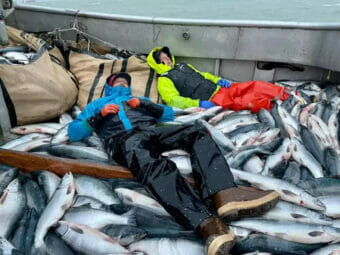
Crewmembers on the Diamond V after a haul during the 2022 season. (Photo Courtesy Of Nick Rahaim)
Bristol Bay fishermen harvested a record-breaking 60 million sockeye last summer, flooding the market with a surplus of salmon.
Early this month, the U.S. Department of Agriculture agreed to help with the glut by purchasing $119.5 million of canned and fileted Alaska sockeye and Pacific groundfish. It’s a win for the state’s marketing branch, which had some help from Alaska’s congressional delegation. But the purchase won’t totally clear out the storehouses and shelves.
“As far as, you know, fixing the problem of such a giant harvest from last year, it’s not going to fix anything,” said Bruce Schactler, the Alaska Seafood Marketing Institute’s global food aid director. “But it’s certainly going to help in a big way — in a really big way.”
Schactler said ASMI asked the USDA to buy Alaska seafood for their food assistance programs last fall, when they knew there would be surplus.
“It kind of got stalled, for whatever reason,” he said. “So we asked the three members of our congressional delegation to provide some encouragement to hurry this along. And that was clearly successful.”
Sens. Lisa Murkowski and Dan Sullivan, and Rep. Mary Peltola submitted a joint letter to the USDA at the end of March. They asked the department to commit to buying millions of pounds of Alaska sockeye and pollock. The request included 5 million pounds of frozen sockeye filets, along with hundreds of thousands of canned salmon and 50 million pounds of pollock.
The USDA agreed to buy up to $67.5 million of Alaska sockeye and $52 million of whiting, rockfish and pink shrimp from West Coast fisheries, according to Schactler.
The pressure from the delegation helped cut through the competition, he said, since there’s only so many federal dollars to go around.
“The folks up in the Northeast Atlantic, they want to sell fish, and they do, and the catfish guys, and the Gulf shrimp guys and the West Coast groundfish people,” he said. “Then you’re also competing with those same dollars with walnuts, pistachios, and fruits and vegetables.”
The federal process of buying and distributing food can be cumbersome. It took eight months for the USDA to agree to make the purchase. And as for when the fish will be distributed, Schactler isn’t sure.
“There’s a lot of things that need to happen now,” he said. “They got to decide where they’re going to ship it, how much they’re going to ship, when they’re going to ship. Is it going to be to Omaha in October? Is it going to be Los Angeles in June?”
Still, Schactler said, the announcement will “provide some relief” to the industry just in time for the summer fishing season. The Copper River fishery is gearing up, and fresh sockeye will soon be on the market.
Close
Update notification options
Subscribe to notifications
Subscribe
Get notifications about news related to the topics you care about. You can unsubscribe anytime.