KDLG is our partner station in Dillingham. KTOO collaborates with partners across the state to cover important news and to share stories with our audiences.

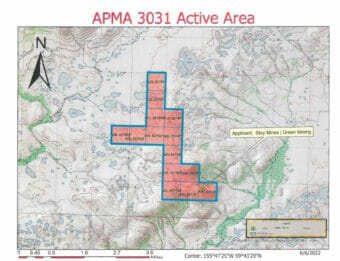
A map included in Stuy Mines application for a hardrock exploration permit. (Alaska Department of Natural Resources)
The Alaska Department of Natural Resources announced last week that Stuy Mines has applied for a hardrock exploration permit along Kaskanak Creek, southwest of the Pebble deposit.
The Stuy Mines company, registered in Washington state, is proposing a multi-year hardrock exploration program, which would include 12 holes a year. The activity could start after the state issues a permit and continue through 2027. To access the site, the company has plotted a pathway that it says mostly follows existing gravel bars along Iliamna Lake and that it would grade existing gravel only where necessary.
Stuy Mines’s primary owner is a company called Love and Above. Manager Greg Ellis has also worked as a screenwriter and a home developer in Washington state, according to his LinkedIn profile.
A joint news release from the Bristol Bay Defense Fund cited the EPA’s recent decision to veto mining at the Pebble deposit. The coalition, which includes the United Tribes of Bristol Bay, SalmonState and Katmai Services Provider, says the decades leading up to that decision show that Bristol Bay residents don’t want mining in the region. They also reiterated calls for watershed-wide protections against mining.
“We have always opposed mining around Kaskanak Creek and will continue to be vocal in our opposition to projects like this that threaten our pristine waters, salmon, landscapes, and way of life,” Igiugig Village Council President AlexAnna Salmon said in the news release.
Salmon said the creek is the home of Igiugig’s ancient villages and is important for traditional hunting and fishing. She said the village council is counting on leaders in Washington to enact protections for the entire watershed.
The deadline for public comments on the Stuy Mines application is March 14.
Written comments, questions or requests to view the full application packet can be directed to Sara Church at (907) 458-6896, faxed at (907) 451- 2703 or e-mailed to dnr.fbx.mining@alaska.gov.
Correction: The exploration activity could start after the state issued a permit until 2027, not between 2024 and 2027 as originally reported.
Kyrstin Arellano holds up her finished vegan macaron shells, made with chickpea water instead of egg whites. Jan. 9, 2023. (Izzy Ross/KDLG)
On a frosty morning in mid-January, Kyrstin Arellano worked in her kitchen on the outskirts of Dillingham. About three dozen perfectly round bright blue blobs rested patiently on a baking sheet.
“I’ve got some vegan macaron shells here,” she said. “They look good so far, and when I was mixing, they felt regular. So I’m really hopeful.”
The national egg shortage has forced everyone to use fewer eggs, and bakers like Arellano are rising to the challenge — just in time for Valentine’s Day.
Arellano is a home baker. That is, she bakes from her house for Bristol Bayking, a business she started last year. Along with signature and custom cakes, Arellano experiments with local ingredients like cranberries, salmonberries and fireweed.
“I mostly make macarons,” she said. Macarons are small French desserts made of two delicate meringue shells that sandwich a filling of jam, curd, ganache or cream. “They’re for sure my most popular, and my favorite thing to make. I also make cakes and cupcakes to order, for birthdays and stuff. But I really enjoy making the macarons.”
Bright blue macaron shells rest on baking sheets before going into the oven. This is a critical step in the baking process – if they don’t develop a tacky “skin” they will erupt in the oven. Jan. 9, 2023. (Izzy Ross/KDLG)
Egg-based desserts in an egg shortage
Macaron shells are normally made by whipping together egg whites, almond flour, and powdered and granulated sugar and piping the batter in rounds onto a tray. But how do you make an egg-based dessert without using eggs?
Arellano uses aquafaba — chickpea water she gets from a can of grocery-store chickpeas, whipping it up into soft peaks just like egg whites.
“Macaron shells don’t actually have a lot in them,” she said.
Arellano is no stranger to staples being out of stock.
“We go through this all the time,” she said. “Last year, powdered sugar and butter were hard to find. Sometimes milk is hard to find.”
Kyrstin Arellano rotates a batch of blue macaron shells in her oven. (Izzy Ross/KDLG)
Baking in the bush
Like many others, Arellano began baking after the COVID-19 pandemic started three years ago. In rural Alaska, that takes a certain innovative flair. Arellano has honed her ability to find substitute ingredients, like using vinegar and baking soda as a raising agent. And when she can’t find buttermilk at the store, she makes it herself, combining a cup of milk with a tablespoon of vinegar.
“You mix it together and let it curdle a bit, ‘cause that’s all buttermilk is: acidic milk,” she said.
Arellano has three fridges at home, so she’s been able to stock up some eggs. But she’s had to cut back, which means trying new recipes and better understanding why eggs are used in baking. They can provide structure, leavening and flavor.
“Depending on your recipe, the egg might provide moisture, in which case you can substitute with something like yogurt or applesauce to get that moisture,” she said. “You get to be a little more resourceful baking in the bush, because what can you do?”
When Arellano first started her business, she shipped most of her cakes out to villages like Togiak, New Stuyahok and Manokotak.
“I really appreciate them,” she said of customers in other communities. “I’m also getting a feel for the big birthday months in Dillingham.”
Arellano has also sent birthday cakes out on fishing boats in the summer. She said her client base is loyal; she does monthly pre-sales, and her flash sale batches regularly sell out.
Kyrstin Arellano packages egg-based macarons while she waits for the vegan shells to cool. (Izzy Ross/KDLG)
Rest, then bake
The first batch of macarons went into the oven for a total of 18 minutes while the second batch rested on the baking sheet. They need anywhere from 30 minutes to an hour before baking to develop a skin, which protects them from the heat.
“If I put them in before they’ve developed the skin, they’re going to – it’s called ‘volcano’ – they literally pop up like a volcano in the middle and crater and are just horrible,” she said. “So, really important to let them sit and develop that skin.”
Arellano opened the oven door and turned the tray around, ensuring that the shells are evenly baked.
“When they first come out of the oven, before they have any filling, they’re hollow,” she said, tapping on a finished shell, which emits a delicate, hollow sound. “And so when you fill them, the moisture allows the shell to expand inside and get soft.”
When the shells came out, they had swelled slightly and developed small ruffled edges, called “feet.” But none erupted — each was still perfectly round, like rows of blueberry emojis.
Gov. Mike Dunleavy joined Lori Townsend for Talk of Alaska on Jan. 31, 2023. (Matt Faubion/Alaska Public Media)
Alaska Gov. Mike Dunleavy says he’s going to pursue legal action against the Environmental Protection Agency’s veto of the Pebble mine. On Tuesday’s Talk of Alaska, he called the EPA’s final determination a political decision.
“It’s on state land. We traded land for this particular mineral find,” he said. “The whole premise of Alaska as a going concern, as an entity, as a sovereign is that we were to develop our resources. That’s the irony of this whole thing.”
The EPA has vetoed mining at the Pebble deposit in southwest Alaska, exercising a rarely-used power under the Clean Water Act to ban and restrict the discharge of mining materials in waters around the site. It says doing so will “help protect the most productive wild salmon ecosystem in the world.”
Some Bristol Bay tribes started petitioning the EPA to use that veto authority in 2010, and the process has flip-flopped between three presidential administrations. Dunleavy, meanwhile, has been one of the most vocal opponents of the EPA’s actions at the Pebble deposit.
Opponents of the mine are celebrating the decision, and Dunleavy said he understands that some don’t like the Pebble project.
“But as governor, my job is to make sure that we take advantage of every opportunity,” he said. “I believe we have the best environmental standards in the world. And I think it’s… I think it’s a sad day for Alaska for the country.”
The U.S. Army Corps of Engineers denied Pebble a federal permit in 2020, but the company appealed that decision.
EPA officials said in a news conference on Monday that this ban is specific to the Pebble deposit and does not apply to any other projects in the state. But Dunleavy called the EPA’s action a “dangerous precedent.” He also said it was one in a series of projects that could have provided jobs in Alaska but were struck down.
“The irony of a lot of these projects that are trying to be shut down is that they’re located in some of the poorest areas of our state,” he said. “Now, what’s the answer for some of those folks that want to develop their resources, whether it’s Kokhanok, whether it’s out of Pedro Bay, Iliamna, what’s the alternative for them? A check from the government?”
Opponents of the mine say it would threaten the region’s ecosystem as well as the Alaska Native cultures that rely on traditional harvesting of wild foods, like salmon.
The Bristol Bay Native Corporation echoed other groups that cheered the EPA’s decision.
“We’re ecstatic that the EPA issued the final determination,” said Daniel Cheyette, the corporation’s senior vice president for lands and resources. “We do want to develop. But we want to develop in ways that are sustainable for the region and supported by the majority of the folks that live in the region and that are our shareholders.”
Cheyette calls the EPA’s decision a major brick in the wall to protect the region’s salmon-based economy. But he said the Bristol Bay Watershed needs an even bigger wall to protect it from projects like Pebble Mine; the corporation plans to ask Alaska’s congressional delegation for help in passing legislation to head off mining and other potentially harmful development in the region.
Alaska’s congressional delegation had mixed responses to the announcement. Sen. Dan Sullivan said that while he opposed Pebble, the EPA’s actions could set a precedent for development on state lands. Sen. Lisa Murkowski reiterated her opposition to the mine but said she supports mining in the state and that the Biden administration has a responsibility to support other projects. Meanwhile, Rep. Mary Peltola supports the EPA’s use of its veto authority at the site.
The proposed Pebble Mine site, pictured in 2014. (Photo by Jason Sear/KDLG)
The U.S. Environmental Protection Agency announced Tuesday morning that it is effectively killing the controversial Pebble mine project in Southwest Alaska.
The decision caps a decades-long battle over a region that is not only home to one of the world’s largest deposits of copper and gold, but also the world’s largest wild salmon run. The EPA says the mine would cause too much damage to the salmon habitat, and it’s banning certain mining activities at the Pebble deposit.
United Tribes of Bristol Bay Executive Director Alannah Hurley called EPA’s decision historic. It’s a move some Bristol Bay tribes have been pushing the EPA to take for 13 years.
“Many of those who began this battle are no longer with us. New generations of our people have been born and raised with the cloud of Pebble hanging overhead,” she said at an EPA press conference on Monday. “But our ancestral responsibility to safeguard our watershed and fishery has united all of us in our work to defend the world’s last great wild salmon fishery.”
The EPA is exercising its rarely used veto authority under section 404-c of the Clean Water Act to prohibit mining the Pebble deposit. This is the 14th time in the history of the Clean Water Act and just the third time in the past 30 years that the federal agency has done so.
Hurley thanked the Biden administration multiple times. She pointed to its nation-to-nation discussions with the region’s tribes and said the federal government consulted with tribes when the state government would not. She also said tribes will continue their efforts to protect the region.
“Our work will not be done until every inch of our traditional homelands are protected,” she said. “And EPA’s action today helps us build that future where our people can remain Yup’ik, Dena’ina and Alutiiq for generations to come.”
Before Tuesday, the proposed Pebble mine already faced serious headwinds. The Pebble company had proposed building an open-pit copper and gold mine about 17 miles from Iliamna Lake. The U.S. Army Corps of Engineers denied Pebble a federal permit two years ago, and the mining company is appealing that decision.
In a written statement responding to Tuesday’s announcement, Pebble CEO John Shively said the EPA’s use of its Clean Water Act authority while the appeal process is ongoing is “unlawful and unprecedented,” and that doing so will likely result in legal action.
“For well over a decade, we have argued that fair treatment under the rules and regulations of the U.S should be followed for Pebble or any other development project,” said Shively’s statement. “Unfortunately, the Biden EPA continues to ignore fair and due process in favor of politics. This preemptive action against Pebble is not supported legally, technically, or environmentally.”
Gov. Mike Dunleavy issued a statement Tuesday along with leaders of several state departments blasting the EPA’s veto. He said the veto “sets a dangerous precedent.”
“Alarmingly, it lays the foundation to stop any development project, mining or non-mining, in any area of Alaska with wetlands and fish-bearing streams,” he said. “My Administration will stand up for the rights of Alaskans, Alaska property owners, and Alaska’s future.”
Alaska Attorney General Treg Taylor called the EPA’s decision “legally indefensible.”
The EPA said Tuesday that the mine’s harm to salmon habitat would be “unacceptable.” It said it would damage or destroy 100 miles of streams that support spawning and breeding and approximately 2,100 acres of surrounding wetlands.
The EPA’s action also goes beyond banning Pebble’s proposed project. It bars future projects that would cause a similar loss of aquatic resources, and it restricts the discharge of mining materials in the South and North Fork Koktuli Rivers and in the Upper Talarik Creek.
Still, EPA Administrator Michael Regan said the determination is focused on the Pebble deposit.
“We know that this particular project would have adverse impacts, that would significantly impact not only the industry, but also impact the ecosystem and have a significant impact from a cultural standpoint as well,” he said.
The EPA’s Assistant Administrator for the Office of Water Radhika Fox said the agency’s decision means that the Army Corps cannot grant Pebble’s appeal as proposed. But she said it does not ban every future project.
“It provides a roadmap for those types of projects that would create these adverse impacts, but does not at all apply to other projects that could potentially be considered,” she said. “And it does not apply to any resource development beyond this one in the state of Alaska.”
The EPA said the habitat around the Pebble deposit supports the diversity of Bristol Bay’s salmon and many other species, which in turn sustain the region’s Alaska Native communities and support its sport and commercial fisheries.
A sign that reads ‘Welcome to Igiugig’ next to a signpost with the place names of communities in Yup’ik on Jan. 18, 2023. (Photo by Isabelle Ross/KDLG)
The sun was just starting to rise at 9 a.m. on a recent January morning in Igiugig as Christina Salmon walked through the snow to her office in Igiugig’s airport, where she works many jobs, including as a village council member. Igiugig, a community of about 70 people, sits on the Kvichak River which flows from Iliamna Lake, where Yup’ik, Dena’ina and Alutiiq peoples have lived for thousands of years.
Salmon said she almost feels like she can relax again.
“We’ve just wasted so much of our life fighting Pebble,” she said.
Pebble Mine would be one of the largest copper and gold mines in the world — but it might never break ground. The U.S. Environmental Protection Agency is expected to issue its final decision on the mine very soon.

Last month, Salmon got the news she was hoping for: The EPA recommended a ban on mining activities at the site, which is about 45 miles from her village. The recommendation would not only ban the mining activities described in the Pebble company’s permit, but any similar mining there.
If the EPA finalizes that decision, it would effectively kill the mine.
The EPA is exercising a rarely used authority under the Clean Water Act, commonly called its “veto authority.” Some Bristol Bay tribes have pushed for this action since 2010. Agency officials declined to be interviewed for this story, but in a statement said the mine could harm fish spawning and breeding areas and that vetoing the mine would protect fisheries and a traditional way of life based on wild salmon.
The U.S. Army Corps of Engineers denied Pebble’s mining permit two years ago, but the company appealed that decision. Pebble spokesperson Mike Heatwole said the EPA is not following normal protocol by using this Clean Water Act authority before the appeal has even been processed.
“We continue to say that it is largely unlawful and unprecedented what the EPA is attempting to do regarding this project,” he said.
Heatwole said the company may take this fight to the courts. But the EPA’s use of this authority reflects its serious concerns about the mine’s impact on the region, according to Joel Reynolds with the Natural Resources Defense Council.
“It’s about as much opposition as one will ever see to a development project anywhere really, but in particular, in a development-friendly state like Alaska,” he said.
Many who want the mine to move forward say they understand the opposition to it, but they say the economic future of the region is at stake.
“I think the EPA should butt out, quite frankly, and let the process continue,” said George Hornberger, who runs the electrical utility in Newhalen, one of the communities closest to the proposed mine site. Hornberger said he’s concerned about the mine’s environmental risks, but that there needs to be other work opportunities in the region.
“If it’s not that, then tell me your plan for this area,” he said. “What is your plan to bring economy into this area and give people a reason to stay here?”
Newhalen Tribal Council administrator Joanne Wassillie in her office. (Photo by Isabelle Ross/KDLG)
Joanne Wassillie, the Newhalen Tribal Council administrator, believes Pebble can develop the mine safely. And she said earlier, when Pebble was exploring the site to see if a mine was viable, the company provided people with good-paying jobs.
“We saw a really positive change when our people were working,” she said. “And then it seems like as soon as they quit working we started noticing a lot more kind of like depression, no jobs, more alcohol- and drug-related activities happening.”
Wassillie said the prospect of good jobs would give people the ability to stay in the place they love. Now, they’re taking that upon themselves.
“We’re going to focus on: What can we do in Newhalen?” she said.
The Newhalen Tribal Council recently opened a grocery store, and it has a roads program to work with the city on maintenance. It’s also helping some members who don’t have driver’s licenses get them. Wassillie isn’t banking on Pebble; instead, she said, she and others are thinking outside of the box.
Karl Hill poses for a photo outside the Igiugig airport. (Isabelle Ross/KDLG)
In Igiugig, Karl Hill, the tribe’s vice president, said he’s excited to focus on things like broadband efforts and a new cultural center.
“We do need projects that can bring money into our region and help to elevate our youth to higher levels of education,” he said. “So there is a need for it. But I think each project is a case-by-case basis, you know, and this one just doesn’t fit.”
Hill said that over the years, debates around Pebble often relied on economic gains that can’t be weighed against culture and tradition.
“When you talk about a way of life, you can’t put numbers to it,” he said. “There is no ‘It’s worth a million, it’s worth a billion.’ We’re all having to integrate into the cash-based society. We still have this way of life that is subsistence, and there’s no value you can put on that. It’s worth everything to people. “
Then-House Speaker Bryce Edgmon, I-Dillingham, talks to reporters at the Capitol in 2019. (Photo by Skip Gray/KTOO)
Alaska’s 33rd legislative session convenes next week. And while the state Senate is organized, the House is not. The midterm elections left Republicans with a narrow majority in the 40-person chamber, but it’s still unclear whether those members will toe the party line or join a multi-party coalition.
Rep. Bryce Edgmon, an Independent from Dillingham, is a former House speaker. He said it’s a familiar pattern: It will be the third legislative cycle where House members begin the session without a concrete idea of who is in the majority.
“The next two years, it’s really up in the air. We just don’t know,” he said. “And I think we’re all going to Juneau, hoping that we can kind of pull a rabbit out of the hat and put a larger group together, and as I say, put a lot of political swords aside. But again, all that remains to be seen at this point.”
The multiparty coalition has controlled the House since 2017. Edgmon, who served as speaker from 2017 to 2021, expects the Legislature to tackle some longstanding issues that are increasingly pressing, like education funding and a shrinking workforce. He also thinks the Legislature underestimated the impact of the pandemic and the toll of inflation on schools.
“There’s one faction of the Legislature that will say that the increase for schools is long overdue. We’ve dilly dallied long enough,” he said. “But there’s also gonna be another sort of core group of legislators are going to say, ‘Yeah, but what about performance metrics? And are the schools achieving what they’re supposed to?,’ because Alaska ranks 49 or 50 in whatever category it might be. So I expect that that’s going to be a real centerpiece of what we talk about in Juneau, and what we ultimately emerge with at the end of session.”
Edgmon said figuring out how to recruit and retain educators is key to addressing many of the difficulties schools are facing, especially in Bush Alaska. Still, he’s cautiously optimistic about the working relationship between the legislature and the governor’s office.
“We have an administration coming in for a second term, and the governor appears more willing to work with the legislature and to be part of the solution, at least in my view,” he said.
Edgmon also pointed out that a second round of funding for the federal infrastructure bill is coming up.
“We’re looking at maybe somewhere in the neighborhood of about a billion dollars going through the state budget process, federal money going through the state’s capital budget process, largely,” he said. “So that should be very interesting and enticing. And I think we’re going to see $100 million or so in broadband money come through the state budget process as well.”
The next batch of pre-filed legislation will be released on Friday, and the legislature convenes on Tuesday.
Listen to KDLG’s interview with Rep. Bryce Edgmon:
Izzy Ross: Representative Edgmon, thank you so much for joining me today.
Rep. Bryce Edgmon: Thank you. My pleasure to be here.
Ross: So the last time we talked was right before the midterm elections in November. Since then a lot has changed. What does the makeup of the legislature look like now?
Edgmon: Yeah, first off, time goes by so fast, isn’t it? So here we are basically, about a week out before the 33rd Legislature convenes. The first day is January 17. And at this point, it’s really up in the air, because the traditional three legged stool, of course, is the governor, the Senate, and then the House. At this point, the Senate seems to be organized. And the governor of course has got his team in place. And then the House for the third cycle consecutively is landing in Juneau, not being organized, having sort of two different factions, equal in numbers, and basically preparing to go into another sort of round of stare-downs, and to figure out how we get a few legislators to sort of decide that the greater good is more important than being with their side.
Ross: Right. And this is not an unfamiliar position.
Edgmon: That’s absolutely right. You know, I’ve been involved in all three of those attempts to organize in the last six years, I’ve been in leadership positions in the Legislature. The next two years, it’s really up in the air. We just don’t know. And I think we’re all going to Juneau, hoping that we can kind of pull a rabbit out of the hat and put a larger group together, and as I say, put a lot of political swords aside. But again, all that remains to be seen at this point.
Ross: Got it. So that’s what we’re looking at in the Legislature. But heading into this session next week, what are you keeping an eye on?
Edgmon: Well, there does seem to be some larger priorities that are sort of bubbling to the surface. Education funding clearly is going to be on the minds of most legislators, and certainly the governor has indicated his willingness to partake in that debate. The issue of a shrinking workforce in Alaska and in the public sector, the state government, the need to be able to offer state workers, sort of an attractive compensation package, but also an attractive retirement package, something along the lines of the defined benefits plan that we had back up until 2006, I think the issue of that is going to come to the forefront.
And then there’s a whole host of other issues that always come up. I was looking at the prefile list of bills before I got here. And it’s about 70 bills that have been pre-filed both in the House and the Senate. And a lot of the bills are quite familiar to me, I’ve seen them come and go many times. But they’re back again. In an environment where oil prices are waning or going down and are below what we projected when we left Juneau this past session, last spring, I think there’s going to be a need to tighten our belt a little bit and look at state spending. And we’ll be examining the Permanent Fund Dividend as we do every year.
And interestingly enough, I should point out that it’ll be round two funding for the federal infrastructure bill. And we’re looking at maybe somewhere in the neighborhood of about a billion dollars going through the state budget process, federal money going through the state’s capital budget process, largely. So that should be very interesting and enticing. And I think we’re going to see $100 million or so in broadband money come through the state budget process as well.
You know, it’s going to be one of those sessions [where] we just don’t quite yet know how it’s gonna turn out.
Ross: Thinking about education funding, I’ve talked with teachers across the region who have mentioned the pre-2006 retirement plan versus the current retirement plan and how in order to recruit teachers to work in this area, you need to have some incentives to get that started. Do you predict the state moving in any one direction with that, or with education funding in general?
Edgmon: I think we have to take a hard look at the proverbial “Where does Alaska go next?” question, because we’re in a situation statewide where we’ve had a somewhat dramatic decrease in younger residents. So we’re at this point where oil money isn’t the primary funder of government services anymore. But when oil prices do rise, as they did the last calendar year, and they’re still fairly high, in the $70 or mid-$80 range, we have other opportunities to tackle things like deferred maintenance, a huge backlogs of projects and everything from the university to our school system to our airports to our roads that just haven’t been maintained over the years. And we have the opportunity to keep up hopefully with inflation when it comes to funding our schools and other areas of our public sector.
But it’s really interesting because at the start of this session, we have an administration coming in for a second term, and the governor appears more willing to work with the Legislature and to be part of the solution, at least in my view. So I’m cautiously encouraged that the next two years are going to really take us in a direction where we start to sort of invest back into Alaska as well. And a lot of it goes back to, you know, particularly out here in the Bush, getting qualified people to come out here and stay and to work and to become part long-term members, hopefully, of our communities. And we have a role to play in the Legislature.
Ross: Are there any other big areas that you’re focused on are that you think the state needs to focus its funding efforts, or needs to reconsider how it’s moving forward?
Edgmon: Well, you know, broadband is a big issue. Alaska is going to see just unprecedented amounts of money come into the state for broadband over the next five to 10 years. So that’s something I’m keeping a close eye on. Last session I introduced – and got the bill signed by the governor – the bill that set up the broadband program in Alaska.
But you know, in many respects, a lot of what I think is going to happen in Juneau comes back to education in our schools. I think we underestimated this past session – we collectively across the state underestimated – the toll that the pandemic took on our schools, and the fact that we do have declining enrollment numbers, not just in Anchorage, but all across the state, and sort of the creeping presence of inflation, really has taken its toll on a lot of schools.
There’s one faction of the Legislature that will say that the increase for schools is long overdue. We’ve dilly-dallied long enough. But there’s also gonna be another sort of core group of legislators are going to say, ‘Yeah, but what about performance metrics? And are the schools achieving what they’re supposed to,’ because Alaska ranks 49 or 50 in whatever category it might be. So I expect that that’s going to be a real centerpiece of what we talk about in Juneau, and what we ultimately emerge with at the end of session,
Ross: That’s an interesting, I guess, dichotomy, or two different perspectives to take, because it doesn’t seem like they’re necessarily competing perspectives. It seems like perhaps an increase in funding could help schools meet those metrics, or could help schools in pursuing those goals for academics for their students, and supporting their students with more resources. What are your thoughts on that? And Bristol Bay schools are dealing with these issues, too, like enrollment, scores being pretty low, and certain communities – I’m just thinking of Chignik Bay – struggling to keep their schools open. So I’m curious to hear what your thoughts are on addressing some of those issues, specifically in the area?
Edgmon: Yeah, well, the challenges that face one school district can be very different for the next school district, and so on and so forth. But I’m very eager to have that conversation in general, and to bring forth the State of the State of education, if you will, and to look at it more sort of holistically. A moment ago, we were talking about broadband, and the role that that could play for school districts as well.
But we have a hard time, and I think it’s getting almost exponentially more challenging going forward. We have a real problem on our hands in terms of recruiting and retaining educators. It is becoming more than pervasive. And I think it’s a big reason why Alaska ranks so low, I think back to my own growing up here in Dillingham, and it was commonplace for teachers to be here throughout the entire first grade through 12th grade. Teachers came and they stayed, and they were part of the communities and they raised their families here and their kids graduated from schools. To some degree that’s still happening, but to a larger extent it’s not.
And so that continuity, and that familiarity, and the comfort level, the acculturation, all that stuff that occurs that I think makes our public education system one of the best in the country, is really being challenged considerably by not being able to get and keep people in those small communities and really across the state as well. That’s going to be a real issue that I’m going to focus on. And I think a lot of legislators and the governor, hopefully as well, too.
Ross: Thinking about broadband, something that’s been coming across my social media feed recently, especially in the Dillingham community groups has been Starlink and satellite internet. What are your thoughts on that, you know, as both a Dillingham resident and also a legislator?
Edgmon: Well, I think to get high speed, reliable, affordable internet in Alaska is going to involve every form of technology that’s out there. Seriously. The gold standard is fiber optic cable. But there are supply chain issues, there’s also a host of other issues in terms of right-aways and availability of workforce and this, that and the other to get fiber optics in place: our working seasons out here are very short. So satellite technology, both the bigger satellites that are further away from the Earth, rotating, the smaller satellites that are more focused, are there to provide service in some capacities in a pretty immediate manner. I think that when you look back at our telephone system and certainly internet for a great part of the state, it’s all come through satellites. So there’s a huge role for satellites to play.
Starlink, I’ve read about it, just like everybody else has, I’m hearing some good things, mostly, about it. And it’s bringing services to a lot of areas that really didn’t have reliable service before at a fairly reasonable price. In the meanwhile, a community like Unalaska now has got fiber, and that is taking shape at the final mile level, getting fiber right into people’s homes and their businesses, and so forth. And so you’re really seeing sort of a dual effort go forward: You’re seeing what satellite services can provide. But at the same time in the intervening years between now and say, a decade out take place, you’re going see more fiber optic cable, criss crossing the states, and that being available.
Ross: And there are also plans to have a fiber optic cable from Dillingham to Bethel. So even in-region, we’re seeing these movements, you know, and we’re seeing these projects happening.
Edgmon: Well, the rule of thumb with broadband – and we saw it in Anchorage – is if a community gets what’s considered to be high speed internet in a short period of time, the demand for that service doubles. So that’s something that in the column of fiber optic cable terms being more of a plus, because there’s sort of unlimited capacity and fiber optic cable, and the satellites don’t really have that ability. So, again, it comes down to a mix and a match. And I think a lot of this federal money coming in Alaska is going to be focused on getting high quality internet to places that don’t have it with an element of making it affordable, however that comes together.
Ross: The state and Bristol Bay are waiting for the EPA to make its final determination on whether and how to veto mining at the pebble deposit and state primacy of the Clean Water Act has been an ongoing discussion.
Edgmon: Well, from the legislature’s perspective, the one issue that we’ll be addressing once again is the Donlevy administration’s desire for the state’s Department of Environmental Conservation to take primacy over section 404, water primacy management of the Clean Water Act. And we sort of put the kibosh on that last year in the legislature and we kind of punted by instead authorizing a million-dollar study that will be finished up in March sometime. And so that issue of the state taking sort of domicile or control over the permitting process involving that very important section of the Clean Water Act, the 404 section that involves dredge and fill sort of type activities in the most pristine waters. It’s going to be complicated and controversial. And we’ll see where that goes this session in Juneau.
Ross: Do you think the legislature is going to make any decisions about that?
Edgmon: It would involve the legislature having to take action because the Department of Environmental Conservation last year, they asked for 28 new employees in order to administer this program. Again, in an era where it’s hard to find any employees in Alaska, these would be highly qualified technical employees. So it’ll have to go through the state budget process. I expect it to, again, involve a lot of back and forth.
I’m passionately opposed to Pebble, I think it shouldn’t really be an issue. But we have an administration, the Dunleavy administration, that wants to see it go through the process, and I don’t know if that’s code for being supportive of it or not. But this issue of gaining primacy over one section of this voluminous, this great federal act called the Clean Water Act that goes some 50 years ago back to 1972, really gave the states the opportunity to take control of this provision.
Over all those years, only three states to my memory – Florida, New Jersey, Michigan – have really taken the federal government up because number one, it’s expensive to administer. And number two, there may not be a whole lot of benefit in doing it, given that you’ve got EPA and Corps of Engineers and others who have been in a state like Alaska with the vast amounts of wetlands of the entire country. They’ve got strong historical presence, a lot of long term employees, great relationships with the federal counterparts and what have you. And so yeah, that’s another issue that could be a flashpoint next session.
Ross: Really looking forward to following along this legislative session. Representative edgemon, thank you so much for taking a couple minutes to talk.
Edgmon: Thank you. I really look forward to further conversations, and I encourage everyone to call my office. A lot of you out there have my personal cell number; I’m happy to talk at any time. And I’d also say that we send out an electronic newsletter every Friday, and so if you’re not on that list, please reach out and we’ll get you on it.
Close
Update notification options
Subscribe to notifications
Subscribe
Get notifications about news related to the topics you care about. You can unsubscribe anytime.