KDLG - Dillingham

KDLG is our partner station in Dillingham. KTOO collaborates with partners across the state to cover important news and to share stories with our audiences.

What was behind Bristol Bay’s record-breaking fire season

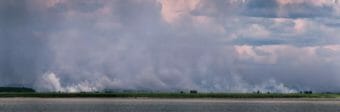
An aerial view of the fire near the Tuklung River. June 9, 2022. (Izzy Ross/KDLG)

Bristol Bay experienced its largest wildfire season on record last year, underscoring a trend toward bigger and more numerous fires in southwest Alaska as the climate warms.

“We really have not seen anything like this,” said University of Alaska Fairbanks climate specialist Rick Thoman. “And the Bristol Bay region was the most extreme of all the extremes.”

Fires scorched nearly 650 square miles in the Bristol Bay region last year — more land than has burned in the region in the past 72 years combined.

The Alaska Fire Service boundaries for Bristol Bay stretch from Platinum in the west to north of Iliamna Lake, east to the Gulf of Alaska coast and down the Alaska Peninsula to Port Heiden.

Rick Thoman put Bristol Bay’s 2022 fire season into context on Twitter. (Rick Thoman/Via Twitter)

Thoman said the biggest fires were the Koktuli and Pike Creek fires north of Iliamna Lake. But there were other big fires, too, like the Iowithla fire, which grew to about 27,500 acres, and burned within about nine miles of Dillingham.

It was by far the largest wildfire on record close to Dillingham, said Thoman.

And there many other fires too, he said, including the Contact Creek fire that ignited early in the season.

“Again, a 10,000-acre fire in a place that we just don’t expect this kind of thing,” Thoman said. “So really, it wasn’t just, ‘Oh, there was one big fire.’ We had big fires, and they were all over the Bristol Bay region.”

For that to happen, many environmental factors have to align. One ingredient is dry fuel. In Alaska, that fuel is both the forest and the ground cover.

“This is very different than, say, the Lower 48 where what you’re going to burn is vegetation above ground,” Thoman said. “We have both the above ground and that duff layer right at and just below the surface that is equally flammable, so we’ve got to get that dry.”

Sun, wind and a lack of rain are all conducive to starting and growing wildfires. And there needs to be a spark. In Alaska, that spark is often lightning.

“We had a burst of lightning from the last days of May through the first week of June, all across southwest Alaska, several days in a row with lots of lightning,” Thoman said. “As is typical for early summer thunderstorms, lots of places had lightning, but no significant rain. And that touched off many fires in the course of a few days across southwest Alaska.”

Smoke from the Iowithla River fire seen from Wood River Road. June 17, 2022. (Brian Venua/KDLG)

Another factor: snowmelt. Some areas of the region, like north of Ugashik Bay, had an early snowmelt and a warm, dry spring. That meant the tundra dried out earlier. But other areas, like Dillingham, had a lot of snow and rain at the end of the winter, which left a high snowpack.

“The early snowmelt was not so much a factor but the warm and dry weather after the snow was all going certainly contributed,” Thoman said.

Thoman said southwest Alaska crossed a threshold in 2015: Wildfires have gotten larger and more numerous since then. For example, in four separate seasons since 2015, more acreage has burned in the Yukon-Kuskokwim Delta than any other year prior. He called it one of the clearest signals of climate change-induced shifts in Alaska.

“The Elders are telling us there is much more vegetation on the tundra, tundra vegetation is growing higher, it’s growing thicker in the transition between boreal forest and the tundra, the trees are growing farther up away from the rivers, the trees near the rivers are growing bigger,” he said. “All of that means there’s more fuel for fire to burn, once it gets going.”

Thoman doesn’t think next summer will be as extreme as the last one because too many factors would have to align again. But as the climate warms, he said Alaskans will continue to experience more and bigger wildfires in the future.

Bird flu in Washington cracks Alaska’s egg supply chain

A bearded man holds a door open in the refrigerator section of a grocery store
Michael Yingst looks for eggs at the AC grocery store in Dillingham on Tuesday. (Izzy Ross/KDLG)

On a recent, snowy afternoon in Dillingham, Michael Yingst scanned the dairy section at the AC grocery store.

“I came here to look for eggs,” he said. “Tomorrow is my birthday and I was hoping to make some banana cream pie. But it looks like we’re going to be out of luck for a while.”

Like Yingst, people across Alaska are running into egg shortages. Many are posting photos on social media of empty shelves and trying to crowdsource where they can buy eggs. Even large grocery chains like Fred Meyer are limiting how many cartons of eggs people can buy. Meanwhile, prices are spiking. Rural areas are getting hit especially hard, because many only have one or two grocery stores, which leaves them with fewer options. And the shortages aren’t expected to let up any time soon.
“It’s not good news in any way,” said Kyle Hill, the president of the Alaska Commercial Co. “It’s really farm-dependent.”

Looking down along empty refrigerated shelves in a grocery store
Empty egg shelves at a Kodiak grocery store on Tuesday. (Brian Venua/KMXT)

The Alaska Commercial Co., or AC, has 35 stores in the state and calls itself the “largest retailer in rural Alaska.” It gets most of its eggs from Washington state, and one of those providers, Oakdell Farms, was recently hit hard by the bird flu.

“They’ve had to unfortunately deal with over a million birds that have had avian flu in that farm,” Hill said. “So there’s huge supply issues, in the sense that we’re struggling to get any eggs at all.”

When they can get eggs, it’s just a trickle. Hill said AC is telling its suppliers that rural communities don’t have a lot of options when it comes to groceries. If AC doesn’t have eggs, that means an entire community might not have eggs, which then becomes a food security issue. But Hill said it’s tough, because AC is competing with large, national chains.

“They are trying to leverage their national scale and their national distribution to get eggs from elsewhere,” he said. “But, you know, when it comes down to it, there’s only so many eggs out there.”

A sign on a shelf saying customers can only by two cartons of eggs each.
A sign at the checkout at a Fred Meyer grocery store in Anchorage on Tuesday. (Tegan Hanlon/Alaska Public Media)

Hill said pressuring suppliers only goes so far. It’s a supply and demand issue, and all retailers are pushing their suppliers.

“It is a fight, because every retailer is making their case to the same suppliers,” he said. “And then this isn’t even just a Pacific Northwest issue. Down in Texas over the holidays a friend said that they saw eggs at $9 a dozen, because they have a farm down there that’s having avian flu issues. So it’s really farm-dependent.”

Prices aren’t going to be any cheaper in rural Alaska. And when supplies run low, costs go up.

At the front of the Dillingham AC store this week, Sarah Nanalook waited for fellow shoppers. She had traveled with them about 30 miles over the tundra on snowmachines from their hometown of Manokotak to Dillingham to go shopping.

“We only have one small trading store which is owned by Manokotak Native Limited. There’s no other store,” she said.

A sign on a glass refrigerator door telling customers there is a shortage of eggs
A sign informing AC’s customers in Dillingham that eggs will be in short supply in the coming weeks. (Izzy Ross/KDLG)

She said she has watched the price of eggs skyrocket.

“For Christmas I had to buy two dozen for, I mean, almost $20,” she said.

A smaller group of Alaskans, like Alicia Swan, are leaning on their backyard flocks of chickens. Alicia Swan perused the dairy aisle, but not for eggs. That’s because she and her family own chickens.

“Out of 17 birds we’re averaging six to nine eggs a day,” she said. “That’s pretty good.”

But it’s not easy to keep chickens in rural Alaska, particularly in the winter, when chickens tend to produce fewer eggs.

“It can be complicated getting feed here,” she said. “Especially during the winter, you have to continually give them water because it freezes, keep them warm. We give them extra light to keep them laying eggs. They kind of have a vacation during the winter.”

And what about Michael Yingst and his birthday banana cream pie? He’s trying to come up with a new plan.

“Researching egg substitutes and see if there’s anything else I can use as a replacement for eggs,” he said. “But they’re kind of irreplaceable when it comes to a lot of things. So hopefully we’ll figure that out.”

Dillingham’s other grocery store, Bigfoot, is also out of eggs, but hopes to get a delivery early next week. Meanwhile, AC expects a shipment to stores throughout the state by the end of next week, but anticipates the egg shortage will last for at least a couple months.

After fighting for their place on the mat, Bristol Bay girls are winning wrestling titles

A ref lies on a wrestling mat and watches as one wrestler pins another
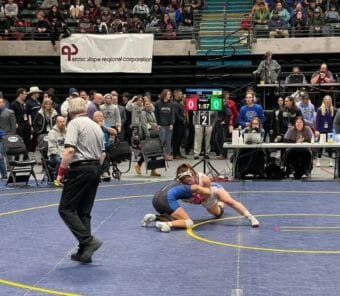
Kiley Clouse wrestles at the ASAA State Wrestling Tournament in Anchorage on Dec. 16-17, 2022. (Courtesy Of The Dillingham Wolverine Wrestling Camp)

Girls weren’t always able to wrestle in Dillingham.

In the early 2000s, they had to petition the school board to let them join the team. Then, they were wrestling against boys. But girls’ wrestling kept growing in Bristol Bay despite those barriers.

Now, 18-year-old team captain Kiley Clouse has become Dillingham’s first statewide girls wrestling champion. And Aileen Lester of Newhalen has won her third state title. Both competed in Division II at the ASAA State Wrestling Tournament in Anchorage this month.

In her final match, Clouse wrestled the undefeated Jessailah Thammavongsa of South Anchorage and won 4-0 in the third period. The crowd cheered as the referee raised her hand high. For a moment, Clouse didn’t believe it.

“I wanted it for so long, and it finally happened.” she said. “I was just so overwhelmed and proud of myself. I just started straight crying on the mat, and I got off and I was just like, crying and hugging everyone.”

A smiling referee holds a girl's fist aloft as she stands on a wrestling mat
Kiley Clouse after her final match at the 2022 state tournament. Dec. 17, 2022. (Courtesy of Shannon Clouse)

This win was a long time coming. Clouse didn’t have a season her sophomore year during the pandemic, and an injury last year made it tough to compete.

And because there were fewer wrestlers on the girls teams, they didn’t have as many weight classes as the boys. Clouse was wrestling at the 189 weight class until this year — which meant she was 20 pounds lighter than some of her opponents.

This season, she wrestled at 165, and she had a lot more confidence.

“It’s the first time I’m wrestling girls who are actually my weight,” she said.

William Savo, the Dillingham Wolverine’s head coach, was a student athlete when girls first started to petition the school for a chance to compete in the early 2000s.

“It’s pretty ironic. When I was in eighth grade, two of my classmates, Kim McCambly and Sarah Evans, wanted to wrestle, but the school board wouldn’t let them,” he said.

The girls petitioned the school to change its policy. When they did join, Savo said, they were wrestling against boys. And the team wasn’t welcoming.

“Boys ain’t very accepting, you know,” he said. “I was part of it. Nobody really wants to change. But they competed in middle school, in high school. They were the first two that kind of got the ball rolling around Dillingham. And then there’s been girls that’ve wrestled throughout.”

Assistant Coach Jack Savo wrestled for Dillingham in the 1990s and came back in 2002. He said girls wrestling was unprecedented.

“It was new, and it was unheard of to have a highly contact and competitive sport like wrestling be co-ed, especially at a time when the girls had to practice with boys and had to compete against boys,” he said. “But I think the determination of the young ladies that started the drive leads us to where we’re at now.”

A high school girl stands with three male coaches.
Kiley Clouse with coaches Reed Tennyson, Jack Savo and William Savo. (Courtesy of Shannon Clouse)

Dillingham’s team — and Alaska wrestling — has come a long way since then. Alaska’s first sanctioned girls’ state wrestling tournament was in 2014. Jack Savo said they brought in three women wrestlers to work with the girls team this year, including one who wrestled on the first U.S. women’s Olympic freestyle team in 2004.

And interest is increasing. There’s a strong cohort of middle school girls, Willie Savo said, and 21 elementary girls have signed up for wrestling this year.

Women’s wrestling is one of the fastest-growing sports in the country, both at the high school and college levels. According to the National Wrestling Coaches Association, since 1994 the number of women who wrestle in high school has grown from 804 to over 31,600.

Another state champion from Bristol Bay is 18-year-old Aileen Lester of Newhalen, a small community on Iliamna Lake. She also won state titles in 2020 and 2021, and she was named last year’s outstanding state wrestler. Lester has wanted to wrestle since kindergarten, and she finally convinced her parents to let her join in sixth grade. Still, she had some reservations.

“When I said something in class, all the boys were like, ‘Oh, girls can’t wrestle, this and that and the other,’” she said. “I remember playing king of the mat, and I kicked all the boys’ butts that were around my weight. And I was like, ‘Yeah, definitely, this is what I’m doing.’”

A ref stands watching two girls wrestle.
Aileen Lester of Newhalen wrestled her way to a third state title at the 2022 ASAA tournament on Dec. 16 – 17, 2022. (Courtesy of Aileen Lester)

Still, she said, she had to prove she belonged there.

“It was pretty tough because at the beginning I didn’t necessarily feel like part of the team,” she said. “But after a while, it was like, I got some wins under my belt. I won some tournaments and matches and I beat some boys and I guess I got respect from them a little.”

Lester said there is a big difference between wrestling with girls and boys — and she has to use different strategies depending on who she’s facing on the mat.

“Girls have a lot more hip control, and a lot more flexibility,” she said. “Guys, usually you get a good half-pin, you’re going to be able to turn them. If you get some sort of pinning combination, you’ll be able to turn them and you can pin them. Like, that’s it for them. But with girls, you can get a good pinning combination in, and they’ll somehow bend their way out of it.”

During her time wrestling, Lester said she convinced several of her classmates to join, as well as her little sister. And she’s enjoyed training with other girls.

Wrestling has been a huge part of life for Dillingham’s Kiley Clouse as well, from making friends to learning new moves to being part of the Dillingham team.

“Wrestling makes me happy. If I’m having a bad day or something, I’m like, ‘Oh, there’s wrestling today.’ Or I’ve had a bad month before school starts and I’m like, ‘Okay, like wrestling starts, one more month. It’s okay.’ And I just love it.”

It was the last high school season for these seniors. Winter practice for middle school begins in January.

With hope and frustration, Bristol Bay awaits the EPA’s final verdict on Pebble

People standing and sitting at a public meeting.
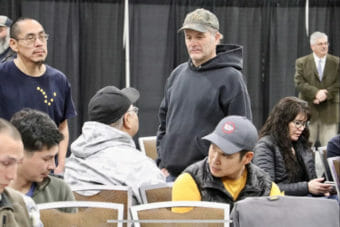
An attendee wears a “No Pebble” hat at the Bristol Bay Board of Fisheries meeting on Dec. 1, 2022. (Izzy Ross/KDLG)

The Environmental Protection Agency has recommended a ban on mining activities in the area around the Pebble deposit. People across Bristol Bay are now waiting for a final decision on the future of the controversial copper and gold prospect.

“I think it sends a real strong message that the science is there; that it’s going to have unacceptable adverse effects on our watershed,” said Gayla Hoseth, the second chief of the Curyung Tribal Council and the natural resources director for the Bristol Bay Native Association.

Hoseth welcomes the move. She said those opposed to the mine have wanted this decision for a long time.

The EPA wants to prohibit the discharge of mining materials in the North and South Fork Koktuli River watersheds, as proposed in Pebble’s permit application. The agency cites its authority under the Clean Water Act to do so. It would extend that prohibition to any future proposals to develop a mine at the Pebble deposit that could result in a similar loss of aquatic resources. The action would effectively kill the mine.

EPA Region 10 Administrator Casey Sixkiller said that if the agency’s Office of Water approves the recommendation, it will provide protections for both commercial and sport fisheries and a way of life for “one of the last intact wild salmon-based cultures in the world.”

“When the information came out yesterday it took a while to actually absorb it,” Hoseth said. “That we were finally this far, that we got this far with the recommendation.”

A broad coalition has worked to oppose Pebble over the years, from tribes and community groups to commercial and sport fishing organizations. Hoseth said tribal consultation with the EPA has been a critical part of this process.

“I want to encourage tribes to take advantage of that government-to-government opportunity that we have,” she said. “Because that’s the time that we can actually sit down and have the dialogue back and forth to have our voices heard from a tribal perspective. And then when your voice is heard of what we are protecting and how we’ve been sustained on salmon for generations after generations, and as we are here today to make sure the protections that are here today, that they continue into the future.”

Jonathan Salmon was attending the state Board of Fisheries meeting for Bristol Bay when the recommendation was announced.

He said EPA officials, including Region 10 Administrator Sixkiller, made an effort to get to know the area. They visited his small home village, Igiugig, earlier this year.

“They got to talk to us and we gave them a tour of Igiugig and who we are and why we’re there. And it was really great to see that our emotion and our responsibilities were able to be shared with him so he can understand the detriment a mine would propose to the region and be able to move the 404 forward,” Salmon said, referring to the section of the Clean Water Act that gives the EPA the authority to block the mine.

Debates around the potential merits and drawbacks of Pebble have gone on for years. Most people in the region oppose mining. But Salmon said that’s not universal.

“Of course we have friends, family members, fellow villagers, and we all have different views. It’s not square across the board. But it doesn’t mean you need to break personal ties over opinions,” Salmon said.

One of those opposed to a ban is Chasity Anelon, who lives in Iliamna and works for Pebble Limited Partnership, the company looking to develop the mine.

“I was just very disappointed in the EPA, because there are people that live in rural Alaska that need to have jobs to be able to support their families to live here. And this would be a great opportunity for that,” she said.

Anelon was thankful that Administrator Sixkiller visited Iliamna. But she is frustrated by his decision. Her family fishes for salmon in the summer and fall, and she wants her daughter, Stormi, to be able to live and harvest there.

“It’s just really hard,” she said. “I know that everybody has their own opinion about it, and I want Stormi to do the subsistence things that we all do as well. But I know that you need a boat and a motor and a net to go and get the fish, and it costs money. And it’s not free. But I’m very thankful to live where I’m at. This is why I live in Iliamna. I love it here. And I’m very thankful to have a job.”

Anelon said she understands that fishing is a big economic foundation in other parts of the region. But commercial prospects have declined in Iliamna; Anelon said many people have sold their commercial fishing permits.

Pebble spokesperson Mike Heatwole said the EPA’s action is political.

“This action is unprecedented. And when we say unprecedented, to help spell it out, is that the EPA is pursuing a veto, what we call a preemptive veto, of the project before the permitting process has concluded,” he said. “And it remains our view that the process for the EPA to follow is a permit is granted by the Corps of Engineers, and then the veto actions are followed by that.”

Two years ago, the U.S. Army Corps of Engineers denied Pebble a federal permit. But Heatwole said the permitting process is ongoing.

“They made a decision and we have the right under their process to appeal the decision,” Heatwole said. “Once we did, that appeal was accepted. And we’re working through that at the moment. So technically, the Pebble permitting process is still underway, if you will.”

Moving forward, Heatwole said, the company is reviewing legal courses of action.

Now that the regional administrator has recommended blocking the mine, the agency’s assistant administrator for water, Radhika Fox, has 60 days to decide whether to impose the veto, make changes or reject it entirely.

Dillingham students celebrate name change for local creek

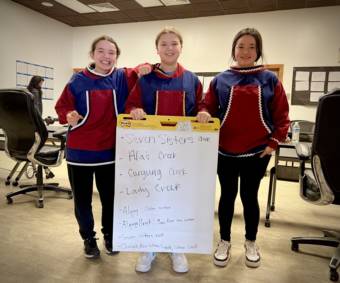
Alora Wassily, Harmony Larson, and Trista Wassily with names community members suggested for the creek in Dillingham. (Photo by Avery Lill/KDLG)

One year ago, Interior Secretary Deb Haaland issued a declaration to remove a slur against Indigenous women from place names on federal lands. Nearly 650 new names were finalized this fall, including one for a Dillingham creek that bore the slur.
But three elementary students in Dillingham — Alora Wassily, Trista Wassily and Harmony Larson — had worked to change the creek’s name since 2021, long before the federal government started its process.

In an interview shortly after the announcement, Alora said they put a lot of effort into reaching that goal.

“It feels good because we worked on it for so long, and it finally got changed, and we just feel relieved,” she said. “We felt accomplished.”

They began advocating for the change when they were in fifth grade, after they heard a local story about seven sisters who had lived along the creek and how both the creek and a road of the same name were marked with the derogatory word.

“We thought about it, and then we decided to change it, and then we talked to our teacher, Ms. Jensen,” she said. “Then we talked with [Curyung Tribal Council Administrator] Courtenay Carty and Robyn [Chaney], and then we just started researching about other places.”

Now the students are in seventh grade, and they have presented their research many times. They started with the Dillingham Parent Advisory Committee and the school board.

“We were all really nervous our first time. And after a while we got used to it, and we just got normal about it,” Alora said.

Since then, they have presented their research to the Curyung Tribal Council, the Alaska Federation of Natives Elders and Youth Conference, and the Bristol Bay Native Corporation. Robyn Chaney helped the students prepare. She is the Federal Programs Coordinator for Dillingham city schools and has been an adult advisor for the students.

“I think them standing behind their information was really powerful,” Chaney said. “They were part of educating people here, including myself. They received mostly positive feedback and support. And really their confidence grew because their facts are accurate. And it was an issue that obviously became really important, not just to us, but on a federal level that Secretary Haaland would take that up.”

When U.S. Interior Secretary Deb Haaland announced last year that the word would be removed from geographic features across the country, the students’ work got more attention. And they had to shift their approach, taking their grassroots advocacy and fitting it into a political process.

“Our process went from slow and steady to very, very rapid,” Chaney said. “It shifted from us educating and garnering local support for change to a government-to-government relationship, following a tribal process and doing tribal consultation between our local Curyung Tribe and the federal government.”

The students recommended renaming the creek Al’a Creek, and they received broad support from the community during a listening session last spring. But at the last minute, a Curyung Tribal Council member suggested a different name: Amau Creek. Chaney said that was difficult.

“It was just a hard pill to swallow because that name hadn’t gone through the public process. It was in their regular meeting. But it wasn’t a name that had been carried forward in the public process that they set forth. And so it was surprising and upsetting,” Chaney said. “But they still achieved the goal, which was to remove a derogatory place name and replace it.”

The students are the latest in a long legacy of work to re-center Native place names in Bristol Bay. Francisca Demoski is the land manager for the Bristol Bay Native Corporation.

Originally from Togiak, she now lives in Anchorage and oversees the land department’s cultural heritage efforts, including the Bristol Bay Native Place Names project. She said it’s one way the corporation celebrates and preserves that heritage.

“Amau Creek translates to ‘great-grandparent’ and is a Yugtun word. And in this case it references a group of sisters, or great-grandmothers, who according to traditional stories traveled to the area and settled near the creek,” Demoski said. “So the community recognized the role of the great-grandmothers in their families and chose the name to honor their ancestors.”

Demoski said BBNC supports the federal efforts to change the derogatory names of places across the country, including in Dillingham.

“BBNC is pleased with the outcome, and I applaud the young students for taking leadership in making this change happen for their community,” she said.

Demoski helped start the Native corporation’s project almost 20 years ago, in 2003. It now has over 1,400 place names on the website. Many are from the areas around Togiak, Manokotak, Dillingham and along the Nushagak River. There are also many Dena’ina and Yup’ik contributions from around Iliamna Lake.

“I am working with the Bristol Bay Native Education Foundation to gather place names along the Alaska Peninsula, including the Naknek area. So that’s where we’re focusing right now, because there’s very limited data in that area,” she said.

Demoski said its purpose is to “capture and preserve important knowledge and safely archive it before it’s lost.”

Demoski hopes this year’s push to change derogatory names around the country inspires communities to consider changing their own names. She says it’s been done before, pointing to the example of Utqiaġvik, which used to be named Barrow. This is a critical effort, she said.

“And ensuring the survival of our people’s cultural history is of the utmost importance to us, and place names is one way that we ensure that our history is being preserved for a future generation,” she said.

The students’ work isn’t over. They are still working on the next steps to change the community’s signs and replace them with the new name: Amau Creek.

House candidates agree bycatch is a problem. They have different approaches to solving it

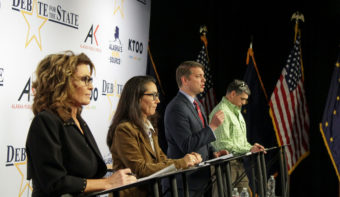
The four Alaska candidates for U.S. House stand on a debate stage
Candidates for U.S. House take questions at Debate for the State, produced by Alaska Public Media, KTOO and Alaska’s News Source on Wednesday, Oct. 26, 2022. (Photo by Hailey Barnes)

Salmon was a hot topic in Wednesday night’s debate among candidates for Alaska’s sole U.S. House seat. When asked what they would do to address declining salmon stocks, all candidates pointed to bycatch as a continued threat to salmon and crab across the state.

Republican and former Gov. Sarah Palin began her answer with a shout-out to Bristol Bay and her time in the region.

“Near and dear to my heart: The fish issues, having for years set netted on the Nushagak in Bristol Bay,” she said.

Palin said the state is doing a good job with management and that it follows the “maximum sustainable yield” mandate outlined in state law. But she said the federal government needs to step up.

“It’s the feds who lack the enforcement, the bycatch laws that too many people are getting away with — especially foreign trawlers,” she said. “They’re not allowing those salmon to get back to where they need to be to spawn. We need to bust these people who are doing these illegal activities. You take their vessels, you take their gear, you take their permits, and we start teaching them a lesson.”

Bycatch is the accidental harvest of species that fishermen are not targeting. Tribes, communities and small-boat fishermen in Western Alaska have been particularly vocal with concerns about whether and how bycatch has contributed to declines in their salmon returns.

Democrat and incumbent Rep. Mary Peltola, who previously directed the Kuskokwim Inter-Tribal Fish Commission, said she wants to ensure there’s funding for research on both the state and federal levels. But she said managers can’t wait for those results.

“We’ve got to take precautionary management. We cannot allow metric tons of bycatch of juvenile salmon, crab and halibut to be thrown overboard every year. This has led to a very devastating collapse of not only salmon, but halibut. And now we’re seeing it in the crab industry as well,” she said.

The Bering Sea snow crab fishery will be closed for the first time in its history this winter, after the number of crabs dropped by nearly 90% since 2018. Bristol Bay red king crab populations have also declined drastically, and that fishery will be closed for the second season in a row.

Republican candidate Nick Begich agreed trawl bycatch should be addressed immediately. And he pointed to the Magnuson-Stevens Act, the main law regulating fishing in federal waters.

One of the late Congressman Don Young’s goals was to renew the Magnuson-Stevens Act. In September, the House Natural Resources Committee passed a revision of the act, adding in restrictions on bycatch and naming climate change as a threat to federal fisheries for the first time. Begich wants to proceed with caution.

“I think that we need to be careful about how we go through our Magnuson-Stevens Act reauthorization and making sure that we’re putting precision language into the act that is actually going to demonstrably improve the sustainability of these fisheries,” he said. “We have a mandate under the state constitution for a maximum sustainable yield, and every fishery in the state needs to be managed with that objective.”

Begich also noted that while some runs in the state have declined, Bristol Bay’s sockeye salmon returns are at a record-high. He said managers must understand why Bristol Bay is succeeding.

Biologists don’t know exactly why Bristol Bay’s runs have been so large in recent years but say it may be due to warming waters, both in the ocean and in freshwater spawning grounds. There is a strong correlation between warming temperatures and the increase in Bristol Bay sockeye runs. Other species have not fared as well: King and chum salmon in the Nushagak River were at some of their lowest numbers on record in recent years, and neither species has been meeting the minimum goal for sustainability.

Libertarian candidate Chris Bye said he saw just three king salmon on the Chena River while working as a fishing guide this summer. He also agreed: Bycatch is an issue.

“But just throwing it back doesn’t solve the problem. I honestly think we need to get industry more involved in reducing their catch. Otherwise, it’s not going to be there,” he said. “It’s only a renewable resource until it’s all gone.”

Bye also suggested divvying up seats on the North Pacific Fishery Management Council by region rather than race. That council decides fishery policy in Alaska’s federal waters. Peltola advocated adding two Alaska Native seats to that council as part of the Magnuson-Stevens rewrite.

Alaska Public Media, KTOO and Alaska’s News Source produced the debates for Alaska governor and the U.S. House and Senate, which aired statewide on television and radio.

Early voting is underway in many communities across the state. Election Day is Nov. 8.

Get in touch with the author at izzy@kdlg.org or 907-842-2200.

Site notifications
Update notification options
Subscribe to notifications