KFSK - Petersburg

KFSK is our partner station in Petersburg. KTOO collaborates with partners across the state to cover important news and to share stories with our audiences.

Forest Service to replace Raven’s Roost cabin near Petersburg

The view of Kupreanof Island and Petersburg Creek from near the site of the new cabin in January 2021 (Joe Viechnicki/KFSK)

The U.S. Forest Service says a popular mountaintop recreational cabin near Petersburg will be replaced this year. The trail that leads to it has also been mostly redone, and that work is slated to be completed in 2021 as well.

The Petersburg company Rainforest Contracting will build a new Raven’s Roost Cabin at a site about a mile closer to the trailhead than the old cabin. The federal agency says that work is scheduled to begin in a few months.

Paul Olson, the cabin and trails program manager for the Forest Service in Petersburg, described the new structure.

“It’s a one-story building with a loft, and it’s got a covered deck out front, so that’ll all be handicapped-accessible,” said Olson. “It’s got about 6-8 people that it could fit. We’ve got some ideas to put some hooks and stuff on the deck so people could use their hammock tents or something comparable for added capacity. There’ll be an outhouse out back. There’ll be a propane heater.”

The wood for the new cabin comes from a sawmill in Hoonah. Local high school shop students made some of the table tops from Alaska yellow cedar and western red cedar.

The new structure will replace the old Raven’s Roost cabin, which is more than 40 years old. Some of it will be salvaged and the rest removed, along with the portion of the trail between the old cabin site and the new cabin.

Olson said the old cabin saw a fair amount of unpaid use, but not a lot of paying customers booking the cabin on the website.

“So we’re hoping by moving it a mile closer and making the trail much more easily accessible and easier to hike, that will get more sort of year-round use almost and kind of self-patrolling in some respects too,” Olson said.

It’s hoped that new cabin will be done this fall. That work is funded by the Forest Service’s capital improvement program for $568,000.

There are 18 cabins on the Petersburg Ranger District. Raven’s Roost is the only one on Mitkof Island, although there are several three-sided shelters.

Meanwhile the hike up to that cabin, about 1800 feet above sea level on the mountain behind Petersburg, has been dramatically improved. Trail reconstruction started in 2019 and will be finished up this year. A different contractor has installed several sections of metal stairs, along with hundreds of concrete steps and new sections of gravel and rock trail. The Forest Service says public use has at least doubled due to the improvements.

The trail work will cost about $800,000 and was funded by the Federal Highway Administration and other federal grant money from the Secure Rural Schools Program.

It’s not the only Forest Service trail work that’s slated to happen on this island. The agency also plans a reconstruction of the trail to Ideal Cove from Hill Lake on the eastern side of Mitkof.

Olson said the agency hopes to award that work this year and it could be rebuilt next year.

“It’ll be a combination of things similar to the Raven trail,” he said. “It’ll have gravel as much as possible, some boardwalk, some concrete or stone steps and that kind of stuff.”

The bridge by Hill Lake will also be replaced. The Ideal Cove trail work is among almost 40 projects on the Tongass and Chugach national forests that have funding secured this year under the Great American Outdoors Act of 2020.

Petersburg to take comment on Alaska Native land legislation

Areas in red show proposed land selections on Mitkof and Kupreanof islands near Petersburg. (From U.S. Forest Service maps presented to the U.S. Senate Energy and Natural Resources Committee)

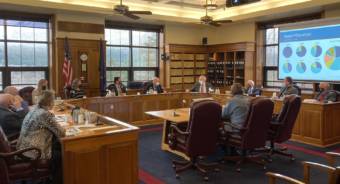
Community members have another chance to weigh in tonight on the potential transfer of Tongass National Forest land to five new urban Native corporations.

Petersburg’s borough assembly holds a work session by teleconference Wednesday, March 10 on legislation that last year was called the Unrecognized Southeast Alaska Native Communities Recognition and Compensation Act.

That bill sought to amend the landmark 1971 Alaska Native Claims Settlement Act and grant 23,040 acres each to five new urban Native corporations in Petersburg, Haines, Wrangell, Ketchikan and Tenakee. It did not pass Congress last year, but Alaska’s Congressional delegation is expected to introduce it again this year.

Assembly member Jeff Meucci thought the assembly was getting ahead of the process by taking comment on legislation that has yet to be proposed in a new session.

“The legislation that was introduced last year didn’t make it as far as people would like it to,” Meucci said. “You know there was lots of concerns with that legislation from a lot of people we heard from when we had, I don’t know if it was a community meeting, but we had a lot of public testimony.”

The assembly in November voted to send a letter seeking more time to review the bill but has not taken a stance on it, for or against. Supporters and opponents have been making their arguments to the assembly for over a year. The bill has been introduced before but the version last session was the first to identify specific land selections that could be transferred.

Mayor Mark Jensen and borough manager Steve Giesbrecht recently took part in a teleconference with Wrangell officials and staffers from Sen. Lisa Murkowski’s office about the legislation. Jensen said tonight’s session for Petersburg would allow for more public comment.

“This is the start of gathering official public comment and the way I understand it, the way it stands now, the legislation and the maps will be reintroduced, potentially just like they are if there is no objection,” Jensen said. “So the maps are not set in stone. The wording in the legislation is not set in stone. And you’re right it hasn’t been reintroduced, so it is kind of … the document we would be working off, people should be working off of, in my understanding, is what was introduced last year.”

Jensen thought the legislation might be reintroduced in May or June. Supporters of the bill say the new corporations would look for economic development potential on the lands other than logging and say public access for hunting and fishing would continue. The bill as drafted would require the lands to remain open to subsistence hunting and fishing but would also allow a new urban corporation to restrict access in certain cases.

There was opposition in Petersburg last year to some of the specific parcels as well as to the idea of transferring land, forest roads, log transfer facilities or recreation cabins from the national forest.

Assembly member Taylor Norheim would qualify as a shareholder of the new corporation and supports it.

“Maybe you want the federal government to own this land still and keep it public, although the tribe has said that they’re not going to keep people off the land, that over one third of all federal land in the United States of America is in Alaska,” Norheim said. “That’s a lot of land. I don’t see a real problem with putting a little more land out of the federal government’s control and into the hands of let’s just say the people who were here first.”

The bill and land selection maps are posted on the borough’s website.

People can call into the work session to offer testimony at 1-800-954-0633 starting at 6 p.m. Written comments can be emailed to assembly@petersburgak.gov

Petersburg COVID-19 outbreak eases

A Petersburg emergency operations center sign in middle harbor this winter (Joe Viechnicki/KFSK)

Health officials are calling on Petersburg to maintain health precautions to get through the local COVID-19 outbreak. The community saw active case numbers drop over the weekend but local emergency and state officials say masking, social distancing and testing are still needed to keep case numbers from expanding again.

Petersburg’s active case count dropped to 39 on Sunday, including three days in a row with no new cases reported. The borough’s incident commander Karl Hagerman reported on the status of the outbreak at Monday’s assembly meeting.

“Happy to report that we are seeming to be over the hump so to speak,” Hagerman said. “We topped out on active cases in Petersburg of 68, a few days ago and we have been seeing a steady drop in cases since that point. We had Friday, Saturday and Sunday had no new cases show up. However, this morning we did a report that there are a couple, two new cases so far today. So we’re not completely out of the woods by any means but the numbers do seem to be heading in the right direction and getting us out of this outbreak.”

Hagerman thanked the businesses that closed temporarily or changed to take out service during this outbreak. The community remains on red level or high risk status this week.

State health officials reported on Friday that between Feb. 15 and March 5 there were a total of 92 cases identified in Petersburg. There were four COVID-related hospitalizations and no fatalities associated with these cases.

State epidemiologist Dr. Joe McLaughlin described the outbreak on a radio show Friday.

“We have seen clusters in Petersburg that are associated with locations where people have gathered, including bars and restaurants and schools, day care centers and other businesses,” McLaughlin said. “About 44% of the cases in Petersburg have been associated with a bar or a restaurant, and another 41% have been associated with a school or daycare. And nearly 10% of the total cases have had overlap between bars and restaurant clusters and the school and day care clusters.”

McLaughlin said transmission had been occurring in large and small gatherings, between family members and classmates as well as in a variety of public venues.

Public health nurse Erin Michael reinforced that message during Friday’s radio show.

“We really are encouraging people not to be gathering outside of their social bubbles and doing social events outside of your household,” Michael said. “We really are discouraging those type of gatherings right now because that’s where we’re seeing a lot of transmission and spreading of this infection. If people can avoid doing that and avoiding indoor gatherings altogether is best right now.”

School has been remote since Feb. 23, and because of spring break won’t return to in class learning until March 22 at the earliest. Classes for most of the school year had been mostly in person, before this outbreak.

Petersburg Medical Center CEO Phil Hofstetter testified to the House Health and Social Services Committee Thursday, March 4 about the outbreak occurring just after the end of the state’s disaster declaration.

“So exactly one week after Senate bill 56 expired, we experienced a COVID cliff, over 60 cases in seven days,” Hofstetter said. “And leading up to that expiration of Senate bill 56 we saw a noticeable behavioral difference within the community with increased public and private social activities in bars, restaurants, reduced masking indoors in public places and certainly bypassing testing at the airport. And of note we did have in place local mandates to support those. It just was not taken seriously.”

Senate bill 56 is the legislation proposed by Governor Dunleavy to extend the disaster declaration. Senators voted against moving out of committee in February. A version is also being heard this month in the House.

Hofstetter has also reported that the local community hospital has spent a quarter of a million dollars responding to this outbreak. He was uncertain of the impact the lapsed disaster declaration would have on funding for PMC’s response.

Free asymptomatic testing will continue at the airport Monday through Friday from 7:30-10 a.m. this week but it is expected eventually to move back to the medical center.

Roughly one third of the total population has received two shots of vaccine and the medical center has another vaccination clinic planned for this Friday March 12.

Petersburg women tell how International Women’s Day was celebrated in their home countries

One of Ola Richards’ family gatherings in Poland; probably Easter brunch. (From L-R) Ola Richards’ great-grandmother : Stanislawa Kuczynska, her grandmother Bozena Marciniak, Ola Richards and her mother: Anna Palenik. (Photo courtesy of Ola Richards)

Today, March 8, is International Women’s Day. Although it’s not widely celebrated in the U.S., dozens of other countries have been celebrating it for decades. Two Petersburg women — Ola Richards from Poland and Elisa Teodori from Italy — talked to KFSK about how the holiday is celebrated in their home countries.

International Women’s Day was first celebrated in 1911 in Germany, Austria, Denmark and Switzerland. In many countries, the new holiday stuck.

“Oh, yeah, Poland is huge about Women’s Day,” Richards said. “It’s a huge deal.”

Richard says they called it Women’s Day for short. She says women didn’t get the day off work, but they were recognized. She remembers the boys giving their female teachers a flower on March 8.

“Just to recognize them as a hard working woman,” she said.

Richards says it’s different than getting flowers for Valentine’s Day because it’s not romantic in nature. It’s also different than Mother’s Day. She says it’s to celebrate women — people like her mother, who was a single, working woman. Richards says her mom received flowers for the holiday every March 8.

“It was like a special day coming home with a bunch of flowers, and they were not flowers from some boyfriend — they were just flowers from men who worked with her or you know, a neighbor,” Richards said. “It’s very important to understand that it’s nothing about love. It’s about respect, about appreciation.”

Richards’ mother worked at an outdoors program taking teenagers into the wild, hiking and camping. Usually, Richards went along, too, out of necessity.

“She’s my hero,” said Richards. “You know, single mom with two kids and she got her education and now she’s a business owner and she’s so independent, and I’m like, ‘Good for you, Mom!’”

Richards came to the United States in her early twenties to work at the cannery through a student visa, known as J-1. She ended up falling in love and marrying a local, Brian Richards, and moved to Petersburg permanently. She noticed that International Women’s Day wasn’t celebrated here.

Petersburg resident Elisa Teodori noticed the same thing when she moved to Petersburg out of love for her husband, Tor Benson.

Elisa Teodori grew up in Italy and remembers celebrating International Women’s Day. She moved to Petersburg seven years ago to be with her husband, Tor Benson. (Photo courtesy of Elisa Teodori)

Teodori grew up in Italy, where they also celebrated March 8th. She wasn’t exactly aware that it was an international holiday. She thought it was just a national day for Italy.

“We call it The Celebration of Women in Italy,” Teodori said.

Teodori says for the holiday women will often receive mimosa flowers, which are yellow flowers that bloom early in the spring.

“It’s traditional that men in family or friends give a bouquet of these flowers to their women,” she said. “Even in school I remember our classmates, the boys, bringing to us and to the teachers, flowers.”

Like Richards, Teodori says the holiday is different than Valentine’s Day and Mother’s Day. Italy has those other holidays too.

“This is just for women to celebrate all the steps, the milestones that were taken by women along history, like the right to vote, the right for abortion, the right to divorce and even just the right to be considered an independent person from the men,” said Teodori.

She says the March 8 holiday encourages girls, when they’re old enough, to go out and celebrate with their girlfriends.

“Just with women,” said Teodori. “So it would be an occasion to be just with your girlfriends.”

Teodori says gender equality is still changing in Italy. She says in some areas, practices still exist like not allowing young women to go out unaccompanied by a male family member or the belief that women have to do all the house chores and take care of the children.

“When I go visit Italy, I was talking to an aunt of mine; she was old and I was telling her that I let my husband wash the dishes,” said Teodori. “And she looked at me shocked and she told me, ‘Shame on you! Aren’t you embarrassed of doing this?!’ And that was just my grandparents generation!”

Teodori says it would be nice for the U.S. to celebrate International Women’s Day if people keep in mind the reason for it. It’s not just about giving flowers — it’s about remembering the women who didn’t have rights not that long ago.

“It’s easy to forget, generation after generation, the more you go away from those hard times, that the women fought for what they got,” Teodori said.

But it might take a while to really take off here. Richards says it’s become sort of a joke with her husband.

“Being married to an America boy – it’s so funny – every year in March, [I say], ‘Brian, it’s March 5th, you know what is coming.’”

He doesn’t know. Teodori says that every year, she has to remind him.

This year in Petersburg, Working Against Violence for Everyone is planning an online event as a way to recognize local women.

Petersburg among top hotspots for COVID-19 in US

Joe Viechnicki/KFSK

Petersburg is among the top hotspots for COVID-19 cases in the country, according to the New York Times.

An online interactive map published by the newspaper shows the Petersburg borough with the fourth-highest daily average of new COVID-19 cases per capita for counties in the nation over the past week. In that time, Petersburg trails only three counties in Colorado, Kentucky and Oklahoma, ranked by average daily COVID-19 cases per 100,000 people.

The Southeast Alaska community of nearly 3,200 people hit its highest active COVID-19 case count since the start of the pandemic on both Tuesday and Wednesday, March 2 and 3. Petersburg’s emergency operations center reported 67 active cases on Wednesday.

Since February 18, local health officials have reported 85 in-town cases. Another four cases are local residents who have been outside of Petersburg. And 22 people are considered recovered since the start of this outbreak.

Petersburg schools switched to remote learning as the outbreak gathered steam last week. Meanwhile, plant managers at OBI Seafoods wrote a commentary in the local newspaper calling on people to follow health precautions so the local workforce could continue to process seafood.

Case numbers had been relatively low for most of the pandemic, until last month.

All but five of the cases have been reported in people who have not yet received either a first or second dose of vaccine. Petersburg Medical Center reported positive test results for two people who are fully vaccinated, two weeks past their second dose, and three who were two weeks past their first dose.

Petersburg, like other communities across Alaska, is well above many other parts of the country in vaccination rates. Over a third of the population has received one dose, and around one-fifth of the total population is fully vaccinated.

Those numbers will likely climb this month. Petersburg Medical Center is holding vaccine clinics March 5 and March 12.

Petersburg’s new visitor plan includes guidance for tourism industry, managing cruise ship wastewater

Ponant’s ship Le Soléal anchored outside Petersburg harbor in August of 2019 (Joe Viechnicki/KFSK)

The Petersburg Economic Development Council released its final version of a community plan for responding to growth in the visitor industry. That plan presents a range of recommendations for managing more tourists and cruise ships.

A working group of residents, business owners, representatives from local government and the Petersburg Chamber of Commerce drafted the 31-page Visitor Industry Management Plan. They met following interest in 2018 from a cruise company looking to bring boats with capacity for up to 900 passengers to town.

The plan identifies potential impacts from an expanded tourism industry and makes recommendations for management and ways to address possible future growth.

Borough assembly member and chamber board vice president Dave Kensinger said during a radio call-in show last month he thought this plan is a good outline of the issues the community faces.

“I think we need to plan for the future,” Kensinger said. “I think we need to have a level of tourism that the community can embrace and I think the best way to do that without causing a lot of issues are some of the recommendations in this plan, so we can maintain the character of our community and also have a good positive experience for visitors.”

Kensinger thought the community may need to take another look at some aspects of the plan later this year and acknowledged a lot has changed with the advent of the pandemic. Petersburg could see some small cruise ships docking here this year, but didn’t last year. In 2019, the last year with a cruise ship season, Petersburg had an estimated 10,000 passengers visit on those ships.

The plan recommends uses for revenue from a new marine passenger fee that the borough started collecting in 2019. Among the recommendations are public restrooms. The borough has already met some of that need, using CARES Act funding last year to purchase two restroom trailers that could open up in town during the warmer months. But the plan also calls for better signage and mapping for restrooms that are open to visitors and opening additional toilets during the Little Norway Festival and the Fourth of July.

Other possible uses of that passenger fee money are a marine wastewater pump-out station, interpretive signs and an improved visitor map. And other ideas are a covered multi-use area for visitor staging, a better ramp for handicapped accessibility on one end of South Harbor and increased tie-up space for ships.

The plan also investigated options for wastewater discharge, at the heart of some local complaints about cruise ships in 2019. For instance, it says the borough could petition the state to implement a no-discharge zone for ship sewage in borough waters. That would apply to all vessels, however. And that’s something assembly member Jeff Meucci acknowledged on a recent radio show that local residents may not want.

“Yeah we have to be careful about what we ask for,” Meucci said. “There’s lots of components to not letting people dump waste in the harbor that I’m not ready to have that conversation. It’s out there it’s part of this conversation but eventually we’ll be there.”

The plan does include draft best management practices or guidelines for ships. Those suggest no discharges of certain types of wastewater while in port or near Sandy Beach. Meanwhile, the state’s Department of Environmental Conservation is already conducting water sampling around Petersburg and other Alaska communities. The Department of Environmental Conservation released preliminary data last month showing unsafe levels of bacteria in water samples taken around Petersburg’s harbors in 2020, a year without cruise ships, as well as other harbors in the state. That water monitoring is continuing into this year.

Other recommendations from the visitor plan came out of focus groups on quality of life, local benefits, infrastructure and planning, communication and quality of experience for visitors.

Among the possibilities are surveying the community about support for visitors or finding out what cruise companies and their passengers are interested in when docking here. The borough could also monitor changes in annual port calls and passengers and establish triggers for evaluating if more growth is desired. The document also recommends a planning process for new docking space or areas for larger ships to lighter in passengers while also exploring ways to lessen pedestrian congestion downtown.

Some recommendations are easy, like providing this plan to cruise and tour companies and suggesting they support community groups and become more vested in the community. Others could be done without too much work, like creating a directory of local services for tourists, posting updated cruise schedules and operating a suggestion line for people to report problems.

It could be up to the assembly to decide the next steps with this plan.

Site notifications
Update notification options
Subscribe to notifications