KFSK is our partner station in Petersburg. KTOO collaborates with partners across the state to cover important news and to share stories with our audiences.
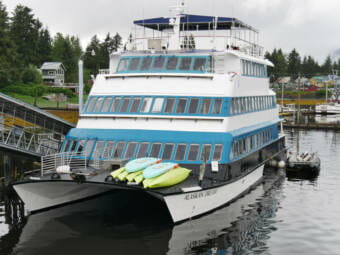
The Alaskan Dream tied up in Petersburg’s South Harbor Wednesday morning. (Joe Viechnicki/KFSK)
After more than a year without cruise ship dockings due to the pandemic, Petersburg saw its first visit from a cruise ship since 2019.
The 104-foot Alaskan Dream, owned by Sitka-based Alaskan Dream Cruises, tied up in Petersburg’s harbor Wednesday as guests enjoyed a show of Norwegian dancing. The company is requiring COVID-19 vaccination for passengers age 18 and up, and it’s allowing those guests to explore communities and shop. Petersburg did not see any port calls during the 2020 pandemic year.
Alaskan Dream captain Eric Morrow said it was exciting to return to cruising after last year’s shutdown.
“I think for all involved, after the hiatus that we all experienced during the 2020 season, there’s definitely some rust to knock off. But overall it’s get back to cruising and enjoy what makes Southeast Alaska special,” Morrow said. “The small boats in particular really emphasize the communities. Petersburg is our visit today, we visited Wrangell yesterday and the reception we’re getting from the locals and from the communities is what makes it special.”
Morrow said the passengers on the first cruise include some Alaskans who chose to see another part of the state.
“We opened it up to the state, the small boat cruise for this trip, so we’ve got quite a few Alaskans aboard,” he said. “In fact, yesterday Frank Murkowski and his wife joined some of the Alaskan guests, and we had the honored gentleman aboard for lunch, and it’s just neat to see what is community and the sustainability of Southeast.”
After visiting Petersburg, the Alaskan Dream headed on to Thomas Bay and Tracy Arm on the mainland.
Petersburg has over 60 port calls scheduled for the companies that are planning to dock here in 2021. Some are requiring vaccination and not planning to let guests off in all communities. Others are encouraging vaccination but not requiring it.
Ocean Beauty’s seafood processing plant in Petersburg. (Joe Viechnicki/KFSK)
Alaska’s seafood industry has a lot of moving parts. There are the fishermen, the processors, the market — as well as the fish themselves.
By all accounts, the pandemic has been hard on the processors. Last year, they spent about $70 million in mitigation measures and responding to the pandemic. But this year it’s expected to be even more. Over $100 million.
A lot of that has already been spent.
“There were challenges and some plant closures that happened despite all these protocols,” said Dan Lesh of the McKinley Research Group.
McKinley surveyed processors and others in March about the effects of COVID-19 on Alaska’s seafood industry. He says the flat fish industry was hit hard with outbreaks in January causing expensive plant closures. Those costs are in addition to the ongoing price for pandemic mitigation.
“A lot of these costs are already baked in, and my understanding is that most the mitigation measures will be continued,” Lesh said.
In other words, this calendar year has more months when processors will be dealing with the pandemic.
Processors surveyed said their peak employment last year dropped 31%. That’s from intentionally smaller workforces, as well as problems recruiting and retaining workers. Two-thirds of processors received pandemic relief money, but it only covered 24% of their costs, on average.
“None of the processors said it covered even half of their costs. 35% was the highest estimate we got in our survey,” Lesh said.
But Lesh says there’s hope that more relief money could come this year with newer programs.
As for the seafood market? While it’s hard to summarize all species together. Some areas saw growth. Salmon, for example.
“Every indication is that everything’s been sold out from last year,” Lesh said.
“There were times where we saw 30-40% increases in frozen and fresh seafood sales,” said Ashley Heimbigner of the Alaska Seafood Marketing Institute, which contracted the research group for the surveys. She says online seafood sales skyrocketed during the pandemic.
“So people are also getting more comfortable buying seafood online,” Heimbigner said “And that’s through Instacart or their local grocer but also through community-supported fisheries and direct marketers ordering direct from fishermen, as well so people are seeking out new ways to find these new seafood purchasing options.”
That’s online, though. The food service market dropped out as restaurants were closed. And that instability affected prices paid to fishermen.
Then there’s the fish. 2020 is considered the worst year for salmon since the 1970s, and the state is seeking eight separate fisheries disaster declarations.
The forecasts for some species don’t look very promising. Chum are expected to be down 23% from the 10-year average. Pinks, which return every other year, could be down 41% from recent odd-years.
But it’s hard to predict what exactly the season will be like. One thing’s for sure: vaccinations are going to play a major role.
One of Alaska’s biggest processors, Trident Seafoods, is requiring a fully vaccinated workforce for its Petersburg plant. Last year workers stayed in a closed campus. In an email, spokesperson Shannon Carroll says they’ll keep campus open this year with some restrictions, as long as the town is in a low risk status.
Tonka Seafoods, a smaller local processor isn’t requiring vaccinations but is strongly encouraging them with incentives. Co-owner Seth Scrimcher says about 80% of its workforce is vaccinated.
Petersburg’s largest processor, OBI, which employs hundreds of workers, would not comment for this story. However, Petersburg’s emergency operations center said the company told the borough that they planned a 90% vaccination rate for resident employees and 100% for transient workers. And if they achieve this, then they would likely have an open campus.
Ultimately, how 2021 turns out for the multi-billion dollar industry will remain unknown. At least for now.
Humpback whale entangled in commercial lobster gear, sighted off San Diego in 2015. The main threats identified for the whales were ship strikes and fishing gear entanglements. (Courtesy of NOAA, photographed under NOAA permit #: 18786)
The National Marine Fisheries Service published a final rule on April 21 designating critical habitat for three populations of humpback whales, including some areas in Alaska. The federal ruling affects the eastern Aleutians, Kodiak and Prince Williams Sound as well as the coastlines of Washington, Oregon and California.
The ruling excludes Bristol Bay and Southeast Alaska.
The rule establishes about 116,000 square nautical miles of protected area for the endangered Western North Pacific and Central American populations of humpback whales and the threatened Mexico population.
Critical habitat for three populations of humpback whales in Alaska and the West Coast/NOAA
These whales winter in warm, southern waters but travel north for seasonal feeding on krill, herring and other small species. In Alaska, critical habitat has been identified near the eastern Aleutian Islands, Kodiak, and Prince William Sound areas.
The Endangered Species Act mandates that the federal government create critical habitat for endangered species. Lisa Manning with NMFS says the 238-page ruling came after careful consideration of public comments.
“The goal is to identify everything the species really needs to get to recovery,” she said.
Some areas in Alaska were excluded in the designation, like Bristol Bay and Southeast Alaska, because the federal agency determined the economic impacts and national security concerns in those areas outweigh the potential protection of the whales.
Manning says NMFS decided to exclude Southeast because it’s considered one of the least important areas for conservation of these whale groups.
“Out of all the other areas considered, it is the one they’re using the least,” Manning said. “Most of the whales there are from the unlisted Hawaii population.”
This image indicates critical habitat near the Aleutians and Kodiak/NOAA
Dozens of Southeast fishermen from different gear groups spoke out against the designation in a public hearing in Petersburg last January.
Amy Daugherty was one of them. She’s the executive director of the Alaska Trollers Association.
“We were a little bit concerned about having some lines drawn over our grounds that could potentially impact us,” Daugherty said. “So we’re glad that the agency is bypassing Southeast Alaska.”
Other fishing groups said they are still reviewing the recent ruling, as is Alaska Fish and Game commissioner Doug Vincent-Lang.
The main threats identified for the whales were ship strikes and fishing gear entanglements, specifically pots and traps that have vertical lines such as for black cod fishing or crabbing. The habitat designation can only affect federal commercial fisheries, not state-managed ones. The ruling could also impact federal activities like Coast Guard operations, oil spill response, seismic surveys and permitting for Army Corps in-water construction.
The Center for Biological Diversity believes this will be enough to help protect the whales. Catherine Kilduff is an attorney with the center.
“We’re excited, this was a huge win for humpback whales,” she said.
The center was one of three environmental groups that had sued the federal government to force the designation required by law. Kilduff says that now the whales’ prey species can be protected, and hopefully the whales can be delisted in the future like the Hawaii population was.
“Animals with critical habitat designated are twice as likely to be recovering as those without them,” Kilduff said. “So, we know that having these areas drawn on a map increases awareness about where the animals are and what kind of protections they need.”
The National Marine Fisheries Service began considering the critical habitat ruling in the spring of 2018 but things became delayed with a government shutdown and then the pandemic.
The rule goes into effect May 21, 30 days after its publication.
The National Geographic ship Quest tied up to Petersburg’s drive down dock in 2017. (Nora Saks/KFSK)
Cruise lines with small ships are planning a 2021 season, with the first stops in Petersburg scheduled for early June. Some are requiring vaccination for COVID-19 for their passengers and crews. And some of those fully vaccinated ships are not planning to disembark their passengers in small communities like Petersburg, at least to start the season.
There are a total of 66 port calls on Petersburg’s schedule this year, with three companies planning stops. Those cruise lines have U.S.-flagged ships of under 250 passengers, so they’re not impacted by the federal law that makes an Alaska season for larger ships unlikely.
Two of the three companies on the schedule say they’re requiring vaccination for passengers and crew.
“That really just came about to ensure maximum safety aboard our vessels as we restart and to minimize any potential interruptions that could occur during the course of the cruise,” said Zak Kirkpatrick, director of marketing and public relations for Sitka-based Alaskan Dream Cruises, which announced the requirement in March.
Alaskan Dream ships plan stops in Southeast communities large and small, and Kirkpatrick said passengers will disembark and circulate if municipalities are willing.
“We will always go with the comfort level that we’re hearing from the voice of these communities,” Kirkpatrick said. “We don’t have any plans to have any tight bubbles for our guests. We’re hoping that we’re able to, even though we’re a much more limited pool of visitors than if the large ships would have come, we hope that these guests can get in and like always support communities, support the local retailers and provide some sort of economic value.”
Alaskan Dream will operate its ships at full capacity, ranging from 40-76 passengers on three different boats planning stops in Petersburg. At the moment it’s also planning testing on top of vaccination, although that could change as the guidance does.
Cruises offered by partner companies Lindblad Expeditions and National Geographic are also requiring vaccination for passengers and crews. Craig Moylan, Lindblad’s director of expedition development for North and Central America, said the decision was based on widespread availability.
“Overall the vast majority of our guests have either already received vaccinations or will be able to prior to the season,” Moylan said. “Before we put in the vaccine mandate, we went out and surveyed past guests, and they were overwhelmingly in favor of requiring vaccines for cruising and feeling that confidence on board.”
Even with vaccination, Moylan said those ships will start off the Alaska cruise season not disembarking in Petersburg.
“We’ll come in. We buy our seafood from Tonka Seafoods and we buy a number of herbs and hearty greens from Farragut Farms and others so. We’ll still come in to provision, but we won’t have guests come off the ship for Petersburg in particular,” he explained.
The company does plan controlled port calls in Sitka and Juneau but will focus on excursions in more remote parts of the region. For the Petersburg area, that means hikes on nearby Kupreanof Island.
“So historically we have hiked over on Kupreanof. That’s what our plan is for this year, is to bring our guests over to Kupreanof Island for the hike in the muskeg while our crews are loading on the provisions,” Moylan said. “So our plan would be to zodiac across and do hikes there. While ashore all social distancing is enforced, masks are required and such, so we’ll be as careful as we possibly can be over there.”
National Geographic ships stopping in Petersburg range from 62 to 100 passengers maximum, and those port calls also start in early June.
A third company, American Cruise Lines, is strongly encouraging vaccination but not requiring it, according to the company’s website. It did not have anyone available to interview but referred to protocols for the 2021 season posted on their website. Their ship, the American Constellation, has capacity for up to 175 passengers. Those who aren’t vaccinated will have to show a recent negative test result. And that company does plan to have its passengers disembark in communities.
Another company that doesn’t have stops planned here but will be going past Petersburg, UnCruise, also says its requiring vaccination and plans port calls in Ketchikan and Sitka.
Cruise companies and others say there’s pent up demand for travel to Alaska.
Dave Berg is co-owner of Viking Travel in Petersburg and works with the cruise companies calling here. He’s optimistic there will be a 2021 season and thinks locals will be able to avoid close contact with visitors if they want.
“If you’re in the mood to not interface with visitors in town, you know that schedule will be available, and you can choose to avoid contact with people. But I tend to think that the ships that are operating are going to encourage their passengers to be wearing masks kind of like what we are doing locally and keeping their social distance to keep infection rates low,” Berg said.
Berg said with the season looking unlikely for larger ships, it’s more difficult for his travel agency to find shore excursions in other Southeast communities that normally see boats with thousands of passengers.
Shortly after the first flight landed, staff and community members crowded into the Alaska Seaplanes office for cake and a ribbon cutting.
Their office is in the former site of Pacific Wings, which closed last year. Alaska Seaplanes offers commuter service from its hub in Juneau to communities around Southeast along with Whitehorse in the Yukon.
Company co-owner Mike Stedman noted his family’s long ties to Petersburg.
“So it’s real special like I say for us to start service to Petersburg and help connect the communities of Southeast here,” Stedman said. “You know we’ve had a lot of people ask us over the years, when are we going to start going to Petersburg, when are you going to start going to Wrangell. Here we are, first day, first flight into Petersburg and it’s a real nice moment for us. So I really appreciate you guys showing up here.”
His cousin and Sitka Republican state senator Bert Stedman was on the inaugural flight from the capital city. He said the new connection will help in a region that has felt the state’s budget crunch for ferries and airports.
“We keep a pretty good eye on the airport funding and the amount of people coming and going in all the airports,” Senator Stedman said. “So it’s very nice to see additional trips with seaplanes into Petersburg, that all counts for people coming in and out and how we allocate dollars around airports, so it doesn’t all end up up north. It’s going to make it a real nice enhancement to get from Petersburg and Juneau and back, for more commerce and then those that have family in Juneau, or like myself in Sitka where my sister could make it easier to come over and see our mom in the Pioneer Home which is very difficult.”
Alaska Seaplanes co-founder Mike Stedman cuts the ribbon on the new service Monday, April 5 at the Petersburg airport. (Joe Viechnicki/KFSK)
Stedman also noted the expansion of the Southeast Alaska Regional Health Consortium hospital in Sitka, where Native health patients from around the region receive their services. This twice-a-day link to Juneau will make for a quicker connection between Petersburg and Sitka compared to the longer layover required on Alaska Airlines. Petersburg also has twice-a-day jet service from that larger airline.
Other companies have tried the daily connection between Petersburg and Juneau but haven’t seen the passenger demand.
Alaska Seaplane’s first Petersburg flight Monday was on a Pilatus PC-12 aircraft. They’ll also be using Cessna caravans. All can carry up to nine passengers.
Pilot John Cahill said it wasn’t his first time landing in Petersburg.
“I’ve been here a couple of times doing training and otherwise, yeah not too challenging, it actually reminds me a lot of Juneau just with the terrain and stuff,” Cahill said. “You just got to keep track of what’s going on and get to the runway safely.”
Those flights go from Juneau to Petersburg and back twice a day, landing in Petersburg around 9:15 a.m. and 5:15 p.m. and departing about 15 minutes later.
Petersburg still has local travel mandates in place for screening and COVID-19 testing. The emergency operation center is looking into what it can do for incoming passengers from this new service.
Alaska Seaplanes is an underwriter of KFSK in Petersburg, where this story was produced.
A portion of the Tongass National Forest along Peril Strait is seen from the ferry Chenega in Sept. 3, 2015. (Photo by Ed Schoenfeld/CoastAlaska)
Petersburg’s borough assembly on Monday was not interested in chipping in money to defend a Tongass National Forest exemption from the Clinton-era Roadless Rule. It didn’t even come up for debate or a vote for that matter.
The Trump administration last year granted a Tongass exemption to the nationwide rule that prohibits new logging and forest roads in parts of the national forest that do not have roads. It was something requested by multiple Alaska governors.
At a borough assembly meeting Monday, local resident Eric Lee testified in favor of keeping roadless prohibitions for the Tongass and against an exemption for the nearly 17 million acre forest.
“Language in the Roadless Rule is aimed specifically at preventing the construction of logging roads in areas that have not already been roaded,” Lee said. “It does not prevent the development of infrastructure projects in roadless areas. What it does do is make the permitting process for such projects more thorough, which is necessary to ensure the health of the forest. This is as it should be if we are to protect the forest that we’re all depending on.”
Alaska under Gov. Mike Dunleavy has intervened to defend the Tongass exemption and allow new logging and roadbuilding in undeveloped areas, calling those restrictions damaging. Others signing on to defend the exemption include the cities of Craig and Ketchikan, along with Southeast Conference, which is a coalition of panhandle municipalities and businesses. Some have agreed to contribute to that legal effort. Also on that side are former Gov. Frank Murkowski, shipping companies, chambers of commerce in Ketchikan and Juneau, and Juneau’s electrical provider.
Petersburg Mayor Mark Jensen asked for the assembly to consider contributing as well.
“Gov. Dunleavy welcomes support from Southeast communities and businesses in defense of the 2020 Tongass exemption rule drafted by the U.S. Department of Agriculture in October of 2020. Like it says here, I requested this to see if the assembly … the Petersburg Borough would like to support the Tongass exemption,” Jensen said.
Borough assembly member Bob Lynn moved to support the Tongass exemption but his motion received no second, meaning it doesn’t come up for a vote or any debate.
In recent years, the assembly has been pretty split over the topic, even voting down multiple resolutions for or against a Tongass exemption. In 2019, assembly members agreed to take no position on roadless.
But contributing to a legal effort wouldn’t have been a first for the Petersburg assembly. They voted last June to donate to the defense of commercial salmon trolling offshore of Southeast Alaska.
Close
Update notification options
Subscribe to notifications
Subscribe
Get notifications about news related to the topics you care about. You can unsubscribe anytime.