KFSK - Petersburg

KFSK is our partner station in Petersburg. KTOO collaborates with partners across the state to cover important news and to share stories with our audiences.
Kings off limits in August for non-resident anglers in Southeast

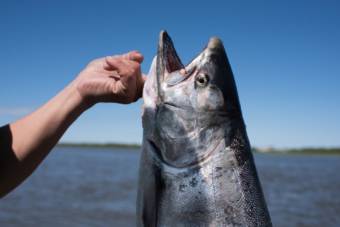
Kuskokwim king salmon caught near Bethel, Alaska on June 12, 2018. (Katie Basile/KYUK)

Throughout Southeast Alaska, non-resident sport anglers will not be allowed to keep king salmon they catch this August.

It’s the latest change aimed at keeping the region’s sport harvest of chinook within a target allocation of 37,900 fish.

“As the season goes along, we’re monitoring how many fish have been harvested, kind of what we project the total for the season is going to be. And we’re getting towards the end of the season now, and it looked like we’re going to exceed our allocation and had to take more restrictive action in order to keep the sport fishery within its allocation,” said Patrick Fowler, the Alaska Department of Fish and Game’s area management biologist for Petersburg and Wrangell.

In June, the department announced reduced bag limits. This is an additional step to slow the harvest. Fish and Game says the number of people out fishing is lower than average, but catch rates are higher than expected this year.

The closure for non-residents also applies to special hatchery areas, like the salt water of the Wrangell Narrows near Petersburg. But it doesn’t apply to Alaskans.

Residents will see a change in king salmon bag limits in August, though. On the outer coast, residents are limited to one fish. On the inside waters, including around Petersburg and Wrangell, residents can keep two kings. Those inside waters are closed in the spring to avoid harvest of kings returning to Southeast’s river systems, and the higher bag limit is meant to make up for some of that reduction later in the season.

Fowler said the harvest of Crystal Lake king salmon in the Wrangell Narrows near Petersburg has been better than average.

“We saw some pretty good catch rates coming out of there and some healthy numbers of king salmon returning to that area, consistent with what we forecasted for the area,” Fowler said. “But that was definitely the highlight for the Petersburg area, especially with so much of our waters being closed in the early season.”

King salmon return to spawn in the spring and early summer. As the numbers of those fish dwindle, anglers may be turning their focus to coho salmon or halibut at this time of year anyway.

After COVID outbreak, small cruise ship to resume Southeast sailings

The American Constellation is docked near downtown on Thursday, July 15, 2021, in Juneau, Alaska. The American Cruise Lines ship has been in port and hosting quarantining crew since several tested positive for COVID-19. (Rashah McChesney/KTOO)

A small cruise ship that canceled a sailing this month because of COVID-19 cases plans to resume its summer schedule this week.

American Cruise Lines’ ship the American Constellation has been docked in Juneau since July 10. Three people tested positive for coronavirus and disembarked to recover in Petersburg July 9. The City and Borough of Juneau says the total case count from that ship eventually reached 16. Nine have since recovered. Juneau’s emergency operations center planned another round of testing for that ship Tuesday, July 20.

The company is requiring COVID -19 vaccinations for its passengers on Alaska cruises. Both vaccinated passengers and unvaccinated crew members tested positive during the outbreak.

During a meeting Monday, Petersburg borough assembly member Jeff Meucci said he was generally happy with the local response but wanted to be more informed.

“I would just had liked to been maybe more in the loop as things were progressing, just so in case the assembly was asked to weigh in on something. I wasn’t quite prepared at that time but I think overall I’m pretty satisfied with the way things went,” Meucci said.

Petersburg disbanded its emergency operations center at the end of last month after the assembly voted to end local health mandates. The community had been requiring cruise ships to get prior approval from the borough’s health officer before docking here, but that ended last month as well. This outbreak occurred a little over a week after that requirement expired.

Borough manager Steve Giesbrecht explained that spread of information would not be as quick without the emergency operations center.

“I would encourage people that have questions to talk to public health and the hospital and to just say the updates are not going to come as fast and furious as they were when we had literally an entire team of borough department heads focused on it as well as many other staff,” Giesbrecht said.

A spokesperson for American Cruise Lines emailed Tuesday that the company planned to resume its schedule, with the ship departing Juneau on Wednesday, July 21. The company declined an interview request. The spokesperson said the cruise line’s protocols have worked.

The ship arrived early in Petersburg Thursday, July 8, seeking testing for a passenger showing symptoms. The first positive was confirmed by the following morning. Nevertheless, other passengers disembarked in Petersburg and circulated in the community that Friday.

Sandy Dixson is the borough’s emergency manager and took part in a conference call with state and local officials and cruise lines representatives on that Friday, July 9.

“They had pondered going to Ketchikan,” Dixson said. “There was a person from Ketchikan and they were like, yeah, we don’t think so. So they immediately made the decision to go back to Juneau and cancel the trip. So they called their people back. Unfortunately people were already out on excursions and roaming about town, which was very unfortunate. But I think they did a pretty good job. I think the communication went well.”

Dixson praised the work of the Petersburg Medical Center and public health nurse to respond to that ship to test passengers and offer vaccine to crew.

Borough assembly member and book store employee Chelsea Tremblay also hoped for quicker communication. She noted that another small cruise ship also had passengers in town that day.

“You know, going forward, if there’s a way to once some things are known, figuring out how to let the Chamber know so they can disburse it from there,” Tremblay suggested. “Because all of us doing front retail, life, interacting with folks, immediately as we’re all talking about it, we’re having face-to-face interactions. I’m seeing other community members coming in who I know are vulnerable. That’s where some of the disconnect, not even just from assembly side, just from public knowledge side, hoping we can dial that in even more,” she said.

The other passengers from that ship continued on to Juneau and flew out of the capital city after an early end to the voyage.

These were not the only COVID-19 cases reported in Petersburg that week. Following a busy weekend of events for the community’s Independence Day celebration, the medical center had already reported two positives in local residents earlier that week with no connection to this cruise voyage.

Southeast commercial salmon season off to slow start

A purse seiner fishes for salmon in Southeast Alaska in 2010. (File photo by KFSK)
A purse seiner fishes for salmon in Southeast Alaska in 2010. (KFSK file photo)

Commercial net fishing for salmon in Southeast is off to a poor start in much of the region. Returns for most species are not meeting forecasts, which weren’t very high in the first place.

With some exceptions, it hasn’t been a very encouraging start to the salmon season.

“I guess for both net fisheries, gillnet and seine, we’re looking at poor chum salmon catches and poor sockeye catches and yet to be determined for pink salmon,” said Troy Thynes, the Alaska Department of Fish and Game’s management coordinator for commercial fisheries in the region.

By the middle of July, the region’s pink salmon catch neared 600,000 fish, still a far cry from the pre-season forecast of 28 million humpies, with the bulk of the season still to come. Thynes explained indicators have been mixed on whether returns later this summer will meet that, with some up and down fishing in southern Southeast near Ketchikan.

“There was some good pink catches that showed up in lower Clarence (Strait) a couple weeks ago, and then the pink catches kind of fell off,” he said. “And then they picked up again here this last opening in districts one and two. We are seeing a higher percent males than what we normally see this time of year, which is generally indicates that the run is coming in a little bit later than normal, and we have been seeing a low average weight on the pink salmon as well.”

Smaller sizes for individual fish can sometimes signal a larger overall return, and managers are hopeful the 28 million harvest forecast for the region is still a possibility. They’ll know more in the next few weeks, heading into what’s normally the peak of the pink season.

Pinks are targeted by the region’s purse seine fleet, which is having 15-hour openings on Thursdays and Sundays in the early season. Most of the focus is around Ketchikan and Prince of Wales Island, with many permit holders not out fishing.

In the past, hatchery chum salmon have filled in a gap for seiners and taken pressure off wild pink stocks. But in recent years that hasn’t been the case. The Northern Southeast Regional Aquaculture Association produces some of those chums around Sitka, Kake and Petersburg.

Association general manager Scott Wagner called chum salmon returns miserable.

“Well it’s just a continuation of last year and the terrible return last year. Whatever widespread issue out in the Gulf (of Alaska) is causing all species of salmon but particularly chum to do very poorly,” Wagner said.

There’s been no fishing this season around the Hidden Falls Hatchery on Baranof Island because of a low forecast. There have been openings at Southeast Cove near Kake and Thomas Bay near Petersburg, but catches have been poor.

Wagner said chum are smaller than normal this year, and he does not expect early summer chum will hit the low end of forecasts at any of NSRAA’s sites.

“We’re about halfway through the return, and particularly Thomas Bay and Southeast Cove are performing very poorly,” he said. “Gunnuk Creek, it’s our first return to the hatchery there with four year olds and it’s looking better. You know we’re seeing about half of our broodstock needs right now, about 10,000 fish which is encouraging but not what we forecasted. Same thing at Hidden Falls.”

Gunnuk Creek is NSRAA’s chum hatchery in Kake. The region-wide chum catch topped 700,000 by the middle of July. All of Southeast’s hatcheries combined forecast a total of 9.5 million chum for 2021.

There have been some better catches of chum for gillnetters closer to Juneau and in Lynn Canal.

In the central part of the region, the drift gillnet fleet has seen one area remain closed for the first part of the season. Fish and Game’s Thynes explained managers have kept district 8 around the Stikine River near Petersburg and Wrangell closed for multiple species.

“It was closed initially for chinook salmon conservation, but it’s also been closed for sockeye salmon,” Thynes said. “We weren’t expecting a large return of Stikine River sockeye this year and as a result district 8 has kept closed because of that. So we haven’t had any indications in our district 6 drift gillnet fishery that the Stikine run is coming in larger than forecasted, so district 8 has remained closed.”

District 6 near Zarembo and northern Prince of Wales Island has seen openings for gillnetters. The Stikine River forecast going into the season was 56,000 sockeye, well below average and similar to what came back in 2020. This year the run may not even meet that poor forecast.

There are a few better showings of sockeye numbers elsewhere in the region, at Redoubt Bay near Sitka and on the Situk River in Yakutat. Thynes says it’s still too early to know the strength of sockeye on the Taku, Chilkat and Chilkoot rivers. Some of those saw high water levels from a big snow pack to start off the summer.

“I would say it slowed at least the chinook and sockeye heading up the big mainland rivers,” Thynes said.

Gillnetters are having openings from two to four days depending on the area with the bulk of the fleet focusing on district 11 near Juneau and district 15 in Lynn Canal.

Volunteers on watch for invasive crab that could threaten Southeast Alaska fisheries

Thomas Olsen-Phillips and Sunny Rice check traps at Sandy Beach. (Katie Anastas/KFSK)

The European green crab might be small, but it can destroy vital habitats for animals all along the food chain. It’s already costing New England shellfisheries million of dollars.

In July 2020, green crab were found in Haida Gwaii, the closest they’ve ever been to Alaska. With the help of volunteers, the Alaska Department of Fish and Game hopes to stay one step ahead of the invasive species.

At low tide at Sandy Beach in Petersburg, Sunny Rice and a group of volunteers walked toward a crab trap — on the lookout for European green crab.

Green crab are small but mighty, measuring around 3 or 4 inches wide. Their shells are a dark, greenish-brown shell with yellow spots, with five triangular points on either side of the eyes.

To check whether the crabs have made it this far north, the Alaska Department of Fish and Game has asked volunteer groups to set up traps all over Southeast. Rice is with the Alaska Sea Grant Marine Advisory Program and wanted to get involved. She and a group of high school students with the Petersburg Indian Association’s natural resource management program set six traps at Sandy Beach and two at Hammer Slough.

So far, they’ve found no green crabs.

“Unfortunately, you guys, this is sometimes what monitoring is about,” Rice told the students. “And as we know, we don’t really want to find a green crab anyway.”

Juvenile Dungeness crabs like this one could be threatened by green crab if they come to Southeast Alaska. (Katie Anastas/KFSK)

Getting a group of kids — or anyone — excited about not finding something is a bit of a challenge, says Tammy Davis. She’s the invasive species program coordinator for the Alaska Department of Fish and Game.

“In this case, you’re hoping to get zeros across the board, which, you know, as a citizen monitor may be somewhat of a deterrent because getting zeros isn’t as exhilarating as finding that thing that you’re looking for,” Davis says.

But citizen monitors are a vital part of the search for green crab in Alaska because of the large size of the geographic area.

Alyssa Guthrie checks a crab trap at Sandy Beach. (Katie Anastas/KFSK)

Green crab could be a serious threat to juvenile salmon, Dungeness crab and other wildlife vital to Southeast ecosystems and industries.

Davis said the big problem is habitat destruction. Green crab like to get into eelgrass beds while they search for clams, mussels and other invertebrates. When they do, they clip the leaves or uproot the eelgrass entirely. That leaves other animals, like juvenile salmon, without a habitat.

“That whole food chain gets disrupted when green crab move in,” Davis says. “It’s sort of a cascading impact, both destruction of the habitat and altering the food chain.”

It’s happening on the East Coast, too. In New England, green crab are uprooting eelgrass and eating soft-shell clams. East Coast shellfisheries have lost an estimated 14 to 18 million dollars annually because of green crab, according to Environmental Protection Agency research. Green crab populations there continue to grow because of rising sea temperatures.

As sea temperatures rise here, Davis said, Alaska could face a similar economic and ecological threat as New England.

“Alaskans love their seafood. We love both commercially and recreationally catching fish. Aquatic invasive species put those things at risk, either through predation or habitat destruction. So it matters to all of us whether invasive species get introduced and then spread.

So what can you do if you see a green crab? Davis says pick it up, take it home, and get a good photo of it, especially the top of the shell. You can call the invasive species hotline or upload the photo online to the department’s invasive species reporter.

Fish and Game is always looking for volunteer groups to help set traps, too. But even if you can’t commit to setting traps each month, you can still play a part.

“Next time you’re walking on the beach, look down,” Davis said. “And if you find a shell that doesn’t quite look like a Dungey or doesn’t quite look like whatever crab is native in your area, that could be really important. You could be the person who finds the first green crab.”

The invasive species hotline is 1-877-INVASIV (1-877-468-2748), and you can find the Invasive Species Reporter at adfg.alaska.gov.

‘We continue to pay a price’: Survivors reflect on generational impact of residential schools at Petersburg vigil

Students at the Bureau of Indian Affairs’ Mt. Edgecumbe school in 1970. (Photo courtesy of the University of Alaska Anchorage Archives)

Since May, the remains of more than 1,000 Indigenous children have been found at sites of former residential schools in Canada.

Petersburg residents gathered outside the municipal building Wednesday night for a candlelight vigil in their memory.

Diane Benson quoted Tlingit elder Jessie Johnnie during her remarks at Wednesday’s vigil.

“Yee gu.aa yáx̲ xʼwán. Yee léelkʼu hás x̲á yee x̲ʼéit has wusi.áx̲ yeedát. Yee gu.aa yáx̲ xʼwán,” she said in Tlingit. “Have strength and courage, all of you. Your grandparents are really listening to you now. Have strength and courage, all of you. We are beginning to walk along it, too.”

Benson, her parents and her grandparents all attended residential schools. She said the recent discoveries in Canada are shedding light on what happened to generations of Indigenous children in the U.S. too.

“The loss of people, the cultural genocide, we continue to pay a price,” she said. “It’s impacted all of our lives. And this brings it more to the forefront for the nation.”

Benson said her grandmother had her mouth washed out with soap for speaking Tlingit. Benson grew up watching her grandparents whisper to each other in the language. Other family members experienced physical and sexual abuse.

Benson attended the Mt. Edgecumbe School in Sitka when it was run by the Bureau of Indian Affairs. She said not learning about the Tlingit language or history left a lasting impact.

“Many of us of our generation have a hard time sometimes — and I’m in my 60s — to express what kinds of things took place and how we felt and the difficulties we had,” she said. “But our hearts carry our culture. And what brings it to life the most is our language. And those schools literally beat it out of children.”

That’s why talking to elders is so important, said local Haida artist Janine Gibbons.

“It’s my hope that it’s not too late,” Gibbons said. “Right now is really a key time. It’s not knowledge that comes easy. You have to go out and search it.”

Last month, Interior Secretary Deb Haaland announced an investigation into boarding schools run by the Bureau of Indian Affairs. That agency ran five schools in Alaska.

The Petersburg Indigenous Arts and Awareness Committee hosted the vigil. The group formed during the creation of the Elizabeth Peratrovich mural now in front of the courthouse.

Benson said events like this week’s vigil can help educate and heal.

“We have to talk to one another as a people and reinforce to the younger people, those things you feel and that emptiness and that hurt is there for a reason. Now we need to help you fill that, and vice versa,” she said. “I think a lot of my generation has carried around a lot of hurt. So this empowers us. Honesty always empowers us.”

7 more COVID cases linked to small cruise ship docked in Juneau

The American Constellation docked in Haines on Saturday, June 12, coming from Skagway the day before. The ship headed to Juneau on Friday, July 15, after three people tested positive for COVID-19 while visiting Petersburg. (Corinne Smith/KHNS)

The City and Borough of Juneau says COVID-19 case numbers have increased from a small cruise ship that ended its voyage after people tested positive in Petersburg last week.

The American Constellation has been tied up in the capital city since Saturday. Passengers flew out of Juneau after docking there and the crew remained on board. Since last Friday, another seven people from the ship have tested positive, driving the total case count to 10. Three of the 10, along with their close contacts, stayed behind in Petersburg last week to isolate and quarantine.

A press release from Juneau’s city government says some of the new positives came back for close contacts isolating in Petersburg, while others received positive test results in Juneau.

Individuals who test positive for COVID-19 isolate for 10 days and close contacts are directed to quarantine for 14 days.

State health and emergency officials Wednesday praised the response of American Cruise Lines, which owns the Constellation, on a weekly COVID update.

“The good news story about the American Constellation is the cases were identified very early,” said Bryan Fisher, the state’s director of Homeland Security and Emergency Management. “The company made the right decision to terminate the rest of that cruise and to isolate the folks that tested positive and all.”

Juneau’s emergency operations center says its working with the company along with health departments at the state and local levels. That EOC planned another round of testing Thursday for the 43 people still on board the Constellation.

Meanwhile, Petersburg’s case count was 11 by Thursday morning, according to the Petersburg Medical Center’s dashboard.

Site notifications
Update notification options
Subscribe to notifications