KFSK - Petersburg

KFSK is our partner station in Petersburg. KTOO collaborates with partners across the state to cover important news and to share stories with our audiences.
As bee populations decline, a statewide study looks into Alaska’s other pollinators

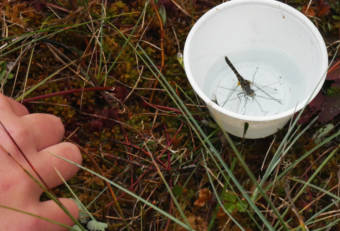
A dragonfly floats in a Forest Service trap near the Raven’s Roost trailhead on Mitkof Island. (Photo by Katie Anastas/KFSK)

When you hear the word “pollinator,” you probably think of a bumblebee. But a lot of different insects act as pollinators, serving a vital role in the ecosystem.

Bee populations in North America have been declining for decades, but the scope of that loss, especially in Alaska, is still unclear. On Mitkof Island, the U.S. Forest Service is contributing to a statewide study of pollinators.

Casey Allen and Shelby Stadler walked through the muskeg near the Raven’s Roost trailhead, checking a row of fluorescent blue, yellow and white cups.

They’re looking to see what insects have landed in them overnight. Allen picked up one of the cups, with three flies floating inside.

“So what we have here is about a quarter full of water with some dish soap,” she said. “The dish soap is there to break the water surface tension. Without that, a bug that lands is going to fall right in and sink and not be able to escape.”

These traps are part of a statewide effort to measure pollinators. And it’s not just bees — a lot of insects act as pollinators, including wasps, flies, dragonflies and butterflies. Stadler said those other pollinators deserve attention, too.

“I think honey bees are sort of the poster child or the mascot for pollinators,” she said. “But our wild pollinators are the ones who do a lot of the heavy lifting also, sort of behind the scenes.”

Allen was surprised to see so many different kinds of insects in the cups. She expected to see some bees and flies. One cup had a dragonfly, and another had what she thinks is a parasitic wasp.

Allen and Stadler collect the cups, remove the insects, and send the samples to the Alaska Center for Conservation Science at the University of Alaska Anchorage. The university is leading the project, called the Alaska Bee Atlas. It’s part of a national effort to conserve bee populations throughout the country.

Alaska’s 22 bumblebee species have been well-documented. But little is known about solitary bees. Those are bees that don’t create colonies or hives and don’t have a separate system of workers and queens. Of the 4,000 bee species in North America, 98% of them are solitary bees.

Allen said bees and other pollinators are important for the entire food chain. Blueberries are just one example of the kinds of fruit we wouldn’t have on Mitkof without pollinators.

“If these bugs aren’t out there pollinating those plants, we don’t have our blueberries,” she said. “That’s sad for us, but more importantly, the animals around here that depend on them don’t have that. Pollinator health doesn’t just affect how bugs are doing or how plants are doing. It affects bears, it affects birds. It’s absolutely a ripple effect. These pollinators affect every single part of the ecosystem.”

Declines in pollinator species have been attributed to habitat loss, pesticide use, invasive plant species and climate change.

Stadler said the goal of the project is to collect more comprehensive data on all pollinator species, including those here on Mitkof Island. If they can keep track of the kinds of pollinators in the area, they can be on alert if a certain population starts to decline.

“Maybe we’re doing something to prevent it from coming here or doing something to kill it,” she said. “We’re trying to figure out what that might be so we can fix it.”

Southeast’s pink salmon catch could beat forecast

Purse seiners enter the Wrangell Narrows near Petersburg in 2018. (Joe Viechnicki/KFSK)

Southeast Alaska’s commercial catch of pink salmon is taking off and could surpass the preseason forecast.

The region’s purse seine fleet netted nearly six million pinks in an opening in early August. That pushed the region’s total catch to around 20 million fish on the season.

“We’re right in the peak of the season, and right now it looks like I project our final harvest if things keep up like this will probably be somewhere near the upper bound of our pre-season forecast,” said Andy Piston, the Alaska Department of Fish and Game’s pink and chum salmon project leader for Southeast. “Our preseason forecast was for a harvest of 28 million with an 80% prediction interval of 19-42 million, and right now it looks like we could get up into that lower 40 million range the way catches are going.”

That would be one of the better catches in the last several years, though far from the record setting run of 2013.

Pink salmon live for two years. The parents of this year’s run spawned in 2019. The catch that year was just over 21 million, and the region saw poor numbers on the inside waters of the northern part of the region.

Piston noted that this year’s returning pinks likely did not experience warm ocean conditions that produced low returns in the past few years.

“You know if you look at the ocean conditions these fish went out into, you know the Gulf (of Alaska) was pretty normal all this last fall winter and spring and so unlike in a lot of recent years the pink salmon that went to sea had pretty average conditions and I think we’re seeing that pay off in some really good survival rates out there,” Piston said.

Catch rates and numbers of fish escaping to spawning streams look to be good throughout most of the region. This year’s pinks are much smaller than average, and the number of male fish is higher than usual for this time of year. Both of those could signal a slightly later and stronger run.

The strong catch is keeping seafood companies busy. OBI Seafoods’ Petersburg plant blew its steam whistle Monday, Aug. 9. That sound means the plant reached 100,000 cases of canned salmon, a mark it hadn’t hit since 2019. Plant manager Nikolai Wendel emailed that they reached that number just before 11 a.m. on Monday. In 2019, OBI canned 140,000 cases. Wendel called this season the best in five years.

Canadian border workers strike, warn of long delays at crossings

A highway sign in Haines shows the distance to the Canadian Border. (Henry Leasia/KHNS)

Just days before the relaxation of some travel restrictions at the U.S.–Canada border, Canadian workers are warning of long delays at the border because of a labor dispute.

Some 9,000 employees of the Canada Border Services Agency announced a partial strike starting Friday, Aug. 6. The workers are seeking a new contract.

The Canadian Broadcasting Company reports that the partial strike means employees will still be at work but will only do the minimum amount of work required under contract.

Unions representing the border agents say that could mean long and unavoidable delays. On Friday, a Canadian government travel website listed wait times at some crossing spots as long as two hours, though others had no delays.

Monday, Aug. 9 is the planned opening of the Canadian border to fully vaccinated Americans. The border has been closed to non-essential travel since March of 2020.

Chinook catch falls short in first Southeast troll opening

Trollers in Sitka’s Eliason Harbor. Extended king closures worry many. “There’s so much down time that a guy’s got to get another job,” troller Caven Pfeiffer told the Sitka Advisory Committee. (KCAW file photo)
Trollers in Sitka’s Eliason Harbor. (KCAW file photo)

Southeast’s commercial troll catch of king salmon fell short of its target in the first summer opening in July. The fleet gets another shot at those chinook in a second fishing period that starts Friday, Aug. 13.

The region’s king salmon catch is managed under the Pacific Salmon Treaty between the U.S. and Canada. Commercial trollers had 119,300 fish remaining on this year’s allocation under that agreement going into the summer season. The Alaska Department of Fish and Game aims for a harvest of 70% of that in July. But this year the catch was around 69,000 chinook from an eight-day opening, short of the target of 83,500.

That leaves a target of 53,000 for the second opening. Fish and Game expects it could take seven to 10 days for the fleet to hit that mark.

Before that, though, trolling shuts down in much of the region to allow some coho salmon to reach the inside waters of Southeast. That’s Aug. 8-12. Fishing is still allowed in a few hatchery chum areas during that time.

Trollers, like other gear groups, are seeing high prices for their fish this summer. Fish and Game reports average prices of $6.68 for kings. Coho have averaged $2.67 and chum 91 cents a pound.

The kings, coho and chum that trollers are catching are smaller in size than recent averages.

Forest Service plans more small timber sales in the Tongass this summer

A forest road on Kupreanof Island near Petersburg (Joe Viechnicki/KFSK)

The U.S. Forest Service plans to offer more small and micro timber sales this summer in the Tongass National Forest in Southeast Alaska. The agency this week announced its plans to sell timber to small sawmills for the remainder of the federal fiscal year, which ends in September.

Dave Harris, the Forest Service’s outgoing director of forest management for Alaska, says the sales will create economic opportunity in the region.

“It’s just going to be a consistent continuation of support for local small niche markets and small operators in our scattered and diverse rural economy and in communities,” he said.

Harris estimates the program averages total sales of around three to five million board feet a year on the Tongass. The Forest Service says the small sale program aligns with the Biden administration’s sustainability strategy for Southeast Alaska. That includes a goal of halting large-scale logging of old growth on the largest national forest in the country.

Two small sales totaling around one million board feet will be put up for sale on Prince of Wales Island near Craig, Thorne Bay and Coffman Cove. There’s a micro sale for 10,000 board feet on the Wrangell Ranger District, and about 120,000 board feet to be offered near Petersburg and Kake. Further north, the agency plans to sell a mix of young growth and old growth wood near Hoonah and Sitka, totaling more than half a million board feet.

“There’s always a little bit more demand over on Prince of Wales than there is around Wrangell and Petersburg and there’s always a consistent, a relatively consistent demand up around Hoonah, Sitka,” Harris said. “And so we’re basically putting out a consistent program for those particular areas.”

The agency also plans to offer wood for Alaska Native cultural uses, like totem poles and canoes. That will be near Hydaburg on Prince of Wales Island.

New public recreation cabin going up behind Petersburg

The cabin looks out over a small muskeg pond with a view of Frederick Sound and the mountains of Kupreanof Island and the coastal range. (Joe Viechnicki/KFSK)

A new U.S. Forest Service recreational cabin is going up this summer on the mountaintop behind Petersburg. The new Raven’s Roost cabin is being built at around 1,800 feet above sea level, at the end of the newly reconstructed Raven Trail.

Jesse West is owner of Rainforest Contracting of Petersburg, the Forest Service’s contractor building the cabin. He says the structure was helicoptered to the mountaintop.

“We built the cabin in our shop and put all the wood finishes on in the shop, and then we broke it down and put it into bundles and then, yeah, we flew it up there in pieces,” West said.

The new Raven’s Roost cabin takes shape in early August. (Joe Viechnicki/KFSK)

West says he and his crew are getting into good shape hiking the new trail to get up to the work site. Construction started later than planned because of a late spring and heavier snow pack. But he says the work is going well and it’s been fun, with a few challenges.

“Just dealing with a lot of hand digging and removal of rock, those are the big challenges,” he said. “And large timbers, how to handle them and deal with them.”

The wood came from a sawmill in Hoonah. The new cabin replaces one that was further along the alpine ridge, another mile south of town.

“It is actually going to be a really nice spot and cabin, and I think a lot of people will use it,” West said. “It’s a challenging enough hike to feel like you went somewhere.”

A lookout on the Raven’s trail above Petersburg (Joe Viechnicki/KFSK)

Reconstruction of the Raven Trail was done by another company, Oregon Woods, and that work wrapped up this year.

West hopes the cabin will be done by end of October or early November. Once finished, it will be available to rent online, like other forest cabins.

Site notifications
Update notification options
Subscribe to notifications