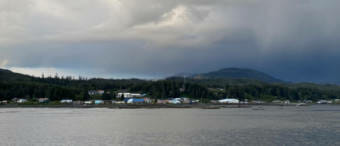
KFSK - Petersburg

KFSK is our partner station in Petersburg. KTOO collaborates with partners across the state to cover important news and to share stories with our audiences.
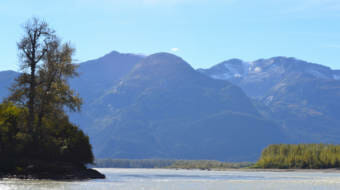
Petersburg group raises money for long-term upkeep of historic Southeast lighthouse

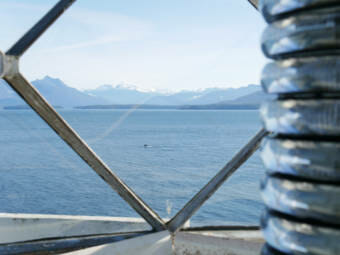
Humpback whales are a common sight from the light at Five Finger. (Joe Viechnicki/KFSK)

It’s a rare blue sky day in between autumn storms of mid-September at Five Finger Lighthouse. A little over 40 miles north of Petersburg, the light endures on a windswept, salt-sprayed rock on the inside passage where Stephen’s Passage meets Frederick Sound. Humpback whales feed offshore, fattening up for the long trip to Hawaii while sandhill cranes have already started their migration south.

Today those aren’t only sounds on the island.

A side view of the historic 1935 building (Joe Viechnicki/KFSK)

A work party for the Five Finger Lighthouse Society tackles a list of projects, winterizing the building, draining pipes, putting away equipment and buttoning up windows and doors. Interpretive signs along the trails of the small island are stowed away until next year.

The society has assumed ownership and maintenance of the light. For years, a Juneau-based organization did that work. Now this group of Petersburg residents is putting more shingles on a new roof for the boathouse. The old one blew off last winter. They’re also getting a troublesome generator to run.

“It looks pretty good. The roof project still has a ways to go,” said Josef Quitslund, one of the volunteers. He’s been multiple times to the remote spot.

“Well it’s hard to get here,” Quitslund said. “I’ve only been here on calm days but the really cool thing about it is it’s right in the middle of everything. You know there’s so much life going on around here with whale swimming right along shore and seals and birds all over the place. It has its own unique little biosphere of critters out here.”

Besides being far from other places, the island is a difficult place to get ashore. Anchoring nearby is difficult. There are a few spots to tie boats up to the rock when the tides and waves cooperate. There’s a rusting ladder up steep rock and rock stairs to an access ramp.

A lighthouse society work party ties up for the day at Five Finger. (Joe Viechnicki/KFSK)

“You can see too there’s been efforts to be able to increase the safety as far as access,” said Eric Castro, a board member of the society. “That’s one of the major challenges that still exists really is accessing the island. So even though there are hundreds of people that pass by, that transit by this island, getting onto the island is one of the major obstacles.”

Names of the last Coast Guard crew to live at the light year-round. (Joe Viechnicki/KFSK)

The lighthouse building dates back to 1935, built in the art deco style. It replaced one completed in 1902 that burned to the ground in 1933. The light’s automated now. The last year-round Coast Guard crew to live there left their names in the basement of the building in 1984.

It’s peaceful out here between storms. But the evidence of the harsh conditions is everywhere. The salt air has rusted a horseshoe on the shop building nearly away. Inside the light itself someone’s built a system of indoor gutters to move the constant rain.

Board member Karen Dillman says there’s been a lighthouse keeper onsite for part of the past two summers, and the group has someone lined up for part of next year as well. She’s hoping a local fund raising effort will help the society land some grant money.

“I think that’s the main goal is really just tapping into some other grants too that really like catapult the whole process into a whole other realm, just because of the power situation, the solar polar, the access, those are big ticket items, if you want to have more people show up and use it as a retreat,” Dillman said.

Lighthouse keepers welcome visitors on passing boats while the structure is open, usually at least part of the time between May and September. The light has also housed whale research and even yoga sessions for cruise ship passengers.

Solar panels help power the light. (Joe Viechnicki/KFSK)

The owners hope it could be a destination again.

“You know you have to have the right person, right group of people who can come out here with the knowledge they might be left out here for a week or more at a time due to inclement weather and just the inability to be able to make it off the island. So it takes a certain kind of grit,” Castro said.

“Grit and flexibility, right?,” Dillman adds. “You don’t want to have a plane to catch tomorrow and come out here the day before or something because that could change,” she said.

Besides fixing things that break, the society has a list of things that would make the island more livable, like a new bank of batteries to store power from solar panels and a better access ramp.

The living room with a painting of the light discovered during former renovations. (Joe Viechnicki/KFSK)

The society has solicited donations from artists and they have an online auction underway. The society has canceled its in-person auction because of COVID cases. The online auction now has a closing date of Oct. 31. The art works will be on display at the Clausen Museum Oct. 4-15.

Petersburg’s COVID response team seeks mask mandate amid surge in local cases

A sign encouraging COVID-19 precautions last winter in Petersburg. (Joe Viechnicki/KFSK)

A Petersburg leadership team responding to the recent surge in COVID-19 cases is imploring the public for help. Cases were up to about 30 as of Wednesday. The team is asking residents to get vaccinated if they can, mask when indoors, get tested, stay home if they’re sick and limit gatherings.

The team will also bring a masking mandate before the borough assembly on next week.

Local officials are worried about a lot — schools being closed, local businesses being affected and limited healthcare services.

“Well, the cases keep coming in,” said public health nurse Erin Michael.

Michael does a lot of contact tracing.

“Obviously, we’re seeing cases in the schools and that has a ripple effect,” she said. “It affects daycares because they may have siblings or family members that go to daycares that are close contacts. It affects other businesses, the borough.”

Petersburg’s middle and high schools have been operating remotely because of cases among staff and students.

“We are buried right now in contact tracing and testing,” said Superintendent Erica Kludt-Painter.

This year, the State of Alaska’s Department of Education tasked school districts with contact tracing for cases among staff and students.

Some of Petersburg’s cases have been students coming to school with symptoms. Others have been caught through required testing of athletes who are competing.

“We don’t exist in a vacuum,” Kludt-Painter said. “So the activities and actions that take place outside of school time, in addition to what happens in the school, impact us directly.”

The Petersburg Medical Center is also dedicating staff to testing on top of their usual work load. They’re running asymptomatic pop-up clinics to deal with the surge.

Like other hospitals, PMC is also giving monoclonal antibody treatment to some COVID-19 patients. The treatment includes lab-made antibodies that help people’s immune systems fight the virus. PMC gave out 14 treatments just last week.

Jennifer Bryner, PMC’s head nurse, says they have about ten doses left but getting more is in question.

“As of the other day the State had 16 doses on their shelf and they were sending them to hospitals who had already run out. So, that supply is very limited,” Bryner said.

If a Petersburg patient did need a medevac, that could be a problem.

“It is very strained,” said Liz Bacom, PMC’s infection prevention manager. She says the big hospitals that usually take medevac patients can’t right now because they are too full.  “It means that if you need an appendectomy, we may have trouble getting you some place because these hospitals aren’t able to accept you. If you have COVID, you may have to stay here longer. We may not be able to provide the same level of care that they could provide you at Providence.”

Alaska hospitals are running on crisis standards of care, meaning that health care workers are no longer providing the same kind of care for all patients. They prioritize care according to what’s available.

PMC has not activated this yet, but CEO Phil Hofstetter says it could be the future.

“If we don’t get our hands around this, we’re not going to be able to — we’re just going to be in a crisis mode,” he said.

The response team is requesting that the borough assembly discuss implementing a masking mandate and limiting gathering sizes.

Sandy Dixon is the Borough’s Emergency Manager and also part of the response team.

“People want things to remain open and operating. It’s not going to happen unless we all pull together and do our part,” said Dixon. “So, people who are dismissing the COVID mitigations or who think it’s ridiculous or that it’s a punishment, please think again because you are or it is impacting the rest of the community and our ability to operate safely.”

The Petersburg Borough had an unenforced masking mandate from November through May. The language allowed for many exceptions.

Pandemic economy contributes to record Southeast Dungeness crab prices

Dungeness crab. (Angela Denning/KFSK)

Southeast Alaska’s Dungeness crab fetched record breaking prices this summer. The size of the harvest was close to average, but the value of the crab was exceptional.

Southeast’s summer Dungeness crab season ended up being worth $13 million. That’s about double the $7.52 million average over the last decade.

The summer fishery brought in just over 3.09 million pounds of Dungeness crab. That’s slightly above the ten year average but well below last year’s near-record harvest of 5.87 million, which was the second highest harvest ever recorded.

Still, the average price paid for Dungeness crab this summer was a record breaker at $4.21 per pound.

“That’s a record high price for the fishery,” said Joe Stratman, who oversees the fishery as Southeast’s lead crab biologist for the Alaska Department of Fish and Game.

He says this year’s fishery was worth about $3 million more than last year’s, which brought in $9.96 million.

“Crabs last year were purchased at a much lower price of $1.70 a pound,” Stratman said. “So, price this year was more than double.”

The 10-year average is $2.70 per pound.

“This summer, in terms of total value and average price, it vastly exceeds the recent 10-year average,” he said.

“It sort of took a lot of people by surprise,” said Dan Lesh who tracks fishery prices for the McKinley Research Group.

He says they’ve seen record prices for Alaska’s crab species since last fall.

“One of the explanations is just that people actually had more disposable income because they were spending less on services during the pandemic and were looking for ways to spend it,” Lesh said. “And seafood, especially premium seafood, seemed to hit that target really well — what people were looking to spend their money on.”

Overall, seafood sales at retail have been up over 30% during the pandemic, Lesh says.

The Dungeness summer season ran two months, from mid-June to mid-August. The strength of the fishery during the first week has set the stage for the whole season. It showed enough crab to hold a full season through the fall and winter. That calculated out to an estimated full-season harvest of 4.23 million pounds, which is slightly above the ten year average.

205 permit holders fished this summer in Southeast. Smaller boats can participate in the Dungeness fishery, unlike Tanner or king crab that requires larger boats.

Stratman says it’s a unique fishery that people can get started in.

“It’s truly like an entry level fishery,” Stratman said. “There’s everything from small skiffs to plus 60-foot boats participating in the fishery. So there’s a lot of permit holders, a lot of deckhands, and there’s also a big shore side component to it, too, processing Dungeness. It’s an important fishery in the region.”

The areas with the highest harvest in Southeast included District 8 near Petersburg and Wrangell, which brought in 680,000 pounds. That area also saw the most fishermen participating with 69 permit holders. District 11, which includes Stephens Passage near Juneau had 650,000 pounds and 40 permits participating. And District 10, which includes Frederick Sound saw the third highest harvest at 459,000 pounds and 41 permit holders participating.

The fall season for Dungeness crab opens on Oct. 1. Most of the region will close on Nov. 30.

Infrastructure bill could boost ferries, energy projects in Southeast

Water flows down the tube and spins a turbine that creates electricity. (Photo by Elizabeth Jenkins/KTOO)
A Hoonah hydro project was completed in 2015. Some panelists emphasized building hydroelectric power infrastructure, especially in rural parts of the state. (Elizabeth Jenkins/Alaska’s Energy Desk)

The Senate passed the $1.2 trillion infrastructure bill last month. The House of Representatives hasn’t voted on it, yet — that’s set for the end of September — and then President Biden would need to sign it into law.

Still, Senator Lisa Murkowski’s chief of staff, Kaleb Froehlich, calls the bill historic.

“Senator Murkoski thinks it’s probably the single most consequential bill she’s worked on in her 20 years in the Senate,” he said.

Froehlich and others spoke at an online town hall meeting in late August, hosted by the Southeast Alaska Conservation Council and the Juneau Economic Development Council. They discussed Southeast Alaska infrastructure projects — like energy projects and ferry funding — that could become possible with the help of new funding.

A major one is stabilizing the Alaska Marine Highway system. Kevin Swanson, from Representative Don Young’s office, says the infrastructure bill could help pay for operating costs and maintenance. That’s something new.

“Traditionally speaking, federal funds only go to capital investments,” Swanson said. “So those are things for building docks, building new ferries, repairing ferries, but didn’t go to the operations of the system.”

McHugh Pierre, CEO of Goldbelt, Juneau’s urban Native corporation, says improving the ferry system is important, especially for tribal communities.

“Right now, we’re at a low point in our history,” he said. “The ferry service is dismal. There’s only two boats that are running. People have to rely on airplanes, it’s very expensive. If someone needs to go to a doctor’s appointment from Kake to Sitka, and they can’t get on a plane, they’re stuck.”

Other panelists emphasized building hydroelectric power infrastructure, especially in rural parts of the state. Jodi Mitchell, CEO of the Inside Passage Electrical Cooperative, says they’ve improved hydropower in communities like Angoon, Hoonah and Kake. The infrastructure bill could help keep customer costs down.

Duff Mitchell, ​​managing director at Juneau Hydropower, says it’s a valuable resource.

“In Southeast Alaska, we’re blessed with hydropower,” he said. “One of the few places in the world that can pull it off. Not only is this good for the environment, but it keeps our local energy dollars here local and it creates jobs.”

The bill also includes $1.5 billion for high speed internet in Alaska and an additional $250 million for tribal internet connectivity.

The House of Representatives has pledged to vote on the bill by Sept. 27.

This story has been updated to correct the spelling of Kaleb Froehlich’s name.

Supply shortages, shipping delays hit Southeast Alaska businesses

Some shelves at the Trading Union grocery store in Petersburg are nearly empty. (Katie Anastas/KFSK)

A COVID-19 outbreak at a warehouse in Centralia, Washington has led to shipping delays at grocery stores throughout Southeast Alaska, including in Petersburg. Some shelves are nearly empty. They’re not likely to be filled anytime soon. And it’s not just grocery stores feeling the strain. Many businesses in Petersburg are experiencing supply shortages and delays more than a year into the pandemic.

Walking down the aisles at the Trading Union grocery store in downtown Petersburg feels like traveling back in time to the start of the pandemic. There’s no toilet paper. There’s no milk. Customers have cleared granola bars off the shelves.

The store’s general manager, Barry Morrison, said they’ve gone six weeks without freight shipments following the Centralia warehouse outbreak.

“The first thing they stopped shipping out was dry goods,” he said. “Those are typically your biggest orders, and they’re the bulk of all store orders. So you want to start limiting cases. You go strictly fresh. But it did impact our meat. They didn’t ship it one week. They missed our whole milk order, so it was a little rough.”

The supplier, United Natural Food Incorporated, sent the Trading Union some orders from their warehouses in Stockton, California and Billings, Montana.

That helped, said Morrison, but it adds two days of travel time. Plus, he said, he couldn’t order more than two cases of any product. He expects it’ll take six to eight more weeks until things are back to normal. In the meantime, backup supplies are running low.

“We’ve made sure since the pandemic started in the beginning that we have extra flour, extra mayonnaise, extra sugar,” he said. “We have extra, we’ve just gone through most of that extra having six weeks of no freight.”

The grocery supply shortage is the most dramatic in Petersburg right now. But other businesses are dealing with their own shortages too.

Will Ware owns The Cedar Box, which sells Alaska Native art and fishing supplies. He said he has more customers this summer compared to last year, when the pandemic severely restricted tourism. This year, he said, the biggest challenges are shipping delays and higher freight rates for supplies.

“I’ll use an example. Like hangers for our slat boards for our wall, we recently got those. We were waiting months for those and we just got them in,” he said. “Even supplies like bags to put our products in, it’s been really difficult to get a steady supply in regularly.”

Down the street, Mark Kubo co-owns FireLight Gallery and Framing. The back of the shop is where the custom framing happens, mostly for local customers.

“We’re still dealing with some backorders,” Kubo said. “Items have been on backorder for almost half a year now.”

Kubo said they’ve found ways to save time on their own. Before the pandemic, the frame moldings would be cut by suppliers before getting shipped to Kubo’s business.

“But during the course of the pandemic, as we saw that shipping was becoming a problem in getting supplies, and getting supplies could be a problem as well, we decided to invest in a chopper so we can chop things down to size,” he said.

Having the chopper means he can process some orders in the shop from start to finish. Though he’s been able to adapt, Kubo said, the future is still uncertain as the highly contagious delta variant of the coronavirus spreads.

Neal Fried is an economist with the Alaska Department of Labor. He said, on a national and international level, the pandemic’s toll on supply chains is unprecedented.

“The supply chain’s going to be studied very heavily in the future as something that we always took for granted in the past,” he said.

A big piece that we took for granted: labor, Fried said. Even when there’s enough of a supply, a lack of workers can mean that supply stays put. Anytime there’s a COVID-19 outbreak at a warehouse like the one in Centralia, it puts the whole process on pause.

Eventually, things will work themselves out, Fried said. But when will that happen? It’s hard to say, he said.

“You know, a year ago I might have been brave enough to tell you,” he said. “But now that we know we were almost all wrong, I don’t know.”

At the Trading Union, Morrison is putting backup supplies on grocery store shelves. At Firelight, Kubo is cutting his own frames. Whatever way businesses might buy themselves time, Fried said, patience and flexibility are key.

Petersburg steam whistle blast a sign of stronger pink salmon harvest

A worker blows OBI’s steam whistle Wednesday, August 25, 2021 (Katie Anastas/KFSK)

People in Petersburg heard the steam whistle blowing at OBI Seafoods in Petersburg again on Wednesday.

The Petersburg seafood plant blew its whistle around noon marking 200,000 cases of canned salmon, just two weeks after the plant hit the 100,000-case milestone.

It’s one of the better seasons in recent years for the local plant, though not a record. Fishing fleets are catching a stronger-than-expected pink salmon return in the region this year.

The Alaska Department of Fish and Game says the region-wide catch last week topped 30 million pinks, already surpassing the 28 million forecast going into the season.

Fish and Game now predicts a total catch of 39 million by the end of the season, which would be an above average harvest.

Site notifications
Update notification options
Subscribe to notifications