KFSK - Petersburg

KFSK is our partner station in Petersburg. KTOO collaborates with partners across the state to cover important news and to share stories with our audiences.
Hatchery salmon production ending at Little Port Walter

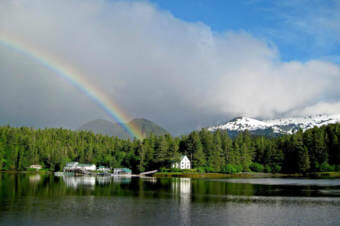
Little Port Walter (Photo courtesy of NOAA Fisheries)

A federal fisheries agency is phasing out production of hatchery king salmon at a remote field station in Southeast Alaska.

The salmon hatchery is connected to a research station at Little Port Walter, near the southern tip of Baranof Island, south of Sitka. NOAA Fisheries sees an annual return there between 500 and 3,000 adult chinook.

Robert Foy, science and research director at NOAA Fisheries’ Alaska Fisheries Science Center, said it’s a budget decision and a change in focus.

“Our goal is to re-prioritize and identify opportunities on the science side, to focus more directly with the National Marine Fisheries Service mission and conduct the research that’s needed to support the existing private non-profit hatcheries in the state,” Foy said last week.

The field station’s research on king, chum and pink salmon and steelhead trout will continue at Little Port Walter. Foy estimated the decision to phase out the hatchery operation will save the agency roughly around a quarter of million dollars a year. And it’s possible a regional non-profit or other organization could take over the king salmon production.

“We’re still communicating with a number of different entities, and our hope is that someone will take this on,” he said. “Again, this is an excellent opportunity. NOAA Fisheries still remains involved. Our scientists are still engaged in this process and by phasing this out throughout this year, the opportunity still exists in order to identify that entity that could come in and assist with the facility.”

Barring that, the final release of young salmon will be in May of 2022. The hatchery will collect broodstock this fall. And king salmon from prior releases are expected to return to Little Port Walter through 2025.

The hatchery run was started in the late 1970s using stock from the Keta River in southern Southeast. Those hatchery returns helped in research used to make king salmon management decisions.

Dungeness catch down from 2020, but price is up

Dungeness crabs. (Angela Denning/KFSK)

Commercial Dungeness crabbers will have a full two-month summer and two-month fall season in most of the region, based on the first week’s catch.

The 2021 Southeast season isn’t off to as strong a start as last year. The Alaska Department of Fish and Game reports the preliminary catch estimate from the first week is around 711,000 pounds, landed by 163 permit holders. Those numbers are expected to increase as more landings are reported.

Still, that’s less than half of the bumper crop harvested in 2020. Last year saw a first-week catch of around 1.5 million pounds, and the full season harvest went on to be the second highest on record, 6.7 million pounds.

Based on that first week catch, Fish and Game estimates this year’s total catch will wind up around 3.4 million pounds. That’s well above the threshold to allow a full season. Fishing time’s been shortened only a few times in the past two decades because of a weak catch or poor quality crab.

The summer season opened June 15 and will run through August 15.

The average price this year is way up, at $4.20 a pound, more than twice the average from last year. It averaged $1.72 a pound in 2020.

Forest Service searches for deadly frog fungus on Mitkof Island

Sam Wynsma walks around a pond during a visual survey. (Photo by Katie Anastas/KFSK)

A deadly fungus could threaten several amphibian species in the Tongass National Forest. On Mitkof Island, the U.S. Forest Service is using a mix of old and new methods to find it.

About 3 miles inland, the Twin Creek Ski Shelter overlooks a pond in the middle of the muskeg. Just a few weeks ago, this part of the island was still covered in snow. Members of the Forest Service are here to look for frogs.

They scoop up buckets of water from different parts of the pond. Then, Marcee Meinhardt pours the water into a pump that carries it through a filter.

“This filter collects all of the environmental DNA,” Meinhardt said. “Then we’ll take a sanitary tweezer and collect the filter from inside here, put it into a sanitary bag, label it with where we are and how much water was sent through it, and then we’ll send that back to the lab.”

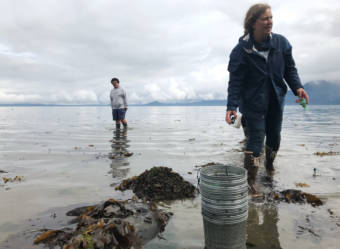
Sam Wynsma, Eric Castro and Marcee Meinhardt. (Photo by Katie Anastas/KFSK)

The filters look like round cotton pads. They’re sending about three dozen of them to a lab for DNA testing.

The results will tell them two things. First, whether there are amphibians at the sites. And second, whether pathogens like chytrid fungus are there, too.

Chytrid is a skin fungus. Frogs and salamanders absorb oxygen through their skin, and the fungus hampers their ability to do that. That reduces their energy level and often kills them.

Last year, the Tongass wildlife and fisheries program detected chytrid in Wrangell, Prince of Wales Island and Yakutat.

“It stops them from being able to reproduce or if they do, if they are able to reproduce, then usually that young won’t be able to reproduce,” Meinhardt said. “It kind of just kind of snips their genetic timeline in the bud.”

One out of every 16 amphibian species has gone extinct or become endangered because of the chytrid fungus, according to a 2019 study. Global trade is thought to have brought it to Alaska from other parts of the world.

There are three frog and three salamander species native to the Tongass. The Forest Service says they’re a vital part of the food chain. They eat a range of insects and other invertebrates. And they’re prey for many fish, birds and small mammals.

Eric Castro is the fish biologist at the Petersburg Ranger District leading the effort to test for chytrid on Mitkof Island. He says the agency has very little baseline information about the size and location of existing amphibian populations.

“If we don’t know how many exist, all we have is anecdotal evidence,” Castro said. “Folks say they used to see more frogs in this area back when they were young, but there’s no data. So right now, we’re collecting data so that we can actually see what the impacts are and then evaluate the future of the species.

Marcee Meinhardt pours water into a filter. (Photo by Katie Anastas/KFSK)

To collect that data, Castro and his team have visited twelve different sites, two times each. While Castro and Meinhardt collect and filter water, Sam Wynsma is using a different tool: his eyes. At each site, a member of the team always looks around the old fashioned way.

“It’s essentially what you do when you’re 12: Go look at the edge of ponds and streams and flip over logs, looking for frogs and toads and newts,” Wynsma said.

Castro thinks he saw salamander eggs on an earlier site visit. Thanks to the DNA tests, he’ll soon know for sure.

“That’s the power of this environmental DNA,” he said. “These are elusive creatures and pathogens, being microscopic, even more so. With the environmental DNA, that really enables us to be able to see what we can’t actually.”

The Petersburg Ranger District will have to wait one to three months to get the test results back. But they’re already thinking about ways the public can help stop the spread of the fungus. One idea is setting up boot-washing stations at sites where chytrid is detected. Castro, Meinhardt and Wynsma clean their boots with a solution of bleach and water after visiting each site to avoid contaminating other parts of the forest.

Castro hopes the project brings more attention to the amphibians that often go unseen.

“They’re out of sight, out of mind,” he said. “You oftentimes consider fisheries resources first. And regardless of them not being the charismatic species that we see climb trees and howl at the moon, they’re part of the natural environment.”

A part of the environment that, hopefully, is here to stay.

Solar-powered boat sails the Inside Passage

David Borton with his boat, the Wayward Sun. (Katie Anastas/KFSK)

Boaters coming and going in Petersburg’s North Harbor may have noticed a new visitor this weekend. David Borton and his son, Alex, sailed from Bellingham, Washington, in a 27-foot solar-powered boat.

Because the Wayward Sun runs on solar, every day at sea can look a little different. Today, it’s cloudy, and Borton is waiting for his boat to recharge.

“Well, today is actually a three or four knot day,” he said. “In the rain, it might be a two or three knot day. If we had plenty of sun, we’d go five or six knots. So it all depends on the sunshine because we run only on sunshine.”

Borton and his son, Alex, have spent the last three weeks sailing north from Bellingham through the Inside Passage. After 20 days at sea, they made it to Ketchikan.

A solar-powered boat might not seem like the best option in the Pacific Northwest and Southeast Alaska. But despite the slow-downs that come with cloudier days, Borton still sees the benefits of solar power.

“Most boats don’t operate continuously — they stop at the dock for a while,” he said. “We’re on a continuous cruise, so you’re always ready to get in. There’s no noise. There’s no smell. You turn the key, and you’re off.”

Still, Borton said it has been a learning experience.

“Now, I knew already that if you’re running all on sunshine, you have to be aware of how much energy you get and how much energy you use,” he said. “I was aware of that. I’ve been doing that for years. But on this voyage, it really comes home and you’re, you know, it’s in front of you all the time.”

Borton grew up rowing Adirondack guide boats in upstate New York. He eventually became a physicist. Solar-powered boats let him combine his love of physics with his love of sailing.

“There was a time when I could not buy gasoline,” he said. “That makes you look for other things, and so I got into solar energy.”

Borton started out by building the boats himself, adding solar panels onto wooden boats. Then, he and a marine architect worked on a 44-foot solar-powered boat. It’s now used for tours in the Hudson River.

Borton and Alex had the Wayward Sun built by Devlin Boat Builders in Olympia, Washington. On their way up to Petersburg, they stopped in Thorne Bay, where Borton once worked as a logger. Their ultimate destination is Glacier Bay.

Until they can set sail again, Borton said he’ll keep enjoying Petersburg. His next destination in town was Coastal Cold Storage for a cup of seafood chowder.

“You are 100% solar-powered. All your food is solar energy. All the fresh water you drink was distilled by the sun,” he said. “So, you know, why not boats?”

You can read a blog written by Borton’s wife, Harriet, with updates on their trip here.

Petersburg businesses report losing nearly half their revenue during pandemic

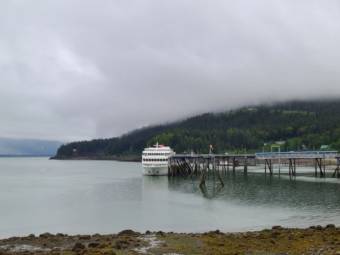
Petersburg’s waterfront in 2019 (Joe Viechnicki/KFSK)

Businesses in Petersburg responding to an annual survey say they lost nearly half of their revenue because of the COVID-19 pandemic and laid off 9% of their workforce.

Thirty-two local business leaders responded to the survey this spring compiled by consultant Rain Coast Data for Southeast Conference, the regional economic development organization. The annual effort also gauges the business climate in other communities and looks for trends, even before the global pandemic.

“This has really been an accurate and really well-used tool over the years,” said Southeast Conference executive director Robert Venables. “So it’s something that allows us to really take the temperature of where things are and the private sector makes their investments and creates their jobs based on the good information they have at hand and I think this is one of those tools in their toolbox that helps them make those decisions. And that’s what we’re really looking for is how do we not only retain jobs but create new jobs in the region and get the economy back on its feet.”

Business leaders were asked how they view the overall business climate. Most Petersburg businesses have responded with poor or very poor, before and during the pandemic as well as this year. Rain Coast Data director Meilani Schijvens said Petersburg businesses had a more pessimistic outlook than their colleagues in other Southeast communities going into last year.

“There was actually a lot of optimism going into 2020 across the region due to the projection of high cruise ship passenger numbers but Petersburg was pretty negative going into it,” Schijvens said. “So clearly Petersburg knew what was going on a little bit, had a better handle on the outlook than anybody else. And so we’ve been able see how Petersburg dealt with the pandemic and how it is coming back sort of comparatively to the rest of the communities.”

Petersburg respondents to this survey are among the more optimistic in Southeast in 2021. That’s mainly because Petersburg hasn’t seen economic losses from the pause on large cruise ship travel and there’s some improvement in the main local industry, seafood.

However, Petersburg businesses report a decline in revenue of 48% from the pandemic, a little higher than the regionwide response, 42%. Some 11% of local businesses say they are at risk of closing, and 13% expect to make more workforce cuts because of the pandemic.

The report also notes businesses, organizations and the tribal government received a combined total of just over $36 million from five sources of economic aid. Seventy-nine percent of Petersburg businesses responding said they received a grant or loan under one of those programs. Schijvens said over half said emergency money is still needed to replace lost revenue from the last year.

“It’s the shutdowns due to COVID, it’s the loss of the visitor industry, passengers and tourists coming to the area,” she explained. “It’s the hit that the seafood industry took. 2020 as you know was just a really terrible year in Southeast Alaska for our seafood. And we’ve gotten, especially in Petersburg, we’ve gotten a lot of comments regarding the impact of less ferry service to the community and how that’s impacting, especially Petersburg businesses that are more reliant on those independent tourists that do utilize the ferry more.”

Support for the ferry system is the original focus of Southeast Conference, and the organization has it as one of four priority objectives in a five-year economic plan published this spring. Other priorities are mariculture development, marketing the region to attract more visitor spending and promoting beneficial electrification.

Petersburg assembly member Dave Kensinger said this week the Southeast Conference survey shows the impact of the pandemic year and highlights the importance of the visitor season.

“I think the thing that a lot of us don’t realize is how dependent some of our smaller businesses are on the tourist industry,” Kensinger said on a radio show Monday. “I know fishing’s a big business here in town but a lot of the small retail businesses in town are definitely dependent upon tourists and hopefully we get a few more tourists coming to town this summer and that will maybe alleviate some of that problem.”

Southeast Conference’s annual meeting this year is Sept. 14-16 in Haines. Business and community leaders will be reviewing the latest survey and economic information there.

US Forest Service asks for input on Alaska maintenance needs

Replacement of the Breiland Slough cabin in Duncan Canal near Petersburg is one potential project that could be funded in 2023 or beyond by the Great American Outdoors Act. (Photo by Joe Viechnicki/KFSK)

The U.S. Forest Service is seeking feedback on a long list of deferred maintenance work for cabins, trails, roads, bridges and boat ramps on national forest land in Alaska. The agency is working to catch up on a backlog of repairs and replacements and has a relatively new source of federal funding to address some of those needs.

The Great American Outdoors Act passed during the Trump administration authorized $1.9 billion a year for five years to reduce deferred maintenance on public lands across the country. It’s aimed at reducing some of the backlog of work for public agencies.

“As we know here in Southeast Alaska, stuff wears out and it wears out pretty quick because we live in a very wet climate,” said James King, the Forest Service’s director of recreation, land and minerals in the Alaska region.

“So this is a new funding source to tackle those challenges,” he added.

The new funding greatly expands the maintenance work the agency can do each year, and the money is targeted at repairs or replacement of existing facilities. The Forest Service agency typically has about $40 million annually nationwide for capital improvements, with the Alaska region receiving a small portion of that. For the Forest Service nationally, the outdoors act provides an annual $285 million allocation each year for five years for maintenance work.

The Forest Service has already announced a list of improvements for the Tongass and Chugach National forests for 2021 and work proposed under the Biden administration’s budget for 2022. King said the pandemic year put off some of that.

“The districts worked really, really hard to do the best they could to keep things maintained and open because we knew there were a lot of people with everything else shutting down that just wanted to get outside and recreate,” he said.

He added, “However, some of the projects that were scheduled and planned to be worked on, because we didn’t have as big a crew or contractors weren’t as available to do work, there were quite a few projects that were postponed and we’re catching up on those this year trying to keep up with things.”

Pandemic year aside, it’s estimated that the deferred maintenance on roads, trails and bridges alone on forest land in Alaska totals around $120 million, not counting recreational cabins and other facilities. The new funding source will mean $12.3 million in repair work for 2021 and $11.3 million proposed for the Tongass and Chugach in 2022.

“Every district on both forests had at least one project funded in 2021,” said Mim Eiben, the Forest Service’s co-leader on an agency team for allocating the money in the two national forests. “And those projects are, we anticipate many of the projects will be implemented this summer. Now, things come up during construction season, especially post-COVID but that is the plan as for right now,” she said.

On the Tongass, the work for this year includes cabin and shelter repairs, along with road, bridge and culvert replacement. The list for 2022 will be finalized during the Congressional budget process later this year. Eiben said the agency has a public comment period underway this summer on work that could happen in 2023 or later.

“We like to look at the way these projects will be affecting the communities and really are interested in soliciting feedback on that experience as well,” Eiben said. “So we combine all of those metrics together and then try to crank out the projects in that way and submit the ones that are top priorities to the Washington office.”

In the Petersburg area, the funding will mean reconstruction of the Ideal Cove Trail on eastern Mitkof Island is expected to happen this year.

Others proposed for funding in the upcoming year are the replacement of the floating bridge portion of the Ohmer Creek Trail and the decking on the trail to Blind River Rapids. The proposed budget would also fund deck replacement for the outdoor hot tub at Chief Shakes Hot Spring on the Stikine River, reconstruct the Cathedral Falls Trail near Kake and replace a bridge on St. John’s Creek on Zarembo Island.

A lot of the work could be done under contract by private companies. Harvey Hergett, the Forest Service’s director of engineering and information management, encouraged people to submit comments on needs for the next few years.

“We’ve suffered some economic downtown especially in Southeast and Southcentral with cruise ships not coming in and the tourist industry being down a little bit,” Hergett said. “So this is an opportunity to supplement some of those local economies and help stimulate them a little bit, put some folks to work.”

There’s an online interactive map to see repairs that are already funded or are proposed for next year or to submit comments on future needs.

The comment period is open through July 6.

Site notifications
Update notification options
Subscribe to notifications