KHNS - Haines

KHNS is our partner station in Haines. KTOO collaborates with partners across the state to cover important news and to share stories with our audiences.

Skagway’s busiest cruise ship dock at risk of catastrophic rockslide, study says

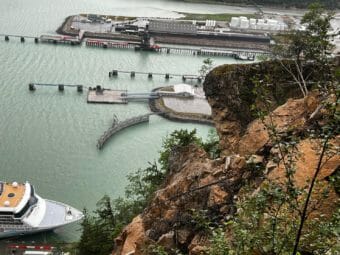
A mass of rocks on mountain slope with a cruise ship docked below.
A view of the largest rock mass geotechnical engineers say will fall eventually, “Such failure will be catastrophic in nature with significant risks to life and property.” (Photo by Mike Swasey/KHNS)

A new report compiled by geotechnical engineers shows that Skagway’s busiest cruise ship dock is at significant risk for rockslides impacting the dock, moored ships, cruise ship passengers and workers.

Of one slide area, the report warns of “significant risk associated with complete failure” with catastrophic results, including “risks to life and property.” The study’s authors go on to say that the slope’s movement is speeding up, suggesting that “the failure event is approaching.”

At its latest meeting, the borough assembly asked the dock’s owners, White Pass and Yukon Route Railroad, to stop using the portion of the dock in the active slide area. But the next day, municipal officials agreed to instead rearrange passenger foot traffic to try to reduce the risk.

KHNS’ Mike Swasey spoke with Skagway Assemblyperson Reba Hylton about the report and the new pedestrian traffic flow agreement.

Listen:

This interview has been edited lightly for length and clarity.

Mike Swasey: Assemblyperson Reba Hylton thanks for joining us. Let’s jump right into the big news coming from the rock slide area right above Skagway’s busiest cruise ship dock, the railroad dock. The municipality brought in scientists to study the slide area. They released a report this week. What did that report say?

Rebe Hylton: Here’s one quote that got everyone’s attention. “It is our opinion that the slope conditions observed during our site visit display significant hazards to people and structures below the slope.” That’s scary, right? I used to work down there. I have friends that work down there. I have a family member that works down there.

A steep cliffside of fractured, brown rocks high above the water.
The view of the rock mass from the north shows the scale of size. The movement of these rocks has accelerated from 1″ – 1.5″ per year to 2.5″ per year. (Mike Swasey photo)

Mike Swasey: I work down there four or five days a week. And I look up at that giant rock that’s perched and has been moving at a couple of inches a year now ready to come down at any time. And I think, what’s my best escape route? That’s what I think when I’m down there. It’s incredibly frightening.

Reba Hylton: Absolutely. And when they first started monitoring this, you know, it was moving at the tune of one and one-and-a-half inches a year. And now this new report released said it’s moving to two-and-a-half inches per year. So historically, we don’t have more data than a few years old, unfortunately. But I mean, you hear those facts, and it’s pretty frightening.

Mike Swasey: Now White Pass is claiming that the rocks that could cause damage on the railroad dock are coming from municipal land. So they’re municipal property. How did the assembly respond to that?

Reba Hylton: Whew, man, it was hard. It was a four-hour meeting. This was the hot topic. Basically, everyone is liable. We all know what’s going on down there, and we are putting not only ourselves at risk, but we’re putting all of our guests that come into this port that are docked on that side in risk. And it’s unacceptable.

Mike Swasey: And so then the Assembly said, well, let’s ask White Pass to stop using the area next to the biggest slide. And then tender people from the aft position. You had a meeting with municipal officials and with White Pass on Friday morning. What sort of agreement did you come up with?

A vertical jumble of gray boulders
Boulder arrangement north of the northernmost slide area. (Photo by Mike Swasey/KHNS)

Reba Hylton: What we did is we looked where there’s most of the congestion, with people congregating in the most dangerous spots down there. That’s right below the rock slide where failure is going to happen at some point. So we’ve come up with a plan together to basically rearrange the flow of traffic down there. And it’s going to be hard for people to wrap their heads around it. It’s late in the season, but we have to make changes because we know the risk now. It’s on paper, and it’s eye-opening, and we had to do something about it.

Mike Swasey: And what are the changes going to look like?

Reba Hylton: The security area where people get back onto the ship will be moved further south. The whole area where the coffee shop is and where the shore excursion booths are, that will be moved — not the caboose itself, I believe the caboose will be closed down. M&M (tour sales) will be closed down. That circular turnaround will not be available to anyone but SMARTbus, but even SMARTbus will be loading further north — just north of the restrooms down there.

Mike Swasey: And when do these new developments go into effect?

Reba Hylton: Immediately.

Haines artist and community leader pursues rare apprenticeship in Northwest Coast formline art

James Hart paints in his studio in Haines. (Photo by Corinne Smith/KHNS)

Bathed in afternoon spring sunlight and a sweeping view of Mount Ripinsky, Haines formline artist James Hart sits in his studio overlooking Main Street. Northwest Coast formline paintings and paddles hang on the walls, and a split board leans against one wall, all painted by his brother, cousin and Hart himself.

He puts the finishing touches on a new formline painting, outlining a bold, black design, highlighted by red forms and a yellow background.

Hart will apprentice with several master Lingít and Haida artists beginning this summer. The young artist says he’s excited to take his skills to the next level in glass and carving.

He began focusing on Northwest Coast formline art just a few years ago.

“It’s been a very long road from the start, which was a paddle-making class with Wayne Price here in Haines, at the woodshop at the school,” he said. “And from there, I was able to apprentice with him on two 40-foot dugouts, and kind of wasn’t sure if that was the direction I wanted to keep going. But it just kept calling me back.”

James Hart puts the finishing touches on a painting. (Photo by Corinne Smith/KHNS)

From there, he began taking formline design classes with Tsimshian artist David Robert Boxley of Metlakatla. Then, the COVID-19 pandemic hit.

“So, I spent a lot of time just working on designs. My design work has gotten a lot better. And I felt like I was in a place where I’m comfortable designing and now I want to start learning how to carve these designs,” Hart said.

During that time, in 2020, he also founded a screen printing company, 3-Mile Designs, and created original formline designs on clothing.

Up next, is something totally new for Hart — working in glass. He was selected to attend a workshop at the Pilchuck Glass School in Washington state, working with renowned Lingít glass artist Preston Singletary and master carver Joe David.

“We’re encouraged to show up with different designs. So I believe we’re going to be blowing glass and then sandblasting our designs onto these different pieces. So super excited to check it out and see what’s going on,” he said.

Then, Hart will apprentice with revered master Haida artist Robert Davidson.

“If you’re unfamiliar with Robert Davidson, he’s your favorite Northwest Coast artist’s favorite artist,” Hart said.

Davidson is a pivotal figure in the Northwest Coast art renaissance starting in 1969, and is an internationally known carver of totem poles and masks, printmaker, painter and jeweler.

Hart approached Davidson last winter, and they discussed his work and agreed Hart would apprentice with him at his British Columbia studio for the next few years.

“I’ll be honest, I got done, I jumped around and like, fist-pumped a few times and then probably cried a little bit too,” Hart said. “It was all the emotions wrapped up in one.”

Hart says Northwest Coast art is a difficult art form to learn and says he feels extremely fortunate to get to work with Davidson.

Hart tears up a bit and grabs a paintbrush again.

“He does a lot for Haida Gwaii and Haida people. He’s also a little bit Lingít so that’s also fun to put in,” he said with a laugh. “But he holds his culture extremely highly. And it seems like that’s been his driving force is the culture, and to be able to kind of learn from somebody and learn how to create a career that’s culturally based, is really what I’m looking for.”

Community members may know Hart from a number of leadership roles in Haines; he’s the president of the Chilkoot Indian Association and is involved in tribal and regional public affairs. He’s also Coach Hart to young basketball players at Haines High, or Little League players during the summer.

James Hart holds up two paintings in his Haines studio. (Photo by Corinne Smith/KHNS)

Hart plans to travel back and forth between Haines and British Columbia and continue participating in those areas, particularly mentoring and sharing traditional arts with youth.

“It’s a place that I’m always going to be coming back to; it’s home,” he said.

Hart says he hopes to take what he learns from other places back to the community.

“So that’s an aspiration, is to learn how to do bigger things and bring the next generation along with me,” he said.

And, Hart says, it’s important for those young artists to not be afraid to ask questions and find mentors who can help bring their skills to the next level.

“We can’t do these things by ourselves. Everybody’s had help along the way,” he said.

Hart will be part of a group show of contemporary Native American artists next month at the Washington State History Museum in Tacoma called “In the Spirit” opening July 15. See his work on Instagram.

Search suspended for woman who fell overboard from a cruise ship in Lynn Canal

Although most people imagine the crews of Coast Guard Air Station Sitka routinely plucking mariners from sinking ships, the most common mission is the non-maritime medevac in flight conditions too treacherous for any other aircraft than the all-weather Jayhawk. Air Station Sitka also performs more terrestrial Search and Rescues (lost hunters and hikers) than any other unit in the Coast Guard. (Photo by Emily Russell/KCAW)
A Jayhawk helicopter from Coast Guard Station Sitka performing a training flight. A similar helicopter is looking for a woman who fell overboard a cruise ship on May 17, 2022. (Photo by Emily Russell/KCAW)

The U.S. Coast Guard has suspended its search for a 40-year-old woman who reportedly fell overboard from the Celebrity Solstice cruise ship early Tuesday morning near Eldred Rock in the upper Lynn Canal.

Petty Officer Ally Blackburn said the captain of the ship reported the incident after a cruise ship camera showed the woman going overboard at approximately 3 a.m. Tuesday as the ship sailed from Juneau to Skagway.

The search included a helicopter from Sitka, a response boat from Juneau and the crew aboard the Coast Guard Cutter Chandeleur based in Valdez.

“Because of the searching that we’ve done, it has yielded negative results,” Blackburn told the Associated Press. Survival time in the cold waters of Lynn Canal is a little over 6 hours according to Blackburn.

The missing woman has not been publicly identified. The Celebrity Solstice is operated by Celebrity Cruises, can carry up to 3,400 passengers and 1,000 crew. It was on the fourth day of a week-long round-trip cruise from Seattle.

First cruise ship in 3 years docks in Haines, where residents worry about COVID-19 coming ashore too

Passengers disembark from the Serenade of the Seas in Haines on May 12, 2022. It was the first ship to visit Haines since 2019. (Photo by Corinne Smith/KHNS)

On May 12, Haines welcomed its first large cruise ship since September 2019. It marks the start of what could be a record-breaking cruise season for upper Lynn Canal communities. But with little public data about COVID-19 cases on ships, some community members worry that the ships could also bring a surge in coronavirus cases.

The town’s deputy mayor Cheryl Stickler welcomed passengers as they got off the Serenade of the Seas.

“You’re the first large cruise ship we’ve been able to host since September 18, 2019. That’s only 967 days,” she said laughing. “Or two years, seven months and 27 days.”

The ship’s captain, Kjell Nordmo thanked borough officials as they exchanged gifts: a model of the ship and a plaque commemorating the Serenade’s first-ever visit to Haines.

“Thank you for your warm welcome and hospitality, during this inaugural call to Haines,” he said.

Haines book store owner Amy Kane says after two years of pandemic and no large cruise ships it’s a much needed boost to small businesses like hers.

“So, it was challenging to build up for it and to find staff for it. But I’m glad I made it. I feel like I just made it to the starting line really after two years,” she said.

But Kane says she’s concerned that cruise passengers could bring a surge in COVID-19 cases to small communities like Haines.

“It’s definitely nerve-racking,” she said. “Because, yeah, people I mean, just travelers in general, pose a higher risk. Having more people here, having the town size, or population double in one day or whatever, depending on how full the ships are, is a lot. I do feel like we’re gonna see a spike in numbers.”

A Royal Caribbean spokesperson said in an email that the cruise line requires passengers ages 12 and older to be vaccinated, and show a negative PCR test before sailing. Children younger than 12 are required to test twice. And all crew are required to be vaccinated.

But that doesn’t mean the ships are COVID-free.

Jim Goettler of Washington state was on the Serenade of the Seas. His son and daughter-in-law tested positive for COVID-19 during their trip. He and his wife tested positive after the trip.

He said he and his family were vaccinated and completed a proctored antigen test prior to sailing but no one from the cruise line checked their results before boarding. He says he saw very few COVID mitigation measures like masks on the ship, and there was crowding, such as in elevators. He says the cruise line should offer rapid testing before disembarking to avoid spreading COVID to small Southeast communities.

“You’re having people walk around town, who are probably, large numbers are infected. And even if you have a minor case, we all know, you’re still very contagious,” he said. “So it’s like, come on, guys. Let’s get this together. Let’s test before we get off the ship. It only takes a few minutes.”

Royal Caribbean did not respond to inquiries about how many passengers tested positive on this Serenade sailing. Cruise lines are required to report COVID data to state authorities, but little data is publicly available.

Goettler says his son reported his positive results to the cruise line and Royal Caribbean offered to reimburse COVID positive passengers for meals after their cruise up to $100 dollars per day, not exceeding ten days. Royal Caribbean did not respond to requests for comment.

Haines tourism director Steven Auch says the cruise lines have agreements with port communities that includes COVID protocols, sanitation requirements, and a commitment that if there is an outbreak, passengers would be medevaced to Seattle.

Auch says Haines does not have COVID requirements but local businesses and residents can take precautionary measures.

“If you look at tour operators, a lot of them require masking on the buses for transportation. So, you know, every business has its own opportunity to take whatever steps it feels is necessary,” he said.

Auch echoed state public health officials who recommend COVID vaccinations, masking indoors, and social distancing where possible.

Spring is time to celebrate, and study, eulachon in Southeast Alaska

Meredith Pochardt collects water samples at the mouth of the Chilkoot River as part of the regional eulachon study in May 2022. (Photo by Corinne Smith/KHNS)

Eulachon, the small fish known in Lingít as saak, has returned to the upper Lynn Canal, marking a celebration of spring. The nutrient rich fish is essential for subsistence culture and marine life. A long-term research study is tracking the fish’s populations across Southeast Alaska to better understand and protect the species.

“It’s a little disconcerting that this is the second year in a row that we haven’t seen a run materialized on the Chilkoot River,” said Meredith Pochardt, a lead researcher with the Chilkoot Indian Association’s regional monitoring project for the fish population. “A few days ago, we saw a small school of fish move in, and there’s a lot of activity and it looked like you know there’s gonna be a bunch more fish that came behind them, and yet we just didn’t see them.”

Pochardt is at the river every day before and during the spring run, from mid April to mid May. The first telltale sign of the spring run is the sound of gulls and seabirds overhead, and seals, sea-lions and sometimes orcas in the water. Another method is gathering DNA.

“Yeah, there’s currently no fish in the Chilkoot River. But we’ll still take samples and see if you know, maybe some came in last night and spawned or maybe there’s some DNA around there we can still pick up from the samples,” she said.

Pochardt fills two large bottles with water from the estuary. Those samples will go to a lab at Oregon State University to analyze the environmental DNA and gauge fish population, ecology and distribution.

The research project launched in 2010, after an alert went out along the West Coast that the eulachon populations were in steep decline. They were labeled endangered in the waters off of Washington, Oregon and California.

It’s not only a spring food source for Lingít communities but also important for medicinal, cultural and social well-being.

“We used to go up to Klukwan, you know had a big travel and all that,” said longtime Haines resident Phillip Jackson. “[The elders] used to spend the whole day with us, and there’d be singing and dancing, you know. And then dipping crackers in the pot, and getting the meat out, with pilot bread. It was always so much fun. And hearing the elders talking in Lingít, telling jokes, giggling and laughing, it was the utmost for me.”

No eulachon in the Chilkoot River isn’t necessarily a bad sign. When and where the small smelt fish run from year to year can vary quite a bit.

Pochardt says there is a run in the Chilkat River this year. Dozens of residents were out with nets over the weekend, harvesting eulachon for oil and smoking.

A spring run was spotted in Skagway too, where Reuben Cash is the environmental coordinator with the Skagway Traditional Council.

“Starting on May 1, we went from, you know, a couple of hundred gulls down to the Taiya River and Dyea to several thousand. We saw sea lions coming cruising up the inlet heading that way, I guess there was a humpback whale in the inlet. So lots of activity,” Cash said.

Cash is also collecting water samples for DNA analysis in the Taiya and Skagway Rivers, as part of the regional initiative.

“I’ve heard reports that the way that the runs will usually work is there will be some scouts that will go up (first) before the main bulk of the fish will arrive,” he said. “And however they’re able to communicate with the rest of the colony of fish, the scouts are able to successfully find a place and the fish will enter the river and the run will kind of increase from there.”

He says the cruise ship season may have also impacted the runs.

“They have an aversion to noise, they really don’t like loud things. We’ve seen that and some other rivers around Southeast,” he said. “When there’s a lot of noise activity, the fish will just switch rivers. So my thought is that perhaps the scouts were coming out checking out the Skagway River and then activity from the tourist season just got to be too intense and so they abandoned the Skagway and perhaps went to the Taiya (River). Or they may have just turned around all together.”

Results from the DNA sampling will help tell the story later in the summer.

New COVID surge hits Skagway the week before this year’s first cruise ship visit

Quiet streets in Skagway in September, 2020. (Photo by Claire Stremple/KHNS)

Less than a week before the scheduled start of the summer cruise season, Skagway’s community health clinic announced a new local surge of COVID-19 cases. That comes on the heels of a federal judge’s decision to strike down mask mandates in the transportation industry.

Skagway’s Dahl Memorial Clinic’s Medical Director Brent Kunzler says the town is in one of its largest outbreaks of the pandemic, with upwards of 30 residents testing positive since the first week of April.

“What I have seen is mostly kids, some adults. Seems like it affects the kids a little harder this time,” Kunzler said.

He says it’s difficult to know the exact number of cases due to the increased use of home tests.

On Wednesday the clinic advised residents to wash their hands thoroughly, get vaccinated and boosted and wear masks in places where social distancing is difficult to maintain.

On Monday, a federal judge struck down the transportation mask mandate. The Alaska Marine Highway System and many airlines promptly announced masks would be optional moving forward.

With Skagway’s cruise season set to start next week, that leaves residents in charge of their own health safeguards as government entities have mostly dropped mandatory public health measures.

Kunzler says he’s not sure which variant could be responsible for the current surge in Skagway, but he stresses that COVID is still very much present.

“I don’t see it going away anytime soon. And it sure hasn’t, has it?” Kunzler said.

There are no public masking requirements in place in Skagway, including at City Hall. Businesses have the option to require masks on-premises.

The CDC still recommends isolating for five days after the onset of symptoms or a positive COVID test, followed by five days of wearing a mask in public for most people. It also still recommends wearing masks on public transportation.

Site notifications
Update notification options
Subscribe to notifications