KNBA - Anchorage

KNBA is one of our partner stations in Anchorage. KTOO collaborates with partners across the state to cover important news and to share stories with our audiences.
Peltola, politics pack first post-pandemic AFN agenda

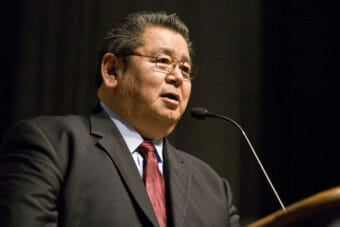
U.S. Sen Dan Sullivan addresses the Alaska Federation of Natives Convention, Oct. 15 (Photo by Mikko Wilson/KTOO)
U.S. Sen Dan Sullivan addresses the Alaska Federation of Natives Convention on Oct. 15, 2016. (Photo by Mikko Wilson/KTOO)

The theme of this year’s Alaska Federation of Natives convention, “Celebrating our Unity,” will hit home for many.

As the gathering gets underway at Anchorage’s Dena’ina Center Thursday morning, AFN will return to its role as Alaska’s largest convention.

It will be the first time in two years that delegates have been able to meet in person, due to the COVID-19 pandemic. AFN normally draws thousands of people from across the state.

AFN is also known for its memorable speeches, and many are anticipating Rep. Mary Peltola’s keynote address. It’ll be the first time in AFN history that the gathering has heard from an Alaska Native member of Congress.

After Congressman Don Young died, Peltola won the seat in a special election in August — but must win a second race against Republicans Sarah Palin and Nick Begich, as well as Libertarian Chris Bye, to keep her job.

Election-year politics always play a big role at AFN, both on and off the main stage.

Several Native corporations, as well as one tribal group, have introduced a resolution to endorse Peltola and Sen. Lisa Murkowski.

The full convention will vote on these resolutions on Saturday, the final day of AFN. This will follow a statewide-candidates forum.

AFN’s agenda also carves out time for economic development, including a session on post-pandemic investment, tribal broadband and Arctic security.

Forums on Native boarding schools and missing and murdered Indigenous women are also on the schedule.

Elders and Youth Conference returns to in-person gathering

Dancers from Sand Point perform at the Alaska Native Heritage Center in Anchorage on Sunday, Oct. 16, 2022. (Rhonda McBride/KNBA)

The Elders and Youth Conference is underway in Anchorage this week, back to what it used to be – a time for both young and old to make a personal connection through their love of Alaska Native culture.

For the last two years, the pandemic kept them from meeting in person. But on Sunday, the First Alaskans Institute held a “Warming of the Hands” reception at the Alaska Native Heritage Center to celebrate the start of the conference, now in its 39th year.

The head of the Alaska Native Tribal Health Consortium thanked the institute for requiring masks and proof of vaccination. Valerie Nurr’araaluk Davidson says the end of a pandemic is still a risky time, so the extra protection is needed – but says she won’t let it stop her from enjoying her favorite dance.

“It’s the one that goes, as you’re walking along – step, step, hug. Step, step, hug. Step, step hug,” Davidson said. “And you just repeat it constantly throughout the week, and it feels so incredible. It’s affirming.”

This is Mason Kvasnikoff’s first Elders and Youth Conference. The 17-year-old from Sand Point says he’s not taking anything for granted.

“I think what’s really special about this Elders and Youth (Conference) is how we are bouncing back, getting out from a time where we have been alone for so long.” Kvasnikoff said. “Just coming together is such a special thing.”

The conference runs through Wednesday at the Dena’ina Center, followed by the Alaska Federation of Natives convention on Thursday.

Monday’s keynote speech is from Christianna Edwards, a 19-year-old Lingít and Haida student from Juneau. She attends the Gallaudet University College for the Deaf.

The theme for this year’s gathering is “Xuu’ts’udeelken iin,” which means “Relatives of Ours” in the Tanacross language spoken in Interior Alaska. Organizers say it’s meant to rekindle the deep sense of community the gathering inspires – a connection between each other and the land.

Watch the First Alaskans Institute Elders and Youth Conference on KTOO 360TV.

Biden reauthorizes Violence Against Women Act empowering tribes to prosecute non-Native perpetrators

President Joe Biden delivers remarks on Wednesday, March 16, 2022, on the reauthorization of the Violence Against Women Act. (Image from C-SPAN)

On Tuesday, President Joe Biden signed an omnibus spending package for fiscal year 2022 into law. The nearly 3,000-page bill includes a reauthorization of the Violence Against Women Act, or VAWA.

As a Delaware senator, Biden helped write the original piece of legislation nearly 30 years ago and has long championed the law. As president, he spoke about the measure on Wednesday.

“Even in 1994, we knew there was much more we had to do,” he said. “That was only the beginning. That’s why because of all of you in this room, every time we’ve reauthorized this law its been improved. It’s not like we didn’t know we wanted to do all these things in the beginning. We did as much as we could do and keep trying to add to it.”

The law focuses on domestic violence and sexual assault survivor programs. The reauthorization includes language that empowers tribes to prosecute non-Native perpetrators of child violence, sexual violence, sex trafficking, stalking and other crimes.

The tribal provisions of VAWA also create an Alaska pilot project that will allow a small number of Native villages to exercise special tribal criminal and civil jurisdiction over non-Native perpetrators in some cases.

Akiak Native Community Chief Mike Williams is also the Alaska region vice president for the National Congress of American Indians.

“This reauthorization of VAWA empowers us to take the necessary steps to build healthier and safer tribal communities in Alaska and across Indian Country for generations to come,” Williams said in a news release from the national Indigenous rights organization.

Supreme Court to hear challenge to Indian Child Welfare Act

The U.S. Supreme Court building in Washington, D.C. (Photo by Liz Ruskin/Alaska Public Media)

The U.S. Supreme Court announced Monday that it will hear several cases challenging the constitutionality of the Indian Child Welfare Act, or ICWA. The law was passed in 1978 in response to the disproportionate removal of Native children from their homes, families and communities.

The Indian Child Welfare Act is a federal law that is used in Native child adoption cases.

ICWA provides Tribes with an opportunity to intervene when state child welfare and adoption agencies consider whether to remove a Native child from a home. The children can be enrolled citizens of the Tribe or be eligible for membership status.

Some states passed their own ICWA laws, but those laws must offer additional benefits — not change or remove the application of federal law.

Many of the arguments opposing ICWA say that law illegally discriminates against non-Native families based on race when placing Native children in homes.

That’s the argument at the core of Brackeen v. Haaland. The case began as a lawsuit in 2018 in Texas. It challenges ICWA as a race-based law and says it should be struck down based on equal protection grounds.

In April, the U.S. Fifth Circuit Court of Appeals split on Brackeen v. Haaland and ruled that parts of ICWA were constitutional, while others were not.

Because of the split decision, the ruling applies only to the judicial district which includes Louisiana, Mississippi and Texas.

In September, four Tribes, the state of Texas and several parents filed petitions to ask the Supreme Court to review the decision.

The Supreme Court has consolidated all of those petitions but has not yet set a date to hear them.

Also Monday, the Supreme Court declined to hear arguments in a case between Little Traverse Bay Bands of Odawa Indians and Michigan Gov. Gretchen Whitmer.

The federally recognized Tribe, which includes more than 4,000 Tribal citizens, appealed a decision against them in which they argued the 1855 Treaties of Detroit established a federal reservation for the Tribe.

The Tribe filed its petition for the Supreme Court to hear the case in November.

Indigenous artists take the mainstage at Juneau’s Rock Aak’w

Juneau’s AirJazz (Arias Hoyle) performs during a closed filming session for Rock Aak’w on Friday, in Juneau. Rock Aak’w is Juneau’s first Indigenous music festival which features artists from across the music industry and around the world. It is airing virtually Nov. 5-6. (Photo by Tripp Crouse/KNBA)

Fourteen musical acts will participate in an international Indigenous music festival based in Juneau. Alaska Native musicians will join several others in the virtual festival called Rock Aak’w. KNBA’s Tripp Crouse talks with one of the festival organizers Qacung Stephen Blanchett about putting together the lineup.

This transcript has been edited for clarity.

Tripp Crouse: Can you give a synopsis of what you’re doing now, but also maybe how you got there?

Qacung Stephen Blanchett: Yeah, sure. I’m one of the members of Pamyua. We’ve been performing almost 30 years now. We’re coming up on 30 years together. One of the things that we’ve really got to realize and notice is that there’s few opportunities for Indigenous artists. We’ve performed at music festivals all around the world, and now a lot of these festivals we’re often put off to the side, right? “Oh, the Indigenous or the world music group will have their own kind of stage off to the corner of the festival.” And that was typically the norm. It was rare that we actually performed on the main stages. And one of the things that we’ve always talked about was the need to just create our own because there aren’t those festivals that really engage with Indigenous artists.

Stephen “Qacung” Blanchett’s experimentation with music began as a kid — when he and his brother, along with some friends tried mixing gospel harmonies with Yup’ik words and rhythms for traditional dance.

Tripp Crouse: It’s being billed as being virtual, but also you’re bringing people into Juneau to actually film stuff for it. So can you talk a little bit about what the make-up is for you?

Qacung Stephen Blanchett: We felt like there was an opening there. Like, things were changing a little bit in July and we had made the decision, OK, let’s do this. It looks like things are changing; the numbers are going down; people are getting vaccined-up and we were all vaccined-up. And so we made the decision to say that we’re going to have an in-person festival. So we went ahead and connected with the folks and bought the tickets and all that. But then as we all know the Delta variant came in and kind of changed things. So we made the decision to go fully virtual, but we had all these tickets bought.

Qacung Stephen Blanchett: We worked up a system where we’re having all these amazing artists flying and we have 10 groups that will be in-person here in Juneau. And we have them scheduled out throughout the day and we have all the virtual hosts. We have 14 different hosts that will be introduced introducing the 14 different bands.

Tripp Crouse: The lineup is a little bit of a mix of Alaskan artists. So there’s Pamyua, there’s Arias Hoyle/AirJazz, Witty Youngman, Byron Nicholai. But then there’s also like a really nice international flavor.

Qacung Stephen Blanchett: Yeah, Snotty Nose Rez Kids, Pura Fé, Supeman, Albino Mbie, Pantayo. One of the things about the festival is that when we look at it in a way of bringing Indigenous peoples together and really doing this intentionally. So we’re opening it up with some protocol from the Aaní here, from the land here of the Áak’w Kwáan, the Aak’w is the name of the Tribe that is from Juneau. And there’s Taku as well. But the Áak’w Kwáan is the folks that will be kind of the main drivers and putting in protocol.

But we also have the vision and the mindset of like those cultures and peoples around the world that many people wouldn’t think of as Indigenous, but those places that have been fighting for their languages, fighting for the traditions and have been colonized, those are people that we’re also going to be inviting. So we have Pantayo, who is an all-female Filipino group who don’t identify as Indigenous, but also but they have their traditions that they’re fighting for and have been influenced by outside colonizers, right? So they really appreciate that we’re doing something like this that brings to light those things that happen around the world.

Witty Youngman performs during a closed filing session for Rock Aak’w on Friday in Juneau. Rock Aak’w is Juneau’s first Indigenous music festival which features artists from across the music industry and around the world. It is airing virtually Nov. 5-6. (Photo by Tripp Crouse/KNBA)

Tripp Crouse: It’s been a really interesting conversation the last few years, seeing that conversation that we’ve been talking about for decades, generations, finally, a global consciousness. But I like to be able to see some of the creativity that comes out of that has been really interesting.

Qacung Stephen Blanchett: Yeah, it’s a beautiful time that we’re in right now. I mean, not just a consciousness and us coming together in the world, right? This world really getting smaller, right? We’re just connecting in many, many ways and more ways. But you know, there’s also this explosion of Indigenous pop culture that’s happening right now. We’re in the midst of something that’s happening. In my 30-year career, this is … it feels different. You know, it really does. You know, we have one of our artists, Ya-Tseen, Yeil Ya-Tseen. He created this beautiful mega installation “Indian Land,” you know? And you know, that thing blew up viral on social media. And it’s — I mean, there’s been so many things happening around that — that space, and it’s just beautiful to just to take that land back, right? And that acknowledgment of Indigenous land.

Quannah Chasinghorse, she was at the Met Gala and, you know, she blew up. I mean, she is like a supermodel now. I mean, you have Sterlin Harjo with “Rez Dogs.” This is … it really feels like there’s just this shift in the consciousness and the recognition of Indigenous peoples. And like, you know, that’s if that’s not this like Hollywood vision of who we are, but we are doing this and we’re on the stage and it’s happening. And it really feels different. And I’m super excited that Rock Aak’w is part of that work.

Tripp Crouse: Where can folks find more information about Rock Aak’w?

Qacung Stephen Blanchett: Oh, it’s definitely on our social media. There’s definitely buzz going on, but it’s Rock Aak’w. And the website is rockaakwfestival.com.

Advocates say the legal system needs more Indigenous representation

Natasha Singh (seated, right) said Tanana Chiefs Conference supports an income tax. She spoke to the House Finance Committee, with her sister Grace Singh (left), May 2, 2017. (Photo by Andrew Kitchenman/KTOO and Alaska Public Media)
Natasha Singh (center) represents the Tanana Chiefs Conference. (Photo by Andrew Kitchenman/KTOO and Alaska Public Media)

According to incarceration data from the 2010 Census, Native American people accounted for more than one-third of adults incarcerated in Alaska. Legal experts say that unless the justice system includes more Indigenous people as lawyers and judges — inequities in incarceration will continue.

Natasha Singh, general counsel for the Tanana Chiefs Conference, says the justice system needs to see significant change. The conference is a Tribal consortium that includes 42 Interior Alaska Native villages.

“We represent a huge part of defendants, right, so then you’d want your lawyers, your public defenders, your prosecutors and your judges and the criminal sector to represent those people who are defendants,” she said.

In 2020, the Law School Admission Council reported that less than 0.3% of students admitted to U.S. colleges of law were Native American, and yet Native American people account for 1.6% of the total U.S. population.

According to the U.S. News & World Report, only 12% of the nation’s nearly 200 accredited law schools offer a certificate, program or legal clinic that specializes in Native American issues.

Alex Cleghorn is the legal and policy director at the Alaska Native Justice Center. He agrees on the importance of diversity, and showing youth that law is a career they can — and should pursue.

“I don’t think that we have been as deliberate throughout the state in talking about justice and talking about public safety and talking about having the same coordinated Native statewide response to those issues,” he said.

When he was in school, Cleghorn said a law career didn’t seem feasible.

“Perhaps disproportionately, Native people experience a lot of interaction with laws and policies that may not be reflective of our values or may not be responsive to our needs,” he said. “So having Indigenous people trained in the law I think can help navigate those sometimes complicated systems.”

Tanana Chiefs general counsel Singh also says that it’s crucial to educate children about their Indigenous heritage, as well as other children state-wide about Indigenous people. She says that educating the current lawyers and judges on Tribal laws could be a massive step toward a more balanced justice system.

“It would probably be restorative and healing because our people who are committing crimes are not actually bad people,” she said. “What’s happening is they’re suffering from historical trauma, they are substance abusers and they are not given the tools to get out of the cycle.”

Cleghorn says encouraging youth and law students to broaden their understanding of justice is an important step toward a better Alaska.

“To be having those statewide conversations about public safety and justice and what an Indigenous or Native or Tribal response to that looks like, and talking about how to engage our young people and seeing themselves as part of the solution,” he said.

The Alaska Bar Association plans to launch a diversity initiative committee within the next year or so. The goal of the committee is to identify systemic issues that impact lawyers of color; issues with attracting lawyers of color to the bar association; and to better support diverse members of the bar association.

Ben Hofmeister is the president of the Board of Governors for the Alaska Bar, and has been a board member since 2018.

He says Alaska is far behind — compared with some states that already have a diversity committee.

“I think we need leadership from diverse numbers so that we can get a diversity of opinions that are going to help us fix our state in the long run,” he said.

The diversity initiative was proposed in January 2021, and passed this May. Now, the Alaska Bar will work on putting the committee together.

For young people, the Alaska Native Justice Center holds a two-day event called Color of Justice, which highlights different career paths in the justice field for students. The location of the program rotates each year between Southcentral Alaska and Sitka. The next program is scheduled for 2022 in Southcentral Alaska.

Site notifications
Update notification options
Subscribe to notifications