KRBD - Ketchikan

KRBD is our partner station in Ketchikan. KTOO collaborates with partners across the state to cover important news and to share stories with our audiences.

In Metlakatla, people from across Southeast learn how to watch for invasive green crabs

Participants of last month’s green crab workshop on the beach in Metlakatla. (KRBD photo/Raegan Miller)

Invasive green crabs are in Alaska. And they are destructive, outcompeting native species and destroying essential eelgrass. At a workshop in Metlakatla last month, citizen scientists learned from experts how to look out for the invasive crabs in their own communities.

Scientists and concerned Alaskans are at Tamgas Harbor. Gathered near Colby Creek Beach, they’re getting a first hand look at the European green crab. And time is of the essence. The crabs showed up in southern Southeast Alaska last summer, and more than 800 have been found since.

“It’s like we hit the ground running coming out here,” said Taylor Stumpf, with the wildlife department of Metlakatla’s tribe. He’s helping people learn to identify, measure, and document the crabs.

The workshop drew participants from around the region, including Ketchikan, Kake and Prince of Wales Island. Green crabs have already infested waters around Haida Gwaii, California and Washington. But for now, Metlakatla is the only place in Alaska to document live green crabs — which are destroying vital eelgrass and habitat for abalone, clams and Dungeness crabs.

Taylor Stumpf tries to get a crab out of a trap to check if it is a European green crab or a Dungeness crab. (KRBD photo/Raegan Miller)

But that doesn’t mean they won’t spread. That’s why the workshop — which was organized by local,  state, federal and tribal agencies — focused on training people to identify the crabs and alert authorities  before it’s too late to control the spread.

People aren’t allowed to kill the crabs themselves — officials are worried they’ll mix up species and take out a perfectly good Dungie — but they are encouraged to collect information and alert authorities. That’s what the workshop is teaching them to do. The agencies organizing the workshop included Alaska Sea Grant, Washington Sea Grant and the National Oceanic and Atmospheric Association. Other involved agencies included the Central Council of the Tlingit and Haida Indian Tribes of Alaska and representatives from the U.S. Coast Guard. Participants included area mayors, concerned citizens, scientists and more.

Stumpf explained a few key tells for a crab that doesn’t belong. Wildlife officials also handed out laminated guides showing pictures of the green crab to all the participants.

“They have the five spines on either side of the eyes and then the three bumps in the middle,” he said. “So we’ve been teaching people with guides how to identify the crabs.”

Ewa Booth is showing people how to set and bait different kinds of traps. She’s an intern with  Metlakatla’s wildlife department. She said the Tribe has been experimenting with what works best.

“They usually like chum and herring fish,” Booth said. “We haven’t really used cat food like they suggested.”

Booth said she’s noticed a difference on the beach since the first crab was found last year. 

“Eelgrass is important because it’s like habitat for other clams, and like juvenile fish, juvenile salmon,” Booth explained. “So it was kind of a worry for us when they first arrived. And I’ve noticed that they’ve gotten a lot shorter, too, like, the eelgrass.”

Booth noted that the crabs tear up the eelgrass while they’re looking for food.

n invasive green crab found near Tamgas Harbor last month. (KRBD/Raegan Miller)

There’s no sure-fire way to eradicate the crabs once they’ve arrived. Tribal nations in Washington state have been fighting them for years. But Genelle Winter, Metlakatla’s grant and invasive species coordinator, said the key is to just keep finding them. She said Metlakatla has always protected its resources, and that’s what the town will keep doing.

“It just sharpened everybody’s need or awareness to protect those resources, right?” Winter said. “Like those resources were already super precious. It’s wanting to make sure they stay intact.”

Each female crab is capable of laying hundreds of eggs. In Metlakatla, green crab catching is a full day’s work. Just ask Gabriel Nathan.

“We’ve been catching a lot when they were molting, when they’re trying to hatch eggs and everything,” he said. “And we caught like over, probably, 40 green crab with egg shells attached to them. And that slowed down a lot. So it was great.”

The workshop’s message is also one of hope: if everyone learns to spot these crabs maybe there’s a way to protect other communities.

Tre Patterson, with Metlakatla’s wildlife department, said that’s the goal.

“I didn’t think that the state or other places near us were taking it as seriously as we wer,” he said. “So to see something like this happening today here on the island is great, to see that more people are taking this issue seriously.

Patterson said everyone has a stake in stopping the crabs — and that things will get even worse if the crabs keep moving north.

Ketchikan Charter School students use theater to tell Indigenous stories

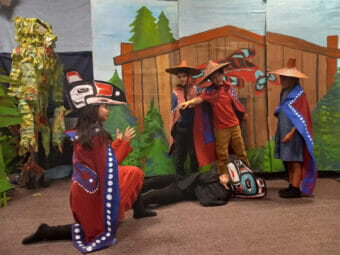
From left to right, Madison Ryan, Chance Side, Isaak Simerly, Mallory Willard Flanery and Olivia Heisler Hinahon act out a scene in “How Devil’s Club Came to Be.” (KRBD photo/Raegan Miller)

Two Indigenous stories came to life on stage at Ketchikan Charter School. Students turned “Killer Whale Eyes” and “How Devil’s Club Came to Be” into short plays featuring handmade props and formline the students learned from an artist-in-residence.
Paddling a cardboard canoe, the student actors are exploring the ocean. They’re looking for their classmate, the one who turned into a killer whale. Pods of hand painted cardboard orcas bob and weave in an ocean of royal blue cloth shaken by the students.

In another play, a student fights a monster who is stealing their tribe’s shaman. The heroine visits the Thunderbird people. She defeats the giant.

Then the metaphorical curtain came down, and they were all kids again, acting out traditional Indigenous stories as plays. The stories, written in those forms by Sondra Segundo and Miranda Rose Kaagweil Worl, are part of Sealaska Heritage Institute’s Baby Raven Reads program.

Halli Kenoyer is an art teacher at Charter School. Her class designed the props, and drama students in Erin Henderson’s class wrote the scripts. She applauds the students’ work.

“I mean, look at their formline,” Kenoyer commented.

Student Amelia Loeffler helped make a lot of the props — she proudly states she learned how to use an Exacto knife. Loeffler says her favorite of the two plays is “How Devil’s Club Came to Be.” That story follows Raven’s niece as she battles a giant who had been taking the village shaman. She discovers devil’s club and its medicinal properties along the way.

Sophia Weston and Madison Ryan act out a scene in “How Devil’s Club Came to Be.” (Raegan Miller/KRBD).

“It’s sort of fun to see how different cultures are,” she said.

Riley Presnell also helped bring the scenes to life.

“I think I really like painting,” he said. “I really like painting the canoe. I really liked painting the blanket.”

Kai Clevenger, a Lingit student, is the daughter of Kevin Clevenger, the school’s artist-in-residence. She helped create the formline that appears on the props. The seventh-grader says it’s important to her to see her culture taught and celebrated in school.

“I like how my culture is communicating with other, like, stuff now,” Clevenger explained. “And l like how my culture is like out there now.”

Student Ryan Boling also worked backstage. He says the fact that they’re traditional stories is what makes it special.

“I feel like Native stories need to get out there more than they are,” Boling said.

Bringing the stories to the stage was a community effort, Kenoyer says, with help  from Ketchikan’s tribe staff. That included Irene Dundas, Ketchikan Indian Community’s cultural resources coordinator.

Fourth- and fifth-graders were able to pitch in, too. Kenoyer says the school’s artist-in-residence had taught the younger kids about formline design, which came in handy.

“And when we ran out of time to work on our props, fifth grade and fourth grade did our designs on the paddles, they worked on the button blankets,” she said. “They worked on the designs for all of the hats. And it was all on account of working with Kevin Clevenger that they knew how to do this. They were really excited to participate.”

That was one of the most satisfying parts of the production process, Kenoyer says.

“It was really cool to see that just that ripple effect of a really great program come into play in our little theater project,” she added.

The students performed their plays for classmates and community members, including the staff of Ketchikan’s local theater. They received a rowdy chorus of applause.

Ketchikan students look to the sky for Crystal Worl’s salmon formline plane

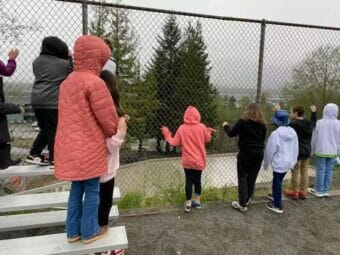
Children in raincoats look through a tall fence.
Houghtaling Elementary School students look toward the airport on Friday, expecting the plane with Crystal Worl’s designs. (Photo courtesy of Starla Agoney)

Ketchikan students tracked the inaugural flight of an Alaska Airlines plane designed by Crystal Worl on Friday.

The former salmon-thirty-salmon is wrapped in Worl’s colorful formline salmon design.

Houghtaling Elementary School teacher Starla Agoney said her fourth graders wouldn’t mind a formline design on every plane.

“Some of the conversations were students think that all of our Alaska Airlines planes should have those designs, formline design, and to be traveling throughout the United States,” she said.

Agoney said that one of her students came to school on Friday morning with the news that the plane would be touching down later that day.

She took it as a chance to show them pictures of the plane, and track the flight through Alaska Airlines. When it got close, they all flocked outside to look. And a conversation about culture took off.

“We talked about how the salmon is the clan of the artist and how the artist always wanted to see a salmon design on one of the planes,” she said. “So it was really deep conversations about what it means to our area.”

It was especially engaging for the students since they’ve been learning formline designs through the school’s artist-in-residence program.
“And so my students were able to talk about the ovoids and the U-shapes and what they thought the design meant,” Agoney added.

Watching the plane come and go was a way for the students to connect what they’ve been learning with real life.

“We’ve been learning about each other’s cultures and the cultures of the Southeast Alaska people,” she said. “And so it was they were able to connect that with what they’ve been learning in class. And so that was really special and unique.”

Agoney said other classes at Houghtaling also watched. Revilla Junior Senior High School students did the same.

Raegan Miller is a Report for America corps member for KRBD. Your donation to match our RFA grant helps keep her writing stories like this one. Please consider making a tax-deductible contribution at KRBD.org/donate.

Judge rules traditional tribal values can stay in Ketchikan schools

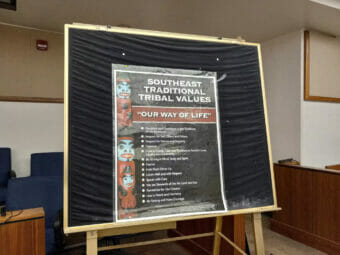
An easel displays the 14 tribal values in Ketchikan Superior Court on Tuesday. (KRBD/Raegan Miller)

After a two-day trial, a Ketchikan Superior Court judge ruled that a list of 14 traditional tribal values can keep their place in Ketchikan schools. The decision comes less than a week after the trial’s end.

The values were created years ago by Southeast Native leaders, and include items like “hold each other up” and “speak with care.” But parents Justin Breese and Rebecca King sued the school district, alleging that one of the values, “reverence for our creator,” was a religious statement that violated the First Amendment’s establishment clause.

They asked for the posters to be taken down from common areas and instead be incorporated into guided lessons. The parents also wanted the values removed from a behavior reward system at Ketchikan Charter School, where King teaches kindergarten.

In the written decision, Judge Katherine Lybrand said that the plaintiffs didn’t prove the statement was religious. Lybrand said that, in order to violate the establishment clause, the posters would have to be forcing students into believing a certain way. She said that fact was not proven at the trial.

And, Lybrand ruled, even if it was religious, it still wouldn’t be a violation of the clause, because the display of the posters isn’t forcing a certain behavior.

“The mere display of the posters around the District’s schools does not foster excessive entanglement or coerce students to believe a certain thing (and in fact there was no testimony that any student has felt coerced in any way),” Lybrand wrote in her decision.

Lybrand echoed testimony from expert witnesses saying the posters were hung to encourage cultural awareness, not a particular behavior.

“The posting of the Southeast Traditional Tribal Values poster has a secular purpose: to promote cross-cultural understanding, place-based learning and strong relationships with the District’s Indigenous student population,” Lybrand wrote.

Lybrand also wrote that the “reverence for our creator,” value wasn’t a required part of the Ketchikan Charter School program and teachers aren’t required to hang the posters in their classrooms. On the first day of the trial, Ketchikan Charter School Principal Kayla Livingston testified that the value “reverence for our creator” hadn’t been used as a “value of the week” or “value of the month” at the school.

Additionally, Lybrand noted that the posting of the value was “more akin to reciting the pledge of allegiance than the posting of the Ten Commandments.”

“Its posting is more akin to reciting the pledge of allegiance than the posting of the Ten Commandments because the poster as a whole demonstrates that its purpose is to promote place-based learning and cross-cultural understanding, not to promote a religious belief,” Lybrand wrote in the court document.

Native leaders in Ketchikan and around Southeast applauded the decision on social media, along with Ketchikan’s tribe.

Plaintiff Rebecca King said she did not have a comment regarding the decision, but that, as parents, they weren’t law experts and received an answer through the legal process.

KRBD could not reach a representative from the Ketchikan Gateway Borough School District via phone. Superintendent Michael Robbins later sent a message to KRBD stating, “we are happy with the verdict.”

Trial underway for Washington man accused of killing Ketchikan surgeon

Jordan Joplin leaves the courtroom in the Ketchikan State Building after he pleaded not guilty to first- and second-degree murder. (KRBD file photo by Leila Kheiry)

Five years after Ketchikan surgeon Dr. Eric Garcia was found dead, the man accused of killing him is on trial in Anchorage. The state of Alaska is accusing 38-year-old Jordan Joplin of killing Garcia and attempting to ship Garcia’s valuables to Washington state. The trial started Monday in Anchorage Superior Court.

Garcia had worked at PeaceHealth Ketchikan Medical Center for a decade before he was found dead on March 27, 2017. Garcia hadn’t been expected at work for some time because he was supposed to be traveling for a conference.

Ketchikan police say Joplin called them saying he was a close friend of Garcia’s and that Garcia hadn’t been seen in 10 days. Joplin said he had last visited Garcia on March 16. Police say Joplin left Ketchikan the day after the phone call.  Joplin hails from Maple Valley, Washington.

There wasn’t a clear cause of death for Garcia when he was discovered dead at his home. His body was sent off for a standard autopsy. Later, police would request a toxicology report.

But just a day after Garcia was found dead, money started to leak out of his bank account. Police said they were able to trace the money to Joplin and he was indicted on a felony theft charge.

Garcia’s family also reported that some of his valuables were missing, shortly after his death. The doctor was known to have collections of expensive watches, wines and hard liquor.

According to police, Joplin had shipped Garcia’s personal belongings to his Washington address. The shipments were intercepted with the help of Washington police.

Joplin was extradited from Washington to Ketchikan on first- and second-degree murder charges, along with theft. He’s been in custody for the past five years.

Joplin’s trial had been pushed back several times, and delayed even further by the COVID-19 pandemic. It was originally moved to Juneau due to the amount of publicity surrounding the case in Ketchikan, and then was moved even further to Anchorage.

An administrator in Anchorage’s court system told KRBD the trial was slated to last six weeks. Jurors were chosen last week.

Superior Court Judge Michael Wolverton is handling the case. Joplin is being represented by Public Defender Mary Fleming Burnell of Anchorage. Burnell did not return a request for comment on Monday.

The trial is being livestreamed.

Trial about traditional values in Ketchikan schools concludes with testimony on cultural importance

Ketchikan’s courthouse and state office building, home to the local Division of Motor Vehicles office, is shown in 2020. (Eric Stone/KRBD)

Expert witnesses testified in court Wednesday that traditional tribal values are ingrained in Southeast Native culture. They were testifying in a trial to determine if it is constitutional to display traditional tribal values in Ketchikan schools. Cultural anthropologists and professors took the stand to answer questions about what the values mean to Lingít, Haida and Tsimshian people.

A trial has been ongoing in Ketchikan to determine if displaying the 14 traditional tribal values, developed by area culture leaders, violates the First Amendment. About a third of Ketchikan students are Alaska Native.

Stephen Langdon is a professor of cultural anthropology. He testified that the values all hinge around the idea of respect — central in Southeast Native culture.

“Well, what’s critically important, is that people have to learn to live together, and by understanding others it’s much more successful to be able to live together,” he said.

The idea of “reverence for our creator” is what plaintiffs Justin Breese and Rebecca King say violates the First Amendment’s Establishment Clause. They say that hanging the posters in school common areas without context or a lesson is endorsing the values. They also take issue with how the values are used in a behavior reward program at Ketchikan Charter School. King is a kindergarten teacher at Ketchikan Charter School. The school’s principal, Kayla Livingston, testified during the first day of the trial that “reverence for our creator” has not been selected as a “value of the week” or “value of the month” for the reward program. But, she says there isn’t any rule preventing it.

Langdon said there isn’t a religion or a specific deity worshiped by Lingít, Haida or Tsimshian people.

He told several traditional stories from clans around the region to emphasize how the values are integral in the Native way of life. He referenced stories about the character Raven, which is both creator and trickster  — he described the stories as teaching tools.

“The ways in which they are used in teaching is to think about what Raven is doing, and it’s not necessarily in a positive light,” he explained.

But plaintiff Breese pointed out what he believed to be references to creation in Raven stories. Plaintiff Rebecca King spoke at length in court Tuesday.

On the final day, Breese highlighted a website from the Central Council of Tlingit and Haida Indian Tribes of Alaska, which makes a reference to “the Creator” that blessed Indigenous people with the land. The site also has a passage that includes a description of the story “Raven Creates the World” and describes it as a story about “how the Raven created the world.”

But Langdon said that he didn’t think that example was typical.

“That particular use of ‘creation’ tells us how the Raven created the world,” he said. “But that an unusual use of the word creation from the vantage point of Western thought.”

He said that the term doesn’t really translate to English, and Raven stories aren’t creation stories. They’re meant to teach lessons.

“So there is already in place an existence for Raven to interact with, and there’s no deeper story so to speak, in terms of where Raven comes from, or who Raven is supposed to be a part of,” he said.

Rosita Worl is the president of the Sealaska Heritage Institute. She testified that the meaning of the word “creator” got misinterpreted in translation.

“In our culture, reverence for, you know, our creator doesn’t refer to any god or any deity that we worship,” she said. “That’s absolutely not within our culture. Within our culture, creator could refer to multiple beings.”

Worl said that the Southeast Native culture includes a belief that everything has a spirit, even a rock or a table.

She said that the values need to be taught to promote healing from historical wrongs. They are necessary to openly living a traditional way of life.

“We want people to learn about our culture and our values,” Worl said.

In closing arguments, Breese said that the district is teaching the spiritual beliefs of Indigenous people.

“They’re used as a guidepost for behaviors and beliefs required of a good student,” he said. “Recognizing and rewarding students for following the 14 traditional tribal values shows the district is teaching, promoting and endorsing those tribal values instead of teaching about them.”

John Ptacin, the attorney for the school district, argued that not every reference to a creator violates the First Amendment. He said that the values are deeply ingrained in an Indigenous way of life, which has a place in public schools.

“These values take on a meaning which are social and customary for these people,” Ptacin said. “And it has taken on that meaning for the last 12,000 years. Every feature of everyday life — subsistence, ceremonies, and every object that the experts and all the witnesses have shown you. These are the values by which they live.”

Wednesday marked the end of the civil trial in Ketchikan Superior Court. Judge Katherine Lybrand did not give an estimated timeline for her decision but told the courtroom she didn’t expect it to take long.

Site notifications
Update notification options
Subscribe to notifications