KRBD - Ketchikan

KRBD is our partner station in Ketchikan. KTOO collaborates with partners across the state to cover important news and to share stories with our audiences.
Prince Rupert mayor reflects on what else was lost as ferry service declined

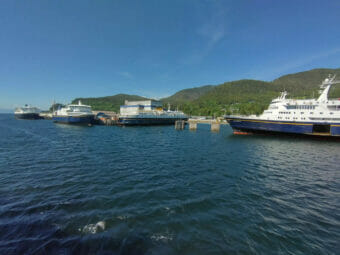
Alaska Marine Highway System ferries tied up in Ketchikan this summer. (Mikko Wilson/KTOO)

There’s no state ferry service to Prince Rupert this summer, a town in British Columbia around 90 nautical miles from Ketchikan. In the past, ferries ran so often that high schoolers could make a quick trip over to play basketball, old friends got to meet up without missing several days of work, and tourism was lively.

Prince Rupert’s mayor, Herb Pond, says 30 years ago, the ferry ran three or four times a week. But over the years, that’s all changed — there’s not the same level of service — and sometimes there’s none at all.

Pond visited Ketchikan during the Fourth of July festivities and walked in the parade. He met a lot of residents who said they wanted the regular run back. Pond also spoke with KRBD’s Raegan Miller about the situation. He remembers when the service started to go downhill, and how it changed the two towns’ connection.

Listen:

Herb Pond: With the absence of ferry service, I wasn’t sure I was going to make it at all. But I was able to run up with a volunteer search and rescue team that was going up, and so I walked in the parade — and although hardly anyone would have known I was there – but it was great to connect with old friends and make some new acquaintances and we’re certainly going to plan on next year.

Raegan Miller: And did you hear from any Ketchikan residents who wanted to talk to you about what the lack of ferry service has been like for them?

Herb Pond: What I heard from a number of people was, in Alaska ferries won’t come south to Rupert, can you get B.C. ferries to come north to Ketchikan? And I actually got on a bus — there was a reunion, high school reunion, and I think it was a class of ‘63. And so, they remember very much what it was like to come back and forth very freely. And that group was dialed right in, they were. They remembered playing basketball. As a matter of fact, I got on the bus, said I’m the mayor of Prince of Rupert, right away one of them said ‘Rainmakers!’ Which was the Rupert team, so those connections are alive, right, this isn’t ancient history. This is very much in people’s minds. People used to come down to golf in Prince Rupert. All the time.

Raegan Miller: So it sounds like maybe there’s a contingent of people who remember how easy it used to be, and they kind of want that to come back.

Herb Pond: Yeah, I’d love it to come back. I mean, it used to be a nice easy getaway weekend, to be able to board an Alaska (ferry). It was just such good memories, right? My wife and I could get on an Alaska ferry, we would go to the lounge, have an Alaskan Amber and sit and get off and wander the streets of Ketchikan and spend their money there and easily come back home in time to, you know, hardly miss any work at all. And that’s just a long lost memory now.

Raegan Miller: And did you notice anything about Ketchikan or also Prince Rupert since the ferry service started to go away? Have there been any effects on these towns?

Herb Pond: Yeah, there’s no question there’s been a shift in tourism – without doubt. But it’s been a slow dwindling reality for you know, two decades now .The impact of that rubber tire traffic that would do some sort of circle route that usually includes, you know, the Alaska Highway up through the Yukon and, you know, maybe into Skagway and down onto the marine highway system. That has dwindled and dwindled and dwindled over the years in Prince Rupert. It used to be a significant part of the tourism business in Prince Rupert, used to be a big part of the hotel business in Prince Rupert. It has really fallen off over the years.

Raegan Miller: And do you think that there are ways to reconnect even if the ferry service doesn’t fall into place?

Herb Pond: It’s going to be difficult. You know, over the years, a number of people have tried small airlines and floatplane service. But shy of that robust and affordable form of transportation, it’s hard to imagine.

Man dies in custody at Ketchikan Correctional Center, one day after arrest

Ketchikan Correctional Center. (Alaska Department of Corrections photo)

A 43-year-old man died while in custody at Ketchikan Correctional Center earlier this week, one day after being arrested.

Alaska State Troopers say that Landon Morgan had been arrested on Saturday for driving under the influence and refusing to take a sobriety test.

Around 6:45 p.m. Sunday night, troopers arrived at the jail after receiving word of a deceased inmate. Troopers say that jail staff found Morgan unresponsive just past 6 p.m. Correctional officers and EMS personnel tried life-saving measures but declared him dead around 6:30 p.m.

“There were no signs of foul play, and initial indications are that Morgan died from a medical issue,” according to the dispatch.

Troopers spokesperson Austin McDaniel wrote to KRBD it could take weeks for the results of an autopsy to come back.
Betsy Holley, a spokesperson for the state’s Department of Corrections, told KRBD that Morgan received a standard medical evaluation when he arrived at the jail.

Researchers are searching underwater for more ancient evidence of Indigenous life near Prince of Wales Island

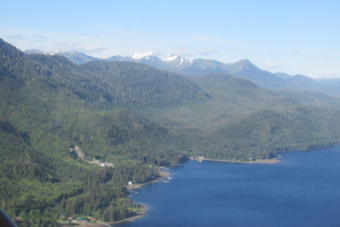
An aerial shot of Prince of Wales Island. (Photo courtesy KRBD)
An aerial shot of Prince of Wales Island. (KRBD photo)

A team of researchers have been combing the waters around Prince of Wales Island, looking for evidence that could shed more light on how long Indigenous people have lived on this land. An underwater robot has a key role.

After the discovery of an ancient fish trap last year, scientists were able to place Indigenous people near Prince of Wales Island around 11,000 years ago.

Now, more research is being done to see if they can push that time back even further.

Kelly Monteleone is a lead researcher with the crew. The crew includes people from the University of Calgary, Sealaska Heritage Institute and SUNFISH.

“We’re really hoping that we can find evidence going back, you know, thousands and thousands of years more — to get people on this continental shelf 16, maybe even 20,000 years ago,” Monteleone said.

She explained that the people who lived along that shelf tens of thousands of years ago are likely ancestors to modern-day residents.

We’re hoping to find caves,” Monteleone said. “And then we know that because of changing in sediments, we’re not necessarily going to find things on the surface in caves. So we’re trying to take a number of sediment samples.”

The samples will then be searched for something called microdebitage. It’s a big word for something that’s actually really small.

“So every time somebody sharpens or uses a stone tool, little, itsy-bitsy flakes come off — sometimes, you know, less than one millimeter in size,” Monteleone explained. “And we can find those in the sediment samples if people were using tools in the cave.”

That sediment will undergo a variety of tests.

“We’re also going to be analyzing the sediments for environmental factors,” she said. “And so we’ll radiocarbon date and we’re gonna get pollen and something called dinoflagellates cysts, which are little microscopic organisms that tell us about the waterfall at the time that sedimentation happened.”

But there’s one catch: the caves are now underwater. Monteleone said they would’ve been above water around 10,000 years ago, when sea levels were about 165 meters lower than what they are now.

So the team is using an underwater robot called SUNFISH. Kristof Richmond is the co-principal investigator involved on the robotics side of the project. He said the robot is going to explore areas that humans pointed out last year.

“And it does very precise mapping using sonar and cameras, and can actually navigate into caves autonomously,” he explained. “So it’s able to explore really complex underwater features and map them out. And so we’re using that tool to help us really identify with precision what kind of features we saw in this high level overview.”

The team also held public events with the robot over the weekend in Craig and Klawock.

“This is just, for us, a real exciting opportunity to demonstrate AI and autonomous functions, you know, to get to places where people can’t and learn lots about our environments, where we come from, and, you know, get into unexplored territory and just push the boundaries of human knowledge,” Richmond explained.

It will take another year or so to comb through what the team finds. But they hope it will lead to even more research about the history of people living in Southeast Alaska.

Ketchikan’s tribe holds awakening and launch for X’oots kuye’ik canoe

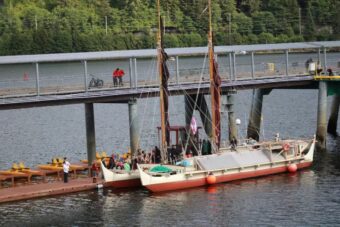
People work together to carry the canoe from Ketchikan Indian Community’s Tongass Ave. building to the Bar Harbor boat launch on Friday. (Raegan Miller/KRBD)

Pouring rain didn’t stop a special ceremony honoring a one-of-a-kind canoe last week. Tribal members and Ketchikan residents gathered to awaken and launch a canoe designed by a late master carver and artist who called Ketchikan one of his homes.

Dozens of people shouted in the Haida language as they heaved together, carrying the canoe to the Bar Harbor boat launch from Ketchikan Indian Community’s Tongass Avenue building. The canoe has a fiberglass hull with wood underneath, and is painted red, white, and black. A design of running salmon swirls around the canoe.

When someone grew tired, another stepped in. It’s a show of teamwork, and of strength.

People listen to instructions as they prepare to lift the canoe, named X’oots kuye’ik. (Raegan Miller/KRBD)

Earlier in the afternoon, a big crowd of tribal members and Ketchikan residents had gathered for an awakening ceremony. The canoe was designed by the late Marvin Oliver, Quinault and Isleta-Pueblo. Oliver owned Alaska Eagle Arts in downtown Ketchikan, but also had art installations around the world, in Canada, Japan and Italy. He was a professor and a curator at the University of Washington and the Burke Museum, respectively, and had won the Charles E. Odegaard Award from the University of Washington for his work in diversity.

Canoes run in the family — Oliver’s father created the Paddle to Seattle in 1982.

Several speakers shared their thoughts during the awakening part of the ceremony, before the launching. They included Ketchikan Indian Community staff and tribal members, and Oliver’s family.

His wife, Brigette Ellis, stood in front of her husband’s creation alongside her family. She talked about respecting the canoe’s place in Indigenous culture.

“First thing I want to share with you is you never say the ‘B-word,’” Ellis said. “Okay? It’s spelled B-O-A-T. But we don’t say the ‘b-word.’ In traditional canoe culture, the canoe is always a canoe and never the ‘b-word’.’ It is said if a paddler speaks of the vessel as a ‘b-word,’ that paddler will be thrown into the water. You learn really fast to call it a canoe at all times.”

People start carrying the canoe, named X’oots kuye’ik, down the hill to the boat launch. (Raegan Miller/KRBD)

She said that Oliver felt connected to canoes because of his Salish heritage and his father’s role in the Paddle to Seattle.

“The canoe revitalization will empower the youth. That’s what he and I had in mind to carry these important traditions forward,” Ellis explained. “It’s the canoe that fosters a healthy sense of identity among young Indigenous people. Those youth that struggle emotionally come together and say, ‘canoe culture is a life changing event.’”

Oliver died in 2019. But the year before, the tribe’s council bought the canoe.

SaanuGa Gianna Willard was a big advocate for buying the canoe, according to a KIC statement. A former tribe president, Willard has taken 14 canoe journeys around Alaska, Canada and Washington.

“When she was KIC President, she made it her biggest goal to secure a canoe for the tribe, and purchased this beautiful fiberglass canoe designed by Marvin Oliver while he was still alive,” the statement from KIC reads.

People watch as the X’oots kuye’ik canoe is carried into the water near Bar Harbor boat launch. (Raegan Miller/KRBD)

Tribe leaders say that the canoe — and canoe journeys — advance’s the tribe’s strategic plan – which focuses on uniting the community and spreading culture.

Norman Skan is the Ketchikan Indian Community President.

“We already have our dance, we have our arts, we have our subsistence food,” he said. “And this is just another component of the wholeness that we are slowly becoming.”

The canoe also received its name.

Brothers Richard and Willie Jackson named the canoe X’oots kuye’ik, or Brown Bear Spirit. Willie Jackson explained their choice.

“He is your protector on the water,” he said. “He is your protector on this canoe.”

He led the crowd through a chant of the canoe’s name.

Those who will be paddling the canoe step in. Cedar boughs still decorate the canoe. (Raegan Miller/KRBD)

Before the canoe is carried into the water, there was drumming, singing, and an acknowledgement of the Indigenous people who have lived on the land since time immemorial. Adults lifted up children and help them drape cedar boughs on the canoe.

After the canoe was floating, the mood was joyous. There was dancing and singing. Some wore cedar hats and drummed, and others danced in their soggy jeans and sneakers.

Garments taken from Ketchikan memorial for missing and murdered Indigenous people

Red clothes hang after being recovered and cleaned from around the Ward Lake trail. (Photo courtesy of Mark Flora)

During most of May, dozens of red garments — some trailing adult-sized gowns, some child-sized frilly frocks — swayed from trees all around Ward Lake last month. They were a tangible reminder of real lives lost — each one representing Indigenous people who were murdered or are still missing.

It’s a project seen in Canada and the Lower 48, too, to bring awareness to the disproportionate number of Indigenous women and girls — and all Indigenous people — who experience violence or go missing.

Most of them disappeared before they were due to be taken down.

“It’s just disrespectful,” Michael Toole, Ketchikan Indian Community’s victim services program coordinator, told KRBD. “It’s a terrible way to discount the reality of the lives of some of these people who were missing relatives who haven’t received justice.”

Toole said he checked on the dresses in mid-May. The tribe held a permit to hang the dresses through the end of the month. That’s according to U.S. Forest Service spokesperson Paul Robbins Jr.

“And there had been some that were, you know, weathered — I mean, the weather, off and on, mixed bag with rain and wind — and some were tattered, but certainly none that I recall being missing,” he said.

There were 60 garments hung as part of the installation. When staff went back to take them down late last month, about 48 of them were gone.

The tribe checked in with Alaska State Troopers and the Forest Service, but they didn’t know what had happened to the dresses. Robbins Jr., the spokesperson for the U.S. Forest Service, told KRBD last week that the organization didn’t take them down.

There was outcry on social media. The tribe’s council issued a statement, condemning what they called “a hurtful and disrespectful act that undermines the efforts to bring understanding and raise awareness about the MMIP epidemic.”

“The theft of the dresses also sends a message that the lives of Indigenous women are not valued,” the statement issued by the tribal council reads. “It is a reminder that Indigenous women are often seen as disposable and that their deaths are not taken seriously.”

“The theft of the dresses is a call to action,” the statement continued. “We need to work together to create a world where Indigenous women are safe and respected.

They asked anyone with information to contact local law enforcement, but also to contact the tribe and learn more about the epidemic.

Some of the dresses have started to turn up in the past few days. Pictures of wet, crumpled dresses appeared on social media.

“[A] number of these dresses had been collected and discarded off the trail and covered up next to a culvert there,” Toole said.

Gloria Burns is Ketchikan Indian Community’s vice president and the chair of the social services committee.

“They’ve been found in the lake vicinity, just, you know, back, almost like they were stuffed into the drain pipe,” she said.

Burns said the act left her with a deep feeling of sorrow. She says it felt like an “intentional, almost vicious attack.” Burns said that the tribe staff hung the dresses with remembrance and intention, trying to make what she called “a safe space.”

“And so when you’re going through that process of trying to create a safe space, and then it’s intentionally made unsafe, it feels very much like a violation,” Burns said. “I think, you know, the hard part is that missing and murdered Indigenous people, it’s been happening since colonization, we really don’t talk about it. We really haven’t spoke those to the outside community.”

The tribal council encourages all Ketchikan residents to reach out to Ketchikan Indian Community and learn more about the crisis.

Burns also hopes that whoever removed the clothing talks to someone, and tries to understand why they did it.

“I hope for somebody, you know, who had a visceral reaction or didn’t understand or didn’t initially that there could be some dialogue and some conversation and some healing, and a different way of looking at kindness, and, and in taking care of each other in our community,” she said.

KIC president Norm Skan wrote to KRBD, “this vandalism is disheartening but it will never deter us from our goal of finding justice for every murdered and missing indigenous woman.”

A note about the terms used in this story: Michael Toole said there are different terms that may be used for missing or murdered Indigenous community members. KRBD chose to use the term used by KIC staff in their statement.

Washington man found guilty of Ketchikan surgeon’s 2017 murder

Jordan Joplin leaves a Ketchikan courtroom Wednesday following a hearing. (KRBD photo by Leila Kheiry)

An Anchorage jury has found a Washington man guilty in the 2017 killing of his friend and romantic partner, a prominent Ketchikan surgeon.

Jordan Joplin, 38, was found guilty of first- and second-degree murder and first-degree theft. Ketchikan police found Dr. Eric Garcia, 58, dead at his home in March of 2017, after Joplin called asking for a welfare check.

Patty Sullivan, a spokesperson for the state’s Department of Law, confirmed the verdict to KRBD on Thursday. Joplin’s sentencing is scheduled for Oct. 5, according to Sullivan.

“He may be sentenced to a term of imprisonment of no less than 30 years and no more than 101 years,” Sullivan wrote to KRBD.

After an autopsy didn’t show any clear signs of how Garcia died, a toxicology screening was ordered.

A statement from the Department of Law, issued during the trial’s opening arguments, said that Garcia died from a fatal dose of morphine. Other drugs, including methadone, diazepam and lorazepam, were also found in his system.

That statement said Joplin had a video showing Garcia, unconscious, in the same clothes and position as when he was found dead —and that Joplin tried to ship about 4,000 pounds of Garcia’s belongings to Washington.

Erin McCarthy, an assistant attorney general for the department, told KRBD that Joplin had been in a romantic relationship with Garcia for six years before the surgeon died.

Site notifications
Update notification options
Subscribe to notifications