KRBD - Ketchikan

KRBD is our partner station in Ketchikan. KTOO collaborates with partners across the state to cover important news and to share stories with our audiences.
Alaska tribes accuse Canada of human rights violations, request international hearing on mining

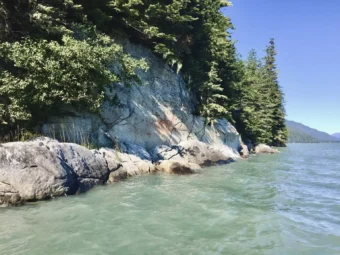
A petroglyph at the mouth of the Unuk River. (Photo by Lee Wagner/SEITC)

At the mouth of the Unuk River near Ketchikan, there is a very old petroglyph. According to Lee Wagner of Metlakatla, the rising sun painted onto a rock above the river is thousands of years old and it’s a family crest.

“And you will also see remnants of more of them along the river as you go up into Canada,” Wagner said.

Further up the river, over the Canadian border, there is a site proposed for an open pit gold mine. It’s one of multiple large-scale mining projects proposed on Canadian soil that Alaska tribes say would directly impact watersheds that run across the border into Alaska. And the tribes have long demanded a seat at the table in how Canada manages those projects.

The tribal coalition is known as the Southeast Alaska Indigenous Transboundary Commission, or SEITC. The tribes submitted a brief on Feb. 19 to the Inter-American Commission for Human Rights accusing Canada of violating their human rights, including their right to a healthy environment.
Guy Archibald is the SEITC executive director. He says the Unuk River case is interesting because the line he has heard from mining companies – that if they build a mine, they can minimize its impact on the watershed – doesn’t work here. There already was a mine at Eskay Creek along the Unuk River in the 1990’s. And Archibald says the watershed is still feeling the effects, over a decade after the mine shuttered.

“Mining is known to impact water quality and salmon. They always do. Modern mines actually fail at a higher frequency and with more catastrophic consequences than mines did 40, 50 years ago – and some of these are the largest mines that will ever be built in the world so far,” Archibald said. “The people using that river, such as Lee’s family, noticed a very distinctive drop off in the hooligan coming in. Hooligan are not like salmon, they will go somewhere else if there’s adverse conditions.”

When the mine closed in 2007, Archibald saw the populations of hooligan, a beloved subsistence fish also known as oligan and eulachon, begin to rebound. But the once productive hooligan fishery in the Unuk River has remained closed to non-subsistence users by the state Department of Fish and Game since the population collapse in 2005.

For Archibald, gold mines mean only two things.

“Jewelry, and its investment,” he said. “Ninety-three percent of all gold is vanity or it is a backup to your investments in the dollar in the stock market in case something goes wrong. It’s vanity and fear. It needs to just stay in the ground.”

“Sacrificing salmon and cultures – and all the language and art that go with them – the economics never pencil out. If ecology is the price that you pay, the economics will never pencil out,” said Archibald.

The SEITC, in partnership with legal advocacy organization Earthjustice, have taken their concerns to the Inter-American Commission for Human Rights, which presides over the defense of human rights across North and South America.

In 2020, the SEITC submitted a petition to the Inter-American Commision regarding Canada’s alleged human rights violations and in September of 2023, the commission accepted it. That started the clock for the tribal group and Canada to both make their cases. This brief is the first official filing of SEITC outlining their argument to the commission since the original petition.

According to Mae Manupipatpong, an Earthjustice attorney, their argument is twofold: that Canada is violating the tribes’ federally recognized right to a healthy environment, as well as violating their own obligation to meaningfully consult with tribal stakeholders.

“They also have an obligation to obtain the free prior and informed consent of SEITC tribal members and make sure that they are participating in the decision making processes and have a voice in whether these mines are authorized or not,” Manupipatpong said. “Toxic water pollution doesn’t stop at the Canadian border. And human rights obligations don’t either.”

Archibald stated that SEITC has attempted to contact the Canada and British Columbia governments multiple times, which is evidenced in the brief. Archibald said the only reply has been from the mining companies. He recalled receiving a letter from one of the mining companies in which they offered to “guide them through” the process.

“Not once in the letter did they say they’d listen to us, or anything along that line,” he remembered.

The mining companies listed in the brief have not responded to KRBD’s multiple requests for comment.

The Canadian and British Columbia governments are required to submit a similar brief in the coming weeks. Afterwards, the Inter-American Commission will decide if there will be a hearing.

Get in touch with the author at jack@krbd.org.

Murkowski pushing to extend federal landslide risk monitoring program

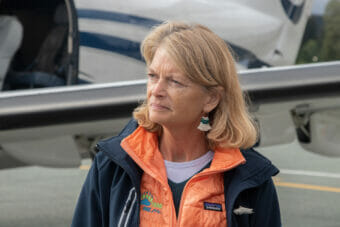
U.S. Senator Lisa Murkowski, R-Alaska, speaks with reporters at the Juneau International Airport on Wednesday August 16th, 2023 (Mikko Wilson/KTOO)

In response to the deadly November landslide that killed six people in Wrangell, Alaska, U.S. Sen. Lisa Murkowski has introduced a bill to help communities better prepare for the increasingly common natural disaster.

Murkowski and Democratic Sen. Maria Cantwell of Washington successfully pushed to get the National Landslide Preparedness Act, a program within the USGS, passed in 2021, and have now moved to reauthorize it for the next 10 years.

In a Feb. 16 address at a community luncheon in her hometown of Ketchikan, Murkowski said Wrangell is recovering from a tragedy felt by both by both Haines and Sitka in recent years. She said these “100-year events” are now happening more frequently.

“And we’re seeing heavier, heavier rains. We got pretty good data back from the Wrangell slide. And it was the combination of just the heavy saturation of the rain, and the wind at the right time,” Murkowski said. “Well, tell me when you don’t get heavy saturation of rain, and wind at the same time in places like this.”

Scientists say climate change is making landslides more common in Southeast Alaska, a region that is well-accustomed to rain but is now seeing heavier rainfall within shorter periods of time. And that’s pushing the limits of soil saturation and stability.

After a 2015 landslide killed three people in Sitka, the community worked with federal agencies to model landslide conditions and eventually partnered with researchers to develop a landslide warning system.

That sort of monitoring and early alert system is what Murkowski hopes the Landslide Preparedness Act can help more communities with. But during that same Ketchikan luncheon, she admitted that any legislation is difficult to pass in an election year.

Later that day, Murkowski spoke more about the topic after an Elizabeth Peratrovich event at Ketchikan High School. She said in the short term, Southeast communities can take solace in the fact that they already have some existing soil data to work with.

“I don’t think people should think that we’re starting from ground zero,” Murkowski said. “When (the U.S.) Forest Service used to harvest timber around here, they actually did soil monitoring, they needed to know what was going on. If they were going to put a road up there, they needed to have some understanding as to whether or not it was going to be safe.”

Murkowski said ultimately the natural disasters themselves can’t be prevented, but an early warning system could help save lives and property.

Alaska Native Tribes pressure Canada for rights in Unuk River mining project

A petroglyph at the mouth of the Unuk River. (Photo by Lee Wagner/SEITC)

Tribes near Ketchikan submitted evidence Jan. 30 to the Canadian and British Columbia governments that they hope will give them a voice in transboundary mining discussions.

The tribes say the evidence proves they’ve had a historical presence along the Unuk River, which runs through the border.

Southeast Alaska tribes have long demanded a seat at the table in how Canada manages mining projects that affect lands and waters across its border.
On January 30, a coalition of the Lingít, Haida and Tsimshian Tribal governments submitted testimonial evidence to protect the Unuk River, one of their river watersheds. The tribal group fears the watershed could be damaged by a proposed open-pit gold mine on the other side of the border.

The coalition is called the Southeast Alaska Indigenous Transboundary Commission (SEITC) and represents 15 tribes and tribal groups in Alaska and Canada.

“The border that transects these transboundary rivers is a completely false construct. Nothing in nature respects that line on the map – the water, the salmon, the people, the wildlife, nothing respects that. What happens in the upper reaches of these trans boundary rivers will impact our tribes, our communities, and our tribal citizens,” said Guy Archibald, SEITC’s executive director.

The evidence submitted by the commission, which includes personal testimony from tribal members of Metlakatla and other communities along the border, is meant to demonstrate the Lingit people’s historic presence along the Unuk River. The river, northeast of Ketchikan, is an established wild salmon habitat and holds cultural significance to Alaska Natives. And the tribal governments say it is under threat from Eskay Creek Mine, a silver and gold mining project proposed upriver in British Columbia,.

Essentially, the tribes are alleging that unregulated mining across the border in Canada is conflicting with the tribe’s obligation to protect traditional lands for future generations.

Tazia W’ally Sthaathi Ta Wagner, a member of the Wolf Clan in Metlakatla, testified that she grew up harvesting hooligan, moose and king salmon on the Unuk and plans to protect that cultural right.

“I would love to see us do another community harvest on the Unuk River again and see those bright smiles on everyone’s faces one more time. And to bring hooligan again to our elders, that is what I would really love to happen in the future, for generations to come,” she said.

Skeena Resources, Ltd., the Vancouver-based mining company in charge of the mining proposal, did not respond to repeated requests for comment.

Earthjustice, the organization representing the tribal commission, has also brought a case against the Canadian government alleging that their refusal to consult with Alaska Native Tribes on large-scale mining development is an international human rights violation. The claim was recently recognized by the Inter-American Commission on Human Rights.

“This isn’t a new right. I mean, these are rights that go back millennia,” said Earthjustice attorney Ramin Pejan. “The ownership of the Unuk River and the territory and the use of that river is integral to their culture, to their subsistence. It goes back thousands of years before these borders were in place.”

Pejan said the goal is to capitalize on recent Canadian legal precedent to get the country to consult with Alaska tribes properly – the way they would for tribes protected under the Constitution in Canada. Something that Guy Archibald said felt hopeless a few years ago – even from the state of Alaska.

“Alaska signed a [Memorandum of Understanding] with British Columbia to have a trans-boundary working group,” Archibald alleged. “They did that without any consent or consideration of the tribes. It’s bilateral. It’s between Alaska and BC. The tribes are not involved. And the state doesn’t share any of that information with us.”

Then, a door opened back in 2021. That door was the Desautel case – an Indigenous American citizen tried in Canada’s courts for killing an elk in British Columbia without a hunting license. The defendant lived on a reservation in Washington and argued that he was exercising his aboriginal right to hunt in the traditional territory of his ancestors. Archibald explained that the case forced the Canadian Supreme Court to ask a central question.

As Archibald put it, “Do Indigenous, non-resident people of Canada – people who live outside of Canada but have ties to traditional lands within Canada – have any rights to those lands? And the Supreme Court said ‘yes.’”

Pejan said that the Eskay Creek Mine case is the first case through that door opened by Desautel but it is by no means the biggest. It is dwarfed by the KSM Mine, a proposed project that would be one of the largest open-pit mines on the planet.

If the coalition succeeds, it would be the first time in history that a US-based tribe is granted “Participating Indigenous Nation” status in Canada. The country has never legally recognized US-based Indigenous peoples as stakeholders in the country’s policy decisions.

“You know, we keep hearing that these resources are so abundant. They’re just infinite. Like the buffalo?” Archibald, an environmental chemist by trade, complained, citing his past as a miner and what he calls “the standard mining company line.” “And on and on. And then we keep making the same mistake over and over and over again.”

For Archibald, the chances to make mistakes are running out.

“Alaska is the last stand,” he said. “These transboundary rivers are the last undeveloped salmon spawning rivers left in North America. If we don’t get it right here, then we’ve run the table. There is no place further to go. So this is the place to make the stand.”

Alaska’s harbors grapple with rusty pilings and rising costs

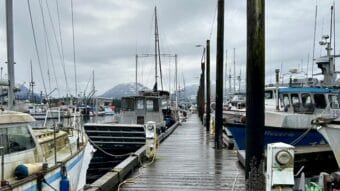
Boats moored in the Thomas Basin marina in Ketchikan. (Jack Darrell/KRBD)

Cody Cowan is a fifth-generation Ketchikan fisherman. He’s standing near a boat his grandfather built on the Bar Harbor North floats, a city-owned harbor dock, talking to other fishermen on a clear, snowy day. He’s furious.

“It’s getting bad,” Cowan says, to nods and echoes from the other men. “And there’s a lot of people just done with it. Like me. Honestly, I’m just done with it.”

A few weeks ago, Cowan was standing behind a podium talking to members of the city council about their proposal to raise harbor rates. Cowan expects his moorage rate to jump from around $1,300 to nearly $2,400 a year. He alleges that with all the other proposed changes, the total cost of keeping the boat his grandfather built in Ketchikan, will more than double.

“This isn’t sustainable. This isn’t a sustainable plan,” he adds.

At a Jan. 4 city council meeting, that proposal to raise harbor rates passed. There was uproar among harbor users like Cowan in and outside council chambers.

The rate change was catalyzed by a study commissioned by Ketchikan Port and Harbors in 2023. The study into harbor rates determined that, essentially, for the city-owned harbors to break even, annual revenue needed to be in the range of $2.5 million. That’s roughly 60% more than the annual revenue in 2022.

But this reckoning is not unique to Ketchikan.

The majority of the public boat harbors in Alaska were constructed and funded by the state during the 1960s and 1970s. Over the last 30 years, those state subsidies have dried up for municipal boatyards. As oil production declined, the financial burden of running the harbors has fallen on individual communities.

A 2023 resolution by the City of Valdez urged Gov. Mike Dunleavy to fully fund the state’s grant program for municipal harbors. The resolution, which was republished by the Alaska Association of Harbormasters and Port Administrators, went on to say that municipal harbormasters inherited a major financial burden that their local governments couldn’t afford.

“So we no longer have a big brother in the oil companies in the state of Alaska who can subsidize those facilities,” Ketchikan City Manager Delilah Walsh explained. “And that’s what happened in the past. Essentially, the state built these power dam projects, the state built some of the water infrastructure, the roads, the harbor infrastructure, there’s no oil money left to do that anymore.”

The Ketchikan harbor runs on a special revenue fund, meaning they are funded entirely by the fishermen, liveaboards, recreational boaters and others that use the docks. According to Walsh, the bottom line is that life in Alaska, on land and on water, is getting more expensive.

“Inflation goes up, supplies go up, fuel goes up, and we pay water and electric bills as a harbor entity,” Walsh said. “So those prices are going up and rates have to go up because that’s how it works. Whoever uses the harbors has to pay for the harbors.”

A community member at a recent city council meeting suggested spreading the cost out to the entire city. For Walsh, this is where it gets complicated.

“That would mean we’re socializing the harbors, essentially,” Walsh said. It’s a prospect that she said is different from other socialized municipal services like police and firefighters and museums, because the user group is smaller. But how much of a benefit do harbors provide to Alaskan communities as a whole?

Walsh said she doesn’t yet know an economist who’s figured out how to do that calculation.

The other question often asked, especially in Southeast Alaska, is if city officials can look elsewhere for the money, such as the cruise industry. The city receives a “head tax,” a fixed amount per cruise ship passenger that varies depending on the community. Ketchikan’s is $11. That money goes into the city’s Cruise Passenger Vessel funds or CPV.

Legally, funds provided to the city by the CPV can only be used to directly benefit the cruise ship industry. Walsh said the city is looking at ways that municipal harbor improvements can satisfy that requirement. Like many city officials in Ketchikan, she’s cautious when talking about how the city can use cruise ship funds.

“We have to be very, very, very careful how we do that, and that it’s well justified,” Walsh added.

But how affordable should it be to have access to Alaska’s waters as an Alaskan? And how does the state measure that value financially? It’s a question Bryan Hawkins, the port director in Homer, has been asking his whole career.

“It’s taken this community a lot of years to get around to the idea of what ownership means and, and our responsibilities,” said Hawkins, who is also president of the Alaska Association of Harbormasters and Port Directors. Homer bought its harbor from the state in 1999 for $1, and with it came years of deferred maintenance. Hawkins says he believes that for many communities in Alaska, harbors mean survival.

“It’s not just the end of the road and a connection to the water for the people who work on land,” he said. “It’s the beginning of the road for everybody who doesn’t have a road connection.”

There is a saying among harbormasters that if you want to build a city in the wilderness, build a harbor, and the city will grow around it. In Ketchikan, fisherman Cody Cowan stands on a dock that is a little rustier than the one his grandfather once used, trying to figure out if he can afford to stay.

Ray Troll’s Soho Coho gallery closing after 31 years in Ketchikan

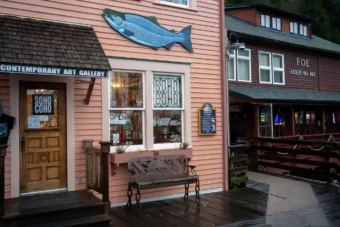
The Soho Coho gallery on Creek Street in Ketchikan. (Jack Darrell/KRBD)

Michelle Troll is sitting in the backroom of Soho Coho, her retail store and art gallery in downtown Ketchikan. Metal shelves all around her are packed floor-to-ceiling with T-shirts. A steady stream of visitors filter in and out of the store to take advantage of closing sales or just offer words of encouragement, gratitude and sorrow.

Michelle Troll got to Ketchikan in 1984. Her future husband, Ray, had been in the city for about a year.

“And I guess our paths just crossed,” Michelle said.

Ray had asked her to lunch.

“It was still late summer. The fish were spawning, you know. So there was love in the air v literally. I’ve always mixed all that stuff up in my art,” he remembered.

In many ways, the building blocks that would become Soho Coho were already in place.

“He was already working on his career as an artist. He was always an artist. I guess my education was visual communications. So it was just a good match,” said Michelle, who got her start working in the advertising department of the Ketchikan Daily News.

The Trolls opened their store in 1992 on the upper floor of the building it currently occupies – above the now-defunct Five Star Cafe. You walk over the wooden footbridge spanning Ketchikan Creek and there, next to a Chinese restaurant, is a light pink, two-story wooden clapboard building on stilts above the salmon stream.

The building, known as The Star, boasts an even longer and richer history. It was built in 1903 and held the title of the largest brothel in Ketchikan. The metal star inlaid into the floor of Soho Coho used to mark the brothel’s dancefloor.

“We moved in and opened our retail store and then we just kept going. Every year, at the end of the year we would say ‘Okay, we made enough money that we can do this again next year,’” Michelle recollected.

Over the course of Soho Coho, they’ve displayed the work of many artists, including Evon Zerbetz and Grace Freeman. They’ve also had over 100 different T-shirt designs that have been sold in shops across the country.

The T-shirts sport Ray’s artwork and are often related to salmon or the ecology of Alaska. Among many other places, they’ve been seen in the movie Superbad and been worn by Harrison Ford and Daniel Radcliffe.

While the cruise ship industry has been very good to them, the support of Ketchikan and Alaskans across the state have kept the Trolls in business.

“Our local customers who bring their families in and are here shopping through the holiday season and support us in the offseason, I mean, we couldn’t have done this without all of them,” said Michelle.

Ray always wanted to have a gallery. But he doesn’t take credit for the store’s operation. The Soho Coho is Michelle’s baby.

“It is her store,” he said. “Michelle has the business head in the relationship. I don’t have the business head. I do not have that. So really, it is Michelle that has run the business all these years.”

Both Trolls expressed gratitude for their employees, around 50 Ketchikan locals including all of their children at various points. Since the store is closing at the end of December, their names are written on 50 paper stockings hanging over a cardboard fireplace in the store. Michelle mentored them all.

Ray and Michelle Troll outside the Soho Coho with their fish. (Courtesy of Soho Coho)

She said that watching her employees grow in their post-retail careers has been a joy. She’s also watched her husband’s career grow with the store.

“I have to say that the Soho Coho has grown, along with Ray’s career, because Ray’s career has just blossomed and grown as he ages. And so we have grown with that,” Michelle said.

Closing the store also marks the end of another era. The Soho Coho is known for the bright neon sign hanging in the window and a large blue fish hanging above the door. When the wooden fish is taken off the side of the building, they have plans for it.

“It’s going to be set on an easel and then ignited because Ray always says everything’s cooler with flames.”

It’s true. He does say that.

“Everything ironically looks cooler with flames. You know, you want to make it look cool? Put flames on it. So I like the cool burning. So we’re gonna do a cool burning. And so Burning Fish,” Ray said separately.

“I just think for a sense of closure, and kind of ceremony and a sort of performance art thing,” Ray explained when asked why. “Because I’m an artist! I usually do weird performance art stuff.”

A sense of closure is important to the Trolls. According to Michelle, it may be a little more important for Ray though.

“This is not easy for him to walk away from,” she said.

Though the daily operations fell on Michelle and her crew, she said it acted as her husband’s public presence. A place synonymous with who they are. For Ray, the store was his stage. But sometimes it’s important to know when to draw the curtain.

“An old lesson in theater is leave them wanting. Before they want you off the stage, just leave the stage. So, for this part of the stage, it’s time to step off.”

The storeroom Michelle is standing in will still be the hub for their online store though which isn’t going anywhere.

A local artist, Evon Zerbetz, will be taking over the space as a gallery. The old brothel on stilts above Ketchikan Creek will continue its tradition of showcasing local artists as it enters its next chapter.

Get in touch with the author at jack@krbd.org.

Former Ketchikan church leader sentenced to 20 years for sexual abuse

Ketchikan’s courthouse and state office building, home to the local Division of Motor Vehicles office, is shown in 2020. (Eric Stone/KRBD)

Note: This story could be triggering for some listeners as it contains details of sexual assault. 

A former Ketchikan church leader was sentenced to 20 years in prison with 30 more suspended by a local judge last week, in a high-profile case of child sexual abuse.

Earlier this year, 72-year-old Dwight “Chris” John was charged with 14 counts of first-degree, second-degree and third-degree sexual abuse of a minor, as well as three related felony charges. John — once the congregation leader of Clover Pass Community Church — pleaded guilty to consolidated charges, and his sentence was handed down Thursday by Superior Court Judge Katherine Lybrand.

Lybrand said that the final sentence will protect the community. If John is ever released from custody, she said, he will be a very elderly man subject to strict probation.

Lybrand also recognized that the impacts to the victim and community were profound, and said her sentence appropriately accounts for that impact.

The victim’s father took the stand at sentencing. He told the court that family members have only just begun to fully realize the pain, sorrow, and damage John caused.

The victim, who is now a teenager, originally reported the abuse to their father. They said John had been abusing them since the age of nine. The father then reported it to Alaska State Troopers.

The victim’s father went on to explain that the faith leader’s crimes “tore apart their family and caused them to leave the state to start fresh elsewhere.”

According to John’s original charging documents, he told the child’s father during a phone call monitored by law enforcement that he almost decided not to take the leadership position because of the abuse. But he said he decided to because he felt God had forgiven him.

Note: Identifying details of the victim have been intentionally left out of this story as KRBD’s policy is to not to identify victims of sexual assault.

Site notifications
Update notification options
Subscribe to notifications