KRBD is our partner station in Ketchikan. KTOO collaborates with partners across the state to cover important news and to share stories with our audiences.

Ketchikan buses sit parked outside the Ketchikan Gateway Borough maintenance facility. (Eric Stone/KRBD)
A 91-year-old cruise-ship tourist is suing the Ketchikan Gateway Borough for negligence after his mobility scooter tipped over on a public bus.
The complaint was filed in federal court in Alaska on May 8. It says that Donald Gillingham of Montana and his wife were on a cruise that docked in Ketchikan in September. Gillingham has limited mobility, so they rented a motorized scooter and boarded a public bus.
The complaint states that the elderly man’s mobility scooter tipped over when the bus made a left turn. It also says that Gillingham sustained serious injuries from the fall, though he wasn’t aware of the severity at the time. It wasn’t until he returned to the cruise ship and was later evaluated at Bartlett Regional Hospital in Juneau that he found he’d allegedly sustained three broken ribs and a punctured lung.
Ketchikan’s public buses have internal straps to secure mobility scooters. Gillingham’s attorneys claim that because the straps aren’t mandatory, the driver didn’t require him to use them. The complaint claims the borough owes a duty of care to its passengers, which it neglected by not transporting Gillingham safely.
Gillinghams’ attorneys, Mark and Jon Choate declined to comment on the case in an email.
Ketchikan Borough Manager Ruben Duran also stated in an email that he’s aware of a potential lawsuit, but hadn’t been served any notice.
The complaint accuses the borough of one count of negligence and one count of loss of consortium. The loss of consortium is a charge filed on behalf of Gillingham’s wife, Patricia Gillingham, and alleges that the physical and emotional trauma her husband suffered has eroded the quality of their marriage.
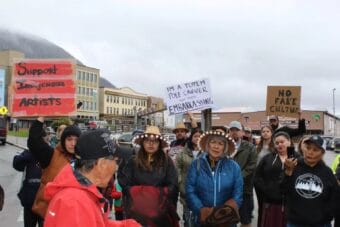
Demonstrators listen as Willard Jackson shares a story and song at a May 5 protest. (Michael Fanelli/KRBD)
Several dozen people gathered in the rain last week across the street from a coned-off Ketchikan property. They held signs saying “No Fake Totem Poles” and “Protect Indigenous Artists.” They faced a small construction vehicle sitting atop a pile of rubble spilling onto two carved, wooden poles.
Leaders from a number of Native groups turned out for the May 5 protest, including Rob Sanderson, 3rd Vice President of the Central Council of the Tlingit and Haida Indian Tribes of Alaska.
“The bottom line is that our people have come too far, too long to get to where we’re at,” Sanderson said to the crowd, gesturing over to the poles lying on the ground. “When I look at these poles, that’s a slap to the face of our local artists here in Ketchikan and abroad.”
At first glance, the poles resemble the art forms carved by Northwest Coast Indigenous artists for thousands of years. But in an interview with the Ketchikan Daily News, owner Joseph Machini said that he bought the poles from a non-Native Minnesota man named Carl Muggli in 2008.
In a bizarre twist, Muggli was later charged with murdering his wife with one of the 700-pound poles they crafted as part of their business. He eventually pleaded guilty to second-degree unintentional murder in that case.
Machini acknowledged that unfortunate history to the Daily News, and explained that he had sought poles from out-of-state suppliers because he wanted something done quickly, and “the Indians here were very busy.” Machini plans to have the imitation poles adorn five small kiosk shops where he will sell local arts and crafts.
Demonstrators at the Sunday, May 5 protest. (Michael Fanelli/KRBD)
Back at the protest, Willard Jackson, a Teiḵweidí Brown Bear spiritual leader, shared a story about respect before leading a song.
“This man doesn’t got any respect! Doesn’t have any at all,” Jackson said, referring to Machini. “It’s time we stand up and move forward as Native people! This is our land. It lives in our heart!”
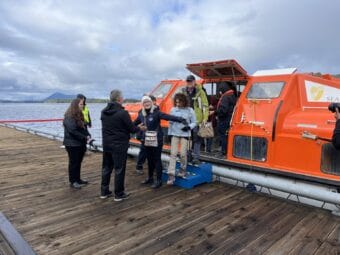
Machini’s property sits directly across from one of Ketchikan’s cruise ship docks, and a number of disembarking tourists stopped to watch the protest. Ketchikan Indian Community President Norm Skan said that demonstration was just the beginning.
“Because really, as I always say, somebody from Iowa getting off one of these cruise ships is not going to know the difference,” Skan said. “But we know.”
Skan said he appreciates the business idea of creating spaces to sell local goods, but the imported poles are a different story.
“We don’t want these fake poles here made by a non-native person in Minnesota brought to our community and put up in Tlingit land,” Skan said. “And I’m surprised that our local politicians would put up with that, it just don’t make sense to me.”
Demonstrators gather as passengers come and go from the Ruby Princess cruise ship behind them. (Michael Fanelli/KRBD)
In fact, one local politician did raise the issue at a Ketchikan City Council meeting days before the protest. Vice-Mayor Janalee Gage addressed her fellow council members during the citizen comment section.
“If we allow these poles to be raised, we will be no better than the individual who thought bringing those poles here that were carved by a non-native from Minnesota was okay,” Gage said. “This is appropriation at its finest.”
Gage cited the 1990 Indian Arts and Crafts Act, which prohibits the sale of products that are falsely marketed as being produced by Native artists.
“The owner may not be selling these poles, but he is selling an idea to those unsuspecting visitors, and our locals, that get off the ships,” Gage said. “They will think these are real, Native art.”
Gage requested a future agenda item to discuss what can be done.
City Manager Delilah Walsh has been looking into what potential regulation might look like to share with the Council. In a phone interview, she said the city works closely with Native organizations to promote authentic Alaska Native art.
“And we very much want to not only preserve, but to support not only that historic aspect of our local culture, but to respect what those items reflect,” Walsh said.
Walsh said that was the purpose behind the creation of the Totem Heritage Center, and its Native Art Studies program.
“It’s absolutely not acceptable for culturally appropriated poles to be surrounded with debris and treated as such,” Walsh said.
When it comes to the Indian Arts and Crafts Act though, Walsh said the law is really only aimed at fake items that are displayed for sale, whereas the Minnesotan poles are simply decorative.
A man poses in front of one of the imitation totem poles, holding a sign saying “I’m a totem pole carver, and that’s embarrassing.” (Michael Fanelli/KRBD)
Some residents are also concerned that the property owner has been drilling into the hillside to make room for the kiosk buildings. A busy, one-lane tunnel runs through that same hillside, and critics say the excavation endangers both the tunnel and the homes directly above it.
Walsh said Machini’s original building permit did not include permission to excavate, but once he was granted that, he obtained the services of an engineering firm which has been monitoring for seismic activity from the drilling. Walsh said thus far, the operation is structurally sound.
As far as what city management can do to intervene, Walsh said their authority is limited to building codes.
The city actually filed a lawsuit against Machini in 2015 for failing to remove the burned down structure of a building he owned on the same tunnel-adjacent property. But Walsh said that didn’t come into play when approving his current building permit.
“Simply because, building code does not talk about prior performance,” Walsh said. “So code doesn’t say ‘if you had a bad relationship or interaction with the city in the past.’ That’s not something that would be considered.”
The City Council will discuss its regulatory authority over the imitation totem poles at its next meeting on Thursday. Walsh said the Council could try to enact new regulations, but that may be difficult due to the First Amendment rights of private property owners.
Jordan Joplin is escorted out of a Ketchikan courtroom following sentencing on April 9, 2024 (Jack Darrell/KRBD)
A Superior Court judge sentenced a Washington man Tuesday to 99 years in prison for murdering a prominent Ketchikan surgeon.
Judge Michael Wolverton handed down the maximum possible sentence to 39-year-old Jordan Joplin for the murder, saying it was one of the most “brazen and craven” acts he’d seen in his 40 years on the bench.
The front row of the courtroom was packed with Eric Garcia’s family and friends. They wore shiny, maroon ribbons pinned to their chests.
Eric’s brother, Saul Garcia, was the first to take the stand.
He described Eric as a loving brother and skillful surgeon. He remembered being approached at a Mexican restaurant in town by a group of Spanish-speaking workers after Eric’s death. They said his brother had provided them medicine when they couldn’t afford it.
“They recounted how comfortable they felt to have access to a Spanish-speaking medical professional, that related to their culture. They were worried about the future of their medical care, as they didn’t feel comfortable speaking English,” Saul said.
Saul Garcia said in the six years since his brother’s death, the family has been swimming through a disorienting fog of grief.
“I felt guilty by not knowing Eric had been suffering from domestic abuse. How did I not not know that? How did I not pick up on it? Why didn’t I call more frequently?” He asked.
He then turned to Joplin.
“Joplin, you’ve made your decision,” Garcia said. “You have chosen your fate. I’m here today to seek justice for Eric and collect on all of your failed gambles. To ensure your unconscious wish of becoming imprisoned for life becomes a reality. I’m here for that.”
Eric Garcia’s sister wasn’t present in the courtroom but delivered a statement through District Attorney Mark Clark. She described their upbringing in a small town in Puerto Rico and Garcia’s life in Ketchikan.
“Eric didn’t have a lot of time for himself – he was working more hours than he could physically deal with,” she wrote, outlining the time when Joplin entered her brother’s life. “At this point in his life, he was very lonely, working many night shifts.”
Eric Garcia’s family and friends after Jordan Joplin’s sentencing. (Jack Darrell/KRBD)
She and Saul said that their brother was a romantic partner, friend, and protector to Joplin. During the trial, the prosecution presented evidence that Garcia had paid for Joplin’s child support, mortgage, and legal fees, as well as jointly leased a car to help Joplin build credit.
The only person who took the stand to support a lower sentence for Jordan Joplin was Blake Joplin, the defendant’s half-brother. He painted a different picture of Jordan. Blake said he met Jordan 13 years ago, when the pair were connected on Facebook. He said they have the same father but weren’t raised together. They eventually connected in person and Blake said that the brother he met wasn’t someone capable of murder.
“Jordan is loving. He’s just a generally really happy individual, very positive,” Blake Joplin testified.
The elder Joplin said he and his half-brother had talked regularly for 13 years.
Jordan Joplin was also given the opportunity to testify for himself, which he did through his attorney.
“Mr. Joplin has asked me to note that he acknowledges Dr. Garcia’s death and the effect it had on the family and Dr. Garcia’s friends and the community of Ketchikan and that he maintains his innocence of the crime,” defense counsel Lars Johnson read.
Prosecuting attorney Erin McCarthy asked for the greatest sentence possible though.
“The domestic, intimate relationship Mr. Joplin fabricated between himself and Dr. Garcia is not only a factor to consider, but it is as much the murder weapon as the poison Mr. Joplin ultimately used to kill the man who loved him. Perhaps the most horrific part of this crime is how Dr. Garcia wholly gave his heart to Mr. Joplin. While for Mr. Joplin, Dr. Garcia was disposable,” McCarthy said in her final comments, adding that the amount of malice and forethought in this crime was chilling.
Wolverton agreed. He paused for a long time before delivering his statements. He also disagreed with the defense’s position that the community impact shouldn’t be factored into sentencing in this case.
“The community condemnation both from this courtroom today, throughout the community of Ketchikan and all the way up to Anchorage and throughout Alaska calls for imposition of a significant sentence,” Wolverton said.
He then addressed Joplin directly, saying that his actions were inexplicable. “You had access to Dr. Garcia’s wealth,” he said. “He wasn’t withholding.”
The judge also gave him two years for the theft, to be served concurrently. As Joplin was fingerprinted and led out of the courtroom, Garcia’s family and friends cried and exchanged hugs with prosecuting attorneys.
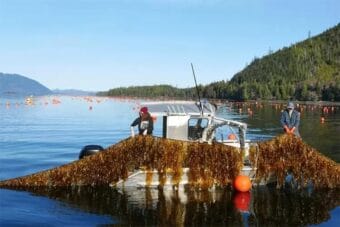
Seaweed farming with Seagrove Kelp Co. in Doyle Bay, near Craig, on Prince of Wales Island. (From NOAA Fisheries)
Aquaculture is a new, but rapidly growing industry in Alaska. That’s according to a recent report from the National Marine Fisheries Service, or NOAA Fisheries, on the state of Alaska’s water-based farming.
James Currie is an Alaska Sea Grant fellow who authored the February report. He said it’s meant to provide an approachable overview for curious non-experts.
“So there have been steady increases over preceding years in our production of oysters and seaweed,” Currie said. “And it’s a really exciting time for the aquaculture industry overall, just in terms of we’re receiving more applications on average year by year.”
Finfish farming is illegal in Alaska, so the primary species grown are shellfish like oysters or various types of kelp. The total pounds of seaweed harvested has ballooned in recent years, going from just over 18,000 in 2017 to nearly 900,000 in 2022.
But along with the excitement around the growing industry, Currie said there are a few notable challenges — what he called “fundamental bottlenecks.” Most of those involve a headache shared by many Alaska entrepreneurs: logistics.
Currie said oysters can be challenging to keep alive and ship long distances, and seaweed is primarily made up of water, making it extremely heavy.
“So one of the needs for the aquaculture industry is more industry to actually process that seaweed immediately as it comes out of the water and dry it down and refine it in some way, so that it is stabilized and easier to ship in large quantities,” Currie said.
Currie sees that as something that can be addressed on a community level, creating new business opportunities for locals to find collaborative solutions.
The report also provides easy access to the various funding opportunities available to Alaskans interested in getting into aquaculture.
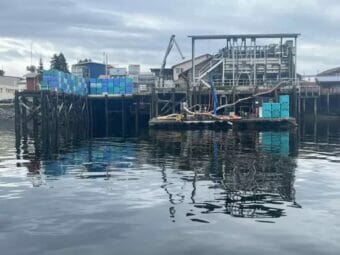
The Trident Seafoods processing plant in Petersburg. (Hannah Flor/KFSK)
Trident Seafoods, one of the largest seafood processing companies in the country, will finalize sales for three of the four plants it listed for sale late last year. According to Friday press release, the Ketchikan, Petersburg and False Pass plants all have buyers.
The seafood processing giant put four of its Alaska plants up for sale in December 2023, citing the need to reduce costs in a harsh global market for United States seafood.
Trident did not name who will buy the plants. A company spokesperson declined comment saying that both Trident and the buyers are bound by non-disclosure agreements.
It’s currently unclear what impact the sale will have on Trident’s fleet, employees, or the local communities. Trident’s vice president of Alaska operations, Jeff Welbourn, said in the Friday announcement that the company is trying to move as quickly as possible on the sale to minimize impacts on the upcoming salmon season.
Welbourn added that the deals are “simple, straightforward transactions” and expects the buyer to communicate with its fleets in the coming weeks.
The view of Ketchikan Creek from Park Avenue, upstream from the ledge where Henderson fell. (Photo by KRBD)
A well-known Ketchikan resident was sent to Seattle for medical treatment after he was allegedly pushed off a 30-foot cliff into a creek. The man’s name is Robert Henderson and in recent days, Ketchikan residents took to Facebook to express anger and sadness at the news that Henderson had died from the fall. Except that he didn’t.
“No, I’d be the first person to know if I was dead,” Henderson joked from his hospital room in Seattle. He says he sustained a few cracked ribs and a busted shoulder, but he’s alive.
Henderson was medevaced to Seattle following an altercation that took place in mid-February at the local homeless shelter. Ketchikan police say that, following an argument, another man attacked Henderson and kicked him off a cliff behind the shelter. Henderson fell roughly 30 feet into the bed of Ketchikan Creek below.
Henderson — who is tall and often sporting a beard — was affectionately nicknamed “Gandalf” by patrons of a local bar he frequents called The Asylum. That bar is also where the grim rumors started this week. An unnamed patron called the bar to share the tragic news about the man who could often be seen listening to music on the second floor.
Word spreads quickly in small-town Alaska, and soon enough, the grief and frustration of Ketchikan residents rippled outward and spilled onto Facebook. “So sad and shameful,” one community member wrote. Another expressed frustration at what they say is a rise in crime and decline in resources for homeless individuals in Ketchikan.
As for Henderson, he says he’s looking forward to returning to Ketchikan.
“I should be back next week. Full recovery, things are looking up,” he said.
Darian Bliss, the man who allegedly kicked Henderson, faces one felony count of second degree assault from the incident. Bliss’ trial is scheduled for May 13.
CLARIFICATION: A previous version of this story stated that the altercation in which Robert Henderson was pushed from the ledge occurred at the local homeless shelter. According to the criminal complaint, the incident occurred on a concrete ledge located behind the two local homeless shelters but not on First City Haven or PATH properties. Thus, the original cover photo for this story may have been misleading.
Close
Update notification options
Subscribe to notifications
Subscribe
Get notifications about news related to the topics you care about. You can unsubscribe anytime.