KRBD - Ketchikan

KRBD is our partner station in Ketchikan. KTOO collaborates with partners across the state to cover important news and to share stories with our audiences.
Body discovered in a bus owned by a missing Southeast Alaska man

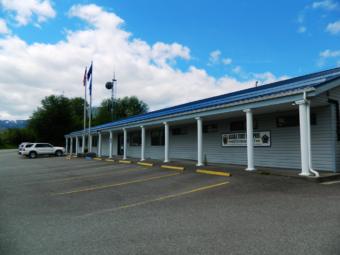
Alaska State Troopers station in Ketchikan. (KRBD file photo)

A body was found inside a bus in Saxman, just south of Ketchikan, over the weekend. The bus belonged to Thomas Nelson, a Saxman man who has been missing since October, but troopers have not yet been able to positively identify the body.

On Sunday, Alaska State Troopers say they detected a foul smell around the big white tour bus parked across from the Three Bears gas station. The bus has dark windows and rows of shelving blocking the view inside.

Troopers said the bus was locked from the inside, but they were able to force the door open. They found the body on the floor in the back of the bus. They said the level of decomposition made it “obvious” the body had been there for months.

The body was sent to the State Medical Examiner’s Office in Anchorage to be identified.

Thomas Nelson, the man that had lived in the bus where the body was found, was declared missing in early December of last year. Members of Nelson’s family were on scene when the body was discovered.

Lacey Nelson, the missing man’s niece, said she believes the body belongs to her uncle.

“We are devastated but also glad we have some closure,” Nelson said in a written message to KRBD. “Our family is sad it wasn’t discovered much sooner.”

The last time Nelson was seen was in mid-October, at the convenience store across the street. At the time, the manager of the Three Bears Fuel and Convenience told KRBD that Nelson came into the store, and their security tape showed him returning to the bus and then he “just vanished.”

According to his niece, most of Thomas Nelson’s relatives do not live in Saxman or on Revillagigedo Island. Kristie McDowell, another of Nelson’s nieces, said they had been requesting troopers search the bus for months.

Troopers said in an email that when Nelson went missing, they made multiple attempts to look inside the locked bus, but couldn’t see through the clutter that was inside. They said they didn’t have authorization to force entry into the bus back then, but were granted forced entry once it was suspected, due to the odor, that a deceased person may be inside.

An investigation into the death is ongoing, but foul play is not suspected at this time. Troopers are currently working to confirm the identity of the deceased.

Two members of a Washington family sentenced for selling fake Alaska Native art in Ketchikan

Alaska Stone Arts, one of the Rodrigo family’s stores, on Front Street in Ketchikan. (KRBD File Photo)

46-year-old Glenda Rodrigo and 24-year-old Christian Rodrigo pled guilty last month to violating the federal Indian Arts and Crafts Act. They were part of a scheme to pass off fake stone carvings and wood totem poles as traditional art made by local Tlingít and Haida artisans.

Cristobal Rodrigo, Glenda’s husband and Christian’s father, was sentenced in 2023 to two years in prison for his role in the scheme. Its still the longest sentence a defendant has received for any similar violation in the United States, according to the U.S. Department of Justice.

The Rodrigo family ran two storefronts in downtown Ketchikan – Alaska Stone Arts and Rail Creek. They were living in Washington state at the time. Rail Creek sold mostly wooden totem poles and Alaska Stone Art sold stone carvings. Both though were advertised as being made by Alaska Native master carvers and artisans.

But they were actually sourced from a business in the Philippines called Rodrigo Creative Crafts. The company in the Philippines was owned by Glenda Rodrigo. Its sole purpose was to use Philippine labor to make knock-off Alaska Native designs.
They were then shipped to the U.S. and the Rodrigo’s Ketchikan storefronts. The family even hired Alaska Native people to sell the art as their own. Federal prosecutors found that the workers told customers they were all one big family and made everything from locally sourced materials.

The stores operated from 2016 to 2021. In 2019 alone, after they’d unknowingly drawn the attention of federal agents, they sold nearly $1 million of the fake art.

Cristobal Rodrigo worked in the tourist trade for over 20 years before the family started Rail Creek and Alaska Stone Works. According to the Department of Justice, he went to the Philippines in the late 90s to teach the Filipino employees of his wife’s company how to imitate Alaska Native styles. He also handled most of the day-to-day operations in Ketchikan.

Glenda oversaw the Philippines operation from afar, and the affairs at both stores – though she only co-owned one of them with her husband. Cristobal was the sole owner of Rail Creek.

As for Christian, he worked as a salesperson and helped operate the stores.

Meridith Stanton is the Director of the Indian Arts and Crafts Board. In a written statement, she said that she hopes the sentences will send a strong message to those who may prey on real Alaska Native artists and vulnerable consumers.

She said: “Fakes and counterfeits, such as those marketed for huge sums of money by the Rodrigos, tear at the very fabric of Alaska Native culture, Native livelihoods, and Native communities.”

Glenda Rodrigo was sentenced to up to six months of home confinement and 240 hours of community service, and Christian Rodrigo was sentenced to up to three months of home confinement and 200 hours of community service. Plus, both defendants are required to serve five years of probation and write a letter of apology to be published in the local newspaper. The whole family is required to pay a little over $54,000 in restitution.

As mining project moves forward, Southeast Alaska tribes say Canada denies their human rights

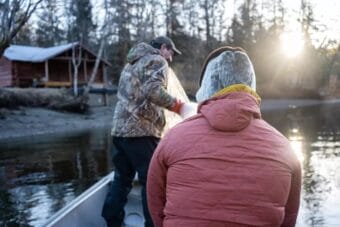
Tazia Wagner and Louie Wagner III cast a net for hooligan on the Unuk River. (Jack Darrell/KRBD)

When hooligan start running in Southeast Alaska at the end of winter, the Wagner family heads to the mouth of the Unuk River.

Tazia Wagner steers the skiff as her uncle throws a weighted cast net into the muddy water. He hauls up a net full of wriggling, oily little fish. They’re aiming to fill five five-gallon buckets. That’s their hooligan allotment under federal regulations for subsistence in the river. It used to be a lot higher, until the population collapsed around 2004. The Wagners blame that collapse on mining operations that started upriver in the 1990s.

After the buckets are filled, they take them back to the Melodee Dawn, the family’s old commercial seiner.

It’s docked near a rising sun petroglyph painted onto the rocks above the river. Tazia’s grandfather Louie Wagner says that sun is thousands of years old and is a family crest of their ancestors, the Tlingit brown bear clan, or Teikweidí.

“It’s not just fish,” Tazia says of her family’s legacy on the Unuk, and what’s at stake. “It’s a loss of cultural identity and a loss of connection to the land and to our people.”

To save what’s left of this hooligan run for future generations, the Wagner family helped form the Southeast Alaska Indigenous Transboundary Commission, or SEITC. It’s currently a coalition of 17 tribes with the goal of securing a seat at the table in how proposed mining projects are managed on Canadian soil if they directly impact watersheds in Alaska.

Louie Wagner, Jr. in front of the rising sun petroglyph at the mouth of the Unuk River. (Jack Darrell/KRBD)

In April, British Columbia’s ministry of the environment sent the SEITC a letter in response to their request for consultation on the Eskay Creek mine, a large gold mine at the headwaters of the Unuk. It was in production in the ‘90s but was eventually shuttered. The SEITC say the lower Unuk River is still recovering from the downstream impacts. Now, a Canadian mining company is in the permitting stage for reopening the mine. Skeena Resources, Ltd, the company in charge of the project, said the mine is “extremely high-grade” and could produce up to 2.8 million ounces of gold and 80 million ounces of silver in a little over a decade.

Guy Archibald, SEITC’s director, said there is a lot of administrative language about statutes and process in the letter, but the way he read it was simple.

“Different groups of Indigenous people, apparently, are only eligible for different levels of human rights,” Archibald said.

Essentially, the letter said that British Columbia is developing a process for consulting with US tribes that would be “distinct” and “differentiated” from Canada tribes.

Esther Reese, SEITC’s president, said it felt like a continuation of a “colonial divide-and-conquer” tactic. She said the tribes across the border were their neighbors and equals before their ancestral homelands were split by an international boundary, which now feels like a wound.

David Karn represents the Environmental Assessment Office of British Columbia’s Ministry of the Environment. He didn’t agree to a recorded interview but sent a long email response. Karn said in the email that the province’s goal is to honor the Canadian Crown and “act with good faith to provide meaningful consultation appropriate to the circumstances.”

Karn also said that the tribes across the Canadian border are interested in being part of deciding what that consultation for SEITC will look like. Those tribes include the Tahltan, whose territory encompasses the headwaters of the Unuk and Eskay Creek, the site of the proposed gold mine the SEITC are pushing back against. The Tahltan tribal government has publicly supported the mine.

Archibald said that time is not on SEITC’s side here. While British Columbia’s tribal consultation policy is being developed, Archibald expects Eskay Creek to go into the environmental application stage. That’s one step before a lease is granted.

“And so they kind of skipped over the whole idea that the Southeast Alaska tribes do have rights that need to be recognized,” said Archibald.

The coalition’s greatest leverage comes from the Desautel case, a 2021 Canadian Supreme Court decision that set the precedent that Indigenous people who live outside of Canada can be granted the same rights as those in the country if their traditional territory lay within what is now Canada.

“I think if we interpret Desautel, it’s very clear from the evidence we’ve submitted that we meet the threshold legal test for recognizing SEITC and its tribes as protected under the Canadian Constitution,” said Ramin Pejan, an attorney for Earthjustice, a nonprofit environmental law group representing the SEITC.

Earthjustice and the SEITC believe British Columbia’s policy is in direct opposition to the Desautel decision. And they have since been joined by the Lummi nation in Washington, who say that British Columbia is expanding a large port on a river that threatens their fisheries.

“Although this is an issue of Indigenous rights in which Lummi, Alaskan and many First Nations find common cause,” Lummi Nation Chairman Anthony Hillaire said in a prepared statement, “it also affects every person who lives here and who depends on the clean waters, the rivers, and the fish of this region.”

Meanwhile, SEITC and British Columbia are in the briefing stages of a potential case with the Inter-American Commission for Human Rights. The tribal coalition submitted a petition in 2020 accusing Canada of violating their human rights, including their right to a healthy environment on the Unuk River and the international commission accepted it for further review.

Archibald said the next steps for SEITC and the Lummi Nation are clear.

“We’re going to push back in every administrative way possible,” he said. “Is this eventually leading to a lawsuit? Very possibly. But we would like BC to do the right thing.”

Tazia Wagner holds a pair of hooligan. (Jack Darrell/KRBD)

Hooligan grease is made by fermenting and cooking down tons of hooligan. It’s an important food culturally for Tlingit, Haida, and Tsimshian peoples. Largely because, as Tazia’s mom Lee Wagner says, it’s delicious. She describes it as rich and fishy, like an umami butter.

The family called it “liquid gold.” But further up the river, there is real gold. And the Wagners say that’s the problem. It’s why they helped form the SEITC.

“We thought we were kind of alone in all of the effects of our subsistence and our cultural rights and our way of living being slowly stripped away,” said Lee Wagner. “But we’re discovering that we’re not the only ones, and that’s really, really scary.”

The five buckets they filled today won’t be enough to make grease.

“Not at all. Maybe a little drop,” Lee Wagner laughed.

But Tazia Wagner chimed in to say that the hooligan represent more than that. They mean ancestral rights, food sovereignty, agency.

She’s sitting in the captain’s chair of the Melodee Dawn, her grandfather’s chair. The evening view out the pilothouse windows was a pod of sea lions. Behind them, snow-capped mountains and the yawning mouth of the Unuk.

“It’s to feed, not only ourselves and our bodies, but also our souls, and to be able to share all of that with each other — that’s that connection,” she said. “It’s really, really frightening to think about how one day without any of this, how it would look for any of us, Native or non-Native. I don’t know what that is supposed to look like.”

Metlakatla seiner sinks near Canoe Cove

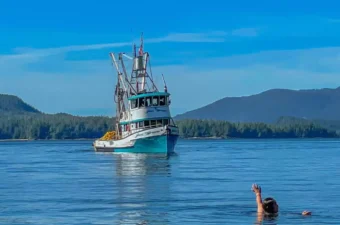
The F/V Jaci Grace. (Courtesy of Kylie Marsden)

A 52-foot seiner, the Jaci Grace, sank on June 30, just south of Metlakatla.

The Jaci Grace was on its second set of the fishing season and the crew were hauling gear near Canoe Cove, about a mile from the western shore of Annette Island.  That’s when the boat’s captain, Josh Marsden, noticed the boat was sitting lower in the water than usual.
He ran down to the engine room. The bilge was dry. It didn’t make any sense.

“Before I knew it, the boat was — the stern was down so far. There was no saving it, and so I had everybody jump in the skiff,” Marsden said.

The small skiff was tied to the Jaci Grace, which was taking on water fast, but they didn’t know from where. Then things took a turn for the worse. They released the skiff, but:

“The skiff line got caught on the stern, and everybody was in the skiff, and the boat started rolling over,” Marsden remembered. “Your skiff is your lifeboat. But when that gets caught on your boat when it goes down, you’re in trouble.”

TJ Jackson, who was running a boat that was fishing nearby, saw the whole thing. He acted fast and cut his skiff loose as the Jaci Grace listed to one side.

The Jaci Grace was built in 1945. She was a beautiful wooden seiner that went by three names in her life – previously the Shelby Dawn and the Esperanza. Marsden renamed the boat after his daughter Jaci, who was in the skiff with her dad and three other crew members when Jackson pulled them aboard.

TJ Jackson came over with his skiff and just got everybody off the boat safely before everything went down.

Terrifyingly, after the crew was pulled to safety, the Jaci Grace was pulled under, dragging the still-tethered skiff down with it. Marsden said the whole thing lasted two minutes max.

“It just happened so fast that there’s no time to get your survival suits on or anything when something like that happens,” he said. “I was fully prepared. I have everything on the boat, every survival suit, and we go through the drills and everything, but there’s no drill for that one, you know?”

Nothing came afloat but a couple jerry jugs and a cooler.

Marsden has been a skipper for 16 years and has been on a boat all his life. He said what he thinks happened was a plank popped in the rear of the old wooden boat – maybe the rudder post. With how quickly the Jaci Grace took on water, he said a large piece of wood coming dislodged is the only explanation. He’d prepared the boat for the fishing season, and tried to cover every base. But some things you can’t prepare for.

Marsden said if Jackson wasn’t nearby and hadn’t acted so quickly, what could’ve happened is unimaginable.

“Everything is replaceable but your life,” he said

But still, the Jaci Grace was Marsden’s pride and joy. He said when it sank 45 fathoms – or about 270 feet – it took everything he’s ever worked for with it.

“I did lose everything I owned on that boat,” he said.

The Triton, a Metlakatla search and rescue boat captained by Metlakatla Fire Chief Desmond King, responded after to take the rescued crew to shore. The U.S. Coast Guard followed them in and took a report.

In the aftermath, Marsden’s family and community mourn the loss of that old wooden seiner, the Jaci Grace, but are thankful people acted quickly to prevent a greater loss.

Invasive European green crabs are expanding their territory in Southeast Alaska

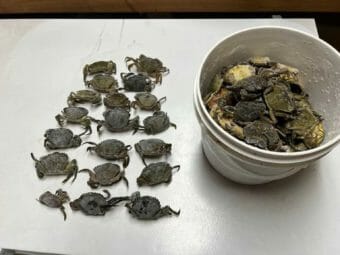
Twenty green crabs laid out in rows on a table, with a bucket full of green crabs next to them
European green crabs collected from Metlakatla’s Tamgas Harbor this week. The crabs were trapped in shrimp pots. (Photo courtesy of Dustin Winter).

Alaska Department of Fish and Game announced on Friday that shells of the invasive European green crab were spotted along the shores of Bostwick Inlet on Gravina Island near Ketchikan.

European green crabs have the potential to wreak havoc on commercial and subsistence fisheries in Alaska — the crabs are highly competitive and very hungry. They eat clams, oysters, scallops, other crabs and are known to rip up seagrass in their search for food. Fish and Game said that as a result, they can displace local crab populations like the Dungeness crabs in Bostwick Inlet. They can also decimate eelgrass and saltmarsh habitats, disrupt ecosystem balance, and cheapen overall intertidal biodiversity.

According to the National Oceanographic and Atmospheric Administration, they have even been reported in British Columbia eating juvenile salmon. The International Union for Conservation and Nature ranks them as one of the top 100 worst invasive species in the world.

Green crabs are believed to have first showed up in Alaska waters in 2022. That was when biologists with the Metlakatla Indian Community found the first evidence of the species, a handful of molted shells, on Annette Island.

The discovery of more molted shells on Gravina Island recently, a few miles across Nichols Passage from Metlakatla, marks the first time the crabs have been documented outside of the Annette Island reserve.

European green crabs were first reported on the Pacific coast in San Francisco in the late 1980s and have been expanding outward and northward since. In Washington and Oregon, the crabs have sabotaged a number of critical fisheries, and the states have spent decades trying to wipe them out, with no success.

Since the invading crustaceans were first discovered on Annette Island, the Metlakatla Indian Community has been doing damage control through a method called “functional eradication,” which involves trying to trap and kill as many as possible. Fish and Game said they’ve successfully thinned 3,000 of the crabs from local waters, including pregnant females which can lay hundreds of eggs. However, there’s no sure-fire way to eradicate the crabs once they’ve arrived.

Green crabs can sometimes be a misnomer — they can be several different colors. But Metlakatla’s tribal wildlife department has said one of the big giveaways is the five spines on either side of their eyes and three bumps in between their eyes.

Officials say if the crabs keep marching north, it could have serious effects on Alaska’s commercial and subsistence fisheries. They are asking people who think they’ve found a green crab or a green crab shell to take it to the nearest Fish and Game office, or take a photo of it and send it in.

For pictures or more information on the invasive crabs, you can visit the ADF&G website. You can also report sightings of European Green Crabs to the Invasive Species Hotline: 1-877-INVASIV. To submit photos and for more information about invasive species, contact: Tammy Davis, ADF&G Invasive Species Program coordinator: tammy.davis@alaska.gov or (907)465-6183.

Ketchikan’s main homeless shelter is shutting its doors for good

After two years operating out of the city-owned Park Avenue building, First City Homeless Services announced on June 10 that the organization was shuttering. (Michael Fanelli/KRBD)

Ketchikan’s main homeless shelter, which had recently been serving more than 200 participants, will close for good this week. The surprise announcement came from First City Homeless Services, the organization that runs the shelter. The organization shared a letter Monday from its board of directors, saying that after 16 years of operation, they’re shutting down.

In the letter, the Board wrote that “continual obstructive behavior” from the Ketchikan City Council led them to the decision.

CEO Deborah Asper said from the time they moved into the city-owned building, they have struggled to keep up with shifting expectations.

“Just constant, you know, ‘Do this, you’re doing this wrong, do this,’” Asper said. “I mean, from what door we enter into, to calling the fire marshal on a building that their departments developed, to the City Council members coming into the building and telling me that I was going to get fired.”

The city had requested that the shelter begin offering 24/7 services and invited them to move into the Park Avenue building, which they did in August 2022. But the building’s proximity to both businesses and neighborhoods quickly created tensions with the community, which Asper has acknowledged.

The group then found a new location, the old VFW building, which they planned to renovate. That new building wouldn’t have been ready for move-in until at least 2026. And back in March, the City Council voted to end the shelter’s lease at its current location this July.

Asper said they looked for temporary relocation options, but couldn’t find anything available to meet their needs. She also said the Board does not want to go back to “warehousing,” or giving people a place to sleep without providing supportive services.

“So you’re keeping them alive to just live this marginalized existence. Rather than keeping them alive, and then working with them to move out of their current situations,” Asper explained. “That model is no longer funded. That model is no longer used. It actually perpetuates all of the issues surrounding homelessness.”

Asper developed a three-tiered model of work and life-skills training for her participants, which she said has been hugely successful, exceeding their own expectations. In the letter, the shelter’s Board said that the model could have effectively addressed Ketchikan’s homelessness needs, but the city “is not yet ready to be a leader in this sector.”

The organization will be ending its operations by this Friday. It’s unclear what will become of their hundreds of participants.

Site notifications
Update notification options
Subscribe to notifications