KRBD - Ketchikan

KRBD is our partner station in Ketchikan. KTOO collaborates with partners across the state to cover important news and to share stories with our audiences.
Sen. Bert Stedman says he’s confident education funding will survive the governor’s desk

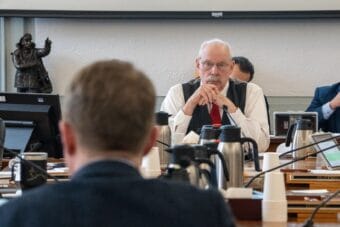
Senate Finance Committee Co-Chair Sen. Bert Stedman, R-Sitka, listens to testimony from Alaska Department of Transportation and Public Facilities Commissioner Ryan Anderson on Feb. 28, 2024. (Eric Stone/Alaska Public Media)

Alaska legislators concluded their session last month and passed a budget that included a one-time increase in education funding of about $680 per student. That budget has yet to be signed by Gov. Mike Dunleavy, who could decrease the amount like he did last year.
That uncertainty has left school districts like Ketchikan’s to make drastic cuts to staffing and activities while they wait to find out how much state funding they’ll receive. Sen. Bert Stedman, who Co-Chairs the Senate Finance Committee, plays a key role in determining the state’s budget and said he expects Gov. Dunleavy to approve the full school funding amount.

The Sitka Republican represents a wide swath of Southeast, including Ketchikan. He spoke with KRBD’s Michael Fanelli while in town May 29.

Listen:

This interview has been lightly edited for length and clarity.

Michael Fanelli: So looking back on this session, from my perspective from Ketchikan, it seemed like the biggest issue was around education funding. And I know you got that big bipartisan bill through early in the session with the intent of having schools know where they stood on education funding early on in the year, so they wouldn’t end up where they did this year, not knowing how much funding they’d have. So I wonder if you can just reflect on that process. Were you caught off guard by Governor Dunleavy’s veto of that bill?

Bert Stedman: No, not at all. The Senate’s been focusing on 680, $680 BSA increase for two years now. So when we started this year, we had that in the previous budget 680. And my duty this year was, I was in charge of the operating budget in the Senate. So I included that on day one, and planned an entire budget with that in it, 680, which is about, almost $175 million dollars increase. And then I have communication with the superintendents on the likelihood of that materializing. So, it turned out to be highly likely the 680 is going to stick and not be vetoed. I’d be very surprised if it’s going to be vetoed at all.

As far as when the timing is, it’s just the way the structure is. The effect of the appropriation is when the governor signs it, and that takes effect July 1. I recognize the timing issue of, that superintendents have, notification due to their contracts with their employees, but that just comes with the territory. There’s little likelihood that that’s going to change. But hopefully, other superintendents are getting information from their elected officials on where they think the BSA will land for the year so they can plan their budgets.

Michael Fanelli: Yeah, just listening to the conversations at the School Board level, there was a lot of reluctance to presume that a certain amount of funding was coming. And I think to this day, the budget that they’re assuming is assuming no increase in the BSA amount, because I mean, they saw what the governor did last year, cutting it in half. And how could you be certain that the money was coming until it’s on the table, right?

Bert Stedman: Only certainty is death and taxes. But there’s a reasonable expectation of the ending dollar amount. It wasn’t going to be the base, the statutory BSA number, in other words, a zero increase. He wasn’t going to cut it $345 from last year, that would be an actual reduction. He could, and he would risk, most likely, more pressure on a veto override.

Michael Fanelli: Do you think there’s any better outlook of getting a permanent BSA increase passed next session?

Bert Stedman: So when you refer to permanent, that’s a statutory number. I would say yes, the 680 is pretty much the floor, from what I can see. So there’s no reason not to change the statutory formula to, in effect, absorb that 680. I would be surprised if we reduced it at all from that next year.

Michael Fanelli: Yeah, when the governor was asked about why he didn’t support that original bill, he said things like, he wanted to see overall education reform before that permanent BSA increase happened —

Bert Stedman: Benchmarks, performance benchmarks, he wants a list of other things.

Michael Fanelli: When it comes to salaries, he talks about bonuses.

Bert Stedman: I don’t tie all that stuff together, personally. That’s the governor, right. I mean, he has a different role than I do. So looking at it from the budget perspective, it was pretty clear to me that the BSA needed to be moved several years ago. And I think if you go back and look at some of the discussions here, probably could go back maybe even as far as four years. So this pressure has been slowly building. And we just need to deal with it. The Senate was steadfast on 680, it didn’t matter if there was the veto votes to override it or not. That was the number in the budget. I put it in in January and built all the remaining budget components with that included on the operating budget.

In my opinion, we should just change the BSA and move on. We got other things to work on. We have to raise our algebra scores and our math scores and our reading scores and we have housing issues and transportation issues with education. We have lots of things that we can spend some time on versus just squabbling about a formula in a statute. We need to move on and work on some of these other issues.

Housing is a big, big issue across the state. Particularly in Western Alaska, but even in Southeast it’s a big issue. Bring in an entry level teacher and have them try to afford housing and have them ever hope to own their own home, it’s questionable.

Michael Fanelli: Is there anything that the state can do to help the housing issue?

Bert Stedman: Yes, one of the things we did this year in the budget. It’s a new pilot program, there’s $4 million that goes to [Alaska Housing Finance Corporation], and they will act as the referee. And they will allocate that money as needed between the University’s land division, DNR, Department of Natural Resources and their lands, and [the Alaska Mental Health Trust] and their lands, on their subdivisions.

Say the university has some land and they want to do a subdivision. Say it costs $2 million to put the road, water, and power in. And they won’t do it because they’re not gonna make any money, because the cost of putting the utilities in consumes all your sales of your land. So they can go to Alaska Housing and say they get a million dollars from Alaska housing, now they only have a million dollars invested in the subdivision. Then the return rate goes up, right? Then they want to go subdivide it and do the development because they’re making money. And then the question is, how does Alaska Housing get a couple pennies back so they can do another project? And that would be, the property then would go on the tax rolls. And part of the property tax, maybe half of it for ten years, or all of it for five years or whatever would go back to Alaska Housing.

Michael Fanelli: How would you say that this session went for your district at large? Were there any notable capital projects that you got approved for this region?

Bert Stedman: Well, let’s just back up a little bit. So when we look at the last several years, we had no district projects to speak of. They were all just state, mostly state projects, off of major maintenance lists and state agency issues, and so on and so forth, because the budgets were so tight. This year, we had the opportunity with the revenues in oil prices that we had some funds for individual legislative districts that we can move around. So there was, gosh, I don’t know, $3.6 million I think in the Senate district I had to sprinkle around. So we put some money in the ball field here for bleachers, some $700,000.

Michael Fanelli: The new Walker Field, is that what you’re talking about?

Bert Stedman: Yes. And then the building, that veteran’s building that burned down.

Michael Fanelli: Oh, the Legion.

Bert Stedman: Yeah, the American Legion building, we just drove by that. So the American Legion was kind of high on the list along with the ballfield. The Legion mainly because it was arson, and they burnt the building down and that needs to get replaced. That was pretty much an insult to all our veterans. And then I’ve been trying to help with that ball field for years. Since we built the one in Sitka, we were gonna get the one built here. And then we ran into budget constraints from deficits, and then COVID, and so on, and so forth. So we finally got to the point where I could help a little bit and the community had already moved forward. And so I had to get on the bandwagon or get left behind. So I want to see the build out of the covered bleachers and participate in that field. So those are the two bigger things in district, that’re small in the scheme of a lot of things, but they make a big impact on our community.

Another issue we’re working on, the Railbelt from basically Kenai up to Fairbanks needs to have their major infrastructure upgraded on their Intertie. Well, they need votes, right? And that’s coming next year, we’re working on a bond package to facilitate that. So we’re looking at trying to build some of our electrical generation and distribution in this district out and attach it to and network it with their desire to move their Intertie forward. So we’re looking at another turbine, in the SEAPA grid, along with plugging into cruise ships. So we’ll be working on that. Also, I need to have some conversations with City Hall on the local electric utility to see if we can help there with some of the maintenance issues there.

Michael Fanelli: The Ketchikan electric utility?

Bert Stedman: Yes. So when the Railbelt is on board for a big, almost billion dollar infrastructure upgrade, they need votes. Well, I need projects. So therein lies the art of the deal, right? And the next couple years, we have a really good opportunity to move our electrical infrastructure forward with both generation and distribution, recognizing the recent news of the utility here in Ketchikan having some challenges. I think that’s momentarily. We’ll work through that issue. And we are in a unique position in Southeast that we have renewable hydro, and we should continue to expand that and minimize our reliance on diesel generation as much as absolutely possible. And I’m looking forward to trying to get another turbine in line between here and Petersburg on the SEAPA grid.

Michael Fanelli: A hydro turbine?

Bert Stedman: Mhm.

Michael Fanelli: I should follow up on that, because you mentioned our electric utility and grid situation here. Do you think that’s something that the state could potentially help with?

Bert Stedman: I’m gonna meet with City Hall this fall and kind of go through some of that issue with them when we look at electrifying the cruise ships and some more grid expansion between Metlakatla and Kake, which would include Ketchikan, Petersburg, and Wrangell up the corridor. And have that dialogue to see what the state can possibly do to assist in that. Clearly, if we’re going to put more generation on the system and more load, we gotta have the rest of it not blow apart in the meantime. So there’s always something to do! That’s a new challenge for us, but we’ll work through it and we’ve fixed other things before and we’ll fix this one too.

Michael Fanelli: Alrighty.

Bert Stedman: There’s one question that was asked in an earlier interview in Petersburg about the student lunch program.

Michael Fanelli: Oh, yeah.

Bert Stedman: And the way it was put together was, I thought, not as clear as it should be. Because when I listened to the story, it sounded like we, in the legislature, or in the Senate, decided we weren’t going to fund school lunches, free lunch program was eliminated. And it wasn’t eliminated at all. That’s the furthest thing from what went on.

So during COVID, the federal government came in and they had free lunch for everybody, all the kids. And the state isn’t going to backfill all the COVID money, so when the COVID money ran out, we reverted back to the standard practice on free lunch. So if you’re at 130% of the poverty rate or below, you have free lunches. And you have a reduced price if you’re between 130% and 185% of poverty. So there was an amendment on the floor of the House that would have taken funds from the Department of Corrections, which, we have to feed our prisoners, and make a free lunch program, backfill the COVID money. So when we put the budget together at the conference committee, we removed that out of the final budget.

If we want to have a discussion on having free lunch for everybody in K-12, that’s fine. We can have that through the budget process. But you don’t put an amendment on the floor of one of the bodies and take money out of another entity, leaving a hole that you just created to fund something else. You have to have a balanced budget. You don’t play those games. But if you are a low income, or no income family, the last thing the state’s going to do is starve our kids in school. That’s not going to happen. Because if they don’t have a good meal, breakfast and lunch, they won’t learn in school.

Michael Fanelli: I’m curious how you feel about the state of the budget. Do you think the way that the budget is working currently is sustainable into the future? I mean, do you see oil prices staying at a point that can keep us going for a while? Or will we need some other revenue source at some point?

Bert Stedman: Oh taxes? No.

Michael Fanelli: I didn’t use the “T” word.

Bert Stedman: I don’t think — at this point, we don’t need them. This budget is built on $78 [per barrel], and we’re in surplus. If the budget numbers come in, and we’re in the low 80s, there’ll be an extra dividend in a year, energy assistance dividend. In the price range we’re at with oil, we’re okay. If oil goes to 50 bucks or 60 bucks, we got a problem. It’s hard to predict what oil prices are, you know, it’s like predicting the world economy, wars, and so on and so forth. And recessions, you know they’re coming, you just don’t know when. So we’re in better shape now than we were the last several years, and we’re slowly getting better. We’re building up our savings a little bit at a time. We got about two and a half billion [dollars], roughly in our main savings account. The Permanent Fund is healthy. It’s got some challenges, but it’s not in any imminent danger of blowing up. There’s 80 billion [dollars] sitting there.

Michael Fanelli: I want to talk a little bit about the PFD. When it comes to budget stuff, I know it’s a hot topic, something people are passionate about. I think you settled on a number around $1600 or so with the energy relief right? Do you feel that you landed on a good number for this session?

Bert Stedman: Yes. The Senate’s had a position since around 2017, that we should have a 25% dividend. That’s a quarter of the 5% payout. And when we looked at the financial projections of the Permanent Fund in the state, that seemed to be a targeted number that was deliverable. It’s not in a perfect world on every scenario, but it was reasonable. And at 50% of the 5% payout, the state’s gonna go broke. It doesn’t work. You’re dealing with almost a billion dollars extra in payments. And then when the number goes even above that, to the current statutory formula, it’s about 40 years old, it’s even worse. You’d run the place out of money, literally. And that debate has kinda died down the last few years. Because even the ones, the folks that want to have a bigger dividend, realize that they can’t do it, it’s undeliverable. State can’t maintain it.

So I think a lot of the wind has come out of their sails, there’s been numerous people around the state that have got elected to office on that very platform, a big dividend. But at the end of the day, you have to run your school system, you have to have prisons, you got to have courts, you got to have a DOT for airports and roads, you got to have a Fish and Game. You’ve got all these agencies, you have to run a state and it costs money.

Michael Fanelli: But you’d like to see that that formula changed?

Bert Stedman: Yes, to 25%. We had very little debate on the dividend this year.

Michael Fanelli: Yeah it seemed like it, especially compared to previous years.

Bert Stedman: Right, because they’re realizing that we could produce a $1,360 dividend this year, and take care of a lot other issues, [like] school funding, deferred maintenance of schools, some of our road issues, even be able to help a little bit with things like with the Legion and ball field bleachers and little things like that. A few years ago, we couldn’t even do that. So we are making progress.

Ketchikan man agrees not to raise fake totem poles carved by convicted murderer

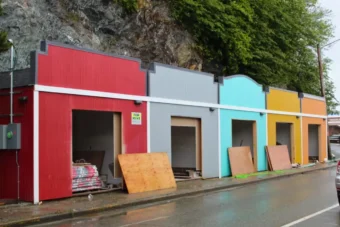
Construction of Joseph Machini’s Ketchikan shops at 420 Water St. appeared nearly complete by Monday, June 4, 2024. (Michael Fanelli/KRBD)

The owner of a prominent downtown Ketchikan property has agreed not to raise inauthentic totem poles carved by a convicted murderer next to his new shops. After meeting with leaders of the region’s Indigenous communities, Joseph Machini also agreed not to use the name “potlatch” for his marketplace.
The 420 Water St. property, which sits directly across from the docks where cruise ship tourists disembark, has been the subject of protest for more than a month. Residents voiced concern over the initial hillside excavation, but the leading concern was with the two large, totem-like poles that had been lying on the property until recently.

Vice-Mayor Janalee Gage raised the issue at a Ketchikan City Council meeting on May 2, calling the poles an affront to the Native community because they were carved by a non-Native man in Minnesota.

The controversy was further fueled by reports that the carver had been charged with murdering his wife with another pole that they were working on together, as part of their shared carving business. In interviews with the Ketchikan Daily News, Machini confirmed he bought the poles from the Minnesota carver in question, and that the murder happened some time after his purchase.

But on Monday, Native leaders announced that they had met with Machini, who apologized and promised not to use the contested poles on the property. Norm Skan, president of the Ketchikan Indian Community, said this was the outcome they were hoping for.

“And he really, he felt bad about it. And he understood it,” Skan said. “And he agreed to reach out to the people that he met yesterday, and to start following our protocols on what would be acceptable or not.”

Skan said he appreciated Machini’s willingness to meet with them, and that they accepted his apology.

“I really respected him for coming into what could have been an extremely hostile environment and just sitting there and listening,” Skan said.

Skan said he and other leaders intend to hold Machini to his word, and that they’ll continue seeking out ways to prevent this from happening in the future.

KRBD was not able to reach Joseph Machini for this story.

Independent Rep. Dan Ortiz withdraws from House District 1 race

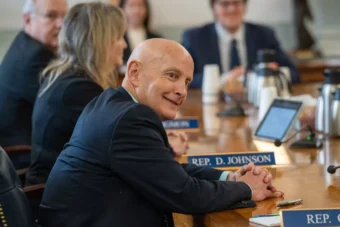
Rep. Dan Ortiz, I-Ketchikan, sits at the Senate Finance Committee table in the Alaska State Capitol during a conference committee meeting on May 14, 2024. (Eric Stone/Alaska Public Media)

Ketchikan Independent Representative Dan Ortiz will no longer seek reelection to his House seat this fall.

Alaska House District 1 covers Ketchikan, Metlakatla, Saxman, Wrangell, Hyder, and part of northern Prince of Wales Island. Ortiz is a former Ketchikan High School teacher and coach, and has represented the district since 2015. He filed for reelection in July of last year.

Ortiz said he chose to end his campaign for the long-held seat due to family considerations and health concerns. Specifically, he received a doctor’s recommendation to curb his stress.

“I could continue to run and I can continue to serve. But, you know, with some of the revelations through some blood tests and things like that, there’s a potential for a chronic condition to develop that I don’t want to develop,” Ortiz said.

Ortiz said it was not an easy decision, especially when there are important issues that he feels are left unfinished – like securing more funding for public education and the marine highway system.

“You’re never going to get everything settled the way you want to see them settled, no matter when you go out of office,” said Ortiz.

Ortiz’s withdrawal from the race leaves Ketchikan Republican Jeremy Bynum as the only remaining candidate, with just days until the filing deadline. The deadline to file as a candidate is Saturday at 5pm.
In a statement sent to KRBD, Bynum said he respected Ortiz’s “many years of service to the District” and that he plans to continue conversations with Ortiz “when the time is right.”

Two other Ketchikan residents have expressed interest in the seat. Republican Robb Arnold entered the race in December but withdrew his candidacy in February. Ketchikan Borough Assembly Member Grant Echohawk also filed a letter of intent to run as an independent, but then called off his campaign before officially filing as a candidate.

It’s unclear if anyone else will join the race before Saturday’s filing deadline.

Ortiz plans to finish out his term as District 1’s representative in the house, which expires January of 2025.

You can listen to more of Rep. Ortiz’s conversation with KRBD about exiting the race, reflections on his decade-long career in the legislature, and the issues he thinks are important coming out of the 2024 Alaska legislative session here:

State prosecutors sue Ketchikan jeweler over sale of fake gold

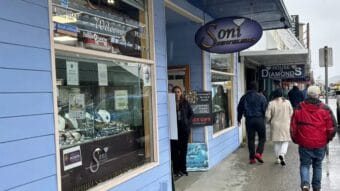
The storefront of Soni Jewelers in Ketchikan on May 23, 2024. (Jack Darrell/KRBD)

A jeweler that operates two storefronts in downtown Ketchikan is being sued by the state for allegedly selling fake gold.

Attorney General Treg Taylor filed the suit Thursday against Soni, Inc., which owns Soni Jewelers and Colors Fine Jewelry, as well as an outlet inside Tongass Trading Company. The two stores are in the heart of downtown Ketchikan, directly across from the cruise ship docks.

The complaint also names the company’s director, Sunita “Soni” Lakhwani. In response to a request for comment, KRBD was told that Lakhwani was out of town and unavailable.

Assistant Attorney General Ian Engelbeck said state investigators made a series of undercover purchases from the storefronts, which sell Alaska-themed jewelry during the cruise ship season.

“In mid-September, our undercover investigator made a purchase, (which) was represented to her as a gold quartz ring with gold quartz mined in Alaska,” Engelbeck said. “We determined that we believed it was imitation, and we applied to the superior court in Ketchikan for an impound order.”

They received that impound order, which allowed authorities to confiscate 10 pieces of jewelry from each store. The state said they tested them in a lab and found them to be man-made “gold nuggets” and “gold quartz” from out-of-state suppliers.

According to the complaint, Soni, Inc. was passing this imported fake gold off as natural stones and nuggets mined in northern Alaska and handmade into jewelry by mostly Ketchikan-based jewelers. Salespeople also allegedly told the undercover investigators that natural gold quartz only occurs in Alaska and can only be legally purchased in Alaska, which is false.

“In addition, Soni Inc.’s salespeople point customers to elements of Soni Inc.’s jewelry that appear to be gold nuggets and proclaim that these are 24 karat Alaska gold nuggets,” prosecutors said in the complaint. “In fact, lab testing and the inventory control tags on many of these ‘nuggets,’ including ones that undercover investigators were told were 24 karat Alaska gold nuggets, show that they are actually imitations made of 14 karat gold shaped to resemble a natural nugget.”

One of the people in the store allegedly making false claims to undercover investigators was Lakhwani herself. The complaint said that when questioned by investigators, Lakhwani admitted that she wasn’t sure where the jewelry was made but did know that the stones weren’t from Alaska, as advertised. One Soni Jewelry employee allegedly told investigators, “(E)verybody thinks that’s from Alaska. So if the customer asks ‘it’s from Alaska?’ I’ll probably say ‘yes’ . . . But the piece comes from L.A.”

“These cases are important because it obviously hurts tourists who think they’re buying a genuine article,” Engelbeck said. “It also hurts businesses and Alaskan communities that are trying to do right and sell the real thing and it hurts Alaskan artisans who make the authentic thing and having imitation goods sold as real squeezes the real thing out of the market.”

State prosecutors asked the Ketchikan Superior Court to enter a temporary restraining order to prevent Soni, Inc. from continuing to sell fraudulent and misrepresented products. As of Tuesday afternoon, the storefronts downtown were still open and operating for the tourist season.

Inside Kasaan’s preparations for 250-mile canoe voyage to Juneau for Celebration

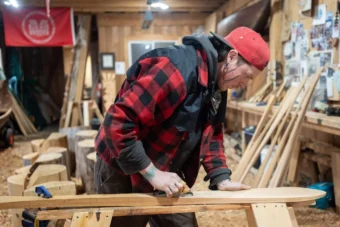
Eric Hamar hand-planes a paddle in Kasaan’s carving shed. (Jack Darrell/KRBD)

Inside Kasaan’s carving shed in early May, Eric Hamar is hard at work.

Hamar is a Haida artist and carver, and he spends his days carving in the workshop in Kasaan, a small village of about 30 people on Prince of Wales Island. The thick smell of cedar in the air, Hamar’s surrounded by canoes, paddles, a half-carved totem pole, and tools.

On this particular day, he was busy getting ready for Celebration, the huge every-other-year gathering of Indigenous people in Southeast Alaska. The event lasts four days and is the largest gathering of Lingít, Haida, and Tsimshian peoples in the world.

Hamar’s preparation for the festival is a little more involved than packing socks and a toothbrush. His task at hand was planing wooden paddles.

“Planes are kind of interesting because they’ll chirp,” he said, as he ran a hand-planer tool down the length of the paddle, laughing at its dullness. “But when they’re really sharp, and you run down a piece of wood it goes ‘chirp’ like a bird, which this one is not doing.”

Hamar is part of a group that’s making a 10-day, 250 mile journey from Kasaan to Juneau, where Celebration is held, in canoes they carved themselves.

According to Hamar, paddles aren’t his favorite thing to work on.

“I like three dimensional stuff a lot more,” Hamar said.

There’s also a large totem pole sitting on saw horses in the corner. He’s been working on that for about a year. It has three watchmen on the top and below that, the beak of a raven juts out.

“[It’s] more exciting for me as an artist,” Hamar said of the totem. “But you know, there’s something beautiful about the simplistic nature of something like a paddle as well.”

Across the room, there is a stack of rough pieces of wood carved into a paddle shape, waiting to be sanded.

“It’s pretty exciting to be going on this journey for the first time in our own canoes from our own community and meeting up with a lot of other communities on the way,” Hamar said as he worked. “I think, hopefully, it’ll bring a lot of inspiration to the people and hopefully get some folks excited about maintaining the traditions.”

Twenty-six paddlers were set to depart Kasaan in three canoes. The group is all ages.

“Well, the youngest has to be six months, because that’s my baby,” Hamar laughed.

The carver’s whole family is with him on the voyage — his mom and dad, sister and brother-in-law, and his wife and two daughters. One of the girls is six months old and the other is almost six years old.

The outside of Kasaan’s carving shed and tribal hall. (Jack Darrell/KRBD)

To get to the village of Kasaan, you turn off the main route that spans Prince of Wales Island and then follow a dirt and gravel logging road for nearly an hour through dense forest and timber operations and then, suddenly, there it is.

To bolster the group, some paddlers will be coming to join them from other communities all over Southeast Alaska, and according to Hamar, a couple as far away as Seattle.

They plan to make stops in Thorne Bay, Coffman Cove, Wrangell, Petersburg and then camp the rest of the way up the coast to Juneau.

There is an 18-foot canoe hanging in the shop. Hamar said that wasn’t one of the ones headed to Celebration. It wasn’t ready yet. The wood of the canoe fanned out but then curled back in on itself like a flower that hasn’t bloomed. Hamar said it needed to be steamed.

“Basically, you just take it down to the beach and you start a big fire and you put a bunch of rocks in the fire. And then you fill [the canoe] up with saltwater. And then you put the hot rocks in there until it starts boiling and cover it with a tarp. And then it just kind of naturally falls open as the wood heats up,” Hamar explained.

Once it’s steamed, the carvers will prop the hull open with sticks so it holds its shape as the wood cools. Eventually, the seats and crossbars — called thwarts — are what will keep the wooden canoe in shape.

Finally, strips of wood are steamed in and riveted to the sides to act as ribs.

“That’s kind of the last step before finishing it with oil and paint or whatever you’re doing,” Hamar said.

Since the canoes are one large piece of wood, they’re prone to becoming overly dried out and splitting. Hamar paints the bottoms with tar to lock in the moisture.

Hamar said making a canoe is a long and difficult process. In his 20 years carving with his dad, he had built just the three hanging in the shed. He said that’s because it’s hard to find the perfect piece of wood. Plus, they aren’t something you can easily sell.

“So then the person who might be using it isn’t actually going to be able to afford it, unless it’s being sold as an art piece, which kind of isn’t the point, right?” Hamar explained, adding that the canoes require a lot of maintenance. But back in the day, people depended on them to get around.

“You [probably] would have had the time to take care of it. It was important,” Hamara said. “It’s now important in a different way, I think. It’s important for the culture and ceremonial use more than anything.”

Eric Hamar inspects the hull of one of his canoes. (Jack Darrell/KRBD)

That’s not to say that the vessels are strictly ceremonial though.

“This one is covered in pine tar, and seal oil, and blood and guts, and it’s pretty beat up and that’s why I like it,” Hamar said, pointing to a canoe he and a friend had used the previous weekend to catch a 250-pound seal. “It looks good that way! Looks like it gets used, because it does.”

Hamar’s work was interrupted by a group of students from Klawock filing into the shed. They were there to learn about sustainable harvesting and the important sacrifices that trees and animals make to provide for them.

“When we’re talking about something like a totem pole, we have to make sure that we’re not only looking after the ones that we cut down and doing a good job to make sure that — that’s why we make them look really pretty,” Hamar told the kids, gesturing at the totem pole next to him. “And you don’t want to kill something and have it just go to waste.”

Hamar isn’t just a carver. He said he loves the carving shed and his work teaching people the traditional ways. But he said that culture and artists should evolve, as well. In his free time, he is working on an art piece commissioned by the Anchorage Museum.

Celebration kicks off June 5, and Hamar had a stack of paddles to finish before his group would head out in late May. They were scheduled to launch on Saturday, May 25.

Klawock hopes for an economic boost as it welcomes cruise ships for the first time

Tourists being ferried from the Seabourn Odyssey to the Port of Klawock during its May 6, 2024 grand opening. (Jack Darrell/KRBD)

Alaska’s newest port, until a few months ago, was full of piles of milled timber in knee-deep mud.

On its opening day earlier this month, local kids and adults in traditional hats and robes danced on the concrete dock below a banner that read “Welcome to Port Klawock.”

After the first dance on May 6, a local teacher named Eva Roan addressed the crowd of visitors who had just walked off of a sleek, white cruise ship. They’re the first cruise ship tourists to set foot in the community on Prince of Wales Island, roughly 60 miles west of Ketchikan.

“You’re in the territory of the Tlingít people,” she told the tourists, the abalone shells at the end of her dance apron clacking lightly. “Before migration, this whole island and islands around it were Tlingít Aaní. And a lot of the people in this dance group, they’re all part of the original clans from this area.”

Klawock’s dancers perform for cruise tourists at Port Klawock’s grand opening. (Jack Darrell/KRBD)

The crowd watching and taking pictures were from a ship called the Seabourn Odyssey. Roan taught them a word in Lingít, the language of the Tlingit people.

“Gunalchéesh,” she said slowly, the word for thank you.

“Gunalchéesh,” the crowd repeated.

The ceremony was the result of 18 months of planning by tribal leaders. Don Nickerson is the mayor of Klawock and president of Klawock Heenya, the local Alaska Native corporation.

For years, he has watched the salmon and logging industries leave the area and is hoping to revive the town’s flagging economy with tourism. He said seeing their kids dance like this and be proud of their culture was something special.

“You know, we looked at the economy in our community. And then we realized, we have so much culture here. Not only on our land, but with our artisans or artifacts, and the stories that come with Klawock,” he said.

Padget Kaiser from St. Helena, California, the first cruise ship passenger to set foot in Klawock, is greeted by representatives of Port Klawock. (Courtesy of Jennifer Black)
The captain of the Seabourn Odyssey, Krasimir Radev. (Jack Darrell/KRBD)

Nickerson loves Klawock. He said he’s lived here his whole life and wants the village’s kids and grandkids to be able to do the same. Klawock is modeling their new tourism economy on another Southeast Village: Hoonah.

“Guests are looking for more unique experiences, and where else to get those than in our Native rural communities?” asked Russell Dick.

Dick is the CEO of Huna Totem Corporation, the Native corporation for Hoonah and Glacier Bay.

“Twenty years ago, we were in the same situation as Klawock is today,” he said.

Patrick Duke of Doyon Limited and Russell Dick of Huna Totem pose in front of the Seabourn Odyssey. (Jack Darrell/KRBD)

Dick was at the helm in the early 2000s when Huna Totem unveiled Icy Strait Point, a tourist destination near Hoonah they built from the ground up. It now brings in megaships from all over the world and accounts for more than half the economy of Hoonah.

“When you look at Icy Strait Point, you see the values of the community imprinted on Icy Strait Point, you don’t see the community of Hoonah becoming a tourism community,” Dick said. “We’ve created some separation in that fabric that exists in Hoonah. It exists at Icy Strait Point because we’ve been able to build it that way.”

Port Klawock is owned by Dick’s Huna Totem Corporation and Doyon Limited, the Native corporation for Interior Alaska. They are operating under the name Na-Dena`.

Dick was actually the person who contacted Nickerson and Mary Edenshaw, the CEO of Klawock Heenya, about building the Port of Klawock. He envisions it as the next Icy Strait Point.

“Yes this is just day one,” Dick said. “But imagine five years down the road of what we can build in a place like Klawock and Prince of Wales Island. It can be absolutely stunning and amazing.”

After the speeches, Klawock Heenya, Doyon Limited, and Huna Totem exchanged commemorative plaques with captain Krasimir Radev of the Seabourn Odyssey, a fit, smiling Bulgarian man. Then the mayor cut the big red ribbon with a pair of cartoonishly large scissors.

Klawock Heenya’s President, Don Nickerson, and CEO, Mary Edenshaw, cut the red ribbon at Port Klawock, flanked by other Klawock Heenya board members. (Jack Darrell/KRBD)

Aaron Isaacs, a village elder, was front and center for the ceremony. He said the Klawock he knew as a kid was different. It wasn’t an easy place to grow up.

“Everything was tough life,” Isaacs remembered. “There was a lot of things we didn’t have.”

But he felt hopeful for the future.

“I am so proud of what they’re doing — the village corporation, the Board of Directors. I’m very proud of what they’re doing. Just amazing,” Isaacs said. “When you read the history of (the) Alaska Native Claims Settlement Act, it shows how the Native people just went on and became self-prominent. There’s a lot of people that are against that.”

The Seabourn Odyssey was on an 80-day journey from Sydney, Australia. With the ribbon cutting done, the passengers lined up to board tour buses. One advertised “Taste of Klawock,” a food tour along a river where visitors would eat halibut and oysters.

Not everyone had such a good day though. Stacey Skan owns a coffee shop called Real Tradish on Klawock’s main drag. She calls it an “unapologetic Indigenous space.”

Stacey Skan in Real Tradish, her coffee shop and art space. (Jack Darrell/KRBD)

She hoped the Odyssey would bring customers. Only two showed up.

“I just think there’s a real lack of collaboration between businesses, city and tribal entities,” she said while wiping down tables before closing.

Still, she was hopeful.

“Really, I thought it can always be a positive thing. I don’t really have a bad opinion. It’s just, I think our city could do more,” Skan said.

As the sun began to set, the cruise ship was gone. Na Dena’ and Klawock Heenya are hoping to slowly ramp up their operations at Port Klawock.

Site notifications
Update notification options
Subscribe to notifications