KRBD - Ketchikan

KRBD is our partner station in Ketchikan. KTOO collaborates with partners across the state to cover important news and to share stories with our audiences.

Washington man pleads guilty to selling fake Alaska Native art in Ketchikan

Alaska Stone Arts, one of the Rodrigo family’s stores, on Front Street (KRBD File Photo)

A Washington man has pleaded guilty to a federal charge of misrepresentation of Indian-produced goods and products. The charge stems from his involvement in a larger conspiracy to sell over $1 million of fake Alaska Native art in Ketchikan.

According to a plea agreement filed in the District Court of Alaska, Jessie Halili Reginio was charged with violating the federal Indian Arts and Crafts Act by passing off stone carvings and wood totem poles as traditional art made by local Lingít and Haida artisans. They were actually produced in the Philippines. The products were sold out of two storefronts in Ketchikan: Alaska Stone Art and Rail Creek.

The stores were owned and operated by Cristobal Magno Rodrigo and his family members.

Reginio was an employee of the family’s stores and received commissions on the Filipino products they sold.  His plea agreement lists his involvement beginning in 2019. Reginio portrayed himself as an Alaska Native carver named “Sonny.”

In May of 2019, Reginio received commission on a stone-carved bear with a fish in its mouth which sold for almost $1,500. In July of that year, he sold a stone eagle for almost $6,500. Then, a month before his involvement with the scheme allegedly ended, he sold a Philippine-made humpback whale to an undercover law enforcement agent. The whale was signed with a false name: “Kilit.”

Federal authorities say that Reginio would lie to customers that he learned to carve by watching his brother and his uncle “Kilit,” both Lingit master carvers. In a later conversation with a customer, he misrepresented his employer Cristobal Rodrigo as his nonexistent uncle, “Kilit.”

Rodrigo was sentenced to two years in prison for his part in the crime in August of this year. It is currently the longest sentence ever given for an Indian Arts and Crafts Act violation in the United States.

In a statement at the time, Alaska District Attorney S. Lane Tucker said that Rodrigo’s monumental sentence was a testament to the feds dedication to protecting indigenous cultural heritage and that the family’s actions were “a cultural affront to Alaska Native artisans.”

Cable TV is coming to an end in Ketchikan

Ketchikan residents will no longer have access to cable television starting next fall. Ketchikan Public Utilities, the island’s last provider, announced it would be sunsetting cable services next year. KPU says that subscribers have gone down and operation costs have gone up as people nationwide turn away from local TV and towards streaming services.

It’s a commercial longtime Ketchikan residents might recognize.

“Are you sitting at home wondering exactly how windy it is? Exactly how cold?” KPU TV’s Michelle O’Brien asks the viewer in the 2010 ad. She is standing on a beach in jeans and a windbreaker. Snow is flying past her sideways. “It’s freezing! Only KPU has the only truly local weather node located right here in Bar Harbor.“

The video quality seems grainy for something made just over a decade ago. But soon, cable commercials like this one are going to be even more of a relic in Ketchikan.

By September of 2024, cable cords in every household will be cut. KPU Telecommunications announced on Dec. 4 that it can no longer compete with providers offering video streaming services.

“When you have large companies, you know – Hulu, Fubo, Netflix, YouTube TV, I mean, there’s a whole bunch of them – they’re all trying to increase their market share and it’s disrupting the whole marketplace, but this transition’s been in play for 10 years and it’s kind of just accelerated in the last five,” said Dan Lindgren, KPU telecommunications manager.

Lingren has a cable box in his home. When asked if he’s going to miss it, he doesn’t get sentimental.

“No, nope. I’m ready to completely transition for sure,” Lindgren said.

There are many who aren’t though. Lindgren estimated currently about 20% of KPU customers are cable subscribers. He knows that this transition won’t be easy for some.

Specifically, the older demographic that may not be used to smart TVs and the overwhelming number of streaming options available. Lindgren assured that they won’t be left behind in the transition though.

“We will really have a focused effort on making sure that we support them and do everything we can to make sure that they have their video entertainment needs fulfilled,” he said.

He noted that for KPU, it’s not just that less people are tuning in to cable TV but that it’s getting more expensive to offer.

“You know, we just got to the point where it just doesn’t make sense anymore,” Lindgren said.

People who watch KPU cable do so on set-top boxes. Lindgren explained that equipment is becoming obsolete faster and faster, and they can’t replace every box on the island, in addition to more costly content and licensing fees.

GCI, the other cable provider in Ketchikan, suspended service in 2021.

Ketchikan’s cable system was the first in the state. In October of 1953, cable television debuted in the Elks Club and a few bars around town. Anchorage got cable a couple months later.

KPU TV didn’t come along until 2005 though, according to Lindgren. When they did, they offered local programming like the show “Live in Ketchikan.”

In a press release, KPU assured customers that it will still produce local content such as high school sports, arts, cultural events, and other community-focused video content. It will just be streamed exclusively on internet and mobile apps.

Get in touch with the author at jack@krbd.org.

Prince of Wales added to state disaster declaration for Wrangell landslide

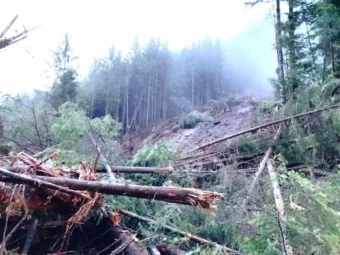
Downed trees and mud block the road leading into Thorne Bay on Prince of Wales Island. (Photo courtesy of City of Thorne Bay)

On Tuesday, Governor Mike Dunleavy amended a state disaster declaration to include communities on Prince of Wales Island.

The declaration stems from the deadly Nov. 20 landslide in Wrangell. The same storm system that hit Wrangell also caused widespread flooding and landslides on Prince of Wales Island, which includes the communities of Hydaburg and Craig.

With the governor’s amendment to the declaration, residents of the island who were impacted by the weather event now qualify for state disaster relief.

During the Nov. 20 storm, roads and culverts were washed out on Prince of Wales Island. Power poles were snapped in half. Residents reported multiple power outages.

Wrangell’s landslide was the deadliest in recent memory in Alaska. The full extent of the damage is still unknown.

The state and FEMA, or the Federal Emergency Management Agency, will be visiting Wrangell and Prince of Wales to conduct a damage assessment. Jeremy Zidek of the state’s division of Homeland Security and Emergency Management says the state already conducted an assessment to amend the declaration but they hope to get federal assistance too.

“The purpose is really to partner with FEMA, go out there, take a look at the damages, verify those. So, if we do request federal assistance, we’ll have FEMA on board with what was damaged. If the federal government does declare a disaster, 75% of the cost is covered by FEMA and 25% of the cost would be covered by the state,” said Zidek. “At the current moment, with our state disaster declaration, the state’s disaster recovery programs would cover 100% of the cost.”

The state and FEMA will be on the ground in Wrangell and on Prince of Wales beginning on Dec. 11 to document damages. Zidek says this won’t look any different for the people affected by the slides and flooding. It’s just assistance coming from a different pot of money. But for some, he said, the pot of money can seem hard to find.

“It’s a kind of a complicated program, we always try to maximize the benefit that we can provide to people. We work in conjunction with insurance. And, you know, it is kind of a process,” Zidek said. “Some folks are not eligible for grants. And but some folks are, and they really have to fill out that application and go through the process in order for us to determine that what they’re eligible for.”

Zidek encouraged residents of Wrangell and Prince of Wales Island who were affected by the landslides or flooding to register for individual assistance at ready.alaska.gov/ia or by calling 844-445-7131.

Tourism, aging population create ‘a lot of challenges’ for Ketchikan’s first responders

An ambulance crew unloads the first “victims” during an emergency preparedness drill. (KRBD photo by Leila Kheiry)

More ambulance calls. It’s something Rick Hines, Ketchikan’s fire chief, is grappling with.

“So, there’s a lot of challenges with the increased call volume and limited personnel,” he said.

The calls are for any number of things. The day before, the crew responded to a cat that was stuck in the dash of a car. The cat is fine. But Hines says the increase in callouts has a few causes.

Ketchikan’s aging population is one of the big ones. According to the U.S. Census Bureau, the number of people in Ketchikan above the age of 65 increased by a little over 75% over the last decade. That’s more than any other population group, and it’s above the state average.

Pair that with more tourists, and Hines says it puts a real strain on the fire department.

“The struggle for us is to provide the best service possible to our year-round residents, the people that live here, while also being able to service those coming in to enjoy our city,” he said. “I think there was a couple of times last year that we had seven emergency calls occurring at the same time.”

When that happens, the fire department pages off-duty crew members to respond to those additional calls. He said the guys need those days off to catch up on sleep and do the things we all need to do on our days off.

“So, I think that it’s a system that’s very challenged,” Hines said. “If you think about it – I’m just giving an example – yesterday, our off-duty crew responded to 17 calls. And we sent out a page for off-duty members to come in. Today, they’re already, I think 10 or 11 calls in one day already.”

Ketchikan is expected to have many days of more than 19,000 visitors next season. Hines believes that number is pretty conservative. For one thing, he said they don’t account for all of the crew members that are getting off the boats and heading into town.

“Some of the lessons we learned is – when a cruise ship, they’ll dock and they’ll call us and say, Hey, we got we have three patients that need go to the hospital, instead of utilizing three ambulances, we’ll send one ambulance crew, and they’ll make an assessment on the criticality of all three of those patients,” Hines said.

The fire department is working with the South Tongass Fire Department and the emergency planning commission to put these lessons into action. They are also trying hard to increase their volunteer ranks ahead of the first cruise ship expected to be making port in April.

None hurt as tour bus plunges into Ketchikan Creek

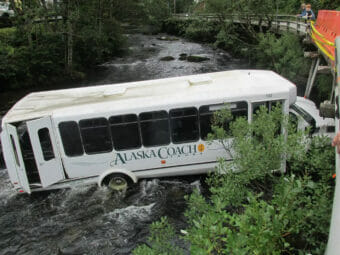
After rolling downhill, an Alaska Coach Tours’ bus sits in Ketchikan Creek on Aug. 16, 2023. (Maria Dudzak/KRBD)

A tour bus in Ketchikan ended up in Ketchikan Creek on Wednesday after it lost power, rolled backward and went over a guardrail. There were no passengers on the Alaska Coach Tours bus, and the driver wasn’t hurt.

Deputy Police Chief Eric Mattson says the crash happened as the vehicle was heading to the Cape Fox Lodge.

“The vehicle was driving up Venetia Ave. towards Cape Fox Lodge when it lost power,” he said. “It went backwards down Venetia, crossed over Park Avenue over the sidewalk railing and crashed, rear end first, into the creek where it laid to rest.”

Mattson says the next step is getting the bus out of the creek.

“We contacted the U.S. Coast Guard Marine Safety Detachment about the vehicle in the creek,” he said. “Obviously worried about any type of fuel or other type of lubricant entering the waters.”

According to Lt. Allen Vorholt with the U.S. Coast Guard, crews did not see a visible sheen or find any evidence of oil or gas leaks. Ketchikan Creek is an anadromous fish stream, and salmon are currently heading upstream to spawn.

Vorholt says the Marine Safety Detachment will continue to monitor the area. He said that if anyone does see signs of oil in the water, they should call the National Response Center at 1-800-424-8802.

Advisories were issued to avoid Park Avenue, which is busy with pedestrians – mostly tourists – and cars and buses heading up to the Cape Fox restaurant and Ted Ferry Civic Center. Though traffic was delayed for a while, Mattson says the road is open.

“They were trying to get as many vehicles through, but still have that safety corridor for removal of the driver and just to make sure that the area was safe. So those that needed to transit quickly were given that opportunity,” he said.

A barrier was placed across the broken railing. A section of Park Avenue will be closed Thursday morning for the bus to be removed.

Hōkūle’a finishes Alaska leg of global journey, headed to Prince Rupert

The Hōkūle’a in Ward Cove (Courtesy Jared Boekenhauer)

The traditional voyaging canoe Hōkūle’a captured statewide attention as it stopped in several Southeast Alaska ports.

The regional tour kicked off the Moananuiākea journey, which is all about Indigenous knowledge and love for the ocean.

The Alaska leg of the global journey ended after visits to Metlakatla and Prince of Wales Island earlier this month.

The Hōkūle’a was towed most of the way from Metlakatla to Hydaburg, since the water was so calm. Lohiao Paoa said that’s pretty rare. The canoe’s crew usually relies on twin sails.

“We got to sail more than halfway across the Dixon Entrance,” he said.

Paoa is a crew member on the Polynesian Voyaging Society’s traditional twin-hulled canoe. He said in Metlakatla, there was a lot of drumming and celebration.

“They had really nice songs and dances and all the kids from one-year-olds were playing the drums and dancing together with elders,” he said.

And on Prince of Wales Island, the crew visited Hydaburg, Kasaan, Craig and Klawock. They were welcomed and received tours in each community. A send-off was held in HydaburgHydaburg has a special connection to the Polynesian Voyaging Society – a different voyaging canoe was built with logs harvested from a bay just six miles away from the town.

“Every community was really nice and treated us with respect and gave a history of their community, as well as a lot of gifts, which is amazing,” he said.

While finishing the Alaska journey, Paoa noticed how similar Alaska’s Indigenous communities are to Hawaii’s islands.

“It’s crazy to see how connected all these tribes are,” he said. “And I think it’s very similar to Hawaii’s islands and how the people are related back home.”

Now, the canoe crew has moved on to Canada. After stopping in Haida Gwaii, the Hōkūle’a is expected to head toward Prince Rupert, British Columbia at the end of the week.

Site notifications
Update notification options
Subscribe to notifications