KRBD is our partner station in Ketchikan. KTOO collaborates with partners across the state to cover important news and to share stories with our audiences.
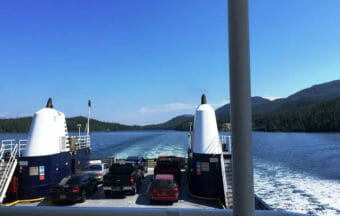
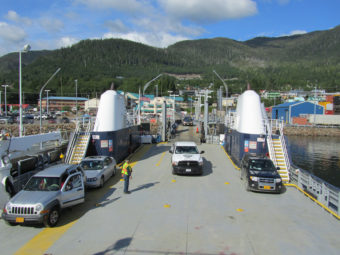
The Alaska Marine Highway System ferry Lituya provides regular service between Metlakatla Indian Community and Ketchikan. (Leila Kheiry/KRBD)
The Alaska Marine Highway System ferry Lituya will be out of service until at least Feb. 1. That’s according to the state transportation department, which made the announcement a week after the boat stopped making runs to Metlakatla.
Shannon McCarthy, a spokesperson for the Alaska Department of Transportation, says the boat has a generator engine failure.
“We had technical reps analyzing the problem this Saturday and should know more details on the repair here shortly in terms of timeline, McCarthy wrote in an email to KRBD on Monday.”
The Inter-Island Ferry Authority, which is a small regional ferry line, will continue to fill in for the Lituya while it’s sidelined. There will not be disruption to the sailing schedule to Prince of Wales Island.
The boat will leave Ketchikan at 11:30 a.m., and arrive in Metlakatla at 12:15 p.m., before leaving Metlakatla at 12:30 p.m. and arriving back in Ketchikan at 1:15 p.m.
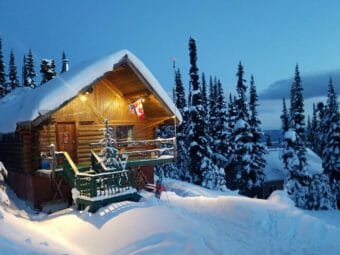
Mary Lynne and Jim Dahl’s cabin in Smithers, British Columbia. (Courtesy of Mary Lynne Dahl)
Mary Lynne Dahl and her husband Jim love to ski in Smithers, British Columbia.
“We’ve done over 160 trips. So we’ve been doing it for about 20 years,” she told KRBD by phone.
The Ketchikan couple usually spends two or three weeks at their cabin in Smithers. After all, it’s no small feat to get there — it’s about four hours of driving through northern B.C. in the middle of winter. And that’s after a seven-hour ferry from Ketchikan to Prince Rupert.
But it’s always been worth it. All nine of the Dahls’ grandkids learned to ski in Smithers, plus half a dozen of their Ketchikan friends.
This year, Mary Lynne says the Dahls planned a longer trip. They’d stay about two months, since the Marine Highway System wasn’t running any ferries in January.
“In order to come down for Christmas to meet with our friends and our family, who drives up from Seattle, we had to come down in the early part of December, and we couldn’t leave until February 7,” she said.
Mary Lynne and Jim Dahl take a selfie with their Smithers, BC cabin in the background. (Courtesy of Mary Lynne Dahl)
Why no ferries in January? The Matanuska, the ferry that runs to Prince Rupert, was in the shipyard getting some work done.
During its annual overhaul, crews spotted some concerning issues on the Matanuska. Deputy Transportation Commissioner Katherine Keith said at a recent Marine Highway Operations Board meeting that one problem is crumbling asbestos.
“There has been always asbestos on board these aging vessels, and we know it’s there. However, when asbestos becomes exposed, or is friable, meaning it’s in a dust that is in the air, basically, then it becomes a health risk,” Keith said.
That stopped work immediately. The state doesn’t want welders and pipefitters breathing in cancer-causing dust. But crumbling asbestos wasn’t the worst of what they found.
“In addition to that, during the overhaul, there was more discovered steel, which is going to increase the cost of this overhaul significantly and the amount of time that the vessel would be in overhaul,” Keith said.
Keith says repairs to the corroded steel will dramatically increase the cost of the overhaul. And she says the ferry service isn’t sure what to do with the 60-year-old ship.
“We would like to pause on our decisions for capital investments in this project, to see what really is the wisest choice right now,” she said. “This steel work could increase the cost of this overhaul up to $8 or $10 million.”
That brings up a whole host of issues. The Matanuska has been the primary vessel serving the so-called “mainline” route that runs through Southeast Alaska. Its sister ships — the Taku and the Malaspina — are both out of service. One was cut up for scrap, the other sold off as a floating museum.
And the Matanuska will need to start major renovations by December 2024 to maintain a key certification under the 1974 International Convention for the Safety of Life at Sea, better known as SOLAS. That’s required to dock in Canada.
But, for a more immediate concern:
“Ultimately, what these developments mean is that the Matanuska will not be able to be on our summer schedule,” Keith said.
Or, for that matter, the February schedule.
The Matanuska waits at Ketchikan’s state ferry terminal on June 20, 2022, the day of the Alaska Marine Highway System’s first voyage to Prince Rupert, B.C. since 2019. (Eric Stone/KRBD)
The ferry service isn’t out of options — Keith says the flagship ferry Columbia is coming off the bench to fill in for the Matanuska.
“The Columbia will now be on our schedule and sailing as soon as February 13th,” Keith said.
That’s just about a week after the Dahls were originally scheduled to sail home. Which, if it were coming to Prince Rupert, might not be a problem. Anyone who’s traveled in Alaska or northern Canada during the winter knows it’s a good idea to plan for a bit of a cushion in case of delays.
So, a few days ago, Dahl says she got the bad news.
“The ferry service called us and said that our ferry home from Prince Rupert to Ketchikan has been canceled. Period. And there’s no plan to replace it. We said, ‘What? What are we supposed to do?’” Dahl said.
They could fly home. But it’s awfully hard to fly with a car full of ski stuff and two dogs. Airlines don’t exactly take cars as checked baggage.
Sunny, age 7, poses for a festive photo. Sunny is one of two dogs who accompanied the Dahls to Smithers. (Courtesy of Mary Lynne Dahl)
“And they said, ‘Well, you know, there is no option unless you drive down to … Bellingham,’” she said.
Bellingham, Washington, is the southernmost port on the Marine Highway System. It’s also a 13-hour drive from Smithers — and that’s in the summer with clear roads.
“So we are going to drive 700 miles to Bellingham from here in Smithers where we are now, and then we have to get on the ferry a week later and go another 750 miles the other direction to get back to Ketchikan, which is kind of crazy,” Dahl said.
KRBD tried to ask the Department of Transportation how many people were affected by the Prince Rupert cancellations. We wanted to know if there are any plans to send another boat to pick up the people stuck in Canada — whether it’s a state ferry or a private vessel. We asked if there were any plans to help people with the cost of driving to Bellingham. But DOT didn’t return interview requests or provide a written statement.
So Mary Lynne and her husband are on their own.
“It’s really irritating,” she said. “I know that these boats are old. And I know they do need maintenance. But that should be that should be expected and planned. And because you’ve sold the tickets already, unless the boat is imminently going to sink. I think you should pick those people up and bring them home.” She says the ferry service should “plan a little better.”
And she has some ideas. She says she’d like to see the ferry system upgrade more ships to handle the Prince Rupert route. She says the Alaska Legislature should find a way to insulate the Marine Highway’s budget from shifting political winds.
But for now, the Dahls are planning for a long, cold odyssey south.
It’s a quick, 45-minute trip down the channel, and the Lituya docks at the ferry terminal in Ketchikan’s West End. But discussion is brewing about tying up the Lituya at the Saxman Seaport, six road miles south of the current terminal.
Lori Richmond is Saxman’s city administrator. She said those six miles could make a big difference.
“Well, Saxman being, like, 83% Native population, and Metlakatla being 100% Native population, there’s a lot of family that goes back and forth between the two areas, villages,” she said. “So right now the ferry dock is all the way in the middle of Ketchikan. So the families have a hard time getting together, because they have to afford taxis or they have to pay that increased amount to bring their vehicle on the ferry.”
The ferry Lituya sails between Metlakatla and Ketchikan in 2012. (Alaska Department of Transportation photo)
The Saxman Seaport is also in the same neighborhood as the future Three Bears Alaska grocery store. Richmond said that proximity is another convenience for travelers.
“Metlakatla is going to have much quicker access to groceries, to hardware, to sporting goods,” she said. “They’re not going to have to try to find a ride from the ferry dock, you know, in the middle of Ketchikan to three different stores, because we’ll have all three of those down at (the) Three Bears.”
The seaport would house both a small boat launch and the terminal. Richmonds says there’s potential funding available from the Statewide Transportation Improvement Project program. Richmond said, at first, Saxman approached DOT about creating a commercial vessels dock at the seaport.
“And they weren’t able to fix any money real quick,” she explained. “But then they found enough money to maybe just retrofit the seaport right now.”
Shannon McCarthy, a spokesperson for the Alaska Marine Highway System, said the regional economic development group Southeast Conference is leading the initiative.
“We are supporting the Southeast Conference efforts,” McCarthy said. “And so the Southeast Conference (is) putting in some funding for a preliminary design, and then we are also putting in about $500,000.”
The preliminary design will be done by PND Engineering. McCarthy said representatives from that company will be in Ketchikan next week.
She said a Saxman terminal could allow the ferry system to add an additional daily run to Metlakatla.
Metlakatla Mayor Albert Smith said there are both pros and cons to developing a Saxman terminal for the Lituya.
“If it works out, the idea is that we can have more runs throughout the day and earlier (in the) morning, run one in the later evening, and then run throughout the whole day,” Smith explained.
But he said moving the terminal further from hotels and other businesses could create its own issues.
“Just the fact that it’s further out of town,” Smith said. “Right now, where the ferry lands, you could walk right across the street to The Landing (Hotel), or if you needed to, you could actually walk — it’s short walk — over to the airport ferry.”
But Smith said if the idea moves forward, it’s a problem that could be solved.
“So you know, there’s transportation stuff we need to figure out,” he said. “And a lot of things, I think that we can work out, but communication will be key.”
Representatives from the state Department of Transportation and Southeast Conference will hold a town hall meeting in Saxman to discuss the idea at 5:30 p.m. on Jan. 25. The public meeting in Metlakatla is set for 6 p.m. the following day.
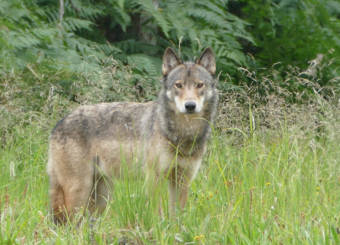
An Alaska Department of Fish and Game wildlife biologist came upon this Alexander Archipelago wolf on Prince of Wales Island in the summer of 2018. It had been sleeping. It woke up and moved away. (Photo by Kris Larson/ ADF&G)
State wildlife officials say 62 wolves were taken during the 31-day harvest that ran from Nov. 15 to Dec. 15.
State biologists say they are comfortable with that number. Based on population estimates and previous harvest rates, the Alaska Department of Fish and Game expected that somewhere between 60 and 100 wolves would be taken this season.
From 1997 until 2019, Fish and Game used a quota-based system for wolf harvests. Starting in the 2019 season, the department switched to an opening-based system based on population estimates. The state estimated roughly 230 wolves lived on Prince of Wales Island and the surrounding islands as of the fall of 2021. Biologists aim for a population of between 150 and 200 wolves.

But environmental advocates are worried.
Collette Adkins is the carnivore conservation director for the Center for Biological Diversity, one of the groups fighting to list the Alexander Archipelago wolf as endangered.
“I mean, 60 something last year, (and) 60 something this year — these wolves are going to end up on the endangered species list if this type of trapping continues,” Adkins said.
Adkins said her organization would like to see trapping stopin Unit 2 altogether. But area trappers have other ideas — including moving the season to the spring, instead of the winter.
Trapper Devin Dalin submitted a letter to Ketchikan’s Fish and Game Advisory Committee explaining why he feels that the wolf harvest should be moved to the beginning of March. Dalin was a member of the committee until his term expired this past summer.
“March offers better weather and longer days which gives the trapper a safer and more effective time of year to trap,” Dalin wrote in the letter “Along with it being warmer weather and longer days in March. March also offers trappers a break as they do not have to compete with deer hunters, and or duck hunters in their trapline area.”
He also addressed the committee at a recent meeting.
“A lot of people have complained for years about ice in November, in December, and snow, and can’t access areas, bad weather, short days,” Dalin said.
Trappers also wouldn’t be in the field around the same time as duck or deer hunters. He says a spring season would avoid snaring deer during their critical breeding season.
“And moving into March, the deer have slowed down a lot,” he explained. “They’re not quite moving as much. They’re still moving but they’re not moving (in) quite a wide of a range where you would catch them in a snare quite as likely. They’re going to be laying a little bit lower.”
The Ketchikan advisory committee unanimously chose to support a spring trapping season. But Adkins, from the Center for Biological Diversity, said the idea comes with its own problems.
“That’s during the wolves’ breeding season,” she said. “It’s a particularly sensitive time for wolves, and there are so many other ways to protect deer from snaring.”
She suggested so-called breakaway devices that have a loop that breaks with a certain amount of force.
“So moving the trapping season to March would only make things worse for wolves,” Adkins said.
While the advisory committee supported the idea, it’s not scheduled for discussion by the Board of Game when it meets in Ketchikan on Jan. 20.
There are a few wolf-related items on the Board of Game’s agenda. One proposal from the Alaska Wildlife Alliance would nearly double the target wolf population to between 250 and 350 wolves. Others would change the way the population or harvest level are calculated.
A proposal from Ketchikan’s advisory committee would open the wolf hunting season Sept. 1 and set a five-wolf bag limit. Most wolves are killed by trappers, but an earlier hunting season would allow deer hunters to kill wolves they encounter.
“He was a great chief,” Nickerson said. “He will definitely be missed by this community. He was kind, caring and very respectful to all community residents.”
Stonecipher had held the job since 2005. He also worked with Metlakatla’s police department.
Bruce Janes, Metlakatla’s current police chief, said Stonecipher was an exceptional public servant.
“As a supervisor, he’s probably one of the best police officers I’ve ever worked with in my 29-year career,” Janes said.
Stonecipher was a mentor, and trained Janes on the job in the 90s.
“Terry was one of those guys that he had a job to do,” Janes said. “But he always treated people with respect.”
Janes lived next door to Stonecipher and his family in Metlakatla. Stonecipher leaves behind his wife Juliet, and four children.
“My kids played with Terry’s kids, you know, growing up and you know, until they left,” Janes said.
Stonecipher moved to Bethel after four years in Metlakatla and worked with the local police department for more than a decade. Janes said he also worked in probation services before moving back down to Southeast.
With Stonecipher’s passing, Nickerson said there’s currently no police officers in Klawock.
“We do not have any acting chief,” he said. “We don’t even have any officers.”
Nickerson said Alaska State Troopers will be answering 911 calls for Klawock, and Craig Police Department officers will patrol the town when they are able. The City of Klawock is asking residents to call 911 for emergencies, not the Klawock Police Department phone number.
Nickerson did not answer questions about Stonecipher’s cause of death or whether it was regarded as suspicious. Alaska State Troopers are handling the investigation, and Nickerson said his remains will be sent to the state medical examiner’s office in Anchorage for an autopsy.
Alaska State Troopers and Craig Police Department officers will drive Stonecipher in a procession to the ferry terminal in Hollis on Tuesday morning. His remains will be in a flag-draped coffin. Members of the public are invited to join the procession or flash their lights in support.
“Any community member who wishes to pay respects to Chief Stonecipher, may either join the procession, or be on the side of the road with flashing lights as he makes his final journey through the City of Klawock,” the city wrote in a social media post. “Klawock Fire Dept and EMS will be along side of the road with flashing emergency lights as he journeys through tomorrow morning.”
Correction: A previous version of this story misstated how many children Stonecipher had.
Ketchikan Police Chief Jeff Walls speaks at a meet-and-greet at the Ted Ferry Civic Center on March 24, 2022. Walls succeeded Joe White as chief. (Eric Stone/KRBD)
Ketchikan’s police chief has been placed on paid administrative leave after he was indicted for an alleged assault related to an off-duty incident in September.
In an email, Ketchikan City Manager Delilah Walsh says Walls is on leave while the city conducts an internal investigation.
“Chief Walls is currently on administrative leave while we complete our internal review,” Walsh said in an email Wednesday morning.
It’s unclear how long that review will take. Walsh declined to comment on how long Walls might be on leave or when he could return to work. Walsh says Deputy Police Chief Eric Mattson will take over as acting chief in the meantime.
Walls was indicted by a Ketchikan grand jury last week on felony third-degree assault charges and five related misdemeanors.
Walls has pleaded not guilty and denied the charges. His attorney, Jay Hochberg, says Walls reacted appropriately to what he believed was an assault on his wife.
Hochberg said Wednesday his client expected to be placed on leave during the city’s internal investigation and hoped to return to work soon.
“We expect Chief Walls to be reinstated after that investigation. We hope it moves quickly, but, of course, with all due deliberation,” Hochberg said by phone.
Hochberg says Walls is well-liked in Ketchikan and has received “tremendous and deep expressions of support” from police department colleagues and other community members.
Walls is due back in court Feb. 7. His trial is scheduled for mid-March.
Close
Update notification options
Subscribe to notifications
Subscribe
Get notifications about news related to the topics you care about. You can unsubscribe anytime.