
KRBD - Ketchikan

KRBD is our partner station in Ketchikan. KTOO collaborates with partners across the state to cover important news and to share stories with our audiences.

Three Bears Alaska to make Southeast debut with Saxman grocery store and gas station

Gas tanks outside a store.
South Tongass Services on Tuesday morning. (Raegan Miller/KRBD).

The Ketchikan area is getting a new grocery store. Three Bears Alaska, a chain with locations in Southcentral and Interior Alaska, plans to open a new location in Saxman, just south of downtown. The store is slated to open next spring.
In the meantime, Three Bears is taking over operations at a gas station and convenience store in the area.

Three Bears Alaska’s move into Ketchikan is two-pronged. First, the grocery chain is taking over management of South Tongass Service. And soon, crews will start to transform a warehouse in the Saxman Seaport into a full-service Three Bears grocery store, complete with a sporting goods outlet and, down the road, a hardware store.

Three Bears owns several stores around the state, ranging from Wasilla to Ninilchik. Some stores offer sporting goods, liquor sales and pharmacy services, in addition to gas and groceries. There are 20 locations around the state and one in Butte, Montana.

Three Bears is leasing the service center from Southeast Stevedoring, a subsidiary of Survey Point Holdings. Meanwhile, the City of Saxman will lease the warehouse to the company. The city said in a news release that it wanted residents to maintain control of the property.

“The Council wants the residents to maintain ownership of as much of the ocean front as it can and so saw fit to rent instead of sell,” a news release from the City of Saxman further explained.”

""
A checkstand displays a Three Bears Alaska logo on Thursday afternoon. (Raegan Miller/KRBD).

Three Bears did not respond to repeated requests for comment.

Lori Richmond is Saxman’s city administrator. She said the financial details of the lease are private for now.

“But essentially, we’re getting a one time payment for a 99-year lease,” Richmond explained. “Then in exchange, they’re doing a certain amount of infrastructure updates. And in the lease, there’s a local hire provision, and (an) infrastructure provision.”

Richmond said a store had always been part of the plan for the city.

“The City of Saxman had been looking for options for economic development that provide jobs and service not only to Saxman, but our neighbors on this side of the island,” she said.

The lease hasn’t been signed yet, but Richmond said the company has access to the warehouse site so it can stage construction equipment for the renovations.

“But then as far as the schedule goes …for building it out, we’ve left that up to Three Bears with that concept that, you know, they’re the professionals in building and opening grocery stores,” she said.

KRBD stopped by a Ketchikan coffee shop to get a feel for how locals feel about the development.

Donna Georgie and Mary Caskey are self-described snowbirds — folks who spend summers in Alaska and head south for the winter.

Georgie said she thinks the store is great for the community.

“I think it’s awesome,” she said. “We need more grocery stores.”

Caskey also welcomed the news.

“I live south of town and I’m so looking forward to it,” Caskey said. “This is news to me.”

Grace McElroy took a break from taking orders at the counter to remember Tatsuda’s IGA. That store served Ketchikan for more than 100 years before a landslide forced it to close.

“(I’m) super excited for the Three Bears,” she said. “It’ll be good to have a grocery store out that way. It’s been a while since Tatsuda(‘s closed). Rest in peace.”

Calvin Traudt lives 15 miles north of town, but he passes by the South Tongass gas station every day on the bus.

“It’s going to be good for all people south of town, you know, put some people to work,” he said.

Ketchikan will be the first community in Southeast with a Three Bears Alaska location.

After deadly crashes, NTSB calls for special regulations on Ketchikan air tours

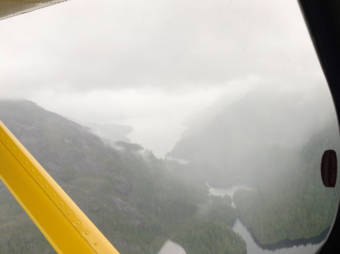
A view from a plane of steep slopes, with poor visibility
This photo, shot with a recovered iPhone from the wreckage a Southeast Aviation flightseeing plane, was timestamped three minutes before an August 2021 crash. (NTSB)

Federal safety investigators are calling for new, more restrictive regulations on flightseeing tours in the Ketchikan area after a series of crashes.

The National Transportation Safety Board says previous approaches focused on voluntary compliance have proven ineffective at addressing the unique hazards of flying in the area.
The agency’s 20-page report calls on the Federal Aviation Administration to impose specific regulations for Ketchikan air tours above and beyond what’s normally required.

The NTSB says it’s looking to prevent pilots being caught in clouds unexpectedly without the equipment necessary to navigate them. Large commercial airliners carry specialized instruments that allow them to fly in low-visibility conditions, but small flightseeing planes typically operate under so-called “visual flight rules” — that is, they rely on what pilots can see out the window.

The report highlights seven fatal flightseeing crashes in the Ketchikan area since 2007 that killed a total of 31 people and injured another 13. Three of those involved flying into poor weather conditions and crashing into terrain, including the most recent crash in Misty Fjords National Monument Wilderness last year. Those three crashes resulted in 20 deaths.

Current regulations on air tours require visibility of at least two miles when clouds are less than 1,000 feet above the ground. Pilots must also fly at least 500 feet above ground level.

But Ketchikan is more complex. NTSB Chair Jennifer Homendy said in a news release that the area’s fast-changing weather and mountainous terrain present “unique — but well-understood — safety hazards.”

The report asks the FAA to work with the National Weather Service to come up with more conservative weather standards for flightseeing tours in Ketchikan and require specialized training.

The board also asks the FAA to require air tour operators to comply with a 2009 agreement that standardizes tour routes, provides alternate flight paths on poor weather days, and encourages pilots to relay poor conditions. That agreement is voluntary — and even though the air carrier involved in last year’s crash had signed on, the pilot was not following the designated route at the time of the crash, according to the NTSB.

ProPublica report last year highlighted that Alaska makes up a growing share of the country’s crashes involving small commercial aircraft. The NTSB says specific regulations issued for other high-risk locales, like the Grand Canyon and Hawaii, have improved flightseeing safety.

“Special federal aviation regulations have effectively reduced air-tour accidents in other areas, saving untold lives. We need the same safety leadership now — before there’s yet another tragedy in Ketchikan,” NTSB Chair Homendy said.

The NTSB investigates crashes, but it doesn’t have the power to issue binding rules. That’s why it’s calling for the FAA to impose new regulations.

In a statement, the FAA said it takes the safety board’s recommendations seriously and will respond “within an appropriate timeframe.”

The FAA said improving aviation safety in Alaska is one of the agency’s top priorities. The agency highlighted what it called a “sweeping examination of safety issues” in Alaska aviation conducted last year. That includes better weather data and forecasting, expanded satellite-based air traffic control coverage, improved navigation charts and new GPS-guided routes that allow pilots to fly at lower altitudes to avoid dangerous ice buildup.

The agency said it meets every spring with air tour operators to discuss lessons learned and recommendations and reminders ahead of the coming season.

But the NTSB says those actions fall short of what’s necessary to protect pilots and passengers.

One Ketchikan aviation heavyweight, Taquan Air, offered support for stricter regulations.

In a statement, Taquan executive Christa Hagan said the airline “supports the concept of a rulemaking process as a focused effort to enhance safety.” If the FAA decides to take action, Hagan said the airline would “welcome the opportunity to actively participate in the rulemaking process.”

Other Ketchikan flightseeing operators said they were reviewing the NTSB’s recommendations.

Alaska’s 2nd fatality-free year of commercial fishing could be part of a trend

""
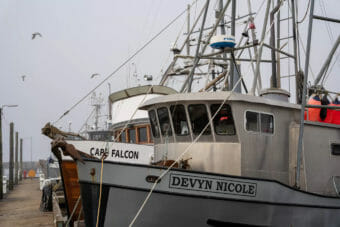
Fishing boats at Ketchikan’s Thomas Basin harbor in October. (Eric Stone/KRBD)

There were no fatalities within Alaska’s commercial fishing fleets this year, for only the second time on record. The U.S. Coast Guard says the credit belongs to the fishermen themselves.
It’s the first time since 2015 that Alaska has gone a year without a commercial fishing death. The Coast Guard said that in the 12-month period that ended Sept. 30, no one died from falling overboard, in an on-deck accident or on a sinking ship.

Scott Wilwert is the Coast Guard’s commercial fishing vessel safety coordinator. He said fatalities have been cut almost in half over the last decade.

“From 1990 to 1999, we had 210, what we would classify as operational, commercial fishing fatalities in Alaska,” Wilwert explained. “And in the 10-year period from 2000 to 2009, that dropped from 210 to 107. And then from 2010 to 2019, down to 62.”

Wilwert said there have been just 10 commercial fishing deaths in Alaska since 2020.

“So yeah, we definitely are seeing a downward, decreasing trend in the number of commercial operational fatalities in the industry,” he said.

But, what exactly is causing that downward shift?

Wilwert said it’s a combination of changing fishery regulations and an industry culture focused on preventing accidents.

“I believe that, you know, the fishermen that I come in contact with, and all our (dockside) examiners come in contact with are much more safety conscious, they understand the risks, they take the preparations, you know, and that’s a big piece of the puzzle,” he said.

Wilwert said that’s a sharp contrast to the ‘70s and ‘80s, when short openings encouraged captains to fish in an all-out sprint — sometimes sacrificing safety.

“The way that fishermen now, in certain sectors, are able to, to some extent, choose when they want to go out, maybe skip a weather window, or look for a better weather window, as opposed to the old derby days when, you know, back in the 70s and 80s, overloading or deck loading with fish or overflowing with gear, because you only had for six or eight days to catch all the crab or the halibut or whatever,” he said.

Wilwert emphasized how important it is for mariners to stay up to date on safety recommendations and equipment, and to take part in the dockside exams offered by the Coast Guard — before it’s too late.

“The time to learn how to use any of that stuff is not at the moment of truth,” he said.

Tracy Welch is the executive director of United Fishermen of Alaska.

We’re a big industry, but in a way, we’re (a) really small industry,” she said. “Everybody knows somebody who knows somebody, right? And so those deaths are tragic.”

Welch said she also thinks that things have changed over the last few decades when it comes to education.

“I think with the younger generation of fishermen coming in and moving towards more rationalized fisheries, as opposed to the derby style fisheries, it’s given people a chance to focus on safety and making sure that people make it home at the end of the day,” she said.

Welch said she hopes the trend continues.

First bear with bird flu in US was cub in Glacier Bay

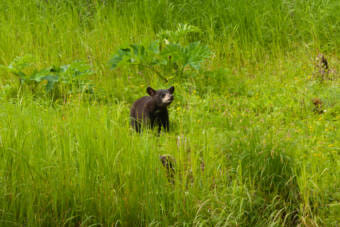
A black bear cub at the Mendenhall Wetlands State Game Refuge on June 19, 2021, in Juneau, Alaska. (Photo by Rashah McChesney/KTOO)

A black bear cub euthanized at Glacier Bay National Park this fall is the first in the country to test positive for a highly contagious strain of bird flu. Park visitors alerted wildlife officials after they noticed the animal’s strange behavior.

The cub was having a hard time walking and struggled to keep up with its two siblings and mother at Bartlett Cove in Glacier Bay National Park.

Kimberlee Beckmen is a wildlife veterinarian for the state’s Department of Fish and Game. She says concerned park visitors captured videos of the cub in October.

“They thought it was drunk — it was stumbling, and then was abandoned by the mother,” Beckmen said in a phone interview Tuesday.

Those symptoms are common with the strain, also called H5N1. It causes exhaustion and neurological problems like seizures.

Beckmen says the bear had no chance of survival at that point.

“It was very sad to see the animal (was) not going to recover,” she said. “Its brain was swollen, and it would have died, probably within hours, had it not been euthanized.”

After euthanizing the cub, scientists took swabs and a sample of the bear’s brain to test for  rabies and canine distemper. They sent the samples to labs in Washington and New York for analysis.

Beckmen says the results came back positive for the strain of flu known as highly pathogenic avian influenza, sometimes called “high-path AI.”

“We do test all wildlife that die with clinical signs or that are suspicious of having inflammation in the brain — encephalitis — for rabies,” she said. “We had to do the rabies testing on this animal before we could test it for high-path AI because of the risk from the tissues if it was infected with rabies.”

It’s the first time the strain has been spotted in an Alaska bear. Wildlife officials say two foxes have also tested positive this year — one in Unalaska and one in Unalakleet.

Beckmen says the only other bear diagnosed with the strain was an adult female black bear in Quebec.

“Because it was the first report in the U.S., that makes it reportable to the World Organization for Animal Health. They’ll report (to) the federal government … because of it being considered a foreign animal disease and of international importance, it’s reportable,” she said.

Beckmen says the cub found at Bartlett Cove was likely infected after scavenging a sick or dead bird.

“They have to inhale a large dose (of the virus) while they’re scavenging infected birds, then get that virus laden into their respiratory passages,” she said. “It does not go bear-to-bear.”

Animals can also become infected by the virus by ingesting water that has been contaminated by sick waterfowl. She says the risk to humans is very low — just four people have tested positive for the H5N1 flu worldwide, and just one in North America.

But the virus has devastated poultry and wild birds — nearly 50 million have been killed or euthanized this year alone, according to the CDC.

In Alaska, wildlife officials say the Matanuska-Susitna Borough is still a hotspot for infections among backyard flocks. Beckmen also says Sitka has recently seen infections among eagles. Fish and Game also reported infections among shorebirds, ravens and waterfowl statewide this summer.

Wildlife officials say residents should report sick, orphaned or dead animals to the Alaska Department of Fish and Game.

Prince Rupert signs 10-year deal with private operator to grow cruise port

An aerial photo of a cruise ship in Prince Rupert.
This undated photo shows a Royal Caribbean ship moored at Prince Rupert’s cruise port. (Creative Commons photo by Province of British Columbia)

The northern British Columbia city of Prince Rupert is looking to an international partner to grow its cruise ship port as the Alaska market continues to expand.

The U.K.-based firm Global Ports Holding announced last week that it had signed a 10-year agreement with an optional 10-year extension with the Prince Rupert Port Authority to manage cruise services.

Head of business development Colin Murphy says they aim to grow Prince Rupert’s tourism sector.

“One of the challenges they have there is that because the volumes have been reasonably low, it’s been difficult for local tour providers and stakeholders to comfortably invest in improving the guest experience by providing more tourism or experiences and so on. So that’s a point of emphasis for us going forward to help Prince Rupert be more successful,” Murphy said in a phone interview Monday.

He says the deal doesn’t commit Global Ports Holding to any infrastructure investments up front, but otherwise declined to discuss the financial terms.

Prince Rupert has welcomed about 41,000 cruise passengers this year, and that’s expected to double next year. Murphy says the one-berth port has already booked calls from cruise company giants Carnival and Princess.

Murphy says he doesn’t expect Prince Rupert to grow as large as some of the massive Alaska cruise ports that welcome more than a million passengers each year — at least, not for a while. But he says Prince Rupert is poised to take advantage of increasing congestion at existing ports, both in Alaska and further south.

“In the long term, we think all of the cruise lines are going to be more focused on finding berths for their ships, so having a port somewhere so close to the Alaska market in Prince Rupert for us is very key,” he said.

Murphy says he expects Prince Rupert to serve primarily as a transit port, rather than somewhere that passengers start or end their cruises. But he says there has been some interest from smaller cruise operators in making Prince Rupert a turnaround port.

Global Ports Holding was one of two companies that bid to take over management of Ketchikan’s port as the community considered a public-private partnership. Ketchikan’s City Council ultimately rejected the bid and chose to keep the port under city management in a 4-3 vote last year. The Prince Rupert deal is the U.K. company’s first investment in the Alaska market.

Biden administration announces $15M in climate grants for Alaska tribes

""
Rotary Beach south of Saxman is also called Bugge’s Beach. A federal grant will support Ketchikan Indian Community’s efforts to test waters at beaches like this for bacteria as the climate warms. (KRBD file photo)

Tribes around Alaska are trying to find ways to stop climate change from eroding their ways of life — like access to traditional foods, clean waterways, and infrastructure in small villages.

The Bureau of Indian Affairs recently announced more than $45 million in federal grant money for tribes around the country to address issues spurred by climate change.

More than a third of that is making its way to Alaska, which has the largest number of federally recognized tribes in the country.

Alaska is warming faster than any other part of the U.S.  The changing climate has left communities to reckon with problems ranging from eroding shorelines and riverbanks to bacteria-infested waterways.

The Biden administration’s climate action grants are partially funded by last year’s landmark Bipartisan Infrastructure Law. They’re intended to give tribes an infusion of cash to put toward projects that will help fend off the worst of the impacts.

In Southeast, there’s a lot of pressure on making sure vital waterways stay clean and subsistence foods remain available.

Ketchikan Indian Community was awarded $246,221 to keep working on the goals outlined in its climate action plan. Tribal officials say it’s the federally recognized tribe’s biggest federal climate grant yet.

Tony Gallegos, the tribe’s cultural resources director, said climate change threatens the Indigenous way of life.

“Well, it presents kind of urgent risks to our traditional resources, food that our citizens depend on,” he said.

And part of preserving the way of life is understanding the role of traditional foods. So the tribe plans to, among other things, interview local elders to learn about what traditional food sources are most important to them. Gallegos said that effort is already underway.

We’ve already made some significant headway (in) gathering and documenting tribal citizen reliance on traditional food and priorities, with over 320 responses to our initial survey last year,” Gallegos explained.

Some of the grant money also will be used to collect bacteria samples from local waters. The tribe has been monitoring bacteria levels at local beaches since 2017, and evidence seems to point to spikes after big rainstorms.

“So sometimes they call (it the) ‘first flush’ after a rainfall event, especially when there hasn’t been a rain for a while, can often carry pollutants into, this case, the (Tongass) Narrows where we … have bacteria problems,” Gallegos said. “And we want to start to collect some water quality (samples), right during and right after those rainfall events.”

Gallegos said they hope to test at least 10 samples over the next two years.

Another $15,000 was awarded to the tribe to fund travel expenses for staff to attend conferences to learn about other ways to adapt to a changing climate.

Further north, the Yakutat Tlingit Tribe plans to use a grant of $113,830 to help deepen local knowledge about tribal lands using LiDAR mapping technology. That’ll allow the tribe to conduct detailed aerial surveys of its lands.

Andrew Gildersleeve is the tribe’s executive director.

LiDAR is a very exciting way for us to map with precision the tribal lands as they are,” Gildersleeve said. “And this is creating a record for us and a baseline for us to use in the future, and we hope for future generations, to be able to establish and recognize trends.”

With LiDAR, Gildersleeve says the tribe can learn more about rising ocean levels, salmon habitat and tidal zones.

The tribe’s grant consultant, Amanda Bremner, said the project will be completed in three phases. And it might even help broaden ancestral knowledge.

We have an Indigenous and traditional place names map that, for years, has just been, you know, a map on the wall drawn of boundaries and areas from a time, you know, decades ago that in this ever changing climate may not necessarily be accurate,” Bremner said. “So we’re looking forward to having these high resolution images.”

In the Upper Lynn Canal community of Klukwan, a grant of more than $589,000 is slated to fund riverbank stabilization as the community faces accelerating glacial runoff and melting permafrost. The tribe hopes the Jilkaat Kwaan Heritage Center Bank Stabilization Project will preserve salmon runs.

The Sitka Tribe of Alaska received more than $298,000 for its tribe-operated research center Southeast Alaska Tribal Ocean Research. That will support more research into the harmful algae blooms and paralytic shellfish toxins that thrive in warming waters. 

And Southeast’s biggest tribe, the Central Council of Tlingit and Haida Indian Tribes of Alaska, is working toward food sovereignty with a regionwide community garden program. That project will be funded with a $2 million grant. Tlingit & Haida did not respond to repeated requests for comment from KRBD.

In Klawock — the only Prince of Wales Island community to receive a grant — the Klawock Cooperative Association will use $248,206 to put into motion its own climate action plan. It will be modeled after one adopted by Tlingit & Haida. The Klawock Cooperative Association did not respond to repeated requests for comment.

Elsewhere in the state, a handful of villages received funding to seek higher ground as they face increasingly brutal storms and erosion.

That includes Unalakleet. With around 800 people, it’s the largest community to receive a grant dedicated to what’s called a “managed retreat” from the shore of Norton Sound. A 2019 Denali Commission study found that Unalakleet was the eighth-most at risk community in Alaska when it comes to damage from erosion and floods.

The local tribe received $290,440 to help plan an eventual move to a nearby hillside.

Kari Duame is the housing director for The Native Village of Unalakleet. She explained that an old seawall that surrounds the silty spit that the village sits on spared it from the worst of the damage from ex-Typhoon Merbok in September. But she said it’s clear the village has to move further from shore to survive the new climate reality.

“The ground itself can be unstable, for the style of building and the era of building — a lot of the houses are from, like the 70s, 80s, even earlier, like the 40s and 50s,” she said. “And more concerning is the seawall probably isn’t sufficient in the long run.”

She said a retreat from the shore would also give the village room to expand.

Also, there’s very little land to build on — (it’s), like, pretty crowded,” Duame noted.

Duame said the plan is in its early stages. She said the tribe’s goal for this grant is to get a completed plan ready for another grant proposal next year.

Unalakleet isn’t alone. Kivalina in the Northwest Arctic Borough received almost $250,000 to plan its own managed  retreat. Akiak, in the Bethel Census Area, got $150,000 to start moving away from the Kuskokwim River.

And in Nunapitchuk, a nearby river has eroded so severely that waters have risen up to the door of the only public safety building in the village. That’s where the village public safety officers live and work, and it’s also where emergency gear is kept. The village’s $2.2 million grant will help pay for a new building, since the current one is a total loss.

In Chefornak, flooding is forcing some parts of town to be moved. The $2.9 million grant will build 19 homes and a new preschool away from the water.

Other tribes are just keeping an eye on things — like in Kipnuk and Tuntutuliak, where tribes received grant money to conduct permafrost risk assessments.

The complete list of BIA climate action plan resiliency grants can be found at the agency’s website.

Site notifications
Update notification options
Subscribe to notifications