KRBD - Ketchikan

KRBD is our partner station in Ketchikan. KTOO collaborates with partners across the state to cover important news and to share stories with our audiences.

Biden administration announces $10.4 million grant for undersea cable from Metlakatla to Ketchikan

""
A view of Metlakatla on Annette Island, Alaska’s only Native reserve. (Photo by Leila Kheiry/KRBD)

A long-planned cable connecting Metlakatla and Ketchikan took a big step toward becoming a reality on Thursday. The Biden administration announced a $10.4 million grant to fund a two-mile undersea cable carrying power and broadband internet service to Alaska’s only Native reservation. Local leaders say they hope it’ll make Metlakatla a better place to live and work.

The $10.4 million grant comes from the Department of Commerce’s National Telecommunications and Information Administration and is funded by last year’s Bipartisan Infrastructure Law.

The grant is part of a package of more than $135 million that was spread across four tribes in Alaska, through the NTIA’s “Internet for All” program. The Central Council of Tlingit & Haida Indian Tribes of Alaska received nearly $50 million for a low-orbiting satellite and broadband service, the Kenaitze Indian Tribe received $7 million for a fiber optic connection, and NANA Regional Corporation got over $68 million for a similar project.

In all, the grant is expected to serve more than 17,000 households.

Keolani Booth is the chairman of Metlakatla Power & Light, the local utility on Annette Island. He explained that the cable will serve a dual purpose.

“It’s a cable that has both the broadband and the electricity,” Booth said. “And then that’ll bring the broadband into town and all the households and get the first parts of the infrastructure for setting it up for everyone and then getting it sorted (so the) utility can run the broadband to the homes.

The connection will benefit 586 homes and businesses in Metlakatla, according to the federal agency.

Once broadband service comes online, Booth said he expects big boosts for the local schools and the clinic, as well as students who are learning remotely. And he said it’ll also be a boon for local businesses.

What we’re hoping for is to start creating some jobs at home,” he said.

The new broadband connection will enable speeds of up to 1 gigabit per second for both uploads and downloads, according to the grant announcement. That’s 40 times faster than the top speed currently available in Metlakatla and on par with what’s available in cities like Ketchikan, Anchorage and Seattle.

Booth said about 1,500 tribal members live in Metlakatla, and he hopes it will encourage others who have left the community to return.

It’s … one of our first steps towards, you know, making lives affordable and livable for our residents here in Metlakatla,” he explained. “So they can stay here — I mean, it’s very expensive to be where we are.”

He also thinks it will strengthen ties between Metlakatla and Ketchikan, thanks to the power sales agreement recently greenlit by the Ketchikan City Council.

“That’ll give us the ability to, through our sales agreement (with Ketchikan Public Utilities) to purchase power, or you know, any hydro power or whatever they have, and then the same from our end and just start being a good partner,” he said. “That’s one thing about being Alaskan, is that you’re always there for each other.”

Metlakatla’s Mayor, Albert Smith, said that the agreement is huge.

That just happened and got signed,” he said. “So for this news to come out shortly after that was completed is just a really big deal for Metlakatla.”

The cable is expected to be installed sometime in the next two to three years, though Booth cautioned that supply chain issues and other roadblocks could delay the project. Faster speeds would be available shortly after the cable is completed.

“I know there’s a lot of formalities that most likely need to happen,” Smith said. We’ll be working, working hard to get it all completed.”
Kasaan welcomes Yáadaas clan pole home after more than a century

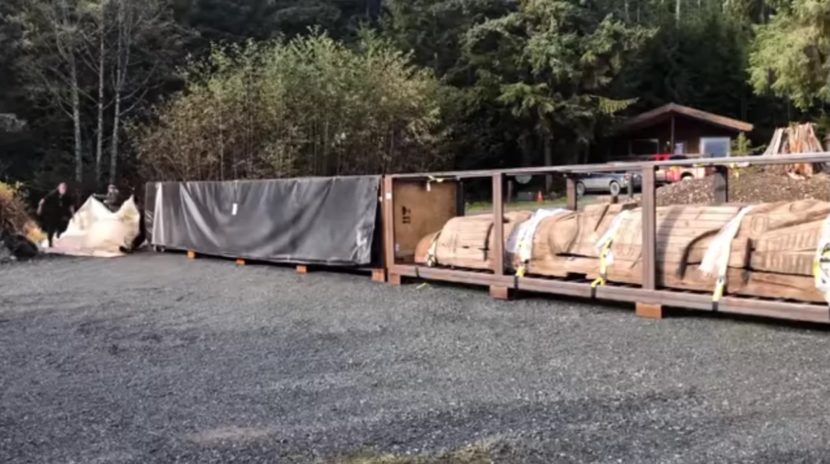
A screenshot of a video showing the reveal of the 52-foot Yáadaas clan pole. (From a video by Anna Harris)

The Yáadaas pole is massive. It’s too old to stand now, having been carved in the 1880s, but when it did, it stood 52 feet tall and 4 feet wide. It even has a steel core, and had to be barged up on a flatbed truck because it was too big for a box.

Mike Jones is the president of Kasaan’s tribe. He said the village turned out on Nov. 5 to see the first piece of clan property to come back to Kasaan.

“I feel like the pole (has) been displaced for a long time and wanting to come home — and had to have some kind of recognition,” Jones said.

The last few years have seen similar efforts around the state, from bringing objects home to Wrangell to long-gone loved ones back to Kodiak.

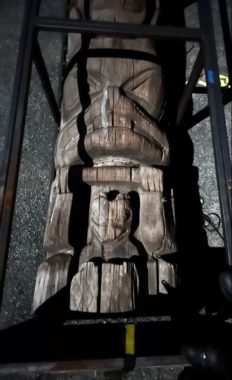
A portion of the Yáadaas clan pole depicting a beaver character. (Photo by Mike Jones)

Jones explained it’s a symbol of pride for the people of Kasaan, a Haida village on the eastern shore of Prince of Wales Island.

“We are the original totem pole people,” Jones said. “We’re the first. Totem pole carving for us goes back to mythical times. We are the only culture in the entire world to have monumental sculpture in front of every single house. Nobody else did that — none of our neighbors did that. So it really became a symbol of bringing our culture back.”

The Yáadaas pole spent more than 100 years away from the village. Jones said it left with then-chief Saanaheit (Wilson Peele), who was taking the pole down to California for the 1906 Indian Crafts Exhibition in Redondo.

Jones noted that he also took a dismantled house and other poles with him.

“And he actually took 200 tons altogether, including the house, the poles, and other paraphernalia — rattles and masks and things like this,” Jones said.

The pole was split into two pieces for the journey. After the show, it moved into a private collection. In 1951, the pole was found in a lumber yard, waiting to be made into pulp.

The pole was then placed in the courtyard of the Colorado Springs Fine Arts Center until 2006, when it became too old to stand up and was put into storage. Jones said the pole was filled with cement and steel in an attempt to make it sturdier for display, and it was struck by lightning.

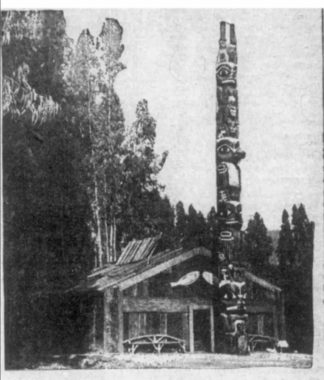
The Yáadaas clan pole stands in Redondo, California, after being shipped from Kasaan for 1906’s Indian Crafts Exhibition. (Courtesy Mike Jones)

Then, in 2010, Jones said the idea of bringing it home started to reach Kasaan — where more than 100 years ago, it fronted the house of the chief.

“The Colorado Springs Fine Arts Center reached out to the Organized Village of Kasaan in 2010, expressing that they wanted to repatriate the pole,” he explained. “And at that time, we did not have our café or the carving shed. And there was some concern as to where to put it. And the main thing was the funding was not available at the time. So it stayed in storage.”

But when Jones took his job as tribe president in 2019, it also sparked his desire to dive deeper into his Haida culture. And he started thinking about the pole again. It was then that he got an email from Richard Rinehart, the CEO of the Central Council of Tlingit and Haida Indian Tribes of Alaska’s business center, who also wanted to make the repatriation happen.

“I first started going through this reawakening of our culture — because we went through what we call ‘the silent years,’” he said. “There’s been a cultural genocide through the boarding schools, and things like that, so a lot of us, my generation — I mean, I’m in my 50s — we didn’t grow up really knowing who we were and our history and our culture and stuff.”

Sealaska Heritage Institute helped pay for the repatriation, along with more help Tlingit and Haida.

Jones said that’s an important gesture.

“It’ll affect the way that I carry myself because I know that my village is important and it was shown that we matter,” he said. “We’re such a small tribe here, and Sealaska really stepped up to help us and bring our history back.”

It’s not just Kasaan that’s benefitting from the repatriation. Jones said he’s heard from Haida people in Haida Gwaii who admire the pole.

“And that’s the ripple effect of touching people from so far away,” he said.

Jones said the pole was placed on a site where the tribe hopes to one day build a cultural center.

“Metaphorically, we have something really solid to build on and work towards more repatriation,” Jones said.

NOAA recognizes 3 cruise ships as contributors to program meant to reduce whale strikes

Passengers disembarking from the Norwegian Encore in Ketchikan. The Encore was responsible for nearly a third of all reports to the Whale Alert Alaska program. (Molly Lubbers/KRBD)

Three cruise ships that visited Southeast Alaska this summer received awards for reporting whale sightings as part of a federal program.

The National Oceanic and Atmospheric Administration recognized the top three contributors to the effort: the Norwegian Encore, the Cunard ship Queen Elizabeth and Holland America’s Nieuw Amsterdam.

Some 927 whale sightings were reported by Alaska cruise lines this year.

Crewmembers from the Norwegian Encore hold a certificate from the Whale Alert Alaska program. (Photo courtesy of NOAA).

The Encore was responsible for nearly a third of them — the Norwegian Cruise Line vessel reported 280 sightings. The Queen Elizabeth submitted 192, and the Nieuw Amsterdam tallied 76.

The reports were all made through the Whale Alert Alaska program. It’s an app that launched in 2012 to help ships avoid whale strikes. NOAA and Glacier Bay National Park expanded it for use in Southeast Alaska in 2016. The app can be used by mariners or pilots.

Carley Lowe is one of the NOAA biologists running the program.

We have sort of a live map that shows where all the whales are, and that way people can look at the map before they take off to see what the sightings were around their area, and hopefully, try to avoid some of the whales in the area that they’re going through,” Lowe said.

The app replaces a previous program where Cruise Line Agencies of Alaska would send out maps of recent whale sightings once a week through email.

We’re trying to just really make it as easy as possible for people to use, and that way, it’s not burdensome, and it’s just seamless into their other programs,” Lowe said.

Lowe said this was the first year that NOAA gave out awards for the most reports to come from a vessel.

And we’re hoping to continue with that program, just some friendly competition,” she said.

The Encore’s first navigation officer, Bodgen Ciordas, also received an award for his specific reports, as did Lauren Peach, a lookout onboard the Queen Elizabeth.

Rep. Dan Ortiz’s lead grows as more votes are counted

A man in a blue windbreaker leans against a white car
State Rep. Dan Ortiz, I-Ketchikan, poses for a photo while waiting to board the first Alaska state ferry to Prince Rupert, B.C. since 2019. (Photo by Eric Stone/KRBD)

Ketchikan independent Rep. Dan Ortiz has expanded his lead over Republican challenger Jeremy Bynum in the race to represent much of the southern panhandle in the state House. Ortiz now leads by five points.

The Alaska Division of Elections released an update to its ongoing count of outstanding ballots Tuesday evening.

The update includes more than 1,000 newly-counted absentee and questioned ballots in House District 1. About 60% of those went into Rep. Dan Ortiz’s column, giving him a 336-vote lead.

Ortiz says he’s glad to have the faith of voters in Ketchikan, Wrangell, Metlakatla, Saxman, Coffman Cove, Hyder and Meyers Chuck.

“I’m feeling pretty good about things. Happy to see that my lead grew to 336 votes. Excited about the potential of perhaps continuing as their state representative,” he said. “I feel like I’m in a pretty darn good position, not ready to declare victory yet, but in a pretty solid position.”

If the results hold, Ortiz says he plans to continue to work on his top priority: a sustainable fiscal plan.

“Everybody can agree that we need a fiscal plan, but the particulars are what has caught, you know, the different groups up over these years,” he said. “But nevertheless, I’m committed to that — committed to taking the tough votes and to doing the things that are necessary to put this state on a sustainable fiscal path.”

Ortiz says he flew to Anchorage the day after Election Day for some early discussions on how the House might organize, but as of Tuesday evening, whether another bipartisan coalition in the chamber might emerge was unclear. Ortiz says he’s hoping to return to the powerful House Finance Committee.

“All options are on the table, but, you know, my first priority would be to see if we could do a bipartisan caucus again,” Ortiz said. “And then as a part of that, hopefully, I could emerge as the co-chair of Finance within that organization.”

Ortiz congratulated Bynum on a well-run race.

“Hats off again to my opponent. He ran a great campaign — a particularly strong campaign, I think, for a first-time candidate,” he said.

The count released Tuesday includes ballots received through Thursday, Nov. 10. Absentee ballots must be postmarked by Election Day but can arrive up to 10 days later in most cases. Another update is scheduled for Friday.

Bynum says he hasn’t conceded — he says he plans to wait until all ballots are counted. But Bynum says it’s tough to imagine a scenario in which he pulls ahead.

“I don’t foresee that there’s going to be a chance for that to happen,” he said. “We’re comfortable with what we see, and this is where it is.”

He thanked his supporters and his wife, Carolyn Henry. Bynum says he’s proud of his campaign’s efforts.

“Part of why we got into this, again, was to make sure that we could elevate the conversation, talking about the needs of District 1, and everybody put their best foot forward,” he said. “We all worked really hard, and I think we kept it clean, and that was really a fairly important part of this, too.”

Bynum says he plans to spend some time with his family and continue advocating for the community as a member of Ketchikan’s Borough Assembly.

The election update released Tuesday evening did not include updated tallies for House District 2, which includes much of Prince of Wales Island in addition to Petersburg, Sitka, Hoonah and Yakutat. Sitka independent Rebecca Himschoot has a 13-point lead over Hoonah Republican Kenny Karl Skaflestad in that race.

And in Senate District A, the results are largely unchanged. Sen. Bert Stedman, a Sitka Republican, has a commanding 36-point lead over conservative Republican challenger Michael Sheldon of Petersburg.

The Division of Elections aims to certify the results Nov. 29.

Prince of Wales wolves are highly inbred, biologists say

An Alaska Department of Fish and Game wildlife biologist came upon this Alexander Archipelago wolf on Prince of Wales Island in the summer of 2018. It had been sleeping. It woke up and moved away. (Photo by Kris Larson/ ADF&G)

Biologists say wolves on Prince of Wales Island have a high level of inbreeding. It’s not an emergency, but it’s something that game managers are keeping their eyes on.

It’s rare for a new wolf to find its way to Prince of Wales Island and breed with a member of the local population. About one new arrival is expected every five years, which equals roughly one generation of wolves.

That’s according to a 2019 study by researchers at the University of Montana. Tom Schumacher is the regional supervisor for Game Management Unit 2, the area that includes Prince of Wales Island. He mentioned the study at a recent meeting with local trappers.

“It’s very rare for wolves from outside unit 2 to emigrate and join the breeding population in Unit 2,” Schumacher said. “And you can actually calculate a rate from genetics. And the rate that (the university) students calculated was about one individual per wolf generation — wolf generation being four to five years. So that means every four to five years, one individual from outside unit 2 moves into unit 2 and breeds with other wolves here and produces offspring.”

By itself, inbreeding in wolves isn’t a huge problem. Schumacher said it’s expected on an island. The problem is what happens when it gets out of control: something called inbreeding depression. That could translate to things like infertility or deformities.

A wolf pack in Michigan at the Isle Royale National Park is suffering from inbreeding depression. And, according to the study of the Prince of Wales Island wolves, the two packs share about the same level of inbreeding.

“When closely related animals breed together, there’s a greater likelihood of passing on unfavorable traits, because both the mother and the father have those traits,” Schumacher explained. “And if both parents have them, they’re more likely to be expressed in the offspring.”

Schumacher said biologists have seen this happen elsewhere, and the study out of Montana is a “red flag” for Prince of Wales Island. But it isn’t time to sound the alarm yet.

“It’s not an emergency,” he said. “But it raised a flag and says, ‘You know, you really need to look at this.’ We currently have a much larger dataset to look at.”

That’s because, as of last fall, the state’s Department of Fish and Game estimated that there are around 268 wolves on the island. That’s higher than the target population of somewhere between 150 and 200 animals.

There are other packs in the region that stick together, too. Packs around the units containing Ketchikan, Petersburg and Kupreanof Island are also highly inbred. These areas are included in game management units 1A, 1B and 3.

Wolves that dominate the area around the Stikine River, the upper Lynn Canal and Glacier Bay also have close connections.

“But they’re less inbred, (they) appear to be better connected to wolves outside the region,” Schumacher said.

For now, management of the wolves will remain the same.

The wolf harvest for Prince of Wales Island starts on Nov. 15 and will last 31 days.

Rep. Dan Ortiz holds narrow lead over challenger

(Campaign photos)

The race for the state House seat representing Ketchikan, Wrangell, Metlakatla and Coffman Cove is separated by fewer than 200 votes. Neither candidate has conceded the race, as hundreds of absentee ballots remain to be counted.

Independent Rep. Dan Ortiz holds a 187-vote lead over Republican challenger Jeremy Bynum in the race for House District 1. That gives Ortiz a roughly 3-percentage point lead with just over 51% of the vote.

That tally includes 821 absentee votes. As of the day before Election Day, the Division of Elections had received more than 1,100 absentee ballots, and as many as 350 more could arrive in the coming days. Another 95 online ballots hadn’t yet been returned by Monday.

Though they must be postmarked by Election Day, mailed ballots have 10 days to arrive from within the U.S. and 15 days to arrive from overseas. That means 750-plus votes could be added to the tally in the coming days. With more than half of the potential absentee vote outstanding, the race is too close to call.

In an interview shortly after 1 a.m. Wednesday, Ortiz said he was glad to be leading in early results.

“I’m not declaring anything yet — long ways from that — but certainly happy to be up 187 versus down 187,” he said.

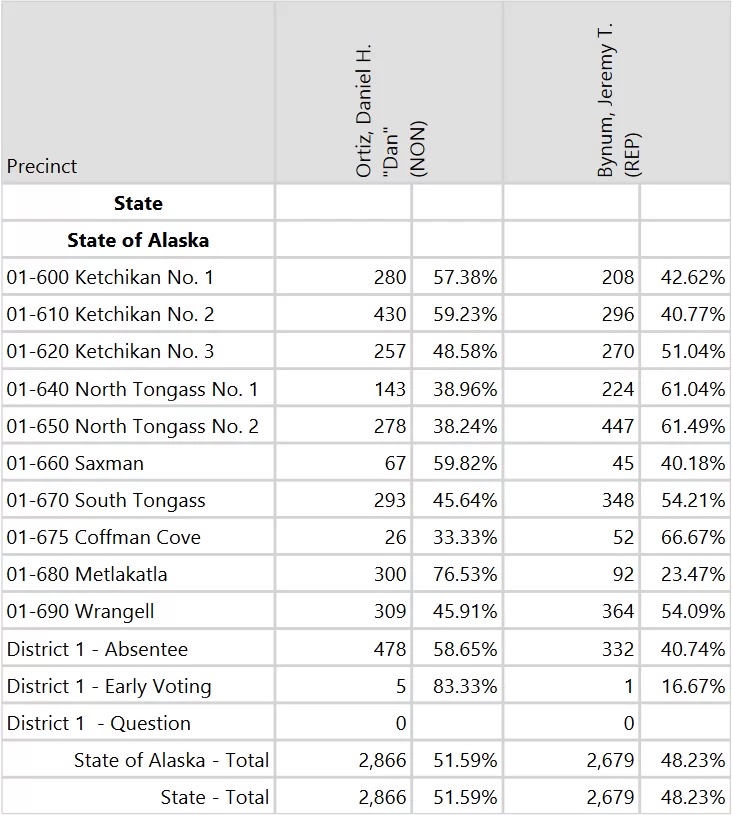
A chart showing the breakdown of votes in different voting districts
This table shows a precinct-by-precinct breakdown of the vote in the House District 1 race. (Alaska Division of Elections)

He congratulated Bynum on a well-run race.

“He got out there in a lot of different ways and certainly worked hard at it and ran an overall good campaign, I felt, and ran a clean campaign as well. So hats off to him. He was a very worthy opponent,” he said.

Absentees counted so far favor Ortiz by a roughly 60-40 margin. Bynum would have to flip that and win at least 62% of the remaining vote to pull ahead.

Even so, in an interview Wednesday afternoon, Bynum said he’s still hoping to eke out a victory.

“We are behind, but, you know, you can always be hopeful. A little bit of hope never hurts,” he said.

Bynum said he’s proud of the race he ran. He thanked his supporters.

“We put hard work into it, and the results are what the results are. We’re just going to continue working in the community and advocating for the things and the reasons why I decided to run,” he said.

Ortiz did the best in Metlakatla, where he won 75% of the vote. He also did well in Downtown and Newtown Ketchikan precincts, as well as Saxman, where he won almost 60% of the vote.

Bynum’s strongest supporters were in the Prince of Wales Island community of Coffman Cove and two precincts north of Ketchikan city limits. He got more than 60% of the vote in those three precincts.

Election officials will run a ranked choice tabulation on Nov. 23 once all valid ballots are counted. But in this two-way race, ranked choice voting is not expected to have an effect on the results.

The election is expected to be certified on Nov. 29.

Site notifications
Update notification options
Subscribe to notifications