
KRBD - Ketchikan

KRBD is our partner station in Ketchikan. KTOO collaborates with partners across the state to cover important news and to share stories with our audiences.

Ketchikan tribe’s business arm eyes ‘healing center’ to help with opioid crisis

A preliminary design for the proposed “10-mile project” that would include a substance abuse treatment center. (Photo courtesy of Camille Booth).

Ketchikan Indian Community owns a swath of land about 10 miles north of downtown, in the Mud Bight area. It’s been set aside for years, and the tribe’s new business arm is working to turn it into something big: what it calls a “healing center” for community members — Native or not — with substance abuse issues.

Ketchikan — and Southeast Alaska as a whole — has seen a steep rise in opioid-related deaths in the last few years. State health officials tallied 23 opioid-related deaths in Southeast in 2021 — the last year that data is available — and eight were in Ketchikan, with two in nearby communities.

Advocates have long rallied for more treatment options for the island. Ketchikan Indian Community President Norman Skan says that’s the problem the tribe hopes to address.

“About two years ago, we just saw the trend of opioid use just getting out of control — in not only in our community, but outlying communities,” Skan said. “And we felt like we needed to do our part to help the individuals out.”

It’ll be the first major project for the Ketchikan Tribal Business Corporation, essentially the business arm of the tribe. The corporation is a so-called IRA Section 17 Corporation, named for the section of the Indian Reorganization Act that sets out the rules governing it. It’s wholly owned by the tribe but operates separately. An online statement says that the corporation’s mission is “to develop Ketchikan Tribal Business Corporation into a stronger, healthier, and more prosperous organization that continues to reach higher levels of economic competitiveness.”

Camille Booth is the corporation’s operations manager.

“It gives us the benefits of being tribal with also being able to build revenue in other streams and other areas,” she explained. “So it’s very much our economic development arm.”

Booth said the corporation is “somewhat comparable” to regional and village corporations set up by the Alaska Native Claims Settlement Act. But instead of distributing profits to shareholders, dividends could potentially go to Ketchikan Indian Community members.

“Just like with any corporation, then, once the company is profitable, … dividends are likely, but the company has to be profitable before dividends are offered,” she said.

The corporation has three divisions — commercial, real estate, and government contracting.

Booth said the real estate division will focus on leveraging the tribe’s existing properties. The government contracting division could provide a variety of services.

“That could be an IT areas, it can be environmental services, it can be in procurement, there’s all sorts of areas of government contracting,” she said. “There’s all sorts of contracting that fit our type of effort.”

The healing center is part of a larger initiative dubbed “the 10-mile project,” from the corporation’s commercial division. The corporation hopes to develop the property with alternative housing for people in recovery, single-family homes, trails, and even tourist attractions and art installations.

“It’s very much the big vision. … In phases, of course,” Booth explained. “So the first phase would be the healing center and actually the substance use disorder center with housing for that sort of a transitional type housing, and then the next then it would build into the business area and then into additional housing out there because it is a very large property, too.”

John Brown is the corporation’s vice chair.

He said work is still in the beginning stages and the 16-bed inpatient treatment center — let alone everything else sketched out for the property — won’t open its doors for at least three years.

“They purchased the property and came up with, you know, and again, this was a long standing thing that he wanted to try to accomplish,” Brown said. “And so we are, we are part of that process. And so we’re in the process of, again, we’re putting ourselves in place, so we can do stuff. And then the next phase is ‘OK, how much funding do we need, who do we need to contact’ — those types of things.”

Details are a bit hazy in this early phase of the project, but Booth said she hopes the project will support community members in every stage of their recovery.

Craig issues boil water notice after failures at treatment plant

Water pours from Jacqueline Vaughan’s faucet on Sunday. (Photo courtesy of Jacqueline Vaughan).

Failures at the water treatment plant in Prince of Wales Island’s largest community have left some residents with dirty and discolored water and others with none at all. Officials in Craig issued a boil water notice Sunday evening and are asking residents to conserve water “as much as possible.”

Craig’s city administrator says crews are working to fix the problem, but it’s unclear when the water will be safe to drink again.
Late Sunday afternoon, Craig residents started to notice problems with their tap water.

Jacqueline Vaughan got home around 4:30 p.m. and did a double take when she opened her tap.

“Wow, it was coming out the color of bright, bright yellow, dark, bright yellow,” she said. “So I actually couldn’t believe it. “

June Durgan’s water is a dark brown, and she says she’s afraid to even boil it. Durgan says she’s seen other residents posting pictures of white-sediment filled water, bright blue water, or dark brown water.

“I’ve lived here my whole life and just turned 66 today, and have never seen anything like this,” she said.

Brian Templin is Craig’s city administrator. He said the pressure started to drop Sunday night.

“We had lost water pressure in most areas of town,” Templin explained. “Some areas don’t have any water, and other areas just have reduced pressure. Some areas have muddy or dirty water, that somehow mud has gotten into the system, because of low water levels in the system.”

Craig Public Works crews were able to get one of the plant’s four treatment systems running at full capacity that night.

By Monday morning, two others were working at partial capacity, and a fourth is expected to come back online late Monday or early Tuesday. But the plant won’t be working normally until two of those systems get new filters, and Templin doesn’t know when that will happen.

Templin said there had been minor issues with the water treatment system over the past few weeks. He said crews had been working toward addressing the issues when the outage happened.

The short of it is that the filter media in our treatment trains has been in need of replacement,” he said. “But in order to do that, of course, we have to shut down water treatment, and so the Public Works Department has been working on getting ready to do that. But those clogged media, the clogged filter media in the treatment trains, has reduced our capacity of treating water.”

Templin said around midday Monday that because of low pressure throughout the system, some areas are worse off than others.

“The points in the system that are farther out have less water,” he said. “And the points in the system that are higher in elevation have less water. But beyond that, it’s kind of spread all over Craig.”

Templin said crews will be looking for leaks in the system once water is working again.

But some residents say they feel like the city has left them in the dark. Vaughan, the resident with the yellow water, said the city owed it to residents to warn them — especially since there had been issues at the plant in the previous weeks.

“We’re not getting any answers from the city people,” she said. “And I think it’s a full-on crisis to tell you the truth, because of that.”

Durgan, whose bathtub is full of murky brown water, expressed a similar feeling.

“I think they kind of knew they weren’t gonna be able to fix it from the get go,” she said. “But yeah, anyway, I’m not really a happy camper with our city right now.”

Templin said crews are working nonstop to get the systems working again, and that before the outage, there wasn’t information to give out.

“We were dealing with some issues with the system, but we weren’t at a point that there was any information really to give out to the public” he said. “The failure yesterday came as a surprise.”

Templin said that residents should report any leaks they see around town, including in their own homes.

Until the boil water notice is lifted, residents are advised to boil all water used for drinking, cooking or teeth-brushing for at least two minutes. The notice will remain in effect until the state Department of Environmental Conservation determines that the water is safe to drink.

Klawock’s city hall opened its doors to Craig residents who need to fill up buckets of water today. Craig City School District schools are closed for the day, along with the public library, the youth center, Craig Tribal Association offices and Whale Tail Pharmacy.

Borough officials in Ketchikan call for more aggressive management of sea otter populations

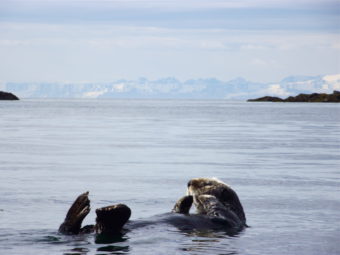
A sea otter floats on its back. (Photo by Theresa Soley/KTOO)

John Ryan lives in Hollis, on Prince of Wales Island. He’s seen the island’s population of sea otters soar over the last handful of years, and he’s worried. Residents like Ryan worry the boom will shut down profitable dive fisheries — like sea cucumbers and geoduck.

“The quota has gone down over the years, and it’s hurting people’s livelihoods,” he said. “That money that’s generated from that, it’s going through and it’s raising families and puts food on families’ tables.”

Sea otters have a critical place in the ecosystem. Scientist and University of Alaska Southeast professor Barbara Morgan said otters eat shellfish that would otherwise decimate vital kelp beds — which would be a big blow to the ecosystem. The sea urchin is the main predator for a kelp bed, and they happen to make up a large portion of the sea otter diet.

“Kelp beds are hugely important to the environment that they are in,” Morgan explained. “They provide protection for the coast that they are along. They break the power of waves as they come onshore. So that really limits how much the wave can affect the coast.”

But there wasn’t always a healthy population in Southeast. Russian fur traders overharvested the animals in the 18th century, and years later, wildlife officials started to try and build the population back up. Now, there’s thought to be more than 25,000 animals around the region.

Now that otters’ numbers are growing rapidly, Morgan said one specific concern is that established populations on the western outer coast of Southeast Alaska will make their way into the inner channels of the Alexander Archipelago.

“And that would put them into areas that have really active shellfish fisheries, crab, in particular, shrimp, and people don’t want the sea otters to impact harvests of those fisheries and wipe them out,” Morgan explained. “Totally understandable. I’m not sure that we’re an imminent threat, though.”

But Ryan said he wants to get ahead of the issue before it becomes a bigger problem. He shared his concerns in a proposal to the Board of Game, asking the state to devise a plan to manage otter populations.

The board dismissed the proposal out of hand before the meeting began. They said they don’t have jurisdiction. That’s because sea otters are protected under federal law by the 1972 Marine Mammal Protection Act.

“It’s not something that’s going to be put into place overnight,” Ryan said. “It’s going to take years. But there needs to be a harvest.”

So Ketchikan’s Borough Assembly highlighted it as a key federal policy issue during a recent lobbying trip to Washington, D.C.

Borough Mayor Rodney Dial says local officials want to see the federal government manage otter populations more aggressively — or turn over management to the state.

“So we’re just asking for a dialogue,” Dial said. “We’re asking for the federal government to be involved in the process, to listen to people on the local level, and hopefully, that we can all work together to, you know, — because everybody loves sea otters. And, you know, we just need to find a way to balance the population so that the sea otter population doesn’t wipe out populations of other creatures.”

As it stands, sea otter populations are managed by the U.S. Fish and Wildlife Service. Current protections allow Alaska Native people to harvest sea otters for subsistence food purposes, and use their fur to create goods and sell them in the form of handicrafts. Federal regulations state that an individual has to have at least one-fourth blood quantum to be a qualified hunter, and they must be from a coastal area.

Anyone who is not Alaska Native is federally prohibited from harvesting the animals, or selling or buying their pelts.

Fishermen have raised concerns over otter populations before — in 2010, then-Congressman Don Young introduced a bill that would roll back some restrictions on the sale of sea otter pelts in response to pressure from fishermen.

Grant EchoHawk, one of the assembly members who traveled to Washington with Dial, said the goal is simply to find balance, and strike up a conversation.

“What we’re looking for is to make sure that … the pendulum isn’t swinging too quickly in the wrong direction,” EchoHawk said.

EchoHawk said he wanted to make sure that lawmakers had the most up-to-date data on otters in Alaska, since the populations have risen considerably since the species came under federal control. A 2015 University of Alaska Fairbanks study found that Southeast Alaska’s sea otter populations have grown by 10% to 15% each year.

“Ultimately, we just want to make sure there’s smart decisions being made,” he said.

No matter what happens, Ketchikan’s tribe says that area tribes need to be involved in the decision-making.

“Anybody who’s proposing changes in the regulations should be talking about the tribes before they propose regulatory changes,” said Tony Gallegos, Ketchikan Indian Community’s cultural resources director.

Gallegos said that tribes are best able to manage the sea otter population, as part of their traditional lifestyle. He said that right now, he doesn’t want to see any changes to the federal law protecting the otter — at least, not until scientists have better data.

“There needs to be a determination on what a good optimal population size is and then try to maintain the sea otter population at that level,” he said. “And that’s probably going to require culling those populations by hunting.”

Whether any changes are coming, though, is an open question. Officials at the U.S. Fish and Wildlife Service declined to say whether they’re exploring options for otter management.

A previous version of this story had an incorrect current population estimate for sea otters in Southeast Alaska. The number has been corrected. 

20 pounds of meth, hidden in tortillas on a state ferry, seized by law enforcement in Southeast Alaska

Security guards watch as passenger embark on the ferry Columbia in Ketchikan on Feb. 17, 2023. (Photo by Eric Stone/KRBD)

Twenty pounds of methamphetamine were seized last week in what law enforcement is calling one of the largest drug busts in Southeast Alaska in recent years. A regional drug enforcement team worked together to locate the meth, which was bound for Alaska on a ferry.

It all started with a tip. According to court documents, Alaska State Trooper Sergeant Casey Hershberger contacted the Southeast Alaska Cities Against Drugs task force to say he’d heard a shipment of meth would soon make its way towards Alaska. And it would be big: 10-plus pounds.

“We received some information from down south with some partnering law enforcement agencies that there may be a person traveling to Juneau on the Alaska Marine Highway System that was carrying a large quantity of methamphetamine,” Lt. Krag Crampbell of the Juneau Police Department said in a phone interview Monday. JPD is among more than a dozen agencies contributing to the task force.

The meth would sail the Inside Passage on the ferry Columbia, from Bellingham to Juneau. But after a trip up the coast of British Columbia, the meth’s journey was interrupted in Ketchikan on Feb. 17.

Acting on Hershberger’s tip, a state trooper and a Ketchikan detective boarded the Columbia with a search warrant for stateroom 151A and its occupant, 43-year-old Oregon man Michael D. Davis.

There, they found a blue duffel bag. Inside, said Ketchikan Police Lt. Andy Berntson, were 18 packages of meth wrapped in tortillas.

“That was a new one. Looked like big ol’ overstuffed burritos,” Berntson said in a phone interview Monday.

The packages totaled roughly 20 pounds, and are valued at over $1 million, according to police. Officers arrested Davis on a felony drug charge and booked him at Ketchikan Correctional Center. He’s facing a felony drug charge that carries a maximum sentence of 10 years in prison. Information on bail was not immediately available.

While Davis’s journey ended in Ketchikan’s jail, the blue duffel bag continued north on the Columbia, along with what investigators describe in court documents as a “representative sample” of the seized drugs.

But now, the bag’s traveling companion was Jack Ford, a Ketchikan Police Department detective.

“Throughout that investigation, we were able to determine that the end goal for that methamphetamine was, it was supposed to go to a person in Juneau, who was supposed to pick it up at the ferry,” Campbell said.

When the Columbia docked in Juneau’s Auke Bay, Detective Ford walked off the ferry with the blue duffel and a phone seized from Davis.

According to court documents, investigators believed the meth was coming from Miles Martin, an Oregon resident and the son of 59-year-old Juneau woman Nanette Brown. So Detective Ford texted Brown to let her know he’d arrived.

Soon afterward, a silver Nissan pickup pulled up. The driver told the undercover detective to put the bag in the truck, and the two went their separate ways. Shortly after, police stopped and arrested the driver, who they identified as Nanette Brown’s husband, 60-year-old Rodney Brown.

Then officers’ attention turned to the Browns’ Vista Drive apartment in Douglas.

They watched as Nanette Brown went to a neighbor’s apartment carrying a multi-colored bag. Police say it contained two ammo boxes — one with nearly $70,000 in cash, the other with more than half a pound of meth and roughly 150 pills thought to contain fentanyl.

Police arrested Nanette Brown and searched her home. According to court documents, they found nine guns and another cache of meth. The Browns are facing two felony drug charges and a felony weapons charge.

The Browns and Davis have pleaded not guilty. They’re due for court hearings in the coming weeks.

All told, the bust was among the largest in recent memory. Campbell says it’s the biggest he’s overseen in the three years he’s led the Juneau Police Department’s drug unit. He says he expects it’ll make a dent in the supply of meth in Juneau.

“I think that’s going to (have) a huge impact. We don’t see that quantity come into Southeast Alaska — it’s very, very rare,” he said.

Berntson, the Ketchikan lieutenant, says he expects the 20-pound bust to reduce the supply of meth in smaller communities throughout Southeast Alaska. And he says that’s the goal of the regional task force — though drug trafficking is sometimes thought of as a victimless crime, Berntson says that misses the bigger picture.

“When people get on these types of drugs, they aren’t the people they used to be,” he said. “They do things out of desperation. They do things because they need to get the drugs, and so that just trickles into all other areas of crime.”

Berntson says it’s also become somewhat rare to see busts aboard state ferries. Many recent busts have been tied to air travel or the mail. Berntson chalks it up to a couple of factors.

“The sailings haven’t been as frequent in recent years,” he said. “Drug dealers essentially like a couple of things. One, speed, and two, reliability.”

Ketchikan podcast puts the spotlight on Filipino culture and voices

Archie Inoncillo, the host of the Halo-Halo Mix-Mix podcast, talks with students Ellhyn Alva, front, and Czarina Cabillo, back, during a recording session at Pilothouse Coffee on Jan. 15. (Raegan Miller/KRBD)

A Ketchikan podcaster is breaking down all things Filipino culture. Halo-Halo Mix-Mix started up last summer and launched a revival this year. KRBD’s Raegan Miller stopped by a recent recording session to learn more.

Halo-halo — a Filipino crushed ice dessert — is a refreshing, cool treat on a warm day. And that’s what Archie Inoncillo wants his podcast, Halo-Halo Mix-Mix, to be like for Filipino listeners.

“I love halo-halo, and it’s one of my favorite desserts,” Inoncillo said during a recent recording session at Pilothouse Coffee. “But here is the debate. Is it an edible dessert? Or is it a drink? What do you think?”

The question was his playful opener to an upcoming episode that tackles a wide variety of topics — ranging from language barriers and education to superstitions and Filipino representation in pop culture.

Inoncillo had two guests, Czarina Cabillo and Ellyn Alva, members of the high school’s Fil-Am Club. The two students both moved to the United States from the Philippines — Cabillo when she was 14, and Alva when she was 10.

So, is halo-halo a drink or dessert?

“Oh, good question,” Alva said.

“I would say edible, because of the ice cream, there’s a lot of stuff in there,” Cabillo chimed in.

Halo-halo was just one of the topics they took up with Inoncillo. The trio chatted with their host about topics big and small — including what it feels like to find community in Ketchikan as a Filipino person.

For Alva, Ketchikan High School’s Fil-Am Club was a gateway to the Filipino community. Before joining, she didn’t hang out with many of the other Filipino students.

So that was the start that I started hanging out with Filipinos — it was really scary to speak Tagalog, too,” she said.

Through the course of the podcast, the trio unpacks shared experiences. That includes a frank discussion of the different pressures they all feel when it comes to speaking Tagalog, the national language of the Philippines.

Cabillo shared she still gets nervous speaking English, her second language.

“I talk with adults, and it’s fine,” she explained. “But if I talk to the people my age, they just, I don’t understand the slang and stuff. And they would say like, ‘Oh, that’s wrong. Did you mean this? And I’m like, sorry. I’m sorry. I’m Asian.’”

And it goes both ways. Host Inoncillo was born in Ketchikan to Filipino parents and said he struggles with Tagalog. He said he practices plenty, but he  still braces himself for jokes about his language skills.

“It doesn’t feel like a joke,” he said. “It feels like I’m not being authentic enough as a Filipino because I don’t know that. I can’t speak the language.”

The podcast episode — which is still in production — will also touch on conversations about Filipino traditions.

Cabillo mentioned someone jumping with coins in their pockets when the clock strikes midnight on New Year’s Eve.

“I think they have to jump five times so they could get taller for that next year,” she said. “It never worked.”

“I think I stopped jumping after a while,” Inoncillo joked.

They also talked about the darker side of Filipino superstition — like stories of monsters that prey on pregnant women and other vampire-like creatures.

“My favorite one is the Manananggal,” Cabillo said.

“Oh man, where it’s like — I had dreams,” Inoncillo responded.

“It’s an Aswang, but his lower body is separated and he flies away,” Cabillo said about the monster.

The conversation touched on the growing number of Filipino people represented in mainstream TV and movies.

“It’s like there’s a whole lot more Filipino stuff in the media now though,” Inoncillo said. “Like in the mainstream media.”

“It’s so cool,” Cabillo responded. “I think it’s because there’s a lot of people here and Jo Koy (actor) has been doing a great job promoting Filipino culture.”

Reflecting, Cabillo said the Filipino community in Ketchikan is one that tries to make you feel like you’re in the Philippines. But she wants the community to stretch out in Ketchikan, and invite more people in.

“Why wouldn’t we do it in a bigger place so everybody could feel it?” she said.

The Halo-Halo Mix-Mix podcast is a project of the Ketchikan Wellness Coalition’s Strengthening Cultural Unity task force.

Metlakatla launches homegrown historical archive: ‘We have the right to know about our people’

A photo of the Duncan Memorial Church fire in 1949. (Photo courtesy of the Annette Island Reserve Historical Archive)

Alaska’s only reservation is fighting to reclaim how its story is told. Metlakatla residents hope that by filling the new Annette Island Reserve Historical Archive with pictures, videos and sounds, future generations will know where they came from — and the current generation will remember the past.

Right now, when someone writes about Metlakatla, they don’t always get to hear the story from the people who live there. Tribal Councilmember Keolani Booth said that’s because there’s not a central archive to store the tribe’s stories and memories.

“You know, when anyone writes about Metlakatla, or does anything … we’ve got one narrative — that’s from our narrative, and, and I think the fact that we don’t have that right now, it’s left up to interpretation by anyone who would want to write about Metlakatla,” Booth said.

Reggie Atkinson is a former Metlakatla mayor. He told KRBD there have been efforts to build archives in Metlakatla before, but they haven’t been digitized, and they aren’t organized.

“We do have a building right next to our council chambers and it’s (an) archive building,” he explained. “There’s archive boxes stacked in there, and actually, I don’t even know what’s in there. I went in there once.”

Atkinson said he’s heard that there are historical images of Metlakatla inside Duncan Church, and that relatives might have even more.

“There are people saying they have photos,” he said. “I know for a fact that a relative has eight millimeter movies from his father. His father was in the territorial guard unit here then.

The Metlakatla Indian Community contracted Caitlin Steinberg, a researcher from Wisconsin, to come to the island and help develop the Annette Island Reserve Historical Archive. When it’s finished, Steinberg said the archive will hold pictures, videos, and interviews with local elders and families.

“It’s been brewing for decades, it seems, in Metlakatla,” she said.

The effort will involve the whole community, largely led by youth: students will interview their parents, aunts, uncles and neighbors, learning more about their family’s history, as well as the history of Annette Island.

“So there was already this hunger for this place for anyone to just go find their stories of their family in the community,” she said. “And it was born from talking about all these different ideas and all these, you know, hopes and wishes for how organizing Metlakatla’s history could benefit the people.”

Once the interviews are completed, Steinberg says they’ll be filed away along with a questionnaire, created by residents.

Steinberg says there will be a little of everything in the archive — from stories about the founding of Metlakatla to the history of residential schools and what life was like in World War II.

“And it’s also going to be fishing, hunting, gathering, you know, it’s going to be things about stories about the old cannery and you know, when there would be coffee meet ups at the old cannery as well as the fishing culture down at the docks,” she said.

The archive will be contained in a room at Metlakatla High School, and anyone will be able to record an interview for the collection.

The work has already started taking shape. On a recent Friday afternoon, community elders gathered at Metlakatla High School for “coffee with elders.”

The recording is a little hard to hear, but resident Henry G. Smith spoke about the value of the archive in this clip from the event sent to KRBD.

In the clip, Smith said, “It’s a good thing for the kids to learn … the history of where thier parents, their grandparents, their great-grandparents came from, how Metlakatla came about. It’s good for them to know this stuff, to know the history of their ancestors.”

And Booth, the councilmember, hopes that knowledge will be preserved for future generations in Metlakatla.

As a councilmember, Booth said if he wanted to look back at something a past member had done, in most cases, he’s out of luck. He doesn’t want that to happen to future generations.

“And there are things that I’d love to speak to Henry Littlefield about, or Solomon Guthrie,” he said. “And they were councilmen, many, many years ago. And, you know, if they didn’t write it down, we don’t know. So I think it’s really going to help a lot in the continuity of serving the community, passing information, and, and preserving our culture.”

“You’ve got to know what you’ve done to move forward,” he added.

He hopes the archive will help preserve knowledge of times both good and bad, as well as traditional language.

It’s things that we need to know, and we feel we have the right to know about our people,” he said.

Booth says that Steinberg, the contracted archivist, plans to train a member of Metlakatla’s tribe to take over as lead historian, once the project is fully on its feet.

Site notifications
Update notification options
Subscribe to notifications