KUAC is our partner station in Fairbanks. KTOO collaborates with partners across the state to cover important news and to share stories with our audiences.
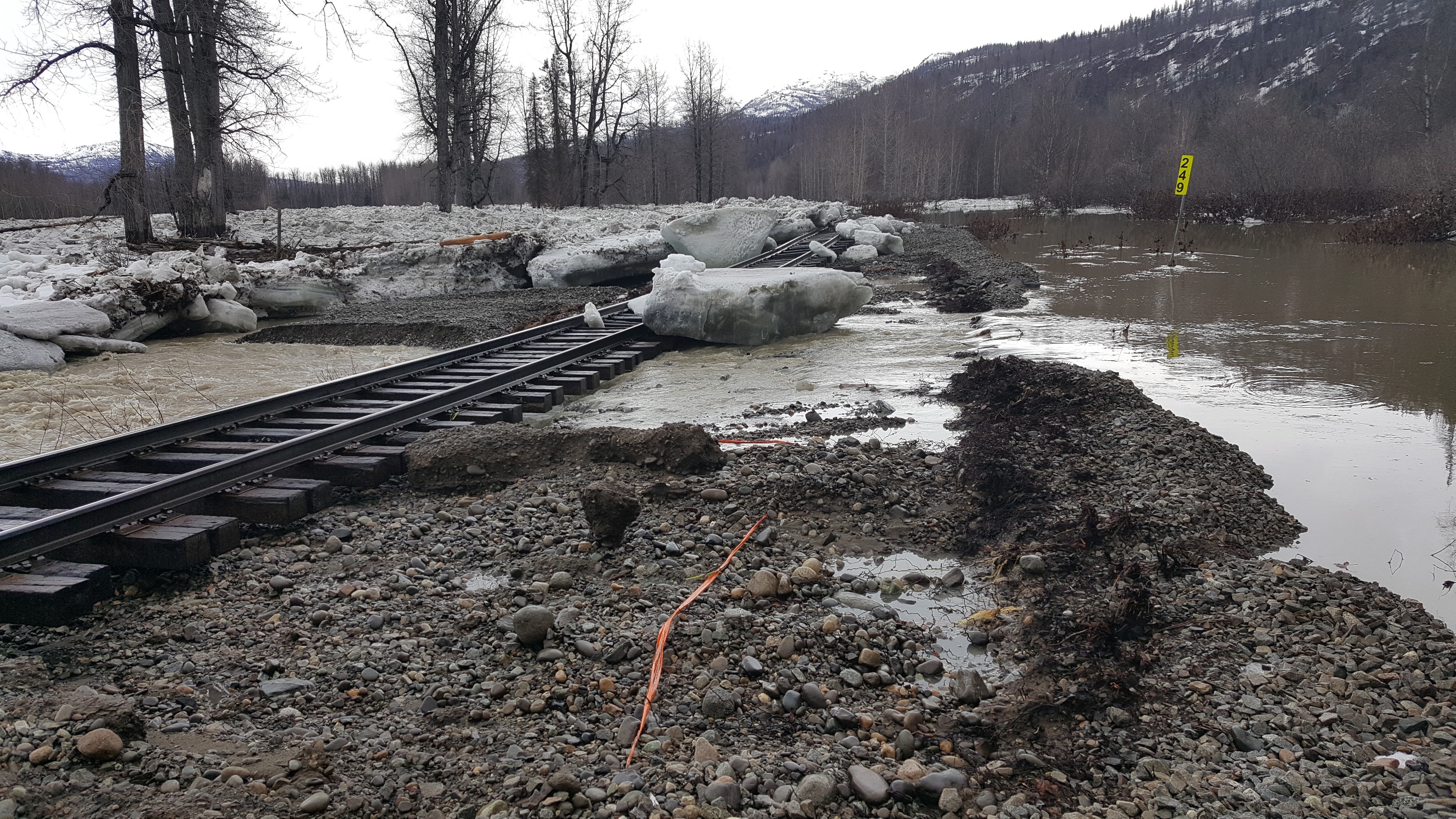
An ice jam Saturday led to flooding and large chunks of ice on the railroad tracks north of Talkeetna. (Photo courtesy Alaska Railroad)
Flooding that halted Alaska Railroad trains north of Talkeetna on Saturday, has receded, but train traffic remains shut down.
Railroad spokesman Tim Sullivan says that’s because the Susitna River ice jam flooding left behind a mess.
“A 6- to 8-foot-high wall of ice over the course of well over 1,000 feet, maybe close to half a mile of ice that we need to get cleared out of there,” Sullivan said. “In some places it has pushed the track off the track as far as 25 feet, so our crews are working to get the ice out of there and get the track back on the track bed.”
Sullivan said the impacted track is in the Curry area, about 22 miles north of Talkeetna.
The railroad’s final winter season trains were halted by the flooding Saturday, and buses were used to move the passengers. He says the goal is to complete cleanup and repairs in time for Wednesday’s scheduled start of the railroad’s daily summer passenger service between Anchorage, Denali and Fairbanks.
”This window is something we’re gonna try to take as much advantage of as we possibly can,” Sullivan said. “And get those tracks cleared up and everything back into good shape so we can have our service going on Wednesday.”
Sullivan said some cargo scheduled for transport has been shifted to truck.
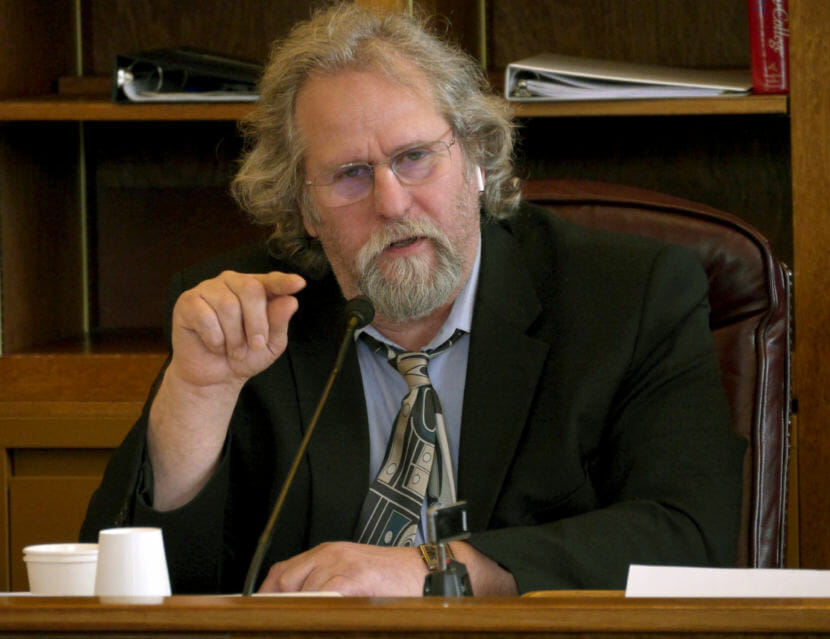
Rep. David Guttenberg, D-Fairbanks, comments on a state operating budget amendment in the House Finance Committee in the Alaska State Capitol on March 6, 2018. (Photo by Skip Gray/360 North)
David Guttenberg will leave his decades of service to his district and the state Democratic party to enjoy life in his home in Goldstream Valley.
Longtime Fairbanks lawmaker Guttenberg decided against running for re-election to an ninth term in the Alaska House of Representatives.
In his usual straightforward manner, Guttenberg said he wants to dispense with the usual speculation that ensues whenever a politician announces he or she has decided to leave elected office.
“My health is fine – has nothing to do with my decision,” the 66-year-old said. “I have no legal matters hanging over my head, right? You’re not going to hear about something come down later on.”
Guttenberg washospitalized earlier this year for chest pains. But he says his reasons have nothing to do with that, nor with anything political.
Instead, he says they have everything to do with enjoying life.
“It’s time for me to step out, for me to just catch up on my personal life,” Guttenberg said. “The house is continually being remodeled and not finished, because of all the endless special sessions. My gardens have been neglected.”
Guttenberg still is in Juneau an extended legislative sessions, made longer by ongoing disagreement over putting together a state budget that’ll pay for the services Alaskans demand, but that will also satisfy Republicans’ demands for more spending cuts.
“People want to talk about cutting the budget, but at the same time they want services,” Guttenberg said. “They want the full PFD. To get people all of those things is very difficult now.”
Despite the rancor of the annual budget ordeal, Guttenberg said he feels good about playing a role in helping pass many important pieces of legislation during his 16 years representing the 4th District, which sprawls north and west of the city.
Before redistricting, he represented the 8th District.
Guttenberg especially is proud of his years-long effort to get a veterans cemetery for Fairbanks, he said, adding: “This summer, they’re actually going to do the groundbreaking for that.”
Another major accomplishment, Guttenberg said, was helping get both the House and Senate to unanimously pass so-called PDM or prescription-drug manager legislation.
He said it was “a significant piece of healthcare legislation that will drive down prescription-drug prices and keep our local pharmacies in place.”
Guttenberg said his disappointments include not being able to persuade his fellow lawmakers to do more about the lack of broadband internet connectivity in many places around the state.
Guttenberg has been involved in Alaska politics since 1986, when he became treasurer of the Interior Democrats.
He was elected chair the next year, and went to serve as chair of the state Democratic party and national committeeman.
Guttenberg was scheduled to officially announce his decision to leave office during a during a meeting of the Laborers Union Local 942.
Mindy O’Neall, the present chair of the Interior Democrats, said that’s an appropriate setting.
“David Guttenberg has been a great advocate for the Interior,” O’Neall said. “He’s been a great advocate for labor and working people and education for the last 16 years. And we sure have been lucky to have had his representation for that long.”
O’Neall said because of his service, no other Democrat has challenged Guttenberg over the years.
She anticipates a fair amount of interest in the 4th District seat now that the longtime occupant is leaving it.
Correction: An earlier version of this story and headline understated how many terms Guttenberg has served. Guttenberg won’t seek re-election for a ninth term, not his eighth.
National Weather Service will automate weather balloon launches in Alaska to concentrate staff at the agency’s urban forecast offices.
The first automated weather balloon launcher came online last fall in Kodiak, and the second recently went into service in Fairbanks.
A weather balloon rises over the new autolauncher in Fairbanks (Photo courtesy Ed Plumb/National Weather Service)
Meteorologist Ed Plumb describes automated steps leading up to a balloon launch.
“This beeping starts about 15 minutes before the balloons can release, and this is indicating that there’s hydrogen now flowing and filling up the balloon,” Plumb said.
The $700,000 robot sits on a gravel pad near Fairbanks International Airport, the same location where twice daily launches have occurred for decades.
The new automated launcher responds to the push of a button at the Weather Service’s Fairbanks headquarters five miles away, sparing staff from twice trips to manually deploy the atmospheric data gathering balloons.
Plumb said meteorologists will use the freed up time to work more closely with government agency and industry customers.
”The Weather Service has sorta shifted its paradigm,” Plump said. “This is just a little piece where it gives us more time to do that sort of mission.”
“Our plan is to reinvest these positions and re-invest the people,” Weather Service regional director Carven Scott said.
Scott said positions eliminated by auto launchers at 11 rural Weather Service offices will shift to forecast stations in Fairbanks, Anchorage and Juneau.
“We will lose some capability, some operation capability, at these WSOs,” Scott said.
Jim Brader is a longtime agency meteorologist in Fairbanks, and Alaska chair of the National Weather Service Employees Organization, which takes issue with the automation and downsizing of rural Alaska offices.
”We basically are spending $17 million in Alaska to outsource 30 jobs across rural Alaska, where jobs are highly needed, and reducing services to rural Alaska too.”
The Weather Service’s Scott counters that the balloon launch technology needs upgrade and that it’s a struggle to staff the agency’s remote offices.
”It’s much easier to fill a position in Fairbanks, Juneau and Anchorage than it is in Kotzebue or McGrath,” Scott said.
Scott emphasizes that the Weather Service is not abandoning rural Alaska, and plans to keep one paid caretaker at each station, and train up a base of local volunteer observers.
”To help us have eyes in the villages, to report on a severe weather event,” Scott said.
Additional stations scheduled for downsize and transition to automated weather balloon launchers this summer include those at Annette Island, Yakutat, Utqiagvik, St. Paul and Bethel.
Alaska’s six other stations will convert the following year.
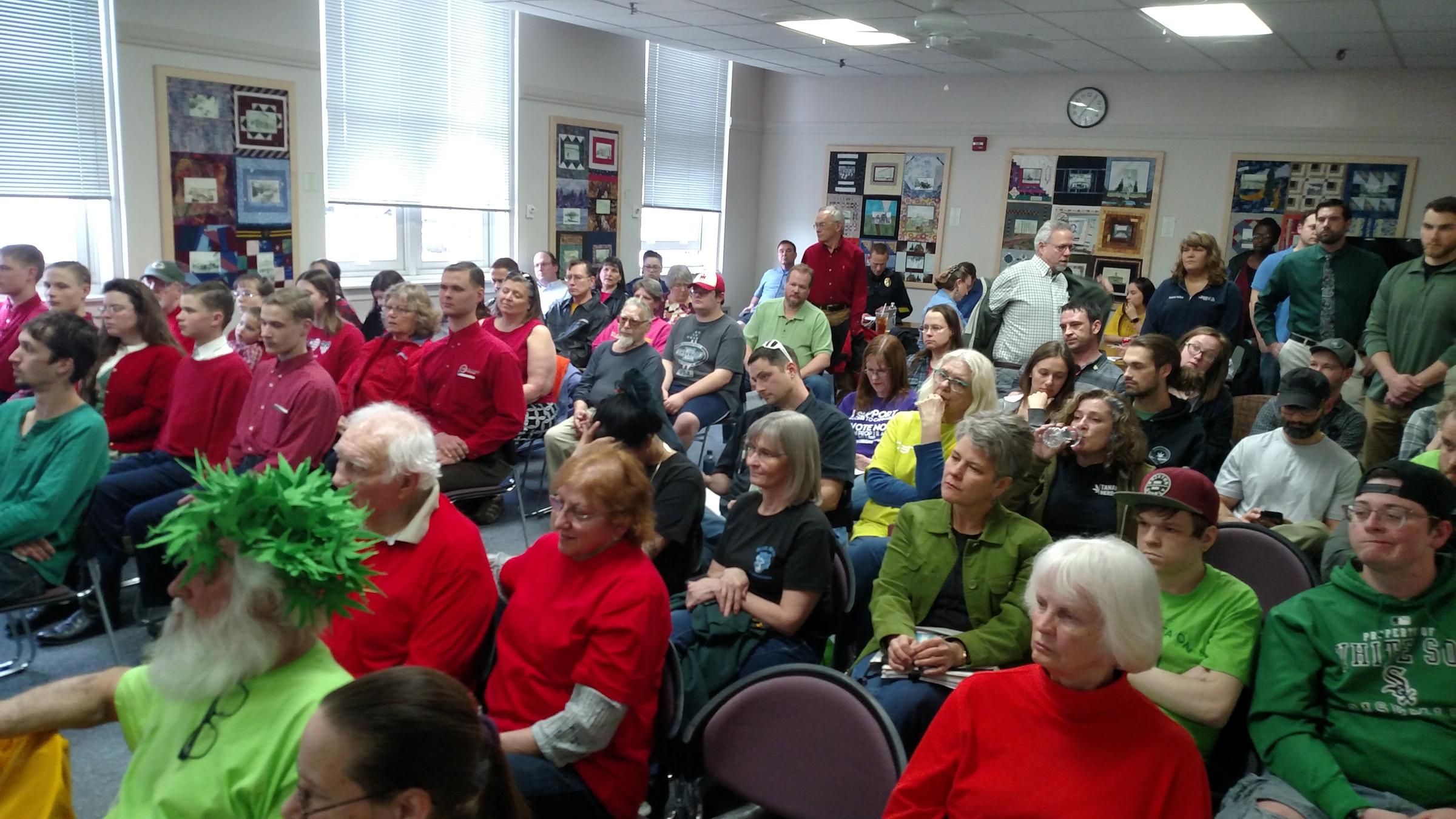
Most of the standing-room-only crowd that turned out for Monday’s City Council meeting identified themselves by wearing red shirts, for those supported stricter marijuana regulation, and green shirts, for those favoring looser regs. (Photo by Tim Ellis/KUAC)
After a heated debate, the Fairbanks City Council approved an ordinance Monday that added regulations to the marijuana industry.
The amended ordinance maintains the city’s ban on on-site consumption of cannabis, but it would allow more than twice as many retail shops as the original introduced by Mayor Jim Matherly three months ago.
Council chambers were packed with partisans for and against the marijuana-regulating ordinance.
Councilmembers debated a flurry of amendments to the ordinance, starting with a provision limiting the number of retail shops in the city to 12, the number of shops that were either currently operating or about to open.
“Nine were open, three were in the queue — that’s where I originally started with the 12 to get it on the table for discussion,” Matherly said.
Jerry Cleworth and June Rogers introduced the substitute ordinance setting set the limit at 15, based on the principle that marijuana ought to be regulated like alcohol, as legalized-marijuana supporters have long advocated.
“Right now, inside the city, we have 15 operating package stores, which is the equivalent to a retail establishment for cannabis,” Cleworth said.
Valerie Therrien moved to amend the substitute ordinance to eliminate the limit and to delete a provision that would require the city to reduce that number to 11 over time.
“We don’t need to put a number on the number of establishments that we need to have in our community,” Therrien said. “I believe that zoning is going to take care of that.”
The council members approved that proposal 5-1, with Cleworth dissenting.
Therrien then moved to increase the retail-store limit to 25. She said that would be fair for the six shops now in business, as well as the three that are close to opening and 16 others that’ve submitted applications and are under review by the state Alcohol and Marijuana Control Office.
“I don’t think it was fair to the marijuana industry to limit the number of licenses after people had already initiated and spent their money,” Therrien said, “And now say to them, ‘Oh, we’re going to cut it down to 15.’”
The council narrowly approved setting the limit at 25, after a lengthy debate, with Cleworth, Rogers and Jonathan Bagwill voting no and Joy Huntington, David Pruhs and Therrien voting yes. Matherly cast the fourth and tie-breaking affirmative vote.
Pruhs and Therrien also prevailed in a vote to eliminate a proposal to establish a new method of measuring the minimum buffer of 750 feet between a marijuana retail shop and residential areas, schools and rehab facilities.
Their amendment re-established the use of the borough’s simpler system of measuring property line to property line.
They did not succeed in convincing the council to go along with a provision to authorize establishments to allow consumption of marijuana on-site.
Pruhs told marijuana advocates at the meeting that’s unlikely to happen anytime soon.
“No one on this council has a taste for on-site consumption,” Pruhs said. “It’s not legal in the state of Alaska. It’s not legal in Fairbanks.”
But the council approved the amended ordinance 6-0. Afterward, Matherly suggested to all in attendance that they may not have heard the last word on the issue.
“This is not the last you’ll see of this ordinance, I’m sure, and the discussion surrounding it,” Matherly said. “Just so everyone knows.”
But for now, the city’s marijuana industry has for the first time a complete set of rules under which to operate.
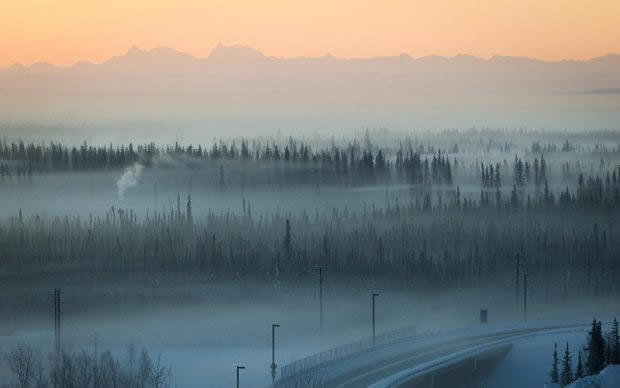
State and borough air-quality regulators are working to develop programs and staff to help clean up air pollution that sets in on cold winter days in Fairbanks. (File photo by KUAC)
The Fairbanks North Star Borough received a $4 million federal grant to improve local air quality.
Last month, the Environmental Protection Agency announced the Targeted Air Shed Grant, the latest aimed at reducing fine particulate pollution from wood and coal burning.
Borough air quality manager Nick Czarnecki said the grant will fund a borough program to help people convert cleaner burning fuels.
”The big difference with this funding is it’s going to target switching out solid fuel burning appliances such as wood, pellet and coal to cleaner burning alternatives such as fuel oil, natural gas or propane,” Czarnecki said.
Borough residents residing within an EPA defined air quality non-attainment area can also apply for funds to purchase emergency power backup systems to eliminate the need for wood fired heaters, Czarnecki said.
”Such as a battery backup or a generator or solar panels that would provide power to their oil boiler,” Czarnecki said. “If the power goes out, you know, they would still have heat.”
Participating in the borough program brings a deed restriction that bans future installation of solid fuel burning devices at the property.
He said the grant will take a bite out of the estimated 12,500 wood and coal burning stoves and boilers in the non-attainment area.
”We’re projecting that this money can be used to change out around around 476 devices,” Czarnecki said.
Qualifying residents are eligible for between $6,000 and $14,000.
”The $14,000 is specifically for if you remove a hydronic heater and go to electric, natural gas or propane,” Czarnecki said. “The incentive levels are based on the level of emission reductions we get because we want to incentivize those devices that would see the greatest emissions reductions.”
Czarnecki notes that there’s still $1.7 million remaining in an earlier EPA grant funded version of the borough program, which helps residents upgrade to more efficient wood stoves and boilers.
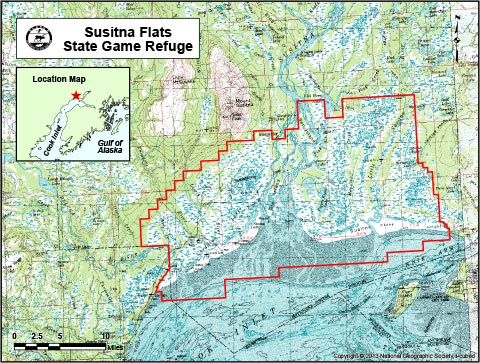
A map of the Susitna Flats State Game Refuge — one of the eight state wildlife refuges to add “hunting preserve” to their names under HB 130. (Image courtesy Alaska Department of Fish and Game)
The Alaska Senate passed a bill that adds “hunting preserve” to the names of eight state wildlife refuges.
The original version of the bill passed by the House last year, clears up boundary discrepancies for numerous state refuges and critical habitat areas.
The refuge name changes were added in a Senate committee Friday at the request of Anchorage Republican Sen. Cathy Giessel.
Giessel told the full Senate Wednesday that it more accurately reflects the refuge’s purpose.
”Hunting is available in all of the places we added ‘hunting preserve.’ Mr. President, a lot of people seem to think hunting is a dirty word,” Giessel said. “I would oppose that attitude. As Alaskans, we should take pride in our hunting heritage, our hunting tradition.”
The amended bill also replaces the word “protect” with “conserve” in regard to the refuge and habitat areas purpose, terms the Alaska Department of Fish and Game officials say are interchangeable, but Anchorage Democratic Senator Bill Wielechowski questioned.
”If it’s not gonna change anything, why are we changing the words,” Wielechowski said. “Of course, it’s gonna change something.”
Wielechowksi referred to a legal opinion provided to legislators that says the wording could sway future refuge management.
Wielechowski also expressed concern that the name and purpose wording changes were made in a committee, without opportunity for public comment.
”Just in the last couple days since this ha happened, we have gotten letters of opposition,” Wielechowski said. “We have gotten letters and emails and phone calls people who are saying, ‘No. Don’t change this. Give us an opportunity to weigh in on this. We don;t know how this will change things.”