KUAC - Fairbanks

KUAC is our partner station in Fairbanks. KTOO collaborates with partners across the state to cover important news and to share stories with our audiences.

Defense secretary highlights Alaska’s strategic military role during Eielson visit

The U.S. military increasingly relies on Alaska, the defense secretary said Monday, both to provide a base of operations to maintaining dominance of the Indian and Pacific oceans to the south and to enable the Coast Guard and Navy to maintain control of U.S. Arctic waters, to the north.
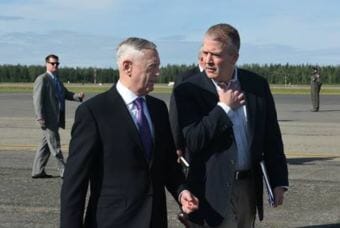
Secretary of Defense James N. Mattis speaks with Alaska Senator Dan Sullivan on June 25, 2018 on the Eielson Air Force Base, Alaska, flight line. Mattis and Sullivan held a joint press conference after a visit to Fort Greely, Alaska. (Photo by Airman 1st Class Eric M. Fisher/U.S. Air Force)

U.S. Defense Secretary James Mattis spoke at a news conference Monday morning at Eielson Air Force Base, after a tour of the missile-defense facility at Fort Greely.

Mattis stopped at Eielson during the first of a five-day trip to Asia, where he’ll meet separately with Chinese, South Korean and Japanese officials.

He told reporters at Eielson before resuming his trip that the military sees Alaska as the key to the U.S. military’s policy of maintaining dominance of what he calls the Indo-Pacific region.

“It is probably the gateway to the Pacific in many, many ways,” Mattis said.

Mattis has just returned from a quick tour of the missile-defense base at Fort Greely.

He says the interceptor missiles there constitute the cornerstone of the defense of the homeland – and two adjacent and increasingly important regions.

“The interceptors we have up here – I will just tell you ladies and gentlemen that Alaska is in many ways the absolute center of the defense of our country, for the Indo-Pacific region and certainly over the polar ice cap,” Mattis said.

The secretary says the Pentagon is challenged to respond to the opening of the Arctic Ocean because of retreating sea ice, which has opened sea lanes and access to resources in the region.

Other nations, especially Russia and China, are taking advantage of that, he said, and are increasingly active in the Arctic, which the Pentagon now considers a region of growing strategic importance.

“It’s cited as an area of concern with our national-security strategy, as it looks more broadly,” Mattis said. “As a national defense strategy, it looks more specifically how we deal with certain other countries in the world.”

Mattis appreciates Congress’s efforts to support construction of six icebreakers, three heavy vessels and three medium, to replace the nation’s two aging heavy icebreakers – one of which has been in drydock in Seattle for eight years now.

The U.S. needs more infrastructure to support the new vessels, he said, including a deepwater port on the Bering Sea coast. But Mattis says the nation has a ways to go to acquire the assets needed to protect U.S. interests in the Arctic.

“The reality is that we’re going to have to deal with the developing Arctic – and it is developing,” Mattis said. “It’s also going to open not just to transport, but also to energy exploration.”

Sen. Dan Sullivan, who accompanied Mattis on his flight to Alaska, says the Senate last week approved a provision in this year’s National Defense Authorization Act to fund construction of the six icebreakers.

The senator said he’ll work to keep that provision from being stripped out of the final version that’s now being worked on in a conference committee.

Congress has already authorized a federal study on a Western Alaska port to support the new icebreakers.

“Two years ago, we did get a provision in there – again, into law – for the Pentagon and the Department of Homeland Security to look at the need and characteristics of what we determined was called a strategic Arctic port,” Sullivan said.

Sullivan said in a follow-up interview that the Senate also has authorized a study of further expansion of the missile-defense base at Fort Greely beyond the project now under way that would increase the number of interceptor missiles to 60.

“Last year’s bill, we did put in a provision for them to look at a study for a hundred silos there – so that would be total, a total of a hundred,” Sullivan said.

Sullivan said those additional interceptors would still be needed even if U.S. negotiators secure an agreement with North Korea to give up its nuclear-tipped intercontinental ballistic missiles, the nation’s defense would still require the additional interceptors.

“You still have Iran,” Sullivan said. “You still have other rogue nations.”

Sullivan predicts continued expansion of the base at Greely and other missile-defense facilities, including radar sites at Clear and Shemya, and more testing at the Pacific Space Launch Complex in Kodiak.

Wildlife biologist discovers possible factor in Cook Inlet beluga population decrease

The population of beluga whales that live in the Cook Inlet has been steadily declining in recent years. (Photo courtesy Marine Mammal Commission)

For years the number of beluga whales in Cook Inlet has been on the decline.

They were put on the endangered species list in 2008.

Recent research by a University of Alaska Fairbanks graduate student has turned up a shift in diet in the Cook Inlet belugas that may help explain part of the decline.

The findings of that research was published this week in the journal Endangered Species Research.

Alaska Department of Fish and Game wildlife biologist Mark Nelson has spent much of his career working with marine mammals.

Biologists in the 1990s noted the decline of Cook Inlet beluga whales. It was a mystery because the population wouldn’t recover despite protections including putting them on the endangered species list.

“This is the only population of beluga whales that is not doing well,” he said. “All the other populations of belugas are doing quite well.”

Nelson decided to tackle the question for a master’s thesis at UAF.

An obvious place to start was diet.

In biology, you are what you eat – diet is captured in bones and teeth.

Drawing on beluga samples collected in the 1960s at the UA Museum of the North against more recent samples, he tested for carbon and nitrogen isotopes that would suggest dietary shifts.

He found them.

But he and his colleagues then took an unusual step in sampling for strontium.

“Which is a common isotope used in geology,” he said, “but it’s not all that common in biology. And we were able to apply it to this project to determine there have been some fairly significant changes.”

Nelson said the strontium reveals the Cook Inlet belugas are now taking more prey from fresh water sources, rather than the ocean.

He said the discovery is an important piece of the puzzle.

“We’re trying to gather a few more puzzle pieces as we kind of build this thing to try and understand what happened in the past, and maybe what’s preventing this population from recovering.”

Hundreds of protesters turn out against ANWR coastal plain exploration

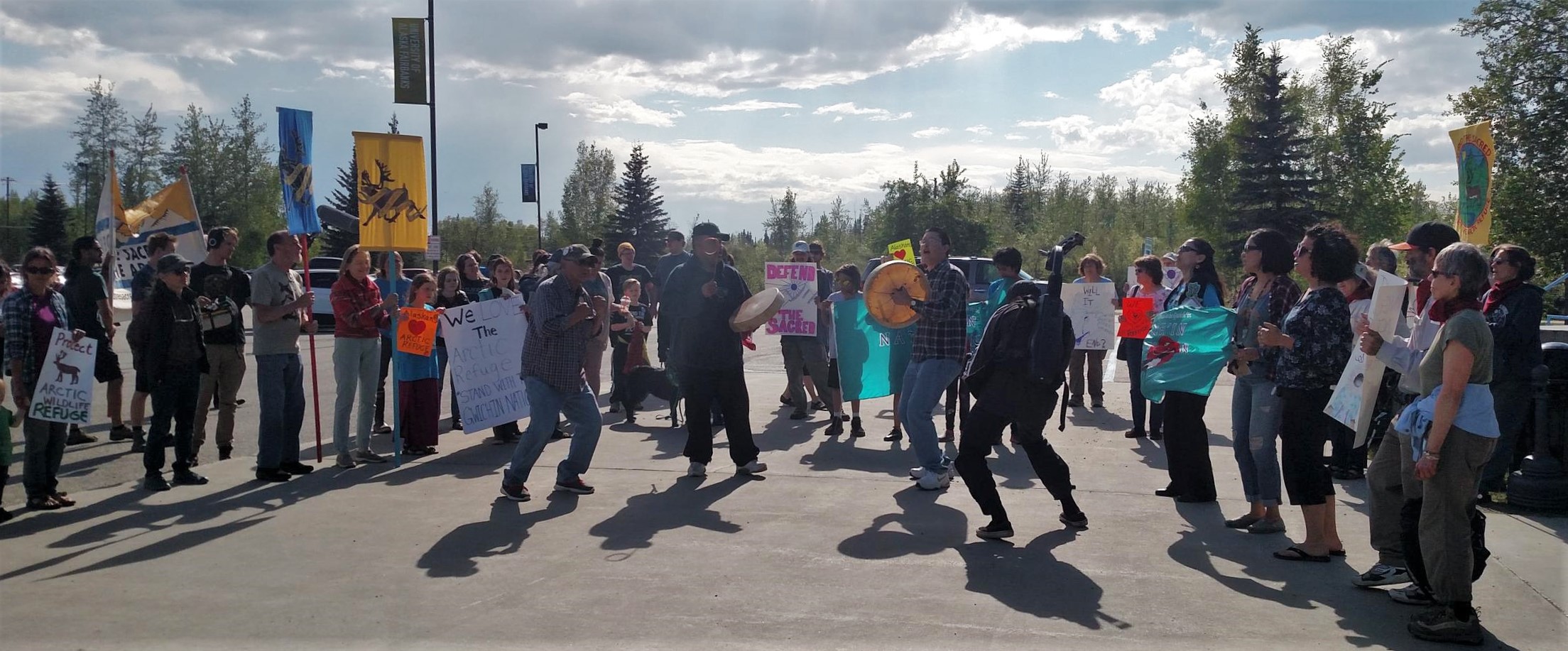
Athabascan drummers Travis Cole, Sunny Luke and Norman Carlo lead protesters to the Carlson Center in Fairbanks on Tuesday, May 29, 2018. The Bureau of Land Management was meeting on the federal plan to lease portions of the ANWR coastal plain for oil and gas development.
Athabascan drummers Travis Cole, Sunny Luke and Norman Carlo lead protesters to the Carlson Center in Fairbanks on Tuesday, May 29, 2018. The Bureau of Land Management was meeting on the federal plan to lease portions of the ANWR coastal plain for oil and gas development. (Photo by Tim Ellis/KUAC)

About 250 people turned out Tuesday at a meeting in Fairbanks to offer comments on a federal plan to launch an oil and gas leasing program in the coastal plain of the Arctic National Wildlife Refuge. Most of those who showed up for the meeting at the Carlson Center oppose the plan, because they say it would disrupt caribou calving season and harm Alaska Native subsistence, culture and the environment. Backers of the plan say coastal-plain development would boost Alaska’s economy.

Eighty-four people signed up to talk about the plan to open the coastal plain to oil and gas development. By the time a half-dozen of them had spoken, nearly 100 protesters showed up outside the Carlson Center to offer their public comments.

“I do have hope and faith that the Alaska Natives are going to stand up and they’re going to put a stop to this,” Fort Yukon Gwich’in Bernadette Demientieff told the crowd with a bullhorn. “Because when it comes down to it, we’re all going to be affected. Climate change don’t care if you’re upriver or downriver. We’re going to all live with the effects.”

Fort Yukon Gwich’in Bernadette Demientieff, of the Gwich'in Steering Committee addresses protesters during their rally at the Carlson Center in Fairbanks on May 29, 2018. After the protest, they went inside and joined the meeting to offer testimony against opening ANWR's coastal plain to oil and gas development.
Fort Yukon Gwich’in Bernadette Demientieff of the Gwich’in Steering Committee addresses protesters during their rally at the Carlson Center in Fairbanks on May 29, 2018. After the protest, they went inside and joined the meeting to offer testimony against opening ANWR’s coastal plain to oil and gas development. (Photo by Tim Ellis/KUAC)

Demientieff is executive director of the Gwich’in Steering Committee, which opposes development on the ecologically fragile coastal plain. Princess Daazhraii Johnson, the committee’s former executive director, said members of the organization and the Fairbanks Climate Action Coalition came to tell federal officials presiding over the meeting that oil and gas exploration will harm the Porcupine Caribou Herd and other wildlife that provides subsistence to Native peoples.

“I wouldn’t be standing here today if it wasn’t for that Porcupine Caribou Herd, if it wasn’t for the tsook-cho, the king salmon,” Johnson said.

Meanwhile, inside the Carlson, representatives from industry and labor and officials with the state Department of Natural Resources accentuated the positive. Kara Moriarty is executive director of the Alaska Oil and Gas Association, and she said extracting the coastal plain’s hydrocarbons could bring economic benefits like those that came from development of the North Slope and construction of the Trans-Alaska Pipeline System.

“It goes without saying that Alaska’s economy relies heavily on the oil and gas industry,” Moriarty said. “One-third of all jobs in the state of Alaska can be attributed back to the oil and gas industry.”

John Hopson Junior is mayor of Wainwright and president of the North Slope Borough. And he said his community and others in the region depend on the industry. “Oil and gas property tax is what pays for our services, when it comes to police and fire and schools and public works,” Hopson said.

But Steve Ginnis, the traditional chief of the Fort Yukon-based Gwichyaa Zhee Gwich’in Tribal Government, said federal officials should not proceed with developing an environmental impact statement or EIS for the lease sales because they haven’t adequately invited public comment from residents of communities that would be most affected by coastal plain development.

“I don’t understand how the United States government, and the Congress of the United States, could shortcut the process, to do what’s going on here today,” Ginnis said.

Rhonda Pitka is chief of the Village of Beaver, and she said federal officials should double the 60-day public comment period for the EIS. She said the feds should stage more meetings in Gwich’in communities and talk directly with tribal government officials — with an interpreter.

“Our chiefs are requesting that you come and consult with us,” Pitka said. “I’m requesting government-to-government consultation in the Village of Beaver. I also sent in a letter requesting that the materials be translated in Gwich’in, for our Gwich’in speakers. And that you also bring along translators.”

Village of Beaver Chief Rhonda Pitka and Assistant Interior Secretary for Lands and Minerals Management Joe Balash.
Village of Beaver Chief Rhonda Pitka and Assistant Interior Secretary for Lands and Minerals Management Joe Balash. (Photos by KUAC)

Pitka also said the meetings should be scheduled for later, because many Gwich’in are away from their villages at fish camps, preparing to harvest salmon.

“Our tribal members right now are getting ready for our subsistence season,” she said. “I’m actually missing out on getting my grandma’s fish camp ready for the fishing season.”

But scheduling the meeting around hunting and fishing seasons can be tricky, said Joe Balash. He’s a former state natural resources commissioner who now serves as an assistant secretary of the Interior, and he was one of the seven federal officials presiding over the meeting.

“The folks that live on the North Slope and participate in the whaling the season — y’know, the spring season has more or less just concluded, and there’ll be a fall season,” he said, “and we’ve got to watch that window as well.”

Balash said during a break in testimony that translating documents would be a new requirement that federal officials may want to consider, along with adjustments to the public meeting schedule. He said the first meeting in Kaktovik that was postponed has been rescheduled for next month. The next scoping meeting will be held tonight in Anchorage, followed by another on Thursday in Utqiagvik.

Public comments on the leasing program plan EIS are due by June 19.

UAF hosts Alaska Native language conference to help preserve knowledge

Alaska Native languages are the focus of a four-day institute at the University of Alaska Fairbanks this week. The Alaska Native Language Revitalization Institute is hosted by the UAF College of Rural and Community Development. College director of Indigenous programs Sandra Kowalski says the conference reflects a new urgency to preserve Alaska’s diversity of Native languages.

“Recently, the Legislature passed a resolution declaring that our Alaska Native languages are in a state of emergency,” Kowalski said. “In addition to that, just in recent years, we’ve seen an increased interest by young people to become second language speakers.”

Kowalski emphasizes that loss of Native languages is not new.

“We’ve had elders passing away,” Kowalski explained. “Just the whole context of having a Western education system and a Western culture kind of incept in our world and our Alaska Native communities has made it challenging for Alaska Native languages to thrive and be maintained.”

Kowalski says the institute will focus on ten of Alaska’s twenty Native languages, including five from the interior region. She says participants will explore strategies for learning and teaching language from Alaska and outside experts.

“From Hawaii, where they’ve got strong revitalization efforts underway and from some experts with the Mohawk language,” Kowalski said. “They’ve been able to produce proficient second language Mohawk speakers.”

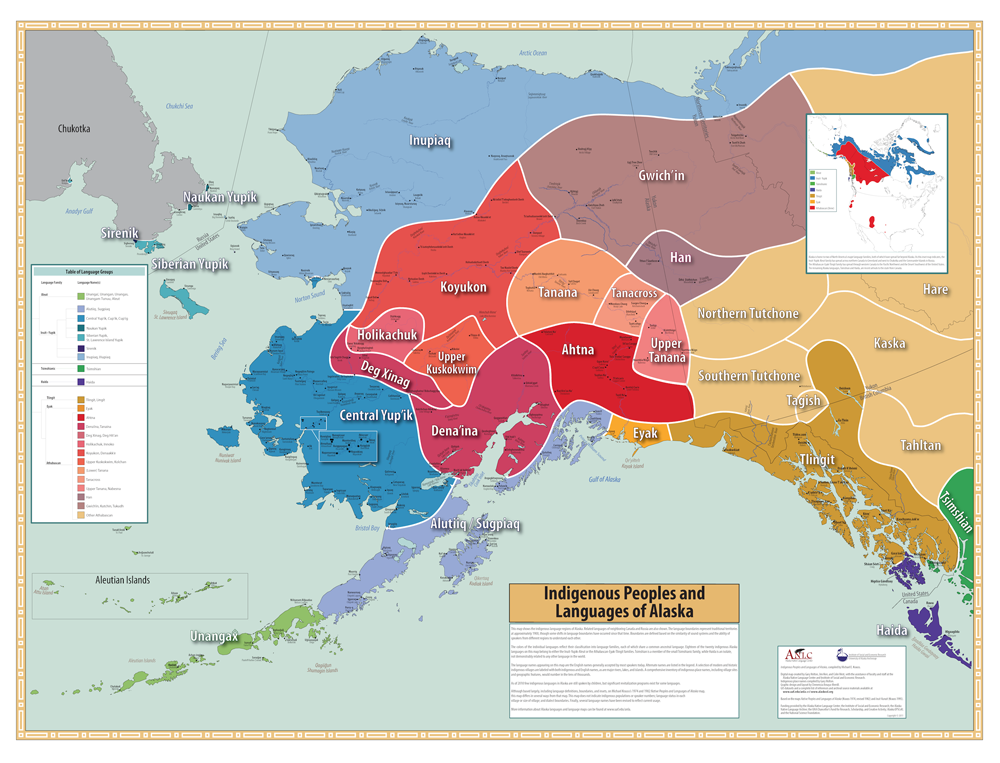
Alaska Native languages map
Indigenous Peoples and Languages of Alaska map by Michael Krauss. (courtesy of the Alaska Native Language Center)

Kowalski notes that UAF’s Alaska Native Language Center has documented the state’s indigenous languages, a valuable baseline of information. Kowalski stresses that this week’s institute is also about empowering people.

“There’s this sense that we have to ask and be given permission to be who we are, and there’s a process we need to bring our communities through to take back our right to speak and promote and teach our own indigenous languages,” Kowalski said.

Kowalksi says the response to the Alaska Native Language Revitalization Institute has been strong and that registration if full. Over a hundred and fifty people signed up for the May 21 to 24 institute.

Murkowski questions military officials over how sexual assaults involving minors are resolved

Alaska U.S. Senator Lisa Murkowski raised the issue of sexual assaults involving minors on military bases during a Senate Defense Appropriations hearing last week.

”Investigators released a total of eight cases at Alaska installations, five of them reportedly at Fort Wainwright,” Murkowski said. “So, of course this certainly gets your attention.”

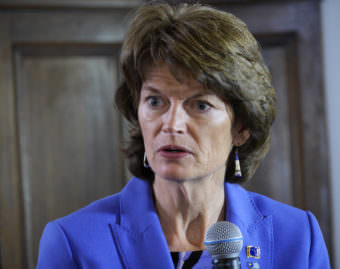
Sen. Lisa Murkowski speaks with reporters at a press availability following her annual address to the Alaska Legislature on Feb. 22, 2017. (Photo by Skip Gray/360 North)
U.S. Sen. Lisa Murkowski speaks with reporters at a press availability following her annual address to the Alaska Legislature on Feb. 22, 2017. (Photo by Skip Gray/360 North)

Senator Murkowski asked U.S. Army Secretary Mark Esper about how youth on youth assaults are handled. Esper responded that the Army conducts an initial investigation, but current protocol requires cases to be handed off to local, state or federal authorities for prosecution.

“We have some authority, but it’s mainly administrative. So what we could do is we could bar that kid from being on post, or we could remove the family from the post,” Esper said. “But beyond that, the authorities really reside outside the military to do that, and I think that’s something we need to take a look at.”

Esper says the Army’s focus is providing victim and family support services.

State attorney general wants to give more criminal justice options to tribes

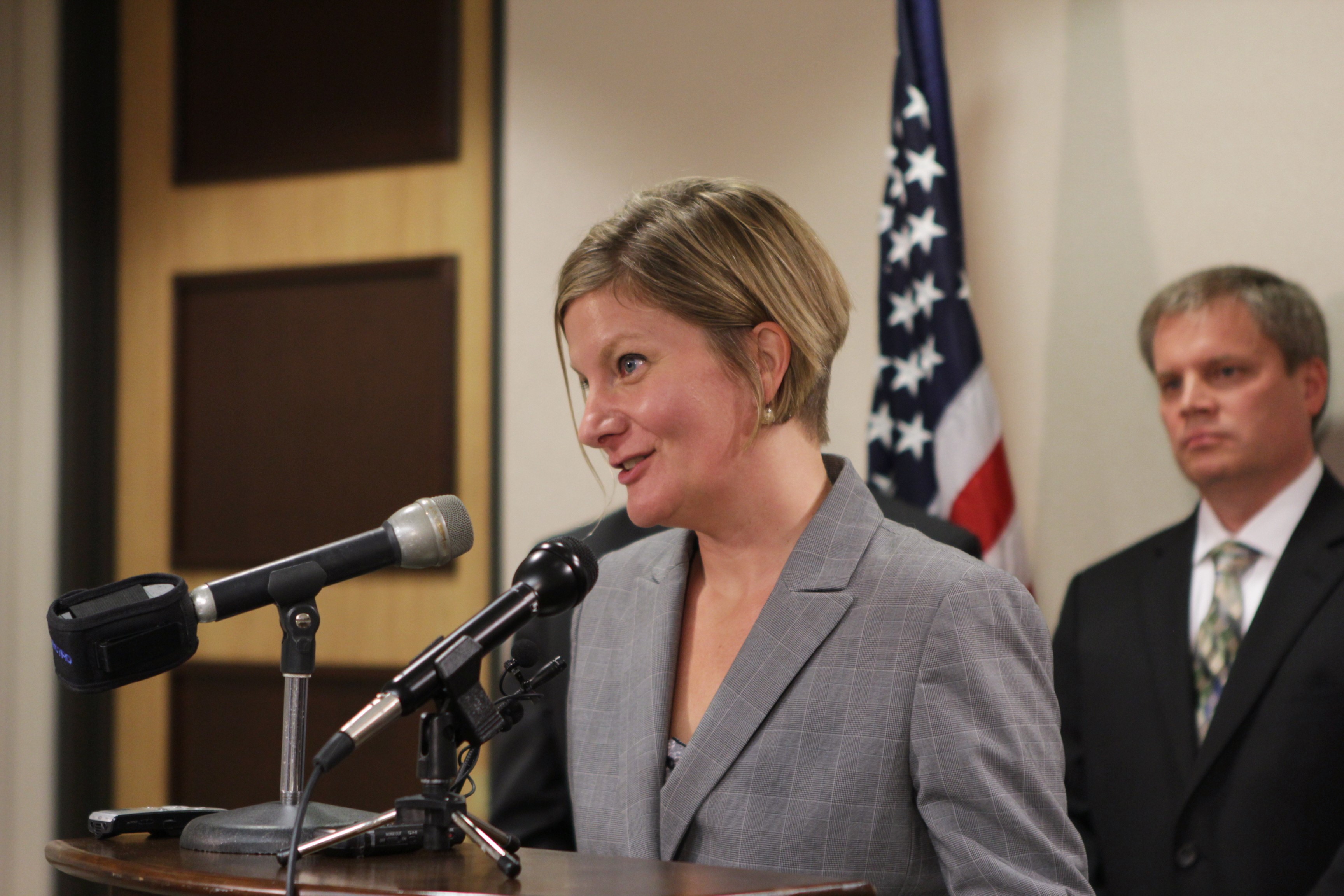
Jahna Lindemuth was named Alaska's attorney general by Gov. Bill Walker. (Photo by Graelyn Brashear/Alaska Public Media)
Jahna Lindemuth the Attorney General of Alaska. (Photo by Graelyn Brashear/Alaska Public Media)

The state is taking steps to expand the criminal justice authority of Alaska Native tribes.

Attorney General Jahna Lindemuth talked about the initiatives at a tribal court conference in Fairbanks last week.

One initiative allows tribal courts to take over low level misdemeanor cases from the state, Lindemuth said.

”It keeps that person outside of the state’s criminal justice system. And many times, that can be really important,” Lindemuth said. “Especially for a first offender or somebody who’s just starting out with dabbling with crime. We want to avoid them getting into the whole system and starting that lifelong pattern that we see so often. And so, I really hope that tribes will look at this closely and that they will consider working with the state on the civil diversion agreement.”

A second change allows state funded village public safety officers to enforce tribal laws.

”If you have a VPSO in your community, and you want that person to help enforce your tribal code, you need to sit down with your VPSO person and work that out. And it’s just a matter of if you can have that agreement in place, then that can go forward. And I really encourage all of you to do that.”

A third initiative allows crime evidence collected by tribal officers, under state compliant search warrants, to be used for prosecution in state court.

“We can prosecute that case in state court, even if a trooper never shows up in your community and investigates.”

Lindemuth said the three tribal justice initiatives are included in a broader public safety action plan being developed by the state, with public input.

“We don’t have a trooper or VPSO in every community, but we need law enforcement in every communit. We need public safety in every community,” Lindemuth said. “So how can we do this better? That’s what this is all about.”

Tanana Chiefs Conference Executive Director of Tribal Government and Client Services Will Mayo greeted the initiatives with enthusiasm, saying it wasn’t too long ago that the state did not even acknowledge the existence of Alaska tribes.

“Their belief was that the Alaska Native Claims Settlement Act terminated any existence of tribes,” Mayo said. “Tribes did not exist in Alaska. That was the official position. They did not even use the word tribe.”

Mayo credited tribes with bringing the state around. The TCC Tribal Court Conference offered training on the new state initiatives.

Site notifications
Update notification options
Subscribe to notifications