KUAC - Fairbanks

KUAC is our partner station in Fairbanks. KTOO collaborates with partners across the state to cover important news and to share stories with our audiences.

$14.8 million contract awarded for Clear Air Force station missile defense project

Clear Air Force Station.
Clear Air Force Station. (Public domain photo by U.S. Army Corps of Engineers)

The Army Corps of Engineers has awarded a $14.8 million contract to a Palmer-based contractor for work on a missile defense-related project at Clear Air Force Station, near Anderson.

The contract awarded to White Mountain Construction calls for construction of a secure facility for the radar site at Clear. The project is one of several going on at the $345 million radar, which is intended to improve the military’s ability to detect and intercept incoming enemy missiles.

Jomo Stewart with the Fairbanks Economic Development Corp. said the radar facility is one of many military construction projects under way at Clear, Eielson Air Force Base and the missile defense base at Fort Greely.

“There are a number of military- and defense-related projects going on throughout the Interior,” Stewart said. “So, a substantial dollar figure, and a substantial amount of work.”

FEDCO President and CEO Jim Dodson said last year that a total of some $1.5 billion in military construction work was scheduled through this year for the Interior. Stewart said that’s bringing more jobs to the Interior.

“We, as much as possible, want to make sure as much of that work is conducted by local contractors, either directly or as subcontractors,” Dodson said.

The $14.8 million entry control facility project at Clear is scheduled to be completed in September 2020.

Clarification: The headline has been clarified to indicate the money is for a contract, not a grant. 
New F-35s at Eielson Air Force Base have local schools preparing for influx

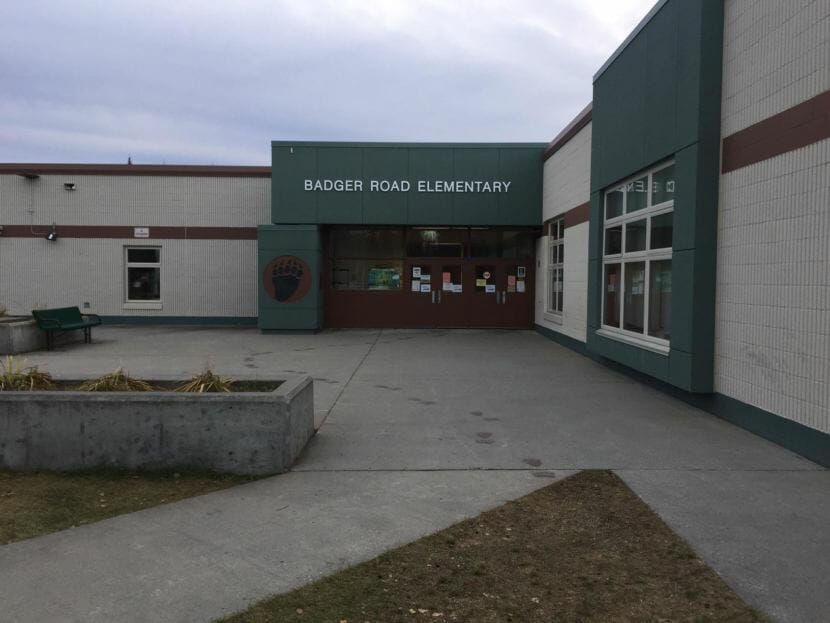
Badger Road Elementary School (Photo by Robyne, KUAC – Fairbanks)

The basing of F-35 fighters at Eielson Air Force Base will increase the number of school-age kids in the Fairbanks North Star Borough.

A federally-funded borough growth plan projects a six percent increase over the next decade. That equates to adding 1,900 students to an existing baseline of 30,000 kids through 2030. Shelly Wade, a consultant with plan contractor Agnew Beck, shared education aspects of the plan with the school board at a meeting Tuesday night. Wade says most of the additional students will be elementary age.

“That’s not surprising as we have a lot of young families that come as part of our active duty personnel,” Wade said.

Wade says the new students can be accommodated if spread out district-wide, but most will go to North Pole area schools.

”So we see, with the elementary schools and with the middle schools that we’re starting to reach a place where, potentially, we would not have the capacity to take on these new 17-and-under school-age kids,” Wade said.

Wade says projections indicate there will only be enough revenue to cover the cost of additional students until 2025.

”You have an increased number of school-aged children, who do not pay taxes, that are a percentage of your total population,” Wade said.

The school board has scheduled an October work session to thoroughly go over the Eielson growth plan which also includes strategies for addressing challenges and opportunities presented by the F-35 basing.

Editor’s note: An earlier version of this story used the wrong last name for the consultant quoted in the story, Shelly Wade. Wade is with Eielson Regional Growth Plan contractor Agnew Beck.

Fairbanks North Star Borough offices closed due to alleged threats

Fairbanks North Star Borough’s administrative center remains shut down due to what officials describe as threatening communications. The Juanita Helms Administrative Center was closed Thursday night, just as the assembly was to begin meeting. No threat suspect has been publicly identified, but a local man suspects the situation is the result of his questioning borough authority.

Chris Ripple claims he’s never threatened the borough. Ripple subscribes to sovereign citizen ideology, a perspective that does not acknowledge laws established after the U.S. Constitution. He considers borough taxes illegal, and is fighting to keep the local government from selling off his foreclosed-upon property.

”Some of the emails that I have been sending to them has been pointing out the law. All it is is trying to educate them to the law that they should have to abide by. Their law. And they take that as harassment. I mean, this whole thing, where they’re trying to build a case against me as I’m some kind of vigilante or something. They shut down the borough yesterday for the meeting the same time I’m sitting there with two troopers watching my house burn and they knew it.”

Ripple says the home he built himself, in a rural subdivision north of town, was found burning Thursday afternoon, two days before it was scheduled to be auctioned off by the borough. Ripple says he was in town when the fire started, delivering copies of a newspaper he co-publishes. “Free the People AK” questions institutional authority.

“How they’ve been stealing from our communities, stealing our wealth, stealing our lives away, stealing our human capital, our human energy away from us,” Ripple said. “What’re you gonna do? Either we need to stand up and try to educate people and hopefully call enough of our community members to come alive, come awake to what’s happening.”    

Ripple says that kind of talk generates backlash, and he suspects his house was set on fire by someone who doesn’t agree with the paper’s message.

The North Star Borough called police to its Juanita Helms Administrative Center Thursday evening, and closed the building just as an assembly meeting was supposed to start.  Mayoral Chief of Staff Jim Williams says the actions were prompted by what he characterizes as escalating threats.

”I cannot comment as to who the threats are coming from. I will tell you that they are targeted to certain individuals in our organization and because of that, we are taking appropriate responses,” Williams said.

Williams says the borough briefly re-opened the administrative center midday Friday but closed it again after becoming aware of additional threats.

“We’re not sure what the scope and depth of it is,” Williams said. “All we know is I have employees that have threats made against them, both overt and covertly. And I need to ensure the safety of my staff. And I also need to ensure the safety of the public.”

Williams says the borough is developing a security plan so that the building can re-open soon.

“We have to operate, so we may need to change our security,” Williams said.

Williams says the borough has postponed Saturday’s auction of foreclosed upon properties until a yet to be determined date. No one had been arrested or charged related to the alleged threats as of early Friday afternoon. State Troopers are investigating the fire that destroyed Chris Ripple’s home.

Regardless of who’s governor, state gasline corporation says China LNG deal can still continue

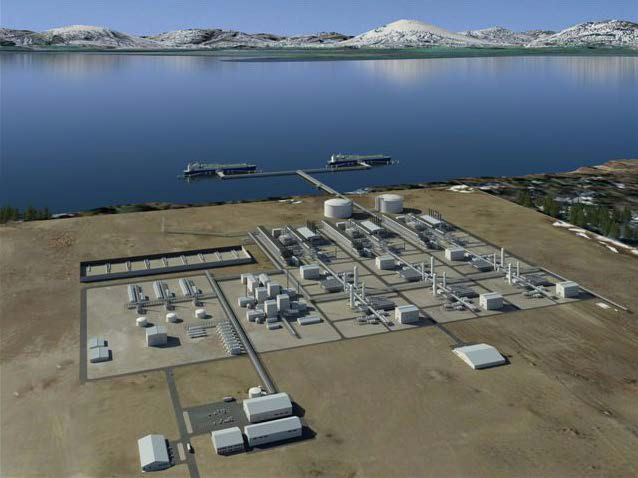
This illustration shows a rendition of what the liquefaction plant in Nikiski could look like if the Alaska LNG project is completed as planned. (Image courtesyAlaska LNG project.)
This illustration shows a rendition of what the liquefaction plant in Nikiski could look like if the Alaska LNG project is completed as planned. (Image courtesy Alaska LNG project)

The state’s liquefied natural gas pipeline export project with China can continue regardless of whether Gov. Bill Walker is elected to a second term in November.

An independent seeking re-election, Walker made the megaproject a top priority, while Republican challenger Mike Dunleavy has expressed skepticism about the state’s ability to manage it.

Alaska Gasline Development Corporation senior vice president Frank Richards said the corporation was set up by the Legislature to transcend election cycles.

”We were created as an organization that would be somewhat apolitical,” Richards said. “The goal was that the project would move forward based on its merits and economic viability.”

Richards was in Fairbanks to update the community on the project, which faces a self-imposed year-end target date to sign a binding agreement with three Chinese government-owned companies, under which they would finance 75 percent of the $44 billion project in exchange for 75 percent of gas line output.

”I would say we’re actively engaged with that. It’s a negotiation with the very astute buyer of LNG,” Richards said. “We are doing our due diligence to make sure that we’re getting the best contract for Alaska and our resources.”

Richards said the agreement will guarantee the Chinese buyers a discounted natural gas price over the 20-year life of the financing.

”That’s where we have to make sure that we’re gonna acquire debt financing that is not too expensive,” Richards said. “Then we’ll be able to utilize our equity portion to be able to sell to the remainder of the Asian markets to acquire higher returns for the 25 percent remaining.”

Richards emphasizes that the Chinese companies will not own the gasline, but notes that the AGDC is required to offer up equity shares of the project.

”We’re gonna develop an equity offering that we’ll take out to the world markets, including Alaskans, individual Alaskans, Alaska municipalities and Alaska Native corporations, the opportunity to invest in this project,” Richards said.

Richards said the offering is expected to be issued this fall.

On another front, Richards said the AGDC will negotiate with North Slope producers Conoco Phillips and Exxon Mobil to supply the gas line. It already has a contract with BP.

In wake of pack-rafter incident at Wrangell St. Elias, experts highlight proper preparation

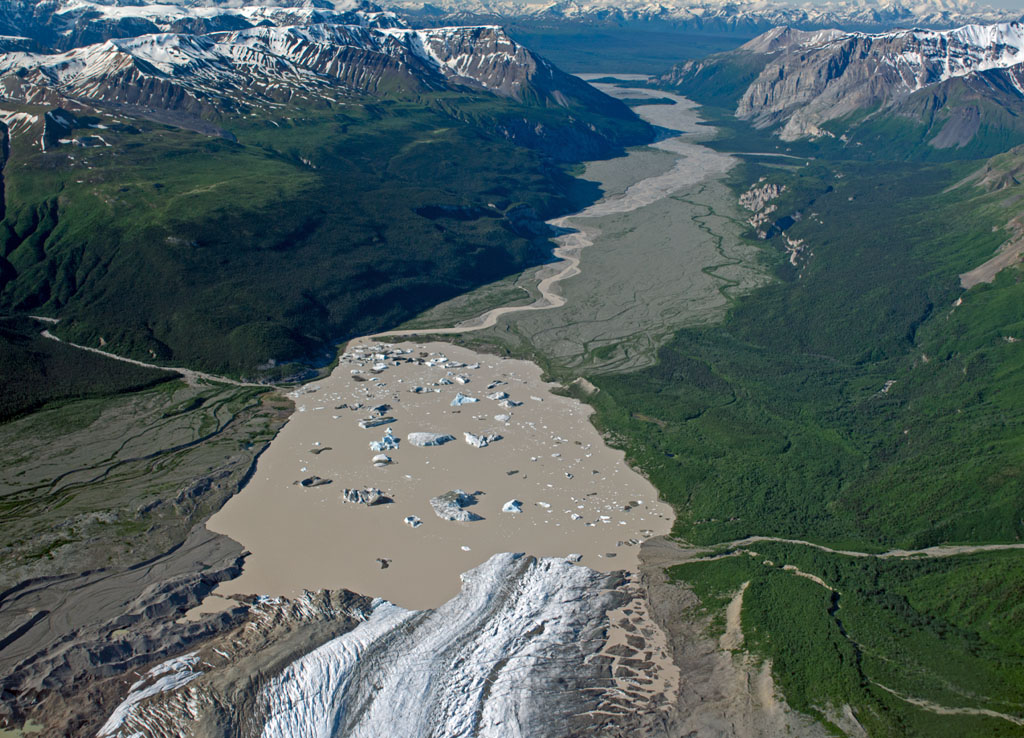
Nizina Glacier and River. (Creative Commons photo by Richard Droker)

The death of a pack-rafter in Wrangell St. Elias National Park this month raised awareness about proper preparation for the increasingly popular sport of floating backcountry rivers in tiny ultralight inflatable boats.

Searchers located Aiden Don’s body Aug. 2 along the glacially fed Nizina River.

The 22-year-old Austrian’s body was seven miles downstream from where he and a paddling partner began a planned one-day float. The trip starts with a stretch of class two rapids, and Wrangell St. Elias National Park spokeswoman Margie Stiegerwald said Don was lacking key gear for the Nizina’s rough, icy waters.

”He was not wearing a personal flotation device or a dry suit,” Stiegerwald said. Steigerwald also points to a lack of training and experience.

”Not recommended to go on unguided trips this year,” Stiegerwald said. “(He was a) novice to pack rafting.”

Don and his paddling partner were flown into the start point of their Nizina River float, but the two pack rafters became separated shortly after setting out on the water.

The partner did not know what happened to Don until finding his empty raft.

Pack raft safety educator Monica Morin emphasizes the importance of keeping close track of fellow paddlers.

”Never, ever would I allow them to get out of sight,” Morin said.

Morin is lead ranger for the Bureau of Land Management for the lower Deschutes River in Oregon.

The former Denali National Park backcountry ranger began doing pack raft specific safety education after moving to Alaska in 2013.

”Sort of a side project because a lot of my friends were telling me stories of near-misses and almost-accidents that they had on the river and felt that there was a need to help catch the pack-rafting community up to speed with the boating community, the river community,” Morin said.

Morin said in the past, most boaters focused on road accessible rivers, but pack rafts have enabled getting to more remote waters, where any trouble can have greater consequences.

”You’re in a completely different realm of risk,” Morin said.

Morin also points to pack rafters focus on pairing gear weight to minimum, which can lead to leaving behind safety essentials, like a personal flotation device, dry suit and helmet.

Morin said pack raft trips remote locations can also result in over-commitment to floating out.

“Once you’re in pack raft mode, to get out and hike can be really hard mentally,” Morin said.

Morin teaches pack rafters to have bailout options, in case their float doesn’t go as planned.

She said that means carrying a map, compass and other emergency gear inside your dry suit, noting rafts can float or blow away.

Fairbanks high schooler gets earthworm survey published in journal

A Fairbanks high school student has identified an earthworm species previously unknown to be in Interior Alaska.

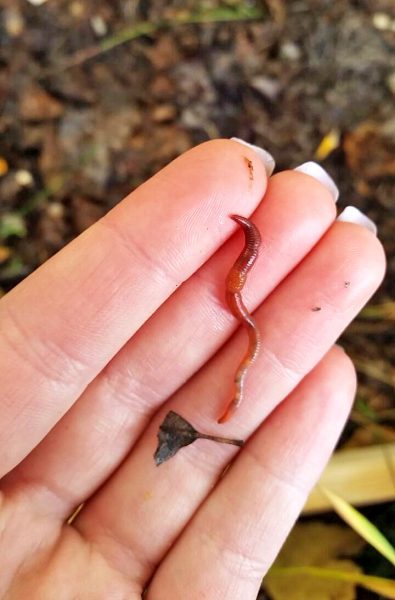
West Valley High School student Megan Booysen holds one of the earthworms (Bimastos rubidus) she collected last summer at sites around Fairbanks. Her research has been published in a July issue of the Biodiversity Data Journal.
West Valley High School student Megan Booysen holds one of the earthworms (Bimastos rubidus) she collected last summer at sites around Fairbanks. Her research has been published in a July issue of the Biodiversity Data Journal. (Photo by Megan Booysen/Courtesy UAF)

West Valley High School senior Megan Booysen conducted survey for earthworms around Fairbanks last summer.

The effort yielded five known species and one previously undocumented in the Interior.

“The species that isn’t positively identified as a European one, so it might be native to the United States, to North America, which means that it might be native to Alaska,” Booysen said. “But we don’t know that for sure.”

Booysen is lead author of an article about the discovery published in a July issue of Biodiversity Data Journal.

Booysen, who worked with University of Alaska Museum of the North insect curator Derek Sikes and other scientists on the project, said more research will be needed to better understand earthworms in the interior.

“We’d like to expand the study range, like, all over the Interior, and get some more data from more varied locations,” Booysen said.

Booysen said if worms are found in remote places, it’s more likely they were not brought to the area by people, and may have existed prior to the Ice Age.

“In the Interior it wasn’t glaciated, so that’s why one of them might be native,” she said. “Because it may have survived the last Ice Age here.”

Booysen also points to the local worm survey as an important baseline, as the climate warms.

“Because you can compare it and see how the changing climate is affecting which earthworms can stay here and spread their range,” Booysen said.

Booysen said the presence of earthworms are important to understand because they change soil ecology and affect the types of plants that grow.

Site notifications
Update notification options
Subscribe to notifications