KUCB is our partner station in Unalaska. KTOO collaborates with partners across the state to cover important news and to share stories with our audiences.
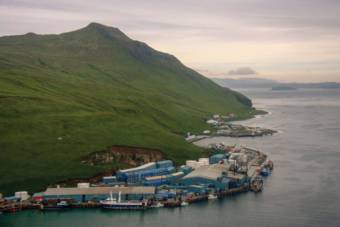
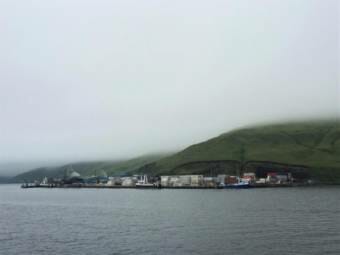
Trident Seafoods has only tested about half of its 700 workers, and officials say they think the outbreak is still on what they call an upward trajectory. (Laura Kraegel/KUCB)
A COVID-19 outbreak at one of Alaska’s largest fish processing plants has infected nearly 20% of workers with testing only partially finished, officials said Tuesday.
At Trident Seafoods’ huge plant on the remote Aleutian island of Akutan, 135 of 700 workers have tested positive for the virus, state officials reported Tuesday.
The company has only tested about half of its workforce, and Dr. Joe McLaughlin, the state epidemiologist, said at a news conference that the outbreak is still on an “upward trajectory.”
“I don’t think this outbreak is going to end in the next several days,” McLaughlin said. “I think it’s going to go on for a while.”
The company’s outbreak has posed a particularly thorny problem because of Akutan’s remoteness.
The island has an airport, but no functional runway, so planes can’t fly there. Instead, workers have to fly into Unalaska, where the airport is often plagued by weather delays.
Then, employees either take a boat directly to Akutan, 35 miles away, or they take a boat or flight to the neighboring island of Akun, followed by a helicopter to Trident’s plant.
Days after the Trident workers tested positive, bad weather continued to delay shipments of the supplies Trident needs to conduct mass testing of its large Akutan workforce.
But the company said Tuesday that testing supplies and more medical workers are now on site.
At least 15 people considered at “high-risk” from COVID-19 are being moved by ship to Unalaska, state health officials said.
Two workers with COVID-19 were evacuated to an Anchorage hospital, they added.
“As we continue to test, we are also assessing and monitoring the health of all individuals across the facility,” Stefanie Moreland, a Trident executive, said in a prepared statement. “We arranged Coast Guard-assisted evacuations yesterday for two employees whose condition was quickly worsening. We now have more private-sector resources lined up in case further emergency evacuations are needed and weather permits.”
Trident is one of three plants in the Aleutian Islands to shut down this year amid COVID-19 outbreaks.
St. Paul in 2016. Historically, local jobs in the STEM field have not been given to residents, according to project manager Dylan Conduzzi. (Ian Dickson/KTOO)
A Pribilof Island community of fewer than 400 people has received more than $250,000 in federal funds to train locals to work at its commercial aircraft test range.
The Aleut Community of St. Paul Island announced last week that it was one of seven recipients nationwide to receive the Economic Development Administration’s STEM Talent Challenge grant.
The ACSPI’s aircraft test range will be through a partnership with Sabrewing Aircraft Company, a California drone manufacturer.
The test range is expected to begin operations in the fall, according to project manager Dylan Conduzzi. He says this grant will give tribal and community members access to technical training.
“[It] is really meant to bring in the resources that bring onsite training into the community,” Conduzzi said. “And to make them accessible to tribal members and community members so that when these jobs open up in the test range — which are high-paying, high-tech, STEM-related jobs — they’re able to jump into and immediately assume those roles.”
Historically, local jobs in the STEM field have not been given to residents, according to Conduzzi.
“Many of the technical roles are filled by folks that are not from St. Paul,” he said. “And that gap is created really from a capacity issue in terms of education and expertise. So the goal of this grant is to be able to provide training that addresses that gap.”
Programs will be offered through the island’s University of Alaska Fairbanks Bering Sea Campus. They will range from hazmat courses and drone pilot certification to tribal management degrees.
The funds also provide an opportunity for the island to diversify its largely fishing-based economy, Conduzzi said.
Eighty organizations applied for the federal STEM Challenge grant last summer, according to the Economic Development Administration. Other recipients include a Maryland community college, the University of Michigan and a non-profit in Hawaii.
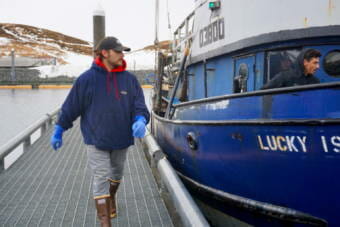
The F/V Lucky Island is docked Friday at Carl E. Moses Harbor on the Aleutian Island of Unalaska. Abraham Camacho Castillo, left, and Saul Rood are crew members, while Captain Diego Castillo peers out from the wheelhouse. (Hope McKenney/KUCB)
A third seafood processing plant has shut down in the Aleutian Islands amid a COVID-19 outbreak, threatening to further derail lucrative winter fisheries in the region.
In the Aleutian port town of Unalaska, at least five local boats are stuck at the dock with nowhere to deliver their cod after the shutdown of the Alyeska Seafoods processing plant, according to a crew member on one of them, Tacho Camacho Castillo.
Alyeska closed its plant Friday “based on a cluster of positive cases” identified through “surveillance testing,” the City of Unalaska said in a prepared statement.
“There’s two days and this fish starts to spoil,” Camacho Castillo, a crew member on the 58-foot Lucky Island, said in an interview Friday. “Am I going to be throwing out fish into the ocean? It’s going break my heart, for real, if I throw all this fish away.”
The plant closures are setting off a scramble among fishermen, industry leaders and political officials involved in the Bering Sea cod, crab and pollock fisheries, which are worth more than $1 billion and support thousands of jobs.
If the outbreaks can be brought under control over the next few weeks and the winter “A-season” pollock fishery can continue, the impacts shouldn’t be too great, said Brent Paine, executive director of United Catcher Boats, whose members fish for Bering Sea cod and pollock.
But extended closures would be costly and much more disruptive, he added. Pollock trawlers, he noted, have a limited window to catch the fish when they hold valuable roe, which is ultimately sold to Asian markets.
“We’ve got some pretty serious problems to solve here,” Paine said in a phone interview Saturday. “The further into A-season we go, if we don’t have processor capacity, we will have less opportunity to solve the problems.”
Last winter, the Bering Sea fisheries largely dodged the COVID-19 pandemic, which didn’t take hold until after companies had flown in hundreds of seasonal processing workers to the Aleutians.
But this year, the virus is far more widespread in the U.S., and it appears to be posing a greater challenge to seafood companies.
The Alyeska plant was the third to announce a COVID-19-related shutdown this month. Its owner, Westward Seafoods, did not respond to a request for comment, and neither it nor Unalaska city officials have said how many workers tested positive.
Earlier in the week, industry heavyweight Trident Seafoods announced an outbreak at its huge, remote plant on the Aleutian island of Akutan, about 35 miles northwest of Unalaska. The company said it would close for three weeks, and several days after its initial announcement, bad weather had thwarted its efforts to bring in enough supplies and medical providers for mass testing of its 700-person workforce.
In the Aleutian fishing hub of Unalaska, the town’s largest processing plant, owned by UniSea, has been shut down for nearly three weeks amid a COVID-19 outbreak — though company officials say they think the virus is under control and that they hope to reopen soon.
The closures are a problem not just for fishermen’s livelihoods and corporate balance sheets, but for the economy of Unalaska and its municipal government, which derives more than a third of its general fund revenue from the fishing industry.
“The city is certainly concerned not only for the health of the individuals who this is directly impacting, but also the health and the livelihood of many individuals working here and the economy as a whole,” Unalaska City Manager Erin Reinders said in an interview Friday. “This is the major driving force of the city’s revenues.”
Reinders said she’s asked Unalaska’s finance director to analyze how the closures will affect the city’s revenues, but added that there are still many unknowns.
“It certainly reminds us of the importance of working towards diversifying the economy,” Reinders said. “We’ve always talked about that: If anything happened in the fishing industry, that would be a significant impact on us.”
Only two of Unalaska’s plants remain operational.
One is Westward’s other facility, and the second is Icicle Seafoods’ floating Northern Victor plant — a 380-foot vessel docked permanently at Unalaska’s spit.
Many boats associated with the closed plants are waiting to start fishing until the facilities reopen.
But some are in limbo, like the Unalaska-based Lucky Island, with its load of cod that Camacho Castillo, the crew member, said is worth “five figures,” or at least $10,000.
“I know that’s not a lot to big boats, but for a ma and pa shop here in town, that’s a huge smack in the face,” said Camacho Castillo, who works on the boat with his brother and cousin.
While fishing late Thursday, the Lucky Island got a call informing them that Alyeska’s plant was shutting down, and that they couldn’t deliver their cod there.
Diego Castillo, the Lucky Island’s captain, said they were told to deliver to the still-functioning plant operated by Westward, Alyeska’s parent company. But Westward told the crew that the plant was too busy processing crab, and that the Lucky Island would have to wait.
While the federal cod fishing season has already wrapped up for boats 60 feet and over, it’s not yet over for smaller boats like Castillo’s. But the fishery is competitive and the window is short, and waiting to deliver their catch “throws a wrench in the operation,” he said.
“We’ve got to get out there when the weather permits, and being here stuck in line to offload behind big crabbers — which take a whole day or a couple days sometimes, depending on the load — it’s just frustrating,” he said. “We’ve got bills to pay.”
In the derby-style cod fishery, boats like Castillo’s compete to catch as many pounds as they can before hitting a fleet-wide limit.
But the pollock fishery is different: Boats form cooperative groups that each have their own quota, allowing them to fish at their own pace.
That structure removes some of the pressure from companies and boats during the plant closures. But the longer the shutdowns continue and the season is delayed, the bigger the problem, said Paine, who works with United Catcher Boats, the trade group.
Companies are currently exploring whether it’s possible to loosen regulations that restrict how much fish boats can deliver to a plant that’s outside their cooperative group, Paine said.
“This is a huge challenge,” he said. “But I think people are looking at finding ways toward solutions.’
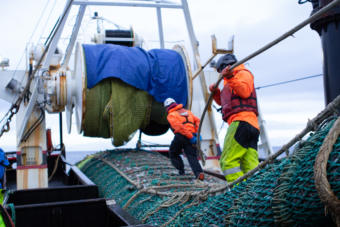
Crew members Joe Johnson, left, and Derrick Justice work to unload a trawl net full of pollock from on board the fishing vessel Commodore on Thursday, January 24, 2019. (Photo by Nathaniel Herz / Alaska’s Energy Desk)
One of North America’s largest fish processing plants is shutting down as a COVID-19 outbreak grows and owner Trident Seafoods struggles to test its 700-person workforce.
The plant, on the isolated island of Akutan, is the second in the Aleutians to shut down this year, just as the billion-dollar Bering Sea pollock fishery was set to kick off.
Now, fishermen and industry leaders are anxious that they might not have places to offload their catch and that their plants might be the next to close down, said Dan Martin, who manages a fleet of nine pollock trawlers for a company called Evening Star Fisheries.
“Any hiccups like this, you really have to reshuffle the deck and try to figure out, ‘Okay, what’s the next step?’” said Martin, a retired skipper. He called the shutdowns “everybody’s worst nightmare.”
The winter fishery for Bering Sea pollock, which goes into products like McDonald’s fish sandwiches, officially opened Wednesday. But two of the region’s largest processors are both shut down: the Trident plant in Akutan, and the UniSea plant located 35 miles to the southwest in the Aleutian port town of Unalaska.
There were about 700 processing workers at UniSea’s facility over the summer, plus support workers, many of whom are full-time residents of Unalaska, according to Tom Enlow. He said the processing workforce will go up to about 1,000 come “A” season. (Hope McKenney/KUCB)
UniSea shut down earlier this month when a number of processing workers tested positive for the virus after a New Year’s Eve gathering on company premises.
UniSea and other onshore Aleutian plants fly in hundreds of workers to process pollock each season. Last year, they were largely successful in keeping COVID-19 out of their facilities through strict travel quarantines and other measures.
But the upcoming season appears to be posing more of a challenge as companies contend with much higher rates of COVID-19 in Alaska and the Lower 48, where many of their workers come from.
In addition to the two outbreaks at UniSea’s and Trident’s plants, the City of Unalaska also announced earlier this week that a large factory trawler, the Ocean Peace, came into port with seven infected members out of its crew of 52.
UniSea officials say they hope to have their plant reopened by the end of next week. But Trident announced Thursday that its Akutan plant would close for three full weeks.
“We know that COVID-19 is now on the site, and until we test everyone we won’t know how extensive it is,” Stefanie Moreland, a Trident executive, said in a prepared statement. “This is the best way to contain the spread of the virus.”
Trident’s outbreak at its huge Akutan plant has been a particularly thorny problem because of its remoteness. The island has an airport but no functional runway, so planes can’t fly there.
Instead, workers fly to Unalaska, then either boat directly to Akutan or take a boat or flight to another neighboring island, followed by a helicopter to Trident’s plant.
On Thursday, four days after a handful of workers had tested positive for the coronavirus, bad weather meant that Trident was still lacking the supplies it needs to conduct mass testing of its Akutan workforce.
The Trident plant in Akutan, which requires either a boat ride or a helicopter ride to get there. (Laura Kraegel/KUCB)
“The weather, it is kind of slowing down getting some additional medical personnel and some additional testing resources out there,” Tom Koloski, a state emergency management specialist, said in a briefing with reporters Thursday.
He added that Trident has “the situation well in hand,” and said “they’re doing the right things” to isolate infected workers and quarantine their suspected close contacts while awaiting further testing supplies.
“We’re in daily meetings with the company, and they have let us in on what their plan is and we fully support it,” Koloski said.
In the meantime, many fishermen who normally deliver fish to Trident or Unisea are able to hold off.
That’s because the pollock fishery operates as a cooperative, where vessels have a fixed quota of fish they can catch and deliver to a specific plant. And that means that crews that don’t catch their quota now can still catch it later in the season, industry officials say.
Short plant closures are manageable, but a longer shutdown would be problematic, said Brent Paine, executive director of United Catcher Boats, a trade group whose members fish for Bering Sea Pollock.
“If they can’t get their workforce able to work here in the next month, or the next couple months, that is a problem,” Paine said.
UniSea officials say they think their outbreak is controllable. The company is currently waiting on test results after retesting its entire workforce for a second time, according to Tom Enlow, the company’s chief executive.
When those results are back from a Washington laboratory, Enlow said UniSea will make a plan to gradually reopen and prepare their plant to take deliveries.
“We’re confident that we think that we can get this contained here,” Enlow said. “We’ll know more in the next couple of days as results from the mass testing come back.”
While Alaska’s seafood industry has lobbied for early vaccine access for workers, Alaska chose to vaccinate its elders before starting the process for essential workers outside of health care.
Martin, the retired skipper, said that it’s unsettling to see the virus get into the Aleutian plants, knowing how seriously his company and others have taken it.
“These guys at UniSea and Trident — I know their management, and I know that they were as vigilant as we’ve been,” Martin said. “So it’s almost scarier, because it’s coming down to the luck of the draw.”
The four cases mark the first confirmed COVID-19 outbreak at any of Trident’s Alaska facilities. (Laura Kraegel/KUCB)
A second seafood processing plant in the Aleutian Islands has been hit with COVID-19 infections as the busy winter pollock fishing season is set to kick off.
The U.S. Coast Guard evacuated a Trident Seafoods worker to Anchorage on Sunday from its huge plant on the remote Aleutian island of Akutan after the man tested positive for COVID-19.
His three roommates also tested positive, Trident said in a statement Monday.
Meanwhile, another large processing plant in Unalaska, 35 miles to the southwest, remains closed and locked down after a COVID-19 outbreak there grew by 20 on Friday.
The Aleutian Island seafood processors were largely successful in keeping the virus out of their onshore plants last year. But that’s proven to be more of a challenge as companies fly in workers for the upcoming season, with the coronavirus much more widespread across the Lower 48.
All four of the newly-infected Trident workers had tested negative just two weeks earlier, after a 14-day quarantine in Anchorage, the company said in its statement.
The four cases mark the first confirmed COVID-19 outbreak at any of the company’s Alaska facilities.
Trident says it’s maintained strict COVID-19 mitigation measures since March. Those include a mandatory two-week quarantine, sanitation and use of personal protective equipment, as well as testing.
“Health and safety are our absolute priority,” Joe Bundrant, Trident’s chief executive said in a statement. “We have said from the beginning of this pandemic that if we have an issue, we’re going to shed a light on it. We want to be sure people are aware and know that we are taking this very seriously.”
Trident management is in communication with the 700 workers currently in Akutan and is working to identify where the employees could have been exposed, the statement said. The company is waiting to send 365 more processing workers to Akutan who are currently in quarantine.
“We have notified the State of Alaska, the City of Akutan and our medical partners and are coordinating with all to conduct further tests, implement protocols and contain exposure,” said Stefanie Moreland, Trident’s vice president of government relations and seafood sustainability. “Next actions may include extensive testing and isolation for those who are at most risk.”
Trident is the largest seafood processing company in North America, with more than 8,000 employees. It operates processing facilities in ten coastal communities in Alaska, as well as three large whitefish catcher-processors and four mobile processing ships.
Trident’s Akutan processing plant has a year-round workforce with more than 1,400 company-housed employees during peak seasons. Its facility handles multiple species, from cod to crab, and is capable of processing as much as three million pounds of raw fish per day, according to the company.
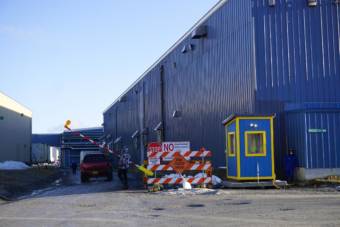
Once the city determines if the community cases are isolated or widespread, the city said the Emergency Operations Center will reassess the local risk level and the City Council will reexamine local measures to protect public health accordingly. (Hope McKenney/KUCB)
The UniSea fish plant in Unalaska is under partial lockdown and has shut down all non-essential work after four employees tested positive for COVID-19 Tuesday.
Four “non-quarantined” individuals complained of not feeling well and were taken to the Iliuliuk Family and Health Services clinic where they tested positive, according to UniSea President and CEO Tom Enlow.
“This raised our risk level to ‘high’ and we sent everyone to their housing quarters and basically shut down non-essential work,” Enlow told KUCB in a statement Wednesday. “We have restricted movement outside of our campus to only essential travel, such as to the clinic or for supplies.”
The processing plant worked with clinic staff on contact tracing and identified roughly 50 close contacts who are being tested at the clinic Wednesday, according to Enlow. He said they are working to determine if the virus was contained to a “small group” that gathered to celebrate the New Year or whether the positive cases are indicative of more widespread community transmission. All four of the people who later tested positive attended the New Year gathering.
“Testing results will allow clinic personnel to determine if these community acquired cases are isolated or widespread within the community,” the city said in a statement.
The results will determine UniSea’s next steps, Enlow added, and whether the plant will allow small groups to return to work.
The city also reported nine additional industry-related cases Wednesday. It did not specify which processing facilities or vessels the cases are from.
Unalaska’s coronavirus risk level remains at “medium.” Once the city determines if the community cases are isolated or widespread, the city said its emergency operations center will reassess the local risk level and the city council will reexamine local measures to protect public health accordingly.
Meanwhile, in light of the positive cases at UniSea, students living in facility housing will likely remain at home through at least Friday with excused absences, according to Superintendent John Conwell.
If they have to remain home longer, they will likely shift to home-based learning.
“We will definitely work with those families and those students,” Conwell said. “We do have teachers who are on contract addendums to work with students who are home-based and possibly signed up for the Alaska Statewide Virtual School. So we do have a plan for that.”
The district will determine how to move forward with classes based on the risk level determined by the EOC, Conwell added.
To date, this marks 223 cases of the coronavirus in Unalaska. 30 of those are currently active.
Close
Update notification options
Subscribe to notifications
Subscribe
Get notifications about news related to the topics you care about. You can unsubscribe anytime.