KUCB - Unalaska

KUCB is our partner station in Unalaska. KTOO collaborates with partners across the state to cover important news and to share stories with our audiences.
Nation’s sole heavy icebreaker arrives in Unalaska, prepares to patrol Arctic waters

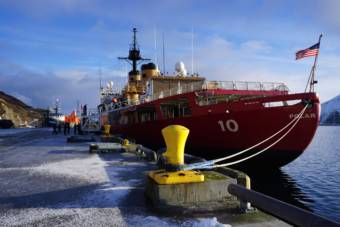
The Polar Star sits in the Port of Dutch Harbor. The ship arrived with 136 crew members on Tuesday for a pit stop 30 days into a months-long deployment to the Arctic to assert maritime sovereignty and security in the far north. (Photo by Hope McKenney/KUCB)

The nation’s sole heavy icebreaker arrived in the Aleutian Islands this week for the first time since 2013.
The U.S. Coast Guard’s Polar Star is preparing to patrol Alaska’s Arctic waters, including the maritime boundary line separating the U.S. and Russia.

The Polar Star sits in the Port of Dutch Harbor. The ship is nearly 400 feet long and can break ice up to 21 feet thick.

The ship arrived with 136 crew members on Tuesday for a pit stop 30 days into a months-long deployment to the Arctic to assert maritime sovereignty and security in the far north.

“The Arctic is incredibly important to us strategically, because of the amount of gas and oil and resources, as well as the fish stocks, which are landed here in Unalaska,” said Capt. Bill Woityra, the cutter’s commanding officer. “These are absolutely U.S. sovereign resources, and we desperately need to protect them against foreign actors, whether it’s foreign fishing fleets or it’s foreign adversaries that are seeking to push the limits of international law and claim those things for themselves.”

Capt. Bill Woityra, the commanding officer of the Coast Guard Cutter Polar Star, looks out from the cutter’s bridge on Dec. 17, 2020 while underway in the Bering Strait. (Photo courtesy of Petty Officer First Class/U.S. Coast Guard)

Typically, this time of year, this special icebreaking cutter is on its way to Antarctica’s McMurdo Station to drop fuel and other supplies to American scientists doing research near the South Pole.

“But this year, with the global pandemic, they had to cancel the mission,” Woityra said. “That created the opportunity for the Polar Star to come back north again.”

This is the ship’s first winter Arctic deployment since 1982.

In addition to the cutter crew, there are partner-agency researchers and scientists, British sailors from The Royal Navy, midshipmen from the Merchant Marine Academy and deck watch officers and ice pilots from the Healy, the Coast Guard’s medium icebreaker that’s capable of Arctic patrols during summer months.

According to Woityra, the mission isn’t only about national security and securing U.S. economic interests as human activity and international interest in the region expands. It’s also about doing environmental research.

They’re partnering with the Woods Hole Oceanographic Institute to take water samples and measurements while the boat transits over the Arctic Circle to better understand the harsh environment there. Getting data in the remote region during the winter, Woityra says, is otherwise extremely difficult.

“Basically, a heavy icebreaker is built so we can go anywhere on the earth in any thickness of ice during any time of year,” he said.

The Polar Star navigates heavy seas in the Gulf of Alaska on Dec. 10, 2020. (Photo courtesy of Petty Officer First Class/U.S. Coast Guard)

Even though the Polar Star was built to break through thick ice, just a month into their Arctic deployment, Woityra said the season has been tough on the 44-year-old vessel.

“Breaking ice in the Arctic winter is especially challenging because it’s so hard,” he said. “It sounds like a car crash, just twisting metal and screeching noises and shattering glass. It’s really kind of disconcerting. There’s no danger, but it leaves an unsettling feeling in your stomach.”

He said the crew has been working around the clock just to keep the ship running. On New Year’s Eve, they got stopped in the ice, and their engineers were up all night working to replace blown diodes and resistors that are usually considered obsolete.

“These are parts that just don’t exist anymore,” Woityra said. “We have a warehouse of spares, but when they’re gone, we won’t be able to run this ship anymore.”

That’s why Woityra and other Arctic planners say it’s so important for the government to invest the billions of dollars needed to build new icebreakers in the next decade to replace the Polar Star, which is the nation’s only functional icebreaker after a fire damaged the Healy this past summer.

The federal government is in the process of commissioning one, and Congress has agreed to build five more, but it hasn’t allocated funding.

The construction on the first new ice breaker is expected to be completed in 2024. Woityra said it will be 460 feet long, 90 feet wide, and weigh 23,000 tons — almost twice as much as the Polar Star.

“It’s going to be the largest, most complex, most powerful ship that the Coast Guard has ever built,” he said.

In the meantime, Woityra said the Polar Star’s Arctic mission will help train the future generation of Arctic sailors and mission leaders.

“This is our chance to really build up that experience and expertise and hold our proficiency operating in this environment,” he said. “Once those polar security cutters are delivered in a few years, we’re going to need operators and leaders to actually take them to sea, and we desperately need them to have experience in this environment.”

The Polar Star is expected to leave Unalaska’s Port of Dutch Harbor on Thursday afternoon. Woityra said he expects they will complete their mission and return to Seattle by the end of February.

Yakutat To Unimak: Minnesota hiker recounts 2,500-mile Alaska traverse

From Yakutat, Binde said he hiked across the Lost Coast, up the Copper River, to the Wrangell Mountains, and up to Denali, then finished the Alaska Range at Lake Clark, and finally made his way into the Aleutian Range. (courtesy Dan Bende)

From mid-June to mid-October, Dan Binde of Minnesota hiked from Yakutat, in the northern reaches of Alaska’s Inside Passage, across the Alaska Peninsula, to Unimak, the largest and easternmost of the Aleutian Islands.
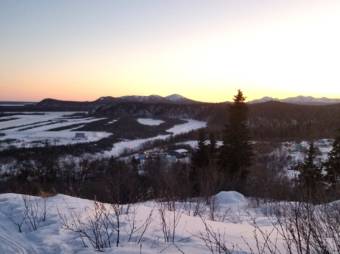
Binde, who was joined by his friend Quoc Nguyen along the way, logged roughly 2,500 miles.

As they neared their journey’s end, Binde said that people repeatedly warned them of the dangers of Isanotski Strait, also known as False Pass — a strip of water that connects the northern Gulf of Alaska and the Bering Sea and separates the Alaska Peninsula from the hikers’ destination point of Unimak Island.

The strait was part of the final stretch of their four-month-long trip and less than one mile in their overall journey so Binde and Nguyen took their time and waited for safe conditions to cross.

According to Binde, they made it across safely and with ease, traversed the island and spent their final day at Cape Sarichef, on the western side of Unimak.

“[There were] waterfalls and so many caves,” Binde said, describing his time on Unimak Island. “We had two weeks of beautiful weather, getting views of [Mount] Shishaldin and the caldera on the island. That last section was really, really nice.”

Binde and Nguyen took the hike week-by-week. Sometimes Nguyen would leave earlier in the day and Binde would catch up with him later, neither of them thinking too much about their final destination, Binde said.

From Yakutat, Binde said he hiked across the Lost Coast, up the Copper River, to the Wrangell Mountains, and up to Denali, then finished the Alaska Range at Lake Clark, and finally made his way into the Aleutian Range.

Along the way, Binde said he encountered some hair-rising and literally sticky situations, including glacier river crossings and deep, treacherous pockets of mud that once left him trapped just 200 feet from a grizzly bear.

Not only did Binde have predators, icy temperatures, and dangerous terrain to worry about, but even small things, like salmon, he said, could be a cause for concern when in his small inflatable boat.

“There was a fish that jumped in my boat as I was going across the Ugashik Bay at like midnight because I took too much time off in town,” Binde said. “And right before that, a salmon — or something that was trying to eat that smaller fish — hit my paddle. And I thought, ‘oh, man, if a salmon tries biting my boat, I’m toast.'”

Now that he’s back in Minnesota doing odd jobs like masonry work, Binde is less worried about menacing salmon and more about saving up for his next adventure. After his four-month Alaska traverse, Binde said he has some saving up to do.

“Now I’m at ground zero,” Binde said. “So I might actually have to work all year. But South America is on the list, the Ural Mountains in Russia, Kazakhstan. There’s a lot of different ideas that I would love to do.”

Included in those, and probably first on the list he said, is to finish a trip he started in India, making his way by motorcycle.

Weather watchers wait to see if this week’s Bering Sea storm sets low pressure record

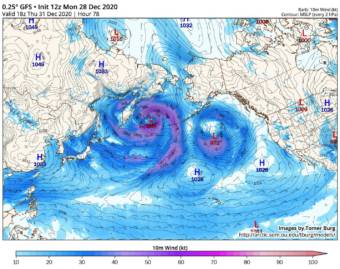
The storm will dissipate as it crosses into the eastern Aleutians and heads towards the Alaska Peninsula, according to Rick Thoman. He said it will likely be a typical storm for Unalaska, recording short-lived 50 to 70 mph winds. (image courtesy Rick Thoman)

The collision of a warm, wet weather front with a mass of cold air from Siberia could set a new record: the lowest barometric pressure recorded in the North Pacific. That could mean hurricane-force winds and high seas in the southwest Bering Sea.
“This storm is generating a lot of interest from weather watchers around the world,” said climate specialist Rick Thoman of the University of Alaska Fairbanks.

He said the storm — which is expected to reach Unalaska by Thursday night — will be comparable to Typhoon Nuri in 2014, and to another record storm that touched down near Adak in 2015, causing wind damage in Unalaska and the Pribilof Islands.

Anchorage-based National Weather Service Climatologist Brian Brettschneider said current models show the barometric pressure plummeting to as low as 920 millibars on Thursday. The current North Pacific record low is 925.

That’s the kind of reading you would expect in a pretty strong hurricane in the tropics, said Brettschneider.

“You have the ingredients that could come together to have the storm kind of explosively develop,” he said.

The places that could be hit hardest are western Aleutian islands like Shemya and Attu. But the heart of the storm could also center on the community on Adak, which has a population of about 100, and Atka, a community of about 50 people located 100 miles further east. National Oceanic and Atmospheric Association forecasts show winds up to 75 mph in Adak.

Thoman said it won’t be as severe in the more-populated fishing port of Unalaska.

“Because this storm is going to be very far west, like the 2014 ex-typhoon Nuri, we’re not expecting those kind of damaging winds to move into the eastern Aleutians or the Pribilofs. But you certainly will notice the weather front,” he said.

Low pressure will likely create more of a typical storm for Unalaska — short-lived 50 to 70 mph winds. Another effect could be waves as high as 40 feet in the western Bering Sea, said Brettschneider.

“That’s going to be a major issue for commercial fishing, for ocean transport. Those are some serious waves,” he said.

The system is caused by the convergence of a deep high-pressure cold front from Siberia with the warm, tropical low pressure from the South Pacific. Parts of Siberia have been recording temperatures in the minus-70s Fahrenheit, said Brettschneider.

“When you have cold air and warm air meeting together, it provides a lot of energy for the storms, for the low pressure to really deepen,” he said

Mainland Alaska likely won’t see any of the winds from the storm, but Brettschneider said there will be indirect effects. A low-pressure system in the Bering Sea will push a high-pressure system over the Yukon.

“It means we’re going to have an easterly flow which is going to bring colder temperatures. And so paradoxically, we may cool down, over the next week, in part because of that low pressure,” he said.

If the pressure does set a record, Brettschneider said, there won’t be any fanfare in the weather world other than the recording in the charts. But he said keeping track is still important.

“We’re monitoring the state of the climate regionally and globally and how these things are changing. And the intensity of storms is going to be a marker of the changing climate,” he said.

Native artist gathers social media followers to get baby formula to Russian Mission families in need

Russian Mission in 2018. (Dept. of Commerce, Community, and Economic Development)

A story about the baby formula shortage in Russian Mission caught the eye of artist and activist CeeJay Johnson, who stepped in to organize a big donation. The post office in Russian Mission has been intermittently closed for nearly half a year. Both the village store and mothers who receive benefits from the Women, Infants and Children Program rely on U.S. Postal Service for formula shipments and have been running dangerously low.

When Johnson caught wind of the story, she posted the information to her Facebook page, Kooteen Creations, and her page on Reddit. She received many messages of support and offers to donate supplies. Johnson organized the donation deliveries, which were dropped off before Christmas.

Although Johnson has never been to the Yukon-Kuskokwim Delta in person, she knows the struggles of the region well. She was born and raised in Sitka, and she went to Mt. Edgecumbe boarding school where she made friends with many students from the Y-K Delta villages.

She’s also Indigenous herself, with Sioux and Tlingit ancestry. Johnson spent many years working in tribal governance in Alaska as well as in the Lower 48. In short, she was uniquely prepared to help with relief efforts.

Johnson originally started her Kooteen Creations Facebook page as a platform for selling her art and beadwork. But when the pandemic struck, she started using it as an antidote to feelings of isolation among Native communities.

“I noticed that a lot of Native peoples were having some difficulties coping with the burden of self-isolation. So I started this project called ‘Bead Your State,” she said.

For the project, Johnson beaded Alaska and Washington and she invited Indigenous people from all over the U.S. to join in and help her complete the map. The project grew to include the provinces of Canada and her platform grew to thousands of followers.

Johnson always used her platform for political posts, but she started organizing donations in October when she read an article reporting that the Yukon-Kuskokwim Health Corporation was dangerously low on gloves. She organized a team to donate supplies and soon the efforts expanded.

Now she coordinates donations of hand-sewn masks, other personal protective equipment, baby formula and many other supplies to villages. In just two months from her initial relief effort, her team has grown to dozens of volunteers. Donated supplies are sent to a storeroom owned by Calista Corporation in Anchorage, where they are inventoried, packed up and shipped off to the villages.

“Because the last thing we wanted to do was send 5,000 masks to villages with 400 people because they don’t need that many,” she said.

https://www.facebook.com/KooteenCreations/posts/1254191594952591

Johnson knows that post offices can’t always be relied on in rural Alaska, so it’s best to coordinate deliveries directly through small shipping services like Ryan Air, which gave their services to her relief efforts for free.

“I’m really good at getting people to help,” laughed Johnson.

She’s not lying. To get Ryan Air to help, she reached out to her former high school classmate who is married to its president.

https://www.facebook.com/KooteenCreations/posts/1254311498273934

Russian Mission is benefitting from Johnson’s efforts.

Margie Larson, who is a mother of a 5-year-old and a 7-month-old, hasn’t received a formula delivery from WIC in almost two months so she was relieved to get the formula canisters.

“I was posting almost every day on Facebook channel for formula, any kind of formula ’cause my daughter was out. We were really, really happy for that package that came in from KC,” Larson said.

But the donation formula will only last her two weeks. A temporary postmaster was supposed to show up early last week, according to a representative for USPS. But Olga Changsak, the tribal administrator, said that she was two days late. The tribe was concerned that she would only be in town for one day, and would not have enough time to get to all of the WIC boxes.

Russian Mission still has one applicant for the position of postmaster, who is waiting to hear back. But the process usually takes at least 30 days, and the company handling the background checks has been slow since the start of the pandemic.

In the meantime, Johnson is sending more donated formula.

Adak under lockdown after finding first case of COVID-19

The city of Adak. (Photo by Zachariah Hughes/Alaska Public Media)

The westernmost community in the U.S. is under lockdown after an arriving visitor tested positive Saturday for the coronavirus.

Adak’s mandatory stay-at-home order and the closure of all-but-essential businesses went into effect Saturday evening. It’s expected to be lifted on Tuesday.

The visitor is the first confirmed case of COVID-19 in the community of about 100 people, according to Adak City Manager Layton Lockett.

“Hopefully, it’s just a traveler that can stay isolated,” Lockett said on Monday. “This is truly a test of our travel restrictions. Are the mandates working? What do we need to do to adapt those? How this goes will dictate whether we will need more restrictions or whether we can continue to have the same program we’ve had in place.”

Under the lockdown order, Lockett said all residents must stay home unless “performing duties related to immediate public health and safety,” in order to allow state health officials to conduct full contact tracing and determine the level of risk of community transmission.

“We don’t expect that there was significant community transmission,” Lockett said. “But again, until [public health officials] can finish their contact tracing, we won’t know for sure. So that’s the reason we’re asking for people to stay at home, pretend like it’s a really bad storm coming through and try to keep everyone safe by staying indoors and not interacting with folks outside their household.”

The city also ordered all businesses to remain closed — with the exception of those necessary for public health and safety — until the order expires.

The Adak City Council passed an ordinance last month to continue restrictions on travel into the community through at least Jan. 26, 2021. All travelers must make arrangements to take a COVID-19 test at the Adak Medical Clinic within 24 hours after arrival, regardless of whether a test was taken as part of the state’s Health Order 8.

Investigation into fatal PenAir crash in Unalaska finds mechanical problem, change in airline safety culture

A crane lifts an airplane from a rocky drop near the runway.
An effort got underway Friday, Oct. 18., to move a PenAir plane that had gone off the runway at Unalaska’s airport. One passenger died as a result of the incident. (Photo by Laura Kraegel/KUCB)

It was a blustery fall day at Tom Madsen Airport. A PenAir flight from Anchorage was making its second attempt to land in Unalaska. Gusting tail winds made the landing extra challenging. As the plane touched down it failed to slow down, broke through the airport’s chain-link fence, crossed a road and hit a rocky embankment just short of the frigid waters of Iliuliuk Bay.

Steve Ranney was among the 39 passengers on flight 3296.  He’s a commercial pilot with 20 years of experience and still trying to understand what went wrong that day.

“I just don’t think that we can flat accept that there’s going to be accidents like this,” Ranney said. “I think that’s really one of the more important things. I know people make mistakes, but in the air carrier world, these things should not happen. This shouldn’t have happened at all.”

Ranney is still recovering from his injuries. A passenger to his left fared much worse; 38-year-old David Oltman was fatally injured in the crash. There were at least nine people hurt. Oltman’s death on Oct. 17, 2019 was the second fatality for a commercial airline in the U.S. in the last decade.

Ranney was traveling with his son who was competing with the Cordova school swim team. He is grateful the students escaped serious injuries.

“I’ll take the hit for the boys,” Ranney said.

On Wednesday, the National Transportation Safety Board released more than 2,000 pages of documents related to the crash. Ranney has already begun to comb through the files.

“A lot of people really get frustrated with how long it takes,” Ranney said. “But I’m actually kind of surprised at how much information they’ve gotten and how close it is to wrapping up.”

Here’s what the federal investigators initially found: A faulty wiring job may have kept an anti-skid device from working properly. And that could have contributed to the plane overshooting the tarmac.

But they also heard from PenAir pilots concerned that the airline was reducing the amount of experience its pilots needed to land on Unalaska’s notoriously challenging runway.

PenAir historically required pilots to have a minimum of 300 hours in a Saab 2000 before they could captain a flight to Unalaska. But after the Seybert family sold the airline to RavnAir Group in 2018, that rule was being reviewed.

In fact, NTSB investigators were told by PenAir pilots that in early summer 2019 a conversation was held where the chief pilot and Ravn vice president of flight operations discussed relaxing that rule.

The captain of flight 3296 had been flying into Unalaska for about three months. On the day of the crash, he had logged 131 hours in a Saab 2000 — less than half the historical requirement for PenAir pilots responsible for bringing flights into the Aleutian city. His first officer had a few hours more. Both had been hired by the company in May of that year.

The NTSB’s investigation describes the airline’s safety culture following PenAir’s sale to RavnAir Group. Ravn’s safety director told investigators he considered the overall safety culture as “still good,” but admitted that pilots had approached him saying they were “not as comfortable anymore” speaking freely about their concerns.

A Ravn VP of flight operations told investigators the requirement was not consistent with how other commercial air carriers operated in the Lower 48.

“I’m not convinced that it’s necessary because it’s not done elsewhere,” the VP said. “There are mountains around the country, around the world. Air is air. Physics are physics. Why is this different?”

So what happens now? Now that fact-finding is mostly complete, NTSB’s Clint Johnson in Anchorage said investigators hope to wrap up their work within the next year.

“The analysis portion is crunching all the information that we have here and ultimately driving towards a probable cause and analysis,” Johnson said. “Also most importantly, probably recommendations will come out of this accident investigation to keep it from happening again.”

The five presidentially appointed members of the National Transportation Safety Board may vote to hold a public meeting to review this investigation and determine a probable cause for the accident. Most accidents don’t have board meetings. The last time this happened for an Alaska investigation was for a fatal Togiak crash from 2016 operated by another RavnAir Group subsidiary, Hageland Aviation.

Johnson said board meetings are similar to a court hearing.

“Each one of the investigators and each one of the disciplines are questioned by the board members,” he said. “At the end of that process, the board members right there in the board meeting will determine probable cause [of this accident].”

PenAir is no longer flying. Its parent airline RavnAir Group declared bankruptcy in April and sold its assets this summer. A Southern California commuter airline bought some of its planes and two of the operating certificates. The company resurrected the name Ravn Alaska and rehired some of its crew. In November, it resumed scheduled flights to Unalaska, under new ownership but with the same old name.

KUCB in Unalaska and ProPublica are investigating aviation safety across Alaska. They are interested in hearing about people’s experiences flying or working for airlines in the 49th state and would particularly like to hear from people who have been in plane accidents or lost loved ones in fatal plane crashes.

If you have something to share, contact KUCB reporter Zoe Sobel via email or via phone call or text at 907-359-1888.

Site notifications
Update notification options
Subscribe to notifications