KUCB - Unalaska

KUCB is our partner station in Unalaska. KTOO collaborates with partners across the state to cover important news and to share stories with our audiences.
St. Paul Island has no confirmed cases of COVID-19, but the community isn’t letting down its guard

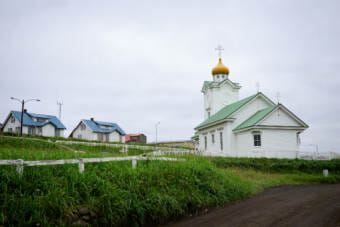
Sts. Peter and Paul Church on St. Paul Island. (courtesy of Ian Dickson/KTOO)

On St. Paul Island in the Pribilofs, the school year started with roughly 25% of students doing home-based education even though the school was open to students.

As the year has progressed, most of those students have returned. But as in many remote areas in Alaska, St. Paul remains on high alert because the effects of returning to distance-based education in the small community of just 397 people could be particularly devastating.

“Our community is very close,” said St. Paul teacher Melissa Zacharof. “We have lots of community events. And generally, lots of ways to interact with each other on a regular basis. For example, we have a community art center. We’d have pottery classes and paint nights. We have regular gatherings, whether it’s for a meeting, or somebody’s wedding, or another important family event — things like that. They have all pretty much had to shut down.”

Zacharof teaches sixth through twelfth grade humanities in St. Paul and is working with 23 students this year. There are about 50 school-aged children on the island. According to Zacharof, the school’s always been a very welcoming place. But since the pandemic began, that hasn’t been quite the same.

“There’s a plexiglas barrier in front of our secretary,” described Zacharof. “Out front, there are paraprofessionals and maintenance directors ushering kids inside and taking their temperatures one at a time. There aren’t kids in the hallway. There aren’t kids in the gym.”

At first glance, the image Zacharof depicted doesn’t seem much different from what’s happening at other schools that also reopened to students amid the COVID-19 pandemic. But in such a remote community, disruptions of daily social interactions can be especially devastating.

But Zacharof said when the city restricted access to social gatherings and the school closed last March due to the pandemic, it wasn’t the loss of the events or places so much that impacted the community.

“Those kinds of things have been — I don’t want to say taken away  — it’s not that,” reflected Zacharof. “It’s just that that access that we have to each other, that we’re used to, has definitely changed.”

Most of the students in the Pribilof School District go to school in St. Paul. And classes are generally made up of about a dozen kids each. There are also about six students at the school on nearby St. George Island, which is a correspondence school of St. Paul.

Because St. George’s population is so small and the island is so isolated, the majority of the students’ work is done virtually — often through online learning systems such as Acellus — and monitored by a single staff member.

Pribilof School District Superintendent John Bruce said both communities are working to keep the kids safe and that the district has stepped down to four days of classes per week on St. Paul to allow extra cleaning this semester. And he said the island’s remote location has been a blessing so far.

“We haven’t had COVID up here yet,” said Bruce. “The downside to [the precautions] is for the kids — they’ve done very well, but they’re not getting a full day’s education.”

With just six teachers on the island, he said the school has had to begin alternating students’ schedules to lower class sizes. Half of the students attend their classes in the morning, and the other half in the afternoon. And that leaves a lot more time with kids at home.

Jill Fratis — a teacher, parent and general manager of the local radio station — said the shortened school day has been challenging.

“Being a working parent and trying to balance and juggle the two, I’m not gonna lie, it’s been really difficult,” said Fratis. “And trying so hard to make sure that I am there fully — in all aspects of my life — is a learning process, but one day at a time is all I’ve got to say.”

As the community has learned to adjust to the shifting schedules, she said she’s been extremely grateful for everyone’s flexibility, and especially for the school district’s commitment to keeping students, staff and families safe.

Fratis’ enthusiastic praise for the city and district for working so hard to keep the students in school — even for just half a day — shows how meaningful in-person learning and interaction are to her.

She said that interaction is also important for the island as a whole, so much so that she described last spring’s transition to purely home-based learning as a “culture shock” for the community.

“Everyone knows each other by first, middle and last names, and everyone’s a part of each other’s lives every single day,” said Fratis. “And then having to go from that to distance learning — just having the kids at home by themselves, not being able to have that connection, that in-person physical connection with your classmates and your teacher — it was something that took them a really long time to get used to.”

St. Paul Island is currently in phase three of its strategic reentry plan. Under that plan, all non-essential travel is banned, people returning to the island are required to quarantine for two weeks and strict social distancing is required in public to protect everyone.

“There are multiple generations here — grandparents, kids and grandchildren on the island,” said Fratis. “And we are the largest population of Unangan people in the world. And we want to protect that. It’s very sacred to us. And I think that the community is doing an amazing job.”

While to some those restrictions may seem harsh for a community with no confirmed cases of COVID-19, Fratis said the island and its community are worth protecting.

Ravn Alaska will resume flights to 6 communities Friday

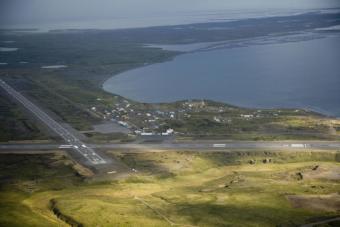
On Friday — for the first time since RavnAir Group filed for bankruptcy earlier this year — a DeHavilland Dash 8 airplane landed on Tom Madsen Airport’s short 4,500-foot runway. (Hope McKenney / KUCB)

Ravn Alaska will return to six Alaska communities on Friday, with regularly scheduled public chartered flights offered by Ravn Travel.

Tickets are now available for scheduled flights between Anchorage and Unalaska, Sand Point, Homer, Kenai and Valdez, according to Ravn CEO Rob McKinney.

“We were issued our public charter status under Part 380 of the U.S. Department of Transportation’s rules, which means that we can publish the schedule for four round trips per week to any given pairs of cities,” McKinney said.

Under DOT public charter regulations, Ravn was required to establish a separate agency, Ravn Travel, in order to offer the service. The airline is also limited to four flights per week to each destination until it receives final DOT approval to resume regular scheduled service.

“We were hoping we would have had our regular authority by now, but that hasn’t worked out,” said McKinney. “So we’re trying this other direction just to get service going as quickly as we can.”

Last month, two airlines — Alaska Seaplanes (Kalinin Holdings, Inc.) and Alaska Central Express (ACE) — objected to Ravn resuming regular commercial operations during the DOT’s “show cause order” window. The order opened up a 14-day period for anyone to show cause for the DOT not to find the air carrier “fit, willing, and able” to provide scheduled air service.

“They are working through the objections that were filed during the show cause period,” said ports director Peggy McLaughlin at a city council meeting Tuesday night. “There were two companies that objected and so USDOT is working on that. We don’t have a timeline for regular scheduled service just yet. It’s going to take them a minute to work through those objections.”

Under Ravn’s public charter service, the airline will be flying to Unalaska on Mondays, Tuesdays, Thursdays and Fridays.

McKinney said flying on Ravn’s charter flights will look similar to flying on normal commercial flights, except that people won’t be able to book online, and will have to call Ravn’s reservation center.

He said for the general population, tickets will cost $649 or $549 to the island, depending on whether or not it’s refundable, and Unalaskans will get a local discount.

“The really exciting part of what we have to offer is that if you have an ID with a local address on it, so if you’re local to the Aleutian Islands, you will be able to get a $399 fare,” he said.

Alaska residents will be allowed two free checked bags, according to McKinney. And for non-residents, it will be $15 for the first bag and $25 for the second.

The flights on the DeHavilland Dash 8 planes will likely make a stop in Cold Bay to refuel. McKinney has said in past interviews that Ravn is eventually moving towards using aircraft that don’t require a refueling stop.

While McKinney said he was hoping to have the DOT’s final approval by now, he is excited to finally offer reliable air service to Unalaska.

“But at the same time, I’m still frustrated that the situation is taking as long as it has,” he said. “We started working on this in July, and here we are in November. So that part is still obviously frustrating, but I’m really, really happy to watch the first airplane take off and head your way this Friday.”

To book a flight on Ravn’s new public charter service, you can call the airline’s reservation center at 833-418-2360, or visit the Ravn counter at Unalaska’s airport for the local discount.

Ravn is still waiting on the DOT’s final route authority approval to begin scheduled commercial flights, which McKinney said he expects to be awarded in the coming weeks.

$9M settlement to be paid to survivors, families of Scandies Rose crew, which sunk on New Year’s Eve

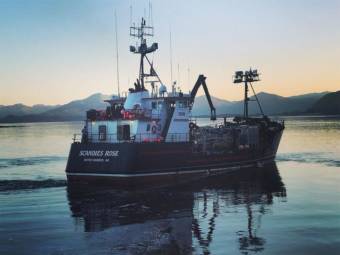
The F/V Scandies Rose sank west of Kodiak on Dec. 31, 2019. (Photo courtesy of Bret Newbaker)

A $9 million settlement will be paid to survivors and families of those lost at sea last New Year’s Eve after a Dutch Harbor fishing vessel sank off the Alaska Peninsula.

The company that owned the fishing vessel Scandies Rose will pay out from its insurance policy to the families of four deceased fishermen and two survivors that worked on the 130-foot crab boat.

Earlier this year, attorneys for the survivors and families of deceased crewmates filed claims on their behalf, alleging that the Scandies Rose went down because it wasn’t seaworthy for the freezing conditions at sea when it left Kodiak and that they were entitled to damages.

“They carried a full load of pots and proceeded into some known icing conditions, which we feel was a major cause of the accident,” said Jerry Markham, a Kodiak attorney who represents the families of three of the deceased.

But neither side is seeking to formally cast blame in court now that a cash settlement has been reached.

“This takes care of everyone’s claims against the vessel,” said Mike Barcott, a Seattle-based attorney representing the vessel owners, Scandies Rose Fishing Company and Mattsen Management.

How the settlement will be divided between the survivors and families of the deceased will likely be done in private, either through mediation or arbitration, he added.

Captain Gary Cobban Jr. of Kodiak owned a stake in the Scandies Rose. He and his son perished when the vessel sank during a storm while on its way to the Bering Sea for Pacific cod and crab.

Barcott said the skipper’s next of kin is not part of this arrangement; his family will be receiving a separate settlement through insurance.

The settlement ends litigation that was headed to trial next spring in Washington state. That means assigning blame for the tragedy will not be decided in a courtroom.

“The trial would have decided if the vessel and her owners had been negligent in some way,” Barcott said. “It would not have divided up the verdict among the parties. This was just a ‘who’s responsible’ trial. And now that’s not necessary.”

But some of the questions raised in the lawsuit may be addressed during a formal inquiry by the Coast Guard Marine Board of Investigation. It’s slated to begin hearings into the incident on Feb. 22 in Seattle.

Barcott said the majority of maritime claims that involve lost ships end in a cash settlement. Trials, he said, rarely bring closure.

“Trials in an incident like this are wrought with emotions, and 99 percent of these cases involving vessel sinkings settle,” Barcott said. “The question is always how much is the settlement. The owners thought this was a terrific vessel, they thought Gary Cobban was a terrific skipper, and to vindicate themselves, they would have liked to have gone to trial. But they also understand there are some estates that are grieving, and it’s frankly better for everyone not to go through the process of the trial. It’s really hard to go through a trial like this. It’s hard on everybody.”

Jerry Markham, the Kodiak attorney who says he’s handled more than a dozen similar cases, echoed that sentiment.

“I think the families are relieved that they don’t have to go to court and cast stones on all the reasons why the accident happened,” Markham said. “It’s part of fishing; vessels sink. It’s [the responsibility] of vessel owners to keep them safe, and not put them in the position of having that happen.”

One of the crew members’ next of kin is a minor. The court will need to approve that portion of the settlement by determining it’s in the best interests of the child, Barcott said.

“Under maritime law, when a seaman dies, one of the claims that can be made is on behalf of their child who has lost the support of that parent. And that’s the situation here,” he said.

The four deceased crew members who will receive a portion of the settlement awarded this week are the captain’s son, David Lee Cobban, of Kodiak; Brock Rainey, Art Ganacias and Seth Rousseau-Gano. The two survivors sharing in the settlement are Dean Gribble and Jon Lawler.

The $9 million settlement will be paid by insurance, Barcott said.

“It’s how much insurance they had,” he added.

High school hatchery revitalizes Unalaska silver salmon population

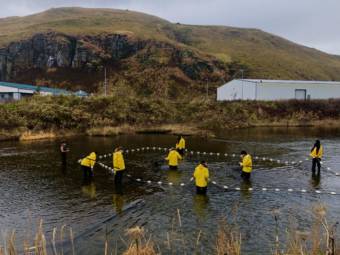
Students in Steven Gregory’s fisheries class stretched a seine net from bank to bank of the Iliuliuk River, while another group waded upstream, slapping large dip nets on the surface of the water. (Maggie Nelson/KUCB)

Around October every year for the last 19 years, Unalaska High School students have been wading into the Iliuliuk River, under science teacher Steven Gregory’s guidance, to collect pairs of spawning salmon.

Last week, students in Gregory’s fisheries class stretched a seine net from bank to bank, while another group waded upstream, rhythmically slapping large dip nets on the surface of the water.

“Two people go down and they scare the fish into the net and then a bunch of people stand on the net so the fish can’t escape,” said Natalie Buttner, a junior at Unalaska High School. “And then as the people come down, scaring [the fish] in, the net comes all the way around and catches the fish, hopefully males and females.”

Buttner said she’s excited to be in Gregory’s class, and that it’s something that seems unique to the region. As the course has progressed, she said she’s gained more interest in the subject, as she’s been able to observe the salmon daily, from counting silvers from the banks of the river to assisting with the fertilization process.

While the class struck out last Tuesday — only catching a single male silver — they caught two spawning pairs the day before.

After they catch the spawning pairs, Gregory said they collect the eggs in a bucket and fertilize them. They then add salt to water from the Iliuliuk River, which is added to the eggs. Gregory said his class started adding the extra salt about four years ago, and it has increased their fertilization success rate to about 90 percent — a percentage that he said is comparable to professional hatcheries.

Gregory encourages the students to actively participate, but he said the beginning of the harvesting process requires a delicate and experienced approach.

“What I do is I express the eggs from the female. I usually do that because it takes a certain amount of experience to be able to squeeze the eggs out,” said Gregory. “You don’t want to break the eggs, it’s very bad if you break the eggs because the contents of a broken egg will interfere with the fertilization of the healthy eggs.”

After fertilizing the eggs, they place them into incubation trays with running water to simulate the undergravel nest in the river — also known as a redd.

Gregory very carefully pulled out an incubation tray filled with about a thousand salmon eggs, directing pairs of students to gather around to get a closer look.

“The eggs can be exposed to the air for a short period of time,” Gregory explained to the students. “You don’t want them to be exposed to the air for too long because the mold spores will land on them and a fungus will start to grow on the eggs. The dead eggs will appear white. So anything that is white was not fertilized.”

Unalaska Senior Landen Shaishnikoff holds a fertilized silver salmon egg. (Maggie Nelson/KUCB)

Gregory said the fisheries course covers a number of topics, ranging from basic biology to commercial fishing and salmon hatchery operation.

He tells the students that they are “the stewards of the river.” And as part of their current unit, they’ve performed a salmon census. The eggs that they are now collecting will ultimately develop into young salmon and will be released into the Iliuliuk River.

Gregory and his students monitor the eggs until they become fry, which are small salmon that no longer have a yolk sac attached to them. Most of the fry are released into the river, but some, Gregory said, are kept longer in the hatchery.

“Once the alevins have turned into fry, we put them in the other part of the hatchery — it’s called the raceway,” said Gregory. “And the raceway simulates the flowing water part of the river. And so that’s where the salmon go when they’re fry and then they turn into what are called ‘smolt’.”

Gregory said they will keep 50 fry in the raceway and feed them and chart their growth.

“And this spring, May of 2021, [the smolt] will be about as long as your hand,” said Gregory. “And we will let them go along with the fry from the eggs that we captured last week.”

Along with some of the elementary students, Gregory’s class will release last year’s smolt into the river in the spring and will nurture another group of salmon for next year’s class to observe and then release.

In the meantime, Gregory uses the fish to teach students about a number of subjects, from the salmon life-cycle to analyzing and protecting the watershed.

Rodrey Sebastian, a senior in the class held up a murky vile of water and explained that they monitor the water in the raceway to ensure it has the correct amount of dissolved oxygen in it.

“So this right here is sodium thiosulfate,” said Sebastian. “This is what we use to determine how much dissolved oxygen there is in the water. So right now the water is just super mucky. After we add this chemical, we have to mix it up and then after that we transfer it into this little tube, and then put it in this mixing jar. And what we’ll do once this is a little bit mixed up and settled, is we’ll drop as many drops of sodium thiosulfate that we need to make the water clear again.”

Sebastian said the number of drops of sodium thiosulfate will tell them the number of units of dissolved oxygen in the water. He said they are aiming for about 9 to 11 drops.

Gregory and his students place the salmon eggs into incubation trays with running water to simulate the undergravel nest in the river — also known as a redd. (Maggie Nelson/KUCB)

And as Gregory discussed aspects of the course and detailed the life-cycle of a salmon, it was easy to see where that enthusiasm originated.

“Do not take the salmon that run in our river for granted,” said Gregory. “The amount of urbanization that has taken place in this town — it’s obvious that [it has] negatively impacted our watershed. And I’m very passionate about that.”

While Gregory remains frustrated with some of the ways local streams and water quality are neglected, he said he’s noticed a significant increase in the silver salmon population in the river since they began regularly offering the course and releasing salmon into the stream.

“Our operations here at the hatchery have done nothing but increase the silver salmon population,” said Gregory. “It’s been amazing to see that come back. When I was a kid here, there were hardly any of them spawning out there. And today, you can go out there for two or three straight weeks and see 100, at least, actively spawning at any one time. So it’s been a success.”

Gregory said the class will try again this week — weather permitting — to catch another spawning pair of silvers.

One Year Later: Unalaska community reflects on fatal PenAir plane crash

A crane hoists PenAir’s Saab 2000 airplane on Oct. 18, 2019. One person was killed and multiple people were injured when the plane went off the runway while attempting to land the evening before.
A crane hoists PenAir’s Saab 2000 airplane on Oct. 18, 2019. One person was killed and multiple people were injured when the plane went off the runway while attempting to land the evening before. (Photo by Laura Kraegel/KUCB)

Saturday marked the one year anniversary of Unalaska’s fatal PenAir plane crash.

On Oct. 17 of last year, the Saab 2000 plane went off the end of Tom Madsen Airport’s runway. Forty-two people were on board, more than 10 were injured and one passenger died.

The National Transportation Safety Board’s investigation of the crash is ongoing and an agency spokesperson said it could take up to two years to finish.

The crash was a tragic event for the island and those involved. It marked the start of an unstable relationship and ongoing struggle with access to airline service on and off Unalaska.

“There’s challenges to traveling off the island because of weather conditions and canceled flights,” said Unalaska City School District superintendent John Conwell. “We’ve all gone through that. We’ve had ferry service that’s been disrupted in the past. So, this last year, that’s just been magnified a lot.”

Conwell said the crash amplified many of the concerns local travelers face living on a remote Aleutian island.

He said he is thankful that more people were not killed in the crash, but he also recognized that the event was still traumatic for everyone involved, including the Cordova swim team that was onboard at the time.

Conwell said he’s proud of the way the community supported the students who were stuck on the island overnight, after the crash.

“People started showing up with cases of Gatorade and potato chips and snack food — comfort food that teenagers like,” he said. “And Unalaska students were loaning their cell phones to the Cordova team members so that they could call their families, and so just immediately, people started pulling together.”

In the weeks following the crash, when the island was cut off from commercial air service, the community also pulled together through social media. Andy Dietrick, who owns a drone business called Aleutian Aerials and tourism company Aleutian Excursions, is the administrator on the Facebook group Unalaska Plane Charter Coordination. The group launched about a week after the fatal plane crash. Dietrick said it originated organically, through the needs the community was voicing on Facebook.

“It was mainly just so people could connect with each other when they were trying to coordinate a flight on or off the island in the absence of regularly scheduled air service,” Dietrick said. “Since much of rural Alaska is so prolific with their Facebook usage, it made sense to use that platform.”

While there is scheduled commercial air service through Grant Aviation to and from Cold Bay now, various charter companies still use the group to advertise available seats and coordinate with locals looking for direct flights between Anchorage and Unalaska.

Bernadette Oller Namasivayam said the Facebook group is an essential means of coordinating flights for the community. After the crash, Namasivayam said she was frustrated with the airline problems on the island and saw an immediate need for another form of transportation.

“Somebody needs to fly here and help us,” Namasivayam said. “Something needs to be done. I mean, there’s got to be a way.”

So she reached out to several different charter companies, asking them to charter flights on and off the island. Namasivayam said Dena’ina Air Charters was the only company that agreed to help.

She said she offered to help fill planes and coordinate flights and now, with the help of her children, she runs Dena’ina’s local operations.

Namasivayam said she plans to continue coordinating charter flights, even though Ravn Alaska said it hopes to start providing commercial service between Anchorage and Unalaska soon. Last week, the Federal Aviation Administration granted Ravn permission to begin flying charter flights on and off the island. But Ravn currently sits in a two-week window for anyone to show cause that the air carrier is not fit to provide scheduled flights before it can begin serving the area commercially.

Despite Ravn flights on the horizon, Namasivayam said she remains skeptical of larger airlines like Ravn coming to the island.

“The trust is not there,” Namasivayam said. “It’s the fear of not knowing. Are they going to set up a new company again, and then what’s going to happen next?”

Conwell said he looks forward to the convenience of consistent and reliable commercial air travel.

“I just think that it really improves the quality of life out here,” Conwell said. “And I know, as a superintendent who’s responsible for staffing the schools, it’s going to make my job easier, attracting qualified teachers and support staff to come out here and live because it’s a great place to live. There are just a few challenges with travel.”

For Dennis Robinson, who sits on both the Unalaska City Council and Qawalangin Tribal Council, the airport plays an essential role in life on the island.

“The airport is the single largest choke point of this community,” Robinson said. “It affects everything we do. And its ability to function is required in every aspect of island life.”

Robinson said that expanding the airport runway and providing access to safe and reliable air service is paramount to improve the quality of life in Unalaska — from access to comprehensive healthcare to basic comforts like movie theaters or gyms to creating an affordable cost of living.

On Wednesday, the Alaska Department of Transportation and Public Facilities will hold an airport master plan virtual meeting. The agency is seeking public feedback on issues related to future air service in Unalaska.

With one hurdle left, Ravn aims to relaunch service To Unalaska

On Friday — for the first time since RavnAir Group filed for bankruptcy earlier this year — a DeHavilland Dash 8 landed on Tom Madsen Airport’s short 4,500-foot runway. (Hope McKenney / KUCB)

Ravn Alaska says it could resume scheduled flights between Anchorage and Unalaska in two weeks, but there’s at least one hurdle left to overcome.

On Friday — for the first time since RavnAir Group filed for bankruptcy earlier this year — a DeHavilland Dash 8 airplane landed on Tom Madsen Airport’s short 4,500-foot runway. And the appearance of a Ravn-branded aircraft could be a sign that regular commercial flights between Anchorage and Unalaska are on the horizon.

On board the aircraft was a nine-person delegation of Ravn executives and Federal Aviation Administration officials. Rob McKinney, CEO of Ravn Alaska, was among them. He leads the company that bought RavnAir Group’s core assets in the wake of its sudden bankruptcy.

“We’ve invited the Federal Aviation Administration to fly with us out here to Unalaska — one of our more challenging destinations — to make sure that they’re comfortable and happy and can see that we are offering a safe service to the flying public,” McKinney said.

It was a dry run to test the Aleutian route before giving the embattled airline the go ahead to resume scheduled air service.

Rob McKinney is CEO of Ravn Alaska, the company that bought RavnAir Group’s core assets in the wake of its sudden bankruptcy. (Hope McKenney / KUCB)

McKinney said he originally hoped to relaunch operations in mid-August. But due to a number of hurdles getting FAA and Department of Transportation approvals in place, the airline shifted the timeline to mid-September and eventually continued pushing the relaunch back.

But on Tuesday, the FAA granted permission for the airline to finally begin flying charter flights, and the DOT issued what’s called a “show cause order,” which opens a 14-day window for anyone to show cause for the DOT not to find the air carrier fit, willing, and able to provide scheduled air service.

The FAA declined a request for comment.

While regulators take public input during the two-week window, McKinney said larger companies will be welcome to charter the 37-seat Dash 8 aircraft round-trip from Anchorage to Unalaska.

“So we’ll be able to, at least, start moving fishermen out here and get prepped for the next season coming,” McKinney said. “So that’s something. It’s not all that we’d hoped for, but at least it’s a little bit of service to get the community back connected.”

McKinney said Ravn has planes and flight crews ready to go, and the airline could start serving places like Unalaska in just two weeks if no formal objections are lodged during the 14-day window.

The airline hasn’t published ticket prices on its website, but McKinney said Ravn is working to codeshare with Alaska Airlines to allow customers to purchase tickets through Alaska Airlines’ mileage program.

“I talk with Alaska Airlines about every week, and they’re eager to start working with us,” he said. “But they want to make sure that safety is what it needs to be. So they’re going to come in and do their own audit of everything that we do and fly on our flights. And then, when they’re ready, they will give us the blessing. But they’ve said it’s their intention in the future that they are going to re-partner with Ravn.”

According to McKinney, the initial plan is to fly Dash 8 airplanes between Anchorage and Unalaska. Eventually, he said, they hope to use larger aircraft — but he ruled out deploying a Saab 2000, the model involved in a fatal plane crash that killed one passenger and injured more than a dozen others on Unalaska’s runway last year.

Site notifications
Update notification options
Subscribe to notifications