KUCB - Unalaska

KUCB is our partner station in Unalaska. KTOO collaborates with partners across the state to cover important news and to share stories with our audiences.
Dead whales wash up near Unalaska, but pandemic complicates necropsies

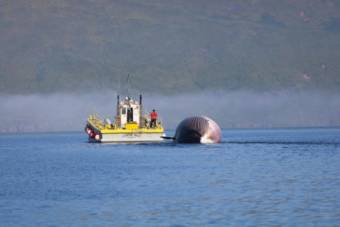
A juvenile humpback whale was spotted in Unalaska Bay on Sunday night. Alaska Sea Grant biologist Melissa Good took tissue samples, but was unable to perform a full necropsy. (Hope McKenney/KUCB)

Two dead whales have washed up on Unalaska’s shores in the past week: an adult fin whale — which is the second largest mammal in the world — and a juvenile humpback.

While local biologists hoped to determine the cause of deaths of both whales, they likely won’t be able to because of COVID-19.

That’s because it takes a large team of individuals to do a whale necropsy — or animal autopsy — which would make protecting public health and adhering to social distancing requirements impossible, according to Melissa Good, the local marine advisory agent with Alaska Sea Grant.

“Human safety is always the number one priority,” Good said. “Other places have difficulties with doing necropsies, whether the animal floats into a remote area or there’s bears in the area — you’re always putting human safety first and then going, ‘okay, can we get a sample after that?’ Right now, it happens to be that COVID-19 is at the forefront of all of our minds. And it’s something that we all need to be cognizant about, and continue to protect ourselves and the community. So we just can’t take those risks.”

Unalaska typically sees about one dead whale wash up on its shores every year, according to Good. When that happens, a team of biologists often perform a necropsy to determine the cause of its death.

But when the dead fin whale showed up floating in the waters of Captains Bay near Westward Seafoods on Friday, and a juvenile humpback washed up on the shores of Unalaska Bay on Monday, Good said biologists were unable to do the necropsies because COVID-19 prevented a large enough team from coming together to perform the task.

Good said that, with support from the Alaska Department of Fish and Game and NOAA Office of Law Enforcement, she was able to collect skin, blubber, and muscle samples from both whales, as well as some fluid from the juvenile humpback’s eye, to send to the state pathologist.

“We weren’t able to do a full necropsy,” she said. “I was able to take a tissue sample [of] skin and blubber, and we’ll be able to look at the skin and get DNA work off of that, and you can get some toxins from the blubber. So we’ll have a small bit of information on the whale.”

Good said the biologists looked for signs of human interaction with both baleen whales that would indicate human involvement in their deaths. But, she said, they didn’t see any fishing lines wrapped around them or any obvious signs of scarring or cut marks due to an entanglement.

“We could have missed something because we couldn’t see the whole body. But there wasn’t really anything obvious right up front,” Good said. “That certainly doesn’t eliminate other human interactions like vessel strikes or anything like that. But we just weren’t able to get that close of a picture of it.”

The juvenile humpback did have a small 5-inch rupture along its throat region, Good added. She said she’s not sure if the rupture was caused by gas buildup as the whale decomposed, or whether it was caused by human interaction, like a vessel impact.

Although they chose not to in these cases, the Qawalangin Tribe often harvests meat and blubber from whales that wash up on shore, which Good said could have provided a great opportunity to get samples to see if paralytic shellfish poisoning or other toxins were a factor in the whales’ deaths.

“We could have gone in with a very small team and possibly gotten some samples that could have been telling,” she said. “I would have been really interested in fecal samples or urine or stomach samples to see if PSP was an issue in this case. That would have been some information we would have looked for and sought after, but we just didn’t have that opportunity.”

In July, Alaska state and local health officials started warning of dangerously high levels of toxins in shellfish after a person died of PSP from mussels and snails in Unalaska. And, Good said, larger mammals like whales can die from ingesting algal toxins.

She said she would have some concerns about people harvesting these two whales for subsistence because they don’t know when or how they died. And, she added, because they were unable to perform necropsies, they probably never will.

Good considered it a missed opportunity. While a dead humpback generally washes ashore once a year, she said she hasn’t seen a dead fin whale in Unalaska since she took her position with Alaska Sea Grant six years ago. Although Unalaska is within their natural range, she said fin whales tend to stay offshore and don’t generally come into the bay.

The fin whale was towed to Wide Bay after biologists took blubber and skin samples to send to the state pathologist. (Maggie Nelson/KUCB)

“Outside of COVID times, we could have flown in a very experienced veterinarian team that would really help us get down and make sure we’re collecting the right samples,” Good said. “And I know there’s a lot of willing people here in the community that would step in and help out with the necropsies — the Qawalangin Tribe would certainly step in and help with that. And so we have the people here that can do it, and it’s definitely a missed opportunity. But no matter what we do, human safety is always the number one priority.”

Although this marks two dead whales washing up in Unalaska in the past week, Good said she can’t speculate if the two deaths are related.

According to the state pathologist, they will process the samples from the two dead whales to confirm things like species and sex, but they will likely be unable to determine cause of death without a necropsy.

Flight co-op aims to ease Unalaska’s travel woes — but they need a lot more people

The runway at Unalaska’s airport, photographed from Mount Ballyhoo in 2017. (Photo by Berett Wilber/KUCB)

Unalaska and Dutch Harbor have been without reliable air service since a fatal plane crash on the island late last year.

But Unalaskans, fishermen and other industry workers trying to get to and from the island have long faced travel woes from harsh weather to ever-changing airlines selling consistently high-priced seats.

Now, two people are promoting a new idea they say could help address the community’s persistent travel problems: a flight co-op.

The vision is a $10 per month service offering $600 seats on charter flights and protection against delays.
While the unproven concept has yet to launch, the co-op’s boosters claim it could fix problems like hours of waiting on standby lists at the airport, countless calls and communication on Facebook message boards — and charges for charter flights that never land at their final destination.

“Fundamentally, the Alaska Travel Co-op is about taking control of the travel situation between Dutch Harbor and Anchorage,” said Nate Chaffetz, who co-founded the Alaska Travel Co-op with longtime Unalaska businessman Mark Horne, founder of Alaska Wireless, Sundance Stevedoring, and Pacific Stevedoring.

Their goal is to sign up 5,000 corporate clients and individuals before launching, Chaffetz said. With that many people, he said airlines that fly between Unalaska and Anchorage would be forced to listen.

“By creating a membership — kind of like a Costco — we would have a group big enough to really advocate for what the community needs from an air travel perspective, in a way that’s never been done before,” Chaffetz said. “And it can only happen if we get a group big enough together to do it.”

Members would use a computer — and eventually an app — to look for seats on charter flights in the co-op’s system, according to Chaffetz. And, as opposed to many charter flights, customers wouldn’t be charged for a flight until it touches down at its final destination, either Unalaska or Anchorage.

“What we do provide is insurance against the fact that Dutch Harbor has a tiny runway, and it’s next to a huge mountain, and the weather is going to be bad,” Chaffetz said. “So when there are huge backlogs, if you’re a member of the Alaska Travel Co-op, you’ll be able to tell us that you’re stuck in either Dutch Harbor or Anchorage, and we will very quickly be able to pair you with other people who are also stuck into charter flights that we book, that you just show up for, and hopefully gets you going ideally the day the airport opens back up again — or at least one day after, instead of several days after.”

Chaffetz, a Seattle-based entrepreneur who is a pilot himself, said the idea was born from his business partner’s frustration with air travel to Unalaska. So he and Horne came up with a solution to a problem that he said is very specific to the island community — which is the number one commercial fishing port in the nation by volume. Although only about 4,500 people live in Unalaska year-round, the population more than doubles during peak fishing seasons.

Ravn Alaska — the rebranded company that bought RavnAir Group’s core assets in the wake of its bankruptcy — and Southeast Alaska airline Alaska Seaplanes aim to relaunch scheduled passenger flights to Unalaska in the coming months. But despite the possibility of stable commercial air service on the horizon, Chaffetz said business won’t be affected.

He said he’s excited that two companies are attempting to solve the critical travel problem in Unalaska, and that he doesn’t see commercial flying as a competitor to the Alaska Travel Co-op.

Scott McMurren is a travel industry analyst and columnist with the Anchorage Daily News. He said he applauds the efforts by Chaffetz and Horne to get a buying club together to have more leverage with airlines and charter companies — which, he said, is what fishing companies, oil companies and even state governments do to get a better deal.

But, McMurren added, he doesn’t know that the Alaska Travel Co-op will actually solve the travel problem for Unalaskans. Ultimately, he said, they need a new runway and bigger planes that offer non-stop service to better serve the needs of industry and of the community.

“I think that the charter companies, of course, would be happy to talk with Mr. Chaffetz or anybody else who would like to charter an aircraft. That’s the business that they’re in,” said McMurren. “I don’t know that they’d get any big breaks, because at the end of the day, you’re still chartering an aircraft to fly to Dutch Harbor, whether it’s $13,000 or $14,000 or $15,000. There are a lot of moving parts, and I’d be anxious to see how this looks in practice.”

As of Tuesday, more than 330 people have signed up with the Alaska Travel Co-op. Chaffetz and Horne aim to get about 4,600 more people to commit to a membership before they launch.

Biologists hope dead sea lion will shed light on endangered Aleutian population

Courtesy Melissa Good, Alaska Sea Grant Marine Advisory Program

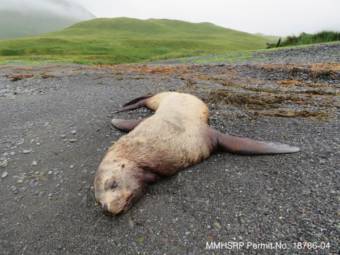
A Steller sea lion in poor health was sighted at Morris Cove in Unalaska over the weekend, prompting biologists to watch the adult male until it died early in the week.

“It’s really unusual to have sea lions hauling out on the soft sanded beaches,” said Melissa Good, a marine advisory agent with Alaska Sea Grant. “We often see them hauled out on the marker buoys or on some of the rocky points where they have rookeries or haul out areas. But we very rarely see them hauled out on a beach, especially here near town.”

A local spotted the Steller sea lion at Morris Cove. Good said the large male wasn’t acting right — he wasn’t holding his head up straight or reacting to the things going on around him, and his hip bones were protruding, indicating he didn’t have much blubber on his bones.

The Steller sea lion weighed about 1,500 pounds, according to Good. She said that’s on the small end for adult males, which can weigh in at over 2,000 pounds.

“It’s typical for them to lose a lot of weight over the summer because the large males spend their summers hauled out with harems of females,” she said. “And they’re guarding the females all summer long and not eating. So they end up losing a lot of their body weight. But I would think that they’d have a little bit more fat on them, and this guy was really skinny.

Good reported the animal to the Alaska SeaLife Center and to the Marine Mammal Stranding Network, a program through NOAA Fisheries that responds to sick, injured, stranded or dead marine mammals.

Officials with the program say they’ve recently been receiving more reports of Steller sea lions hauling out on beaches in poor condition but have been unable to retrieve the animals for research — largely because they’re in remote areas — so they still don’t know what’s causing the increase in sick or injured animals.

Because of unexplained widespread population declines in Alaska, Steller sea lions were first listed under the Endangered Species Act in 1990. The eastern stock has since recovered and is no longer listed. The western stock — which can be found west of Cape Suckling near Kayak Island through the Aleutian Islands and into Russian territory — remains endangered, according to NOAA Fisheries.

Good hopes the male sea lion found in Unalaska will contribute to the research on why the largest of the eared seals aren’t doing well in the western Aleutians.

On Tuesday, the Steller sea lion died. Good, with support from four volunteers from the Alaska Department of Fish and Game and the Museum of the Aleutians, performed a four-hour necropsy — or animal autopsy — on the 1,500-pound male.

“We collected the head, we collected samples of the internal organs, skin, muscles and blubber,” said Good. “And then we were also able to collect the stomach with all of its contents, feces and urine. And all of these samples will help us get an idea of what caused this guy’s death.”

The samples got shipped off island Wednesday morning to the state pathologist, who will be doing a full workup — looking for toxins, viruses, bacteria and any other abnormalities. Good said she hopes to hear back about the results in a couple weeks, but she said some of the more detailed analyses take time.

“My hope here is that it gives us insight into the broader population of our sea lions in this area,” she said. “The species has been listed [as an endangered species] for several years. Some areas are continuing to decline within our region, some of the smaller populations are increasing, and others are stagnant. And we just don’t know why we’re not seeing big increases in Steller sea lions, and why that population continues to not rebound.”

Good said if anyone sees a marine mammal in a strange spot, or that looks unhealthy, don’t approach it. Instead, call the Marine Mammal Stranding Network on its 24-hour hotline at (877) 925-7773, and the group will send a local responder to check it out.

Southeast Alaska airline to relaunch passenger service on former Ravn routes

For the community of Unalaska, Alaska Seaplanes and FLOAT Shuttle both intend to operate aircraft capable of flying directly from Anchorage. (Photo by Berett Wilber/KUCB)

Alaska Seaplanes announced Tuesday it intends to relaunch passenger air service on routes formerly served by RavnAir Group, which declared bankruptcy earlier this year amid the COVID-19 pandemic.

Juneau-based Alaska Seaplanes had previously put in an offer to buy the Part 121 federal operating certificates from Ravn-operated airlines PenAir and Corvus — which allow scheduled service to rural hubs in the Aleutian Islands, Bristol Bay and the Kenai Peninsula.

“We bid on some of the assets in the Ravn bankruptcy,” said Kent Craford, co-owner and president of Alaska Seaplanes. “We unfortunately lost it in a very bizarre auction for the Corvus and PenAir certificates that were attached to RavnAir Group.”

After Ravn — which was Alaska’s largest rural airline, with 72 planes, 1,300 employees and more than 100 destinations across the state — cancelled the auction process to sell off its assets earlier this month, Southern California-based FLOAT Shuttle struck a deal with the bankrupt airline to buy the PenAir and Corvus operating certificates and aircraft.

Craford said Alaska Seaplanes was disappointed by the auction process, but not deterred. The Southeast Alaska commuter air carrier still intends to serve the communities that were previously served by Ravn.

“But instead of taking over the old Ravn certificates, [we’ll] simply move operations out there under a different and new certificate,” he said.

Craford says the airline will partner with Wexford Capital, a Connecticut-based investment firm and long-standing participant in the regional airline industry that recently acquired a Florida-based airline out of bankruptcy.

“So we’re going to be adding aircraft to that certificate and serving Unalaska and other communities on the Alaska Peninsula that were previously served by Ravn,” he said.

For Unalaska and Dutch Harbor, Alaska Seaplanes intends to operate aircraft capable of flying directly from Anchorage, said Craford. The island has been without non-stop commercial service since a fatal plane crash last October, when one of Ravn’s Saab 2000 planes crashed while landing at Unalaska’s airport, killing one passenger and injuring more than a dozen others. Afterward, the company switched to using the smaller, slower DeHavilland Dash 8 aircraft, which require a refueling stop.

Since Ravn declared bankruptcy in April, Unalaskans have depended largely on chartered planes and twice-a-week commercial flights fulfilled by the regional airline, Grant Aviation, which flies between Unalaska and Cold Bay, and then a connecting Alaska Airlines flight from Cold Bay to Anchorage.

“PenAir really had set the bar with their Saab 2000 service,” said Craford. “And so right now, we’re looking at our aircraft options, but whatever we choose, it’s going to be an aircraft that can serve Unalaska directly from Anchorage without a stop in Cold Bay or anything like that.”

The airline intends to hire former Ravn and PenAir pilots who are experienced on Aleutian Chain routes, Craford added.

Alaska Seaplanes will be operating alongside FLOAT Shuttle, which also intends to restart scheduled service on all routes formerly served by Ravn — with the exception of Kodiak — in September, according to FLOAT Shuttle’s chief operating officer, Rob McKinney. That includes non-stop service between Anchorage and Unalaska/Dutch Harbor, he added.

McKinney previously led a Southeast Alaska airline, Wings, for six years.

Sand Point docks and road damaged by magnitude 7.8 quake

Photo of a large, offset crack in a warehouse floor.
Damage at a warehouse at the old dock in Sand Point (Photo courtesy of David Walls)

A magnitude 7.8 Aleutian earthquake late Tuesday night prompted tsunami warnings in communities across coastal Alaska, from Homer to Unalaska.

In Sand Point — a fishing community of about a thousand people in the eastern Aleutians — earthquake damage has closed both city docks, which are used to land freight boats and the M/V Tustumena ferry. The earthquake damaged the road to the harbor as well.

On Sand Point’s old dock, a warehouse floor sank and cracked along the length of the cement. City Administrator Jordan Keeler says that a team of engineers will inspect the damage in the next week or so, but he’s confident that it looks worse than it really is.

“We have two docks total and they are both closed, effective immediately until we can get an inspection to verify the extent of the damage to both the new dock and the old dock,” Keeler said.

In the meantime, closing down the docks could mean that freight shipments will be cancelled until they reopen. That could impact the island community’s ability to get fresh food.

All things considered, and despite the damage caused by the earthquake, Keeler says things went smoothly.

Photo of a large, offset crack in a warehouse floor.
The floor sank in a warehouse on Sand Point’s old dock, creating a large crack across the length of the cement. (Courtesy of David Walls)

“I’m just glad nobody was hurt,” he said. “Everybody was safe, and given the magnitude of the earthquake, the small amount of damage we did see, we are fortunate.”

Tsunami warnings after the earthquake named Sand Point as the first community that could see a wave, but the wave turned out to be less than a foot tall, according to the National Tsunami Warning Center.

Keeler says the community’s tsunami sirens sounded and the evacuation to the local school was orderly, even with only two public safety officers in the community.

“We had people from the Trident plant go to the evacuation center. We had community members who live in lower lying areas, as well as people associated with the commercial fishing fleet go to the evacuation center,” Keeler said.

But he added that given the COVID-19 pandemic, it was unusual to see members of the community in the same space as workers from the Trident Seafoods processing facility, which employs as many as 400 people.

“Trident has a company-wide policy of not leaving the premises,” Keeler said. “So it was the first time this season that there was any even remotely close interaction between the community and the Trident plant employees.”

The processors and community members did not gather in the same room, he added.

To date, there are no known cases of COVID-19 in Sand Point.

A fishing boat docked in Dutch Harbor with 85 COVID-19 cases

Medical worker in full protective equipment
Sarah Spelsberg, a physician assistant at Iliuliuk Family and Health Services, waits to test crew members on the American Triumph over the weekend. (Hope McKenney/KUCB)

More than two-thirds of the crew of a huge factory fishing vessel docked in the Aleutian fishing port of Dutch Harbor has tested positive for COVID-19, local authorities announced Sunday.

The 85 cases are on board the American Triumph, owned by Seattle-based American Seafoods — one of the biggest players in the billion-dollar Bering Sea pollock fishery.

The Triumph arrived in Unalaska/Dutch Harbor on Thursday, with seven crew members reporting symptoms consistent with COVID-19.

All seven were tested for the virus upon arrival, and six of those tests came back positive, officials announced Friday. That prompted staff from Unalaska’s clinic, Iliuliuk Family and Health Services, to test the remaining 112 crew.

All crew members were restricted to either the vessel or their isolation locations while in Unalaska, city officials said.

Chartered planes are in the process of flying the 34 crew members who tested negative for the virus from Unalaska to Anchorage to begin a period of quarantine and symptom monitoring, said City Manager Erin Reinders.

Those who tested positive are receiving further medical screening from clinic staff.

The American Triumph, and its crew members who tested positive, are scheduled to depart Unalaska late Sunday or early Monday with American Seafoods medical support personnel on board. They’re scheduled to sail to Seward and arrive by Wednesday, when crew members will be moved directly to an isolation location in Anchorage for further care and monitoring.

American Seafoods has brought in an “additional paramedic” to assist and monitor crew members during the sailing, and the vessel plans to hug the coast on its sailing to make it easier to evacuate sick people should that become necessary, said Melanee Tiura, chief executive of Unalaska’s clinic.

“All of that has been well thought out,” Tiura said. “There are exit strategies if that additional level of care is needed.”

Clinic personnel are still assessing whether any of the crew members who tested positive are too sick to travel and if any of the sick individuals may need to stay in Unalaska.

Unalaska is the largest community in Alaska without a critical-access hospital, and the nearest emergency room is almost 1,000 miles away, in Anchorage. Unalaska’s clinic is the only healthcare facility on the island, with one part-time and four full-time providers living in the community, and four part-time providers that provide additional coverage as needed.

They serve anywhere from 10,000 to 15,000 year-round residents and seasonal workers. Tiura said testing 119 people from the factory trawler took a toll on the healthcare resources of the island, but she added that Unalaska still has plenty of COVID-19 testing supplies at this time.

“We’re a small facility,” Tiura said. “Our team was all hands on deck for the last couple of days. It’s certainly something we can recover from, and our team is in very good spirits. They’ve done an excellent job, as always.”

Reinders said the island and clinic are prepared and moving forward, and Unalaska’s Unified Command — a COVID-19 response team made up of healthcare officials, seafood industry and school district representatives, social service agencies, and the Qawalangin Tribe — has planned for similar situations.

“We’ve got the relationships in place and plans in place,” Reinders said. “We’ve talked about this kind of thing before, and I think we have learned from our past experiences. I think we’re able to respond quite well to the situation. Obviously, we hope it doesn’t repeat itself, but we’ve got a good team.”

The American Triumph had been at sea since June 27, fishing both offshore from Washington and Oregon and then moving to Alaska to fish for pollock.

The seafood company runs six vessels that fish for pollock, hake and sole in both the North Pacific Ocean and the Bering Sea. It generated concern among Alaskans last month, after it announced more than 100 crew members on three of its vessels had tested positive for the virus in Washington, ahead of the summer fishing season in Alaska.

At the time, experts questioned the company’s decision to mandate a more liberal five-day quarantine period, rather than the 14 days required for fishing companies operating in Alaska. No other companies that operate large Bering Sea factory processing vessels have confirmed cases of the virus among their crews — let alone an outbreak.

The American Triumph — a 285-foot factory trawler, with an onboard processing plant — sits in the Port of Dutch Harbor on Friday, waiting for clinic staff to test the remaining members of its 119-person crew. (Photo by Hope McKenney/KUCB)

American Seafoods subsequently said it had extended its quarantine period to two weeks. Now, before boarding, all new crew members had to undergo a series of testing and screening procedures, including two nasal swab PCR tests and the longer quarantine period, according to the company.

The fact that American Seafoods had put those stricter rules into place makes the source of the new outbreak somewhat of a mystery.

“I can’t speak at this point (about) anything specific that was done wrong,” said Tiura, the clinic executive “We know this is a very infectious agent, it can be difficult to detect, someone can be completely asymptomatic, can test negative, and then still develop the virus days later. So, in a large vessel like this, the ability for it to spread is significant.”

Reinders said Unalaska is not concerned about community spread at this time, and will not be increasing its assessment of the local risk level, which is currently set at “medium.” She said all cases are related to the American Seafoods vessel and that everyone was kept isolated.

“I think this does remind us all that this is an active pandemic that we are all currently experiencing and so, each of those individual choices that we make day in and day out, they really do make a difference,” she said. “And so, please remain diligent in your efforts.”

Site notifications
Update notification options
Subscribe to notifications