KUCB - Unalaska

KUCB is our partner station in Unalaska. KTOO collaborates with partners across the state to cover important news and to share stories with our audiences.
‘One mussel could kill someone’: officials warn of extremely high shellfish toxin levels in Unalaska

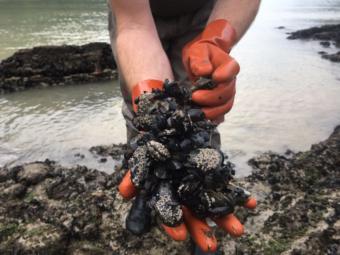
Blue mussels at Nahku Bay. (Claire Stremple/KHNS)

Alaska state and local health officials are warning of dangerously high levels of toxins in shellfish, after a person died of paralytic shellfish poisoning from mussels and snails in the Aleutian Island community of Unalaska.

“Right now, the levels are high enough that just one mussel could kill someone,” said Sarah Spelsberg, a physician assistant at Iliuliuk Family and Health Services, Unalaska’s clinic.
The state health department announced the death in a prepared statement Wednesday.  The person had underlying health conditions that contributed to the death, but the state medical examiner’s office confirmed that the primary cause was exposure to the toxins from seafood, the statement said.

This is the first known paralytic shellfish poisoning fatality in Alaska since 2010, although serious illnesses are reported more frequently, the state said. Dating back to 1993, the state has recorded four previous PSP deaths: in 1994, 1997 and two in 2010. There have also been more than 100 non-fatal cases of shellfish poisoning.

The person who died ate the mussels and snails collected from an Unalaska beach July 4. The shellfish were cooked, and the person developed symptoms some four hours after eating.

Blue mussel samples collected from the beach the same day were found to have extremely high toxin levels — more than 100 times higher than the safe limit, the state said. The snail samples also had elevated toxin levels, but not as high as the mussels.

The patient’s initial symptoms included tingling fingers, numbness, a floating sensation and vomiting, the state said. Several hours later, the patient reported numbness in their mouth, weakness in their hands and pain in their neck and back.

The patient was transferred to Unalaska’s clinic, and later was flown to an Anchorage hospital, where they died.

Two other people ate smaller amounts of the same shellfish but never developed symptoms, according to state health officials.

“When it comes to PSP, you have to medevac this person — that’s their only chance,” said Spelsberg, the physician assistant. “The problem with this is there’s no antidote, so the only thing we can do is be ready to breathe for you if you can’t breathe for yourself. And we can be ready to try to help your heart beat if you can’t keep your own heart beating. But there’s no antidote to this and sometimes there’s nothing we can do. You could land in the ICU at the best hospital in the world and they wouldn’t be able to save you.”

Officials have been monitoring local beaches for PSP since 2009, said Melissa Good, a marine advisory agent with Alaska Sea Grant in Unalaska.

She said there have been a few summers where toxin levels have exceeded the regulatory limit, which the U.S. Food and Drug Administration sets at 80 micrograms per 100 grams of tissue.

A recent report of some of the highest-ever recorded levels of PSP toxins in butter clams taken from the Alaska Peninsula community of King Cove last month prompted officials to test in Unalaska, too, Good said. Test results from Unalaska showed 11,200 micrograms of toxins per 100 grams, she added.

High levels of algal toxins that can cause PSP have also been found recently in shellfish from other Alaska communities.

Those include Craig, Hydaburg, Ketchikan, Kasaan, Juneau and Metlakatla in Southeast Alaska, as well as Kodiak and Chignik Lagoon along the Gulf of Alaska, the state said.

In recent years, communities across the state have reported spikes in toxin levels, possibly related to rising ocean temperatures, which create a better environment for the algae that produce the toxins – alexandrium catenella in Alaska — to grow year-round, as opposed to only in warmer months, according to some researchers.

Shellfish toxicity can vary by beach, harvest, and mussel bed, and Spelsberg said it’s important for people to understand that the toxins cannot be eliminated.

“It’s really important that people understand that you can’t freeze it out. You can’t cook it out. It’s a preformed toxin. And once you’ve ingested it, all we can do is try to keep you alive until you can flush the toxin out,” Spelsberg said.

If someone decides to harvest bivalves — that includes mussels, clams, cockles, scallops and rock jingle — in the region, officials highly recommended that they do not immediately consume their harvest. Instead, freeze it and send in a sample to the Alaska Department of Environmental Conservation’s lab, said Good.

Prior to sending in samples, contact Matthew Forester, bio-analysis section manager with the DEC’s Environmental Health Lab by phone at 375.8204, or by email at Matthew.Forester@Alaska.gov.

The state’s warnings apply only to non-commercially harvested shellfish, since commercial operations are required to regularly test for toxins.

A person has died from paralytic shellfish poisoning in Unalaska

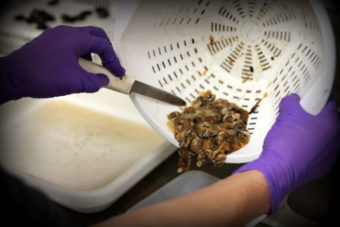
Sitka Tribe of Alaska fisheries biologist Jen Hamblen empties blue mussel meat into a blender.
Sitka Tribe of Alaska fisheries biologist Jen Hamblen empties blue mussel meat into a blender. (Photo by Emily Russell/KCAW)

The person had underlying health conditions that contributed to the death, but the State Medical Examiner’s Office confirmed on Wednesday that the primary cause was exposure to the toxins from seafood.

This is the first known paralytic shellfish poisoning fatality in Alaska since 2010, although serious illnesses are reported more frequently.
The person who died ate blue mussels and snails collected from an Unalaska beach on July 4, 2020. The shellfish were cooked before consumption, and symptoms developed about four hours afterward.

The patient’s initial symptoms included tingling fingers, numbness, a floating sensation and vomiting. Several hours later, the patient reported numbness in their mouth, weakness in their hands and pain in their neck and back.

The patient was transferred to Unalaska’s clinic, then flown to an Anchorage hospital where they died.

Blue mussel samples collected from the beach the same day were found to have extremely high toxin levels — more than 100 times higher than the safe limit. The snail samples also had elevated toxin levels, but not as high as the mussels.

High levels of toxins that can cause paralytic shellfish poisoning have been found recently in shellfish from numerous Alaska communities.

Recent paralytic shellfish poisoning reports have found dangerous levels in butter clams and/or blue mussels from beaches in Craig, Chignik Lagoon, Hydaburg, Ketchikan, Kodiak, Kasaan, Juneau, Metlakatla and Unalaska, among others.

State warnings apply to non-commercially harvested shellfish, since commercial operations are required to regularly test for toxins.

After fears, crew of American Seafoods vessel tests negative for COVID-19 in Unalaska

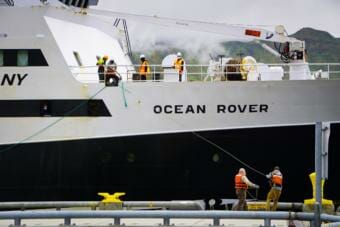
The F/V Ocean Rover left Bellingham, Washington on May 29, and arrived in the Port of Dutch Harbor Sunday evening after a voyage of 16 days, 15 hours. (Hope McKenney/KUCB)

The crew of the F/V Ocean Rover, an American Seafoods vessel that arrived in Unalaska late Sunday afternoon for summer pollock season, have tested negative for COVID-19.

The arrival of the 255-foot boat had generated concern among Alaskans after more than 100 asymptomatic crew members aboard three of the company’s other factory trawlers tested positive for the virus in recent weeks.
“In a coordinated effort between the IFHS Clinic, City of Unalaska (Fire/EMS, Ports, and Police), State of Alaska Health & Social Services and American Seafoods, all 121 members on board responded to health questionnaires and were tested for COVID-19 as warranted,” according to a press release from the City of Unalaska. “Sixteen crew members were found to have possible symptoms of COVID-19 and were quarantined pending test results. All tests returned negative.”

American Seafoods is based in Seattle and runs six vessels that fish for pollock, hake, and sole in both the North Pacific Ocean and the Bering Sea.

Three of its six-vessel fleet have now had positive cases of COVID-19, including 92 people on the American Dynasty, four on the American Triumph, and 21 on the Northern Jaeger.

Until last week, the Seattle-based company said it required only a five-day quarantine, far less than the two weeks that it can take for people infected with COVID-19 to show symptoms, according to the Centers for Disease Control and Prevention.

On June 5, the company announced it would boost efforts to keep the virus off its boats, raising its five-day quarantine requirement to the 14 days required for fishing companies operating in Alaska, and the amount of time recommended under state and federal guidelines.

The Seattle Times reported last week that the crew of the Ocean Rover underwent the same shorter quarantine period as the crews of the other three vessels, and that some crew members and families of crew were concerned that some might unknowingly be carrying the virus.

American Seafoods told the Times in a statement Thursday that the Ocean Rover had been at sea for a month, and that “the vessel and its crew are in full compliance with Alaska’s COVID-19 related requirements for fishing vessels.”

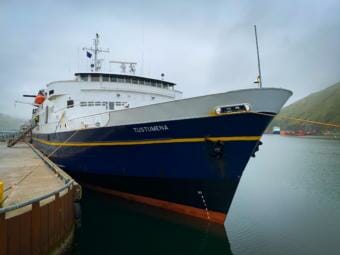
Tustumena sailings will resume in June after crew member tests positive for COVID-19

Per company protocol, crew and passengers are not required to have a COVID-19 test prior to boarding AMHS vessels.
Per company protocol, crew and passengers are not required to have a COVID-19 test prior to boarding AMHS vessels. (Photo by KUCB)

Sailings for the M/V Tustumena will resume later this month, according to the Alaska Department of Transportation and Public Facilities.

Initially, on June 8, the DOT said it would cancel all of the state ferry’s sailings “indefinitely” after a crew member on the Tustumena tested positive for COVID-19. The positive result came just hours after the vessel arrived in Unalaska Saturday.

Officials said the indefinite suspension was due to a shortage of crew. However, a day later, DOT said sailings are expected to resume June 27 when the ship departs from Homer to Kodiak.

The Tustumena arrived in Homer late Monday night, having sailed back to port without making any stops along the Aleutian chain.

Dr. Joe McLaughlin, Alaska’s state epidemiologist, said in a Monday press briefing that the 35 crew members and six remaining round-trip passengers were set to be tested for COVID-19 upon arrival in Homer. Only the symptomatic crew member was tested while in Unalaska.

“Crew and passengers can leave the ferry [in Homer] while their swab results are pending if they’re returning to their final destination or home where they can appropriately quarantine for 14 days, and they have private transportation to their final destination, and that private transportation would not expose new individuals,” McLaughlin said.

If passengers and crew cannot meet those three criteria they will likely have to quarantine for 14 days on the vessel.

John Falvey, general manager of the Alaska Marine Highway System, said it will likely be difficult for many of the 35 crew members to meet those conditions because many are from the Anchorage and Kenai area or the Lower 48, and use public transportation to get to and from the Tustumena’s port in Homer.

Officials from the state’s health department said all but one of the individuals they’ve identified as close contacts of the COVID-19 positive crew member are fellow ferry workers on the ship.  A separate ferry worker is currently quarantining at home officials said.

Any passengers on board the Tustumena’s journey last week should remain in quarantine for 14 days. Officials made an exception for those passengers who only briefly boarded in Unalaska for the northbound leg on Saturday afternoon.

Meadow Bailey, communications director for the DOT, confirmed that marine highway leadership knew there was a potential COVID-19 case among the crew before boarding began.

“A lot of these decisions were happening simultaneously — first notifying all of the required officials and then working to determine if we could get a [COVID-19] test, and what the arrangements would need to be, and how quickly that test could be returned,” said Bailey. “So those decisions and that scenario were happening at the same time.”

Officials contacted Iliuliuk Family and Health Services at 3:30 p.m., clinic staff tested the crew member at 5 p.m., and they received the positive test results at approximately 6 p.m., according to Bailey. AMHS personnel then asked Unalaskans to disembark.

Falvey said there’s minimal risk to those approximately 21 northbound passengers because they didn’t come in contact with the sick crew member who was isolated in a ventilation-secured cabin with a face covering on.

Still, state health officials said out of an “abundance of caution,” those passengers should self-monitor for symptoms of COVID-19 for 14 days, but they needn’t quarantine.

In response to the coronavirus pandemic, AMHS implemented enhanced COVID-19 mitigation protocols at all of its facilities and aboard all vessels earlier this month, in order to protect the health and safety of its customers and employees. Measures include limiting the number of passengers allowed on its ferries and requiring that passengers complete a health screening form before boarding. However, per company protocol, crew and passengers are not required to have a COVID-19 test prior to boarding AMHS vessels.

When asked if the first positive case among ferry workers is an indication that the State of Alaska opened up too soon, Dr. Anne Zink said the state has “clearly met the criteria to open up.” And although communities around the state are seeing spikes in numbers, it is now up to Alaskans to work together to help minimize risk.

Ferry Tustumena crew member tests positive for COVID-19, passengers quarantined

The M/V Tustumena pulls away from Kodiak on Jan. 11, 2020, beginning a ferry service gap of more than three months. (Photo by Kavitha George/KMXT)

The first ferry of the season to Unalaska, brought a case of COVID-19 to the community. The ferry Tustumena sailings have been canceled after a crew member tested positive for the virus on Saturday.

The ship will now be sailing back to Homer from Unalaska on Sunday. It will not make any stops.

That’s according to state Department of Transportation officials that said a crew member developed mild symptoms including a runny nose, cough, and body aches, but they did not have a fever during the voyage along the Aleutian Chain.

The employee is in isolation on the ferry and did not disembark the vessel, but did have contact with passengers and crew before arriving in Unalaska.

“This is not considered a community case. This is a travel-related case,” said Unalaska City Manager Erin Reinders. “It was an individual who was an employee of the Alaska Marine Highway System. I don’t know a lot of the details behind it, but what we do know is that this individual was symptomatic, did not leave the room that they were in, was tested here locally, and that test came back positive.”

The Department of Health and Social Services has begun contact tracing and will contact people who may have had interactions with the crew member.

A statement from the Department of Transportation says there are 35 crew members on the Tustumena. It says 16 close contacts — all crew members — have been identified and are quarantined on board the ship. It also says all crew stayed on board while docked in Unalaska and that no passengers have been identified as close contacts.

Dutch Harbor Ports Director Peggy McLaughlin said 21 passengers got off the ferry in Unalaska. She said all passengers were directed to follow the city’s protocol to self quarantine for 14-days upon arrival.

The ferry was on its first trip after returning to service on June 2.  It left Homer and visited the communities of Seldovia, Kodiak, Chignik, Sand Point, King Cove, Cold Bay, False Pass, Akutan. DOT did not say which of those communities received passengers.

Neither the city nor state has said how many passengers had boarded the Tustumena in Unalaska on Saturday before being informed that the sailing had been canceled. DOT says the infected crew member did not have contact with any of these passengers.

McLaughlin said those passengers should take precautions.

“The recommendation for the passengers that were trying to leave on Unalaska/Dutch Harbor today, was to get off the ferry, go home, shower, and self-quarantine,” said McLaughlin. “The state is working on various options for them to continue to get from point A to point B.”

Melanee Tiura, chief executive of Iliuliuk Family Health Services in Unalaska, said the health clinic’s staff have been informed of the situation.

“We are all concerned with the possible risks present in this scenario,” said Tiura. “If there is good news so far, it is that the most recent information from the state indicates that there was limited direct exposure to the passengers, both those who disembarked today and those who had briefly boarded.”

The city has a mandatory 14-day quarantine for anybody traveling to the island, whether by air or sea, with the exception of AMHS “day travelers” during their stopover in Unalaska.

State officials said the symptomatic crew member was tested at 5 p.m. Saturday. The positive result was returned an hour later. Unalaska’s local medical provider said it wasn’t part of that decision chain that allowed passengers to board with a potential coronavirus case on board.

“We, at the clinic, would like to make sure the community knows that we were not involved in any decisions that led to community members boarding the ferry with a symptomatic individual on board,” said Tiura. “We are here to care for patients and to help to keep Unalaska safe.”

Unalaska has had three cases of COVID-19, all among seafood workers.

Officials said there is no known community spread in Unalaska at this time. The city will not be raising its assessment of the community’s risk level, which is currently at “medium.” Under the city’s COVID-19 emergency response plan, the city will not move to “high” risk unless there is confirmed community spread or widespread exposure of COVID-19 on the island.

Mayor Vince Tutiakoff Sr. said the city’s unified command — which is a COVID-19 response team made up of healthcare officials, seafood industry, school district representatives, social service agencies, and the Qawalangin Tribe — has developed comprehensive plans.

“I want the community to know that we keep all of their health as number one priority, and today shows that [our plan] works,” said Tutiakoff. “The team got together, worked out a plan, and got it working within a half hour of when the question arose as to whether the employee was infected or not. So [the plan] works and the community has to have confidence in what we’re trying to do.”

Reinders said it is up to every Unalaskan to practice social distancing measures and limit community spread as the state continues to open up. She said those measures include washing hands, maintaining a six-foot distance from others, wearing a face covering over both the nose and mouth, and keeping social circles small.

The Tustumena departed Unalaska on Saturday night with crew and six passengers that had originally boarded in Homer. During transit, only essential crew will operate the ship, and the remaining people  on board will self-quarantine, DOT says.

Everyone will be tested for COVID-19 once the ship arrives in Homer. The Tustumena’s future sailings are suspended until further notice.

Seafood industry workers test positive for COVID-19, marking first cases In Unalaska

The first cruise ship of the 2019 season is scheduled to arrive in Unalaska on May 6.
Unalaska has its first two confirmed cases of COVID-19. (File photo courtesy KUCB)

The City of Unalaska has confirmed its first local cases of COVID-19. Two seafood industry workers tested positive for the virus on Wednesday.

The two men are employees at Icicle Seafoods, and have been in quarantine since arriving in Unalaska seven days ago, said City Manager Erin Reinders.

“The plans that Icicle had in place is that [the two] were tested in Seattle prior to traveling to Unalaska. At that point, their test results were negative. Then at the seven day point in that quarantine, they got a second round of testing, and the positive test results occurred today,” Reinders said.

Reinders said the men are both asymptomatic and were immediately moved to isolation in Unalaska upon receiving positive test results.

“Upon learning of the two positive cases, Icicle immediately enacted our isolation protocol for the employees and our cleaning and sanitation protocol as per our community and workforce protective plan,” said Chris Pugmire, Icicle’s general manager of operations for western Alaska, in a written statement. “Although we tested all employees prior to travel to Unalaska, we were prepared for the event of a positive case and we greatly appreciate the local Unified Command’s swift and coordinated response.”

The city, Icicle Seafoods, and Iliuliuk Family and Health Services are following the protocol developed by Unalaska’s Unified Command, which is a COVID-19 response team made up of healthcare officials, seafood industry, school district representatives, social service agencies, and the Qawalangin Tribe.

“The clinic is taking care of working with the Department of Health and Social Services, making sure that they have the information that they need so that the state can begin contact tracing,” Reinders said. “The clinic has also been working with Icicle Seafoods to ensure that the appropriate care is being provided. We don’t anticipate, at this point, to be raising our risk level here locally. Because these are identifiable cases, we’re able to keep these individuals isolated, and our clinic is able to still maintain a standard of care for the community as a whole.”

The state’s health department is taking care of the contact-tracing and will reach out to people who may have had interactions with the two men.

Unalaska is the largest community in Alaska without a critical access hospital. The nearest emergency room is almost a thousand miles away, in Anchorage. Melanee Tiura, chief executive officer at Unalaska’s only health care facility — which serves anywhere from ten to fifteen thousand year-round residents and seasonal workers — said the clinic is prepared to handle cases of COVID-19.

In partnership with the city and fish processors, the clinic created an isolation and quarantine facility for those infected with COVID-19 and began local “rapid” testing in April. As of Wednesday, 194 people had been tested.

“While confirmation of the first positive cases of COVID-19 in our community is concerning, the parties involved did everything correctly,” Tiura said. “The positive cases were identified as part of the employer’s testing protocols, which were put in place specifically to protect Icicle’s workforce and our community.”

Reinders said the city will not be increasing its community risk level – which is currently at “medium.”

The individuals are not residents of Alaska, and will therefore be listed separately from the total state case count. The two men join 23 other people from out-of-state who have tested positive for the virus in Alaska.

Site notifications
Update notification options
Subscribe to notifications